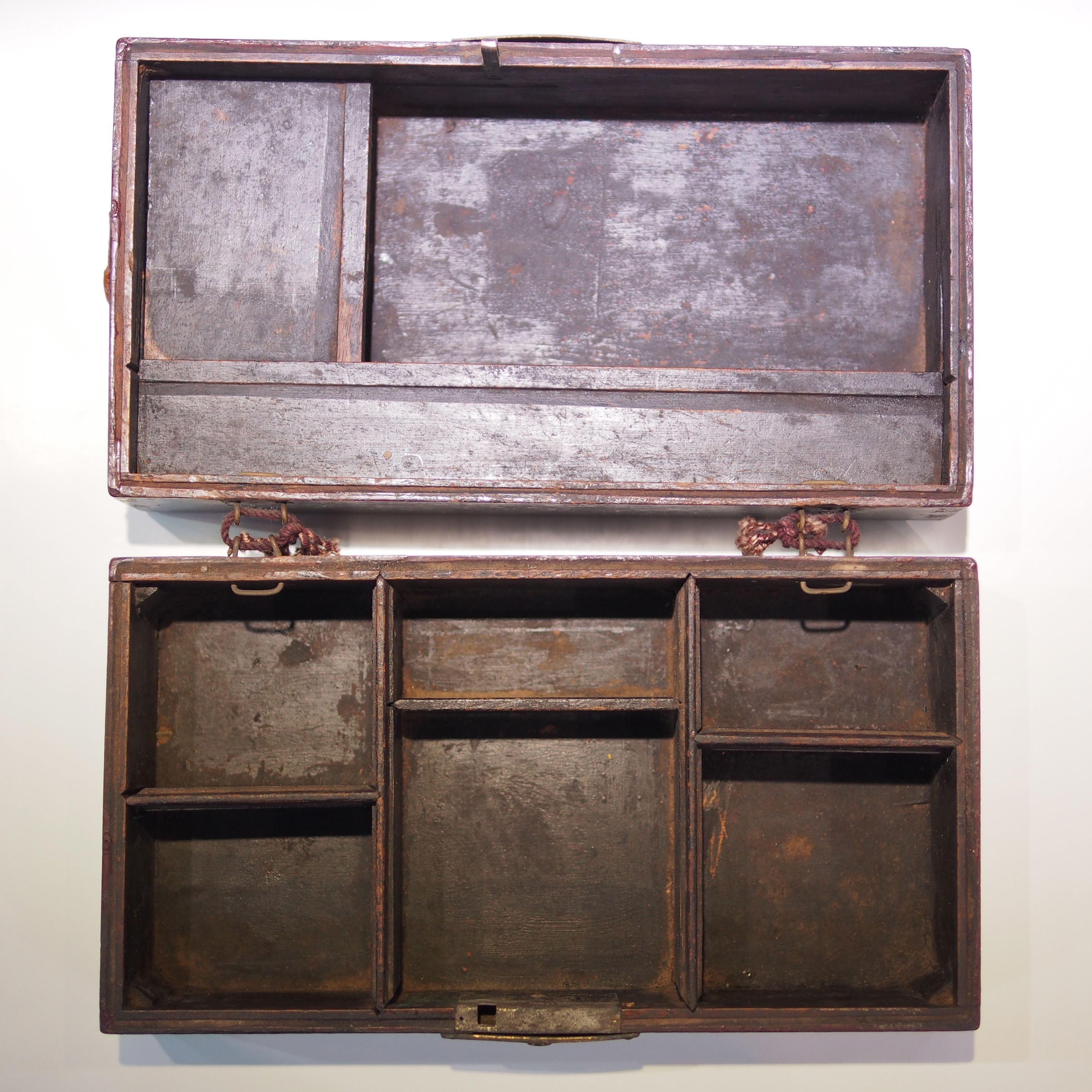
An old wooden jewellery box with compartment, a mirror and a small latch for pad lock.
It gives a feeling of nostalgia and mystery.
Perhaps an ideal setting for a Joseph Cornell type box project.
A box of dream inside a lock treasure box.
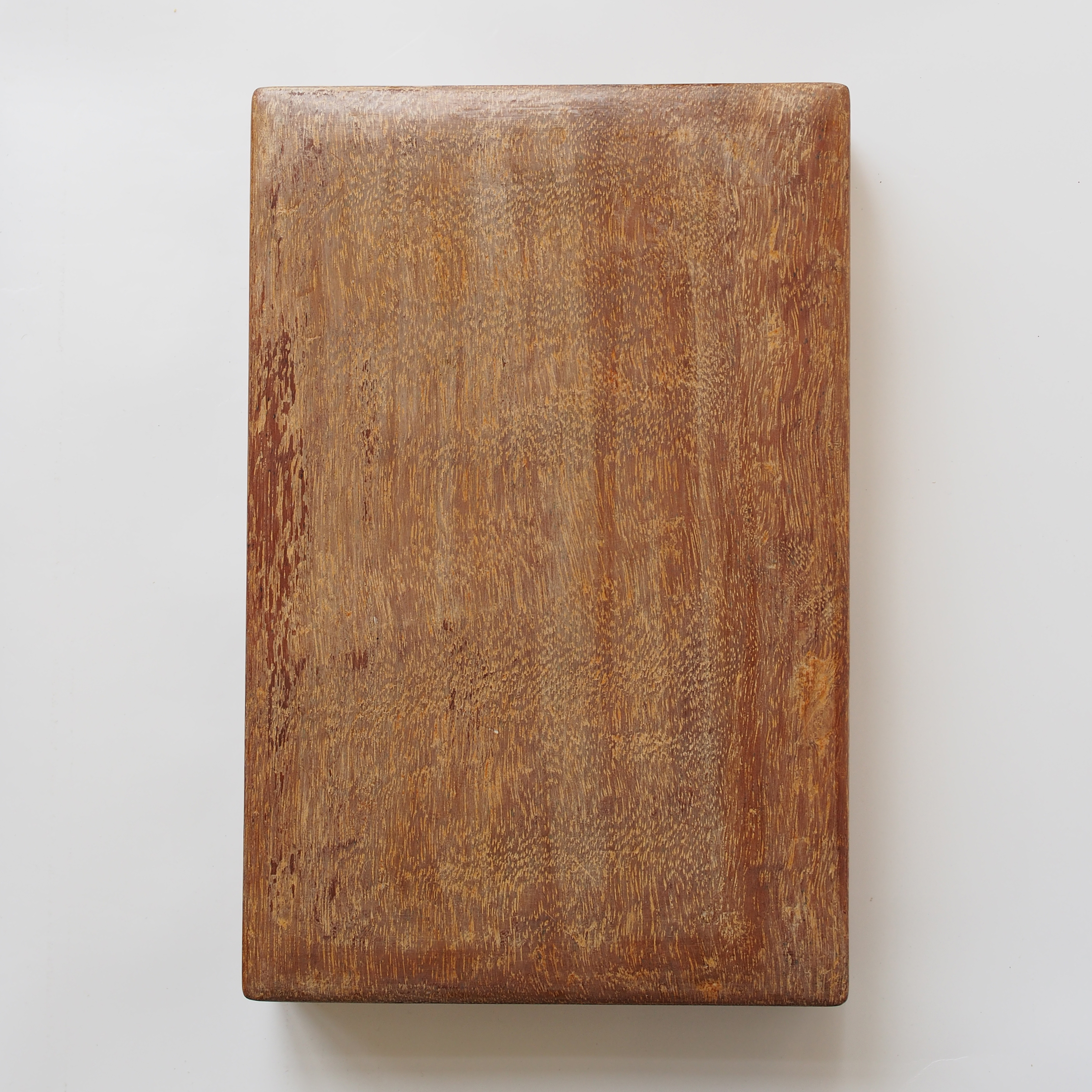
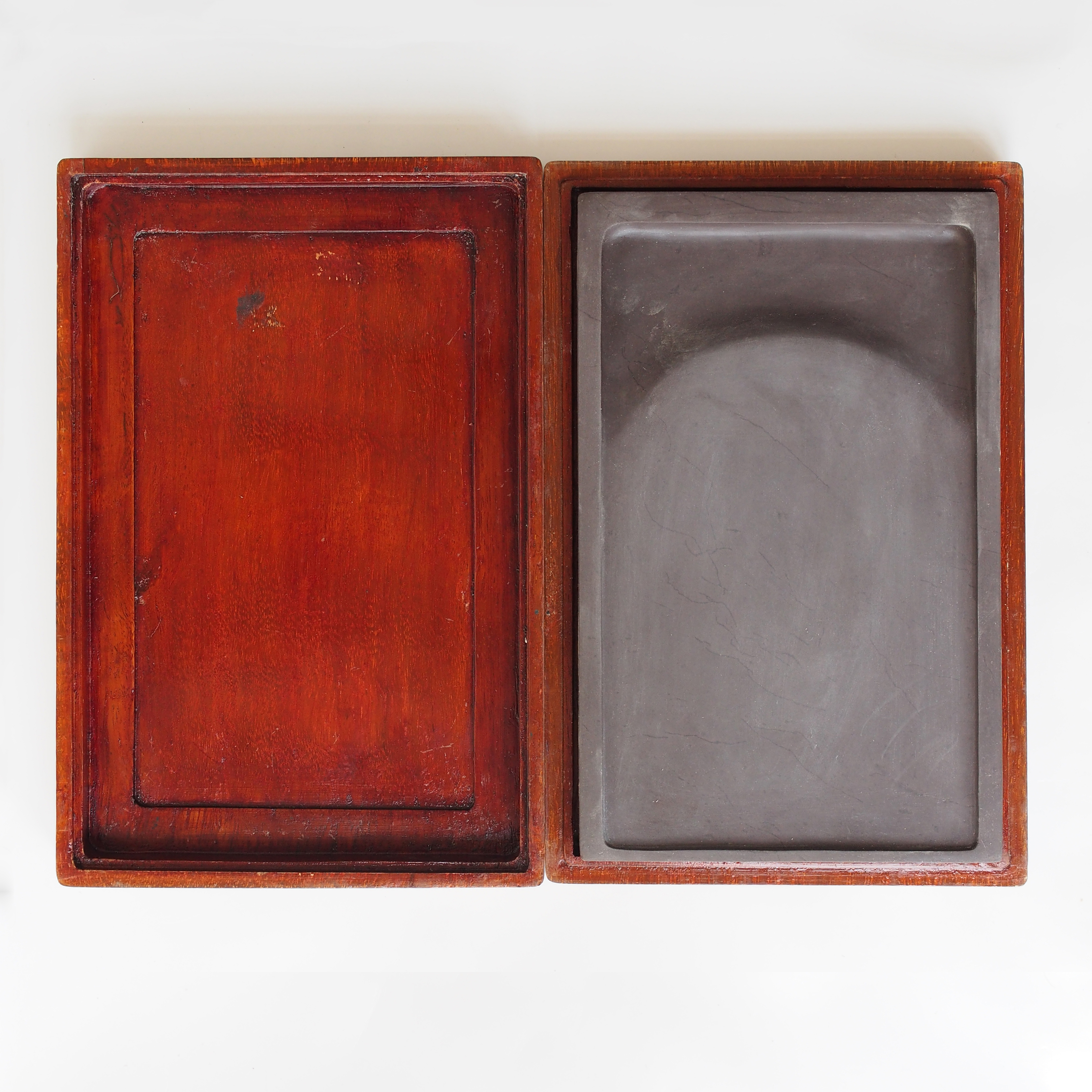
A wooden box that contain a piece of stone. A stone that is used for grinding the ink bar – an inkstone.
A little water is added from the water drip onto the inkstone, one can still starting grinding the ink. In a small circular movement while keeping the ink still perpendicular to the stone, slowing the ink is dissolved. Though the inkstone has a very smooth surface, under the microscope this surface is in fact saw like, able to fine grind the inkstone.
The inkstone is carved out from a single piece of stone and this detail is carried through to the case which is also carved out from a single piece of wood.
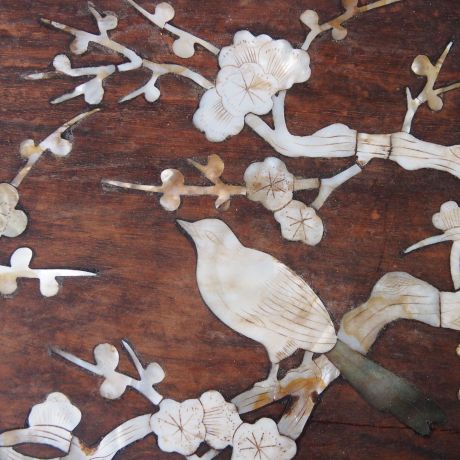
A box for the precious objects, decorated with mother of pearl inlay describing a scene of plum blossom and playful birds. The theme of plum blossom and birds often appears in jewelry, paintings and pottery, symbolizing the beginning of a new year (click to see our other items of the same theme).
Some point in every boy’s childhood came the grand project of making a toy boat.
This keel is part of my father’s.
Carved out from a single piece of wood, its almost sculpture like.
The smoothness of the surface, the textured interior reminded me of the coco de mer.
Boys today are more sensitive in digital nature, perceiving the world through the screen and the input device.
The Chinese chess is a popular game since the Warring State period 1600BC and today major tournaments are held across China and it is a major past time for many.
The character of the chess resembles different roles in the military and have their own rule in movement. Unlike western chess, the pieces are placed on the nodes rather than the square itself
General – 將 / 帥 (restricted in the middle “palace” 9 nodes except when executing the flying attack at the other general)
Advisors – 仕 on either side of the general (restricted in the palace and can only move in a diagonal fashion)
Elephants – 相 / 象, protectors of the general (restricted on their own side of the board which is separated by the river in the middle, moves in a 2 nodes diagonal (田 field) but the first diagonal point has to be cleared)
Horses – 馬 (moves in an elongated diagonal (日 sun))
Chariots – 車, a powerful piece (move in a vertical or horizontal straight line and more restricted to one node at a time.
Cannons – 砲 (move as the same way as the Chariots, it require another piece as a spring board for taking down opponent’s pieces)
Soldiers – 卒 / 兵 (can only advance and no retreat, once on the enemy’s side it can move side ways)
From these rules, and the popularity of the game, there are some idioms basing on the game of chess.
過河卒 – “the soldier that crossed the river” – point of no return
卒子過河當車使 – “soliders across the river can be used as chariots” – even minute, it can be very effective
事急馬行田 – “urgent! the horse will need to across the field” – normally, the horse moves in a 日 sun fashion and the elephant in a 田 field, but being so desperate the horse will need to forfeit its usual move and do the field.
放馬後炮 – “putting the cannon behind the horse” – a powerful move, the horse enters the opponent’s palace and restricting the general from moving to either side, then the cannon come in and checkmate. the idiom refers to those comments after checkmate.
飛象過河 – “elephant fly across the river” – as the elephant is forbidden to cross the river, it refers to those who dont follow the rules.
棄車保帥 – “forfeit the chariot to save the general” – making sacrifices to avoid a total loss
The Kalaha is played by 2 persons who make their moves alternatively. They take a seat at opposite sides of the boards. Each player has at his disposal the 6 small grooves next to him – the ambos – and the big groove at his right – the kalaha
The aim is for each player to gather as many balls as possible in his own kalaha; the total amount of balls is 36
Before the game starts the balls must be placed in the ambos, 3 pcs. In each, none in the kalaha.
The player selects one of his own ambos from which he removes all the balls. Then he drops these balls one by one, from the left to the right, into his own ambos and also into the kalaha when it is next in turn. If there are any balls left these must be dropped into the opponent’s ambos, but not into his kalah.
An extra move is granted if the player drops his last ball into his own kalaha.
if the player drops his last ball into an empty ambo of his own he may take both this ball and the balls in the opponent’s ambo directly opposite and drop all of them into his own kalah.
The game is over when the ambos of one of hte players are empty. The player who still has balls left in his ambos may move them into his onw kalaha as they shall be included in the final result.
The player whose kalaha holds the major part of the balls is the winner.
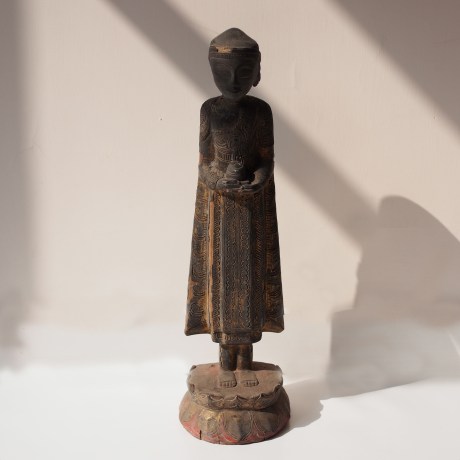
This is a figurine of the Buddha with an alms bowl standing on a lotus flower.
In Theravada Buddhism, “pindacara” a daily alms collection of food “pindapata” is practiced by the monks (and nuns). The word for monk “bhikkhu” means one who lives on alms, while “pindapata” means dropping a lump. The monks would leave their monastery, in a group they walk barefooted in single file according to seniority, their robe formally arranged covering both shoulders. The route will go through the village house by house, accepting but never requesting food that is dropped into the bowls. This figurine, the Buddha, is leading figurine of a group which consists of monks of different heights which unfortunately is not with us.
Monks in Burma
the second film has a more in depth view of a monk’ life.
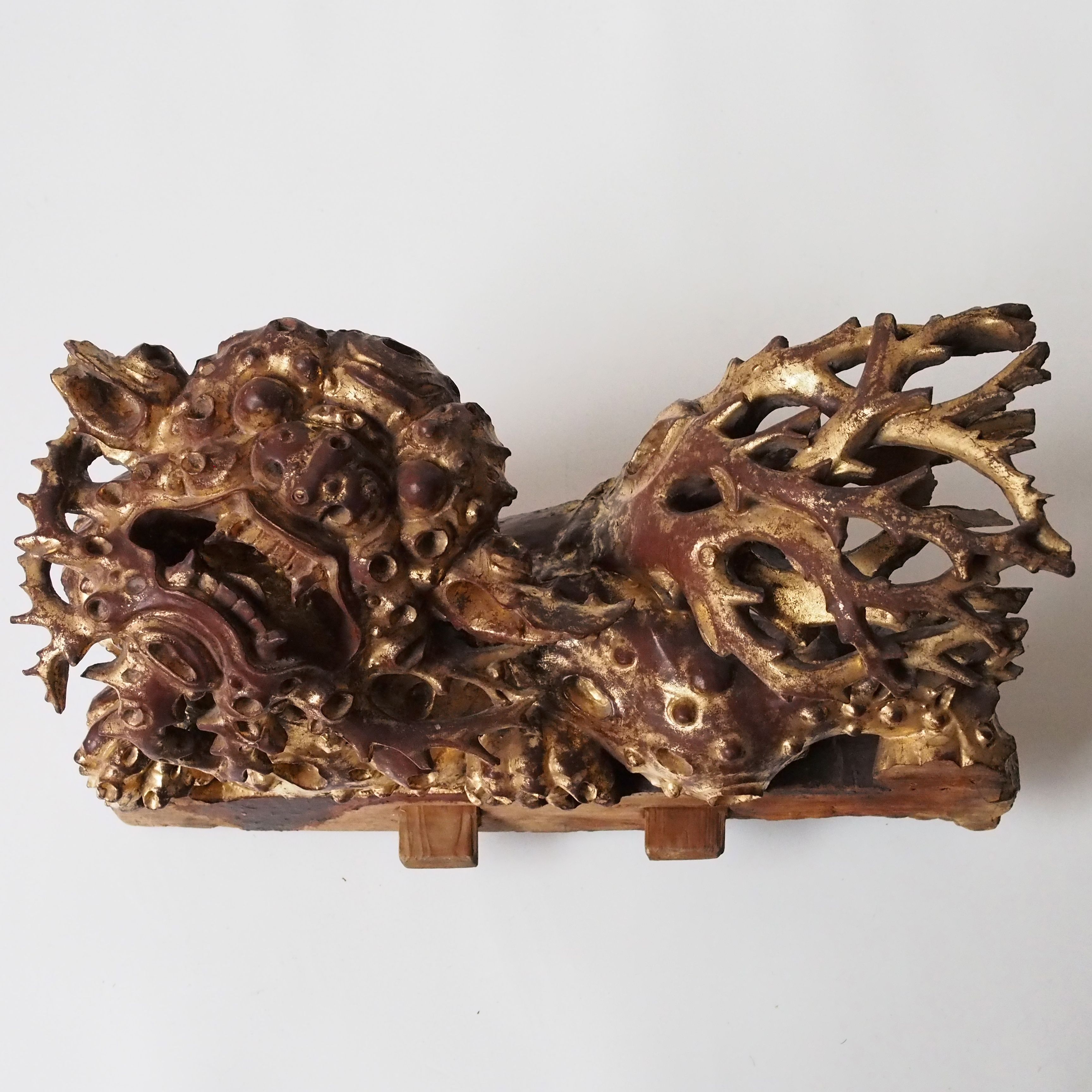
Chi Wen, the second son of the dragon, like the Tao Tie and the Suan Ni. The Chi Wen loves enjoying the vista and fire eating, because of this it is often found on the ridges of traditional buildings as a protection against fire. The Chi Wen has a head of a lion but the tail of a fish, the legendary owl fish (which was likely to be the whale)
This beautifully carved golden wood carving is used as a decoration for the company logo.
You can take a glimpse of it in the film below, a documentary about a traditional cake shop in Hong Kong. In the first episode, the decoration construction for the Mid Autumn festival starts at 3:34″. The pair can be seen under the logo at 5:05″, closed up at 5:10.
This series of documentary “May Food Keep Us Together” is one of my favorite, it examines the tradition, the generations of the family who runs these food places that are quickly replaced by the chain fast food outlet.









 Mountain Folkcraft