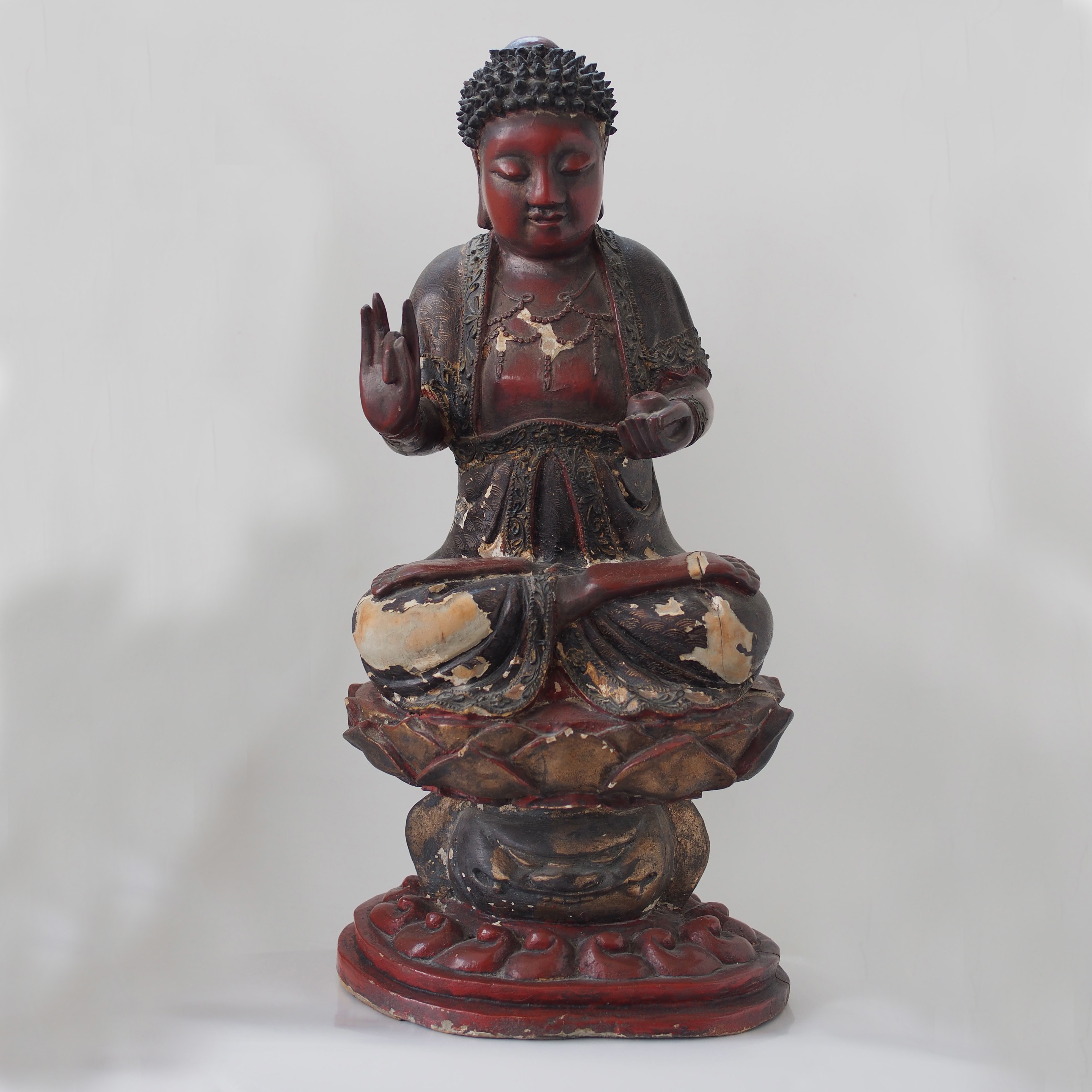
This is an old lacquer figurine of the Gautama Buddha. He is sitting on a lotus blossom which symbolizes purity of the mind and body. Though the lotus is rooted from the mud, its leaves naturally repel dirt and water, its blossom raises well above the muddy pool. Under the lotus blossom sits a lion; lions are symbolic of bodhisattvas, being that have attained enlightenment.
The hand gesture of the Buddha indicating the banishing of evils (karana) and the gesture of leisure (avakasha).
At the back of the figurine is a secret compartment for storing scripts.
A wood carving of a duck with hand painted feathers.
I am afraid there is no Chinese legends of ducks but only recipes …
Cantonese Roast Duck
INGREDIENTS
1 duck
1 tbs of honey
Chinese spiced salt
METHOD
set up an area where you can hang the duck for 8 – 12 hours (e.g. over the sink, etc.)
fill up the kettle and put it on.
spoon out 1 tbs of honey and put the spoon in a mug.
wash the duck and clean out all the giblets
pour half a mug of hot water into the honey containing mug.
in an unplugged sink, carefully pour the rest of the boiling water over the outside of the duck, you will notice the skin will tighten up as the water touches.
hang the duck and pour the honey water over the skin.
leave the duck alone for 8 – 12 hours
in a preheated oven roast the duck breast side up for 20 mins at 180c, turn it over and roast for another 20 mins, then breast side up again for another 20 mins.
leave to rest for 15 mins if you can resist the temptation, carve it out, sprinkle with salt and enjoy!
This is a figurine of the character Fan Li Hua, one of the four famous Chinese female warriors (Hua Mu Lan, Mu Gui Ying and Qiu Jin).
Fan Li Hua is the beautiful daughter of a border general, well treated in military tactic and martial art, married to General Xue Ding Shan, she was also a general herself and pacified the western counties in the Tang dynasty. The story of Fan Li Hua has been made into opera, “Fan Jiang Guan”. The story began with Emperor and General Xue’s father trapped by the enemy in the town, Suo Yang Cheng. The mother of General Xue has send a message for Fan to help with situation, at the same time, the twin sister of Xue has arrived with the army supply. At this point, Xue’s sister has a strategic dispute with Fan Li Hua (who by then is already a General). The spoiled sister-in-law started a fight, though no match against Fan wanted the upper hand. Fan uses her wit and managed to calm the household as well as rescuing the Emperor.
The story goes like this; in the Sung dyansty, there was an additional of a baby boy to a wealthy household. Precious and spoiled, he cried every night till dawn. Worried that something was wrong, the family consulted all the well known doctors in town but cries continued. One day, the father came home with a clay toy shaped with a rounded bottom and a small top. The child pushes, it wobbles and bounces back, it amuses the child and the crying stopped. The father believed that it was a blessing from god and had the figure of Guan Yin painted onto it, hoping it will protect his family from toppling. Unfortunately, one day the child broke the clay toy in half, a bad omen the father thought but the clay cannot be put together again. Cleverly, he used the broken toy as a mold and created a paper mache version and it became a popular folk toy in China.
A figurine of a boy dressed in a du dou, a long life locklet and lifting a bowl on top of him. The bowl is the oil container for the oil lamp while the boy being the stand. The name of the lamp, “Boy Raising A Lamp” (童子舉燈) signified however, the lamp is referring only to the container itself. This is a popular theme for Chinese oil lamp, of different material and for pottery different kilns. This figurine is an example of the Ci Zhou kiln. The name 童子舉燈 “Tong Zi Ju Deng” is taken as a blessing for the child of the family, the first three words 童子舉 is a name for a official tang dynasty exam for the gifted child of under 10 years of age, while the word 燈 “deng” is a homonym to the word 登”deng” meaning ascend, achieved.
Clay figurines are a popular toy for adults and childern allover China and could be dated back to over 5000 years. In the area of Xu Zhou, clay figurines of dogs, pigs, rooster, duck and even houses were found in Neolithic sites. The tradition continues and was the most established in the Ming and Qing dynasty more subject matter were covered. The more natural non coloured version were favored by intellectuals while the mono white and black version are amulet figures. This figurine being decorated with colour is toy tiger.
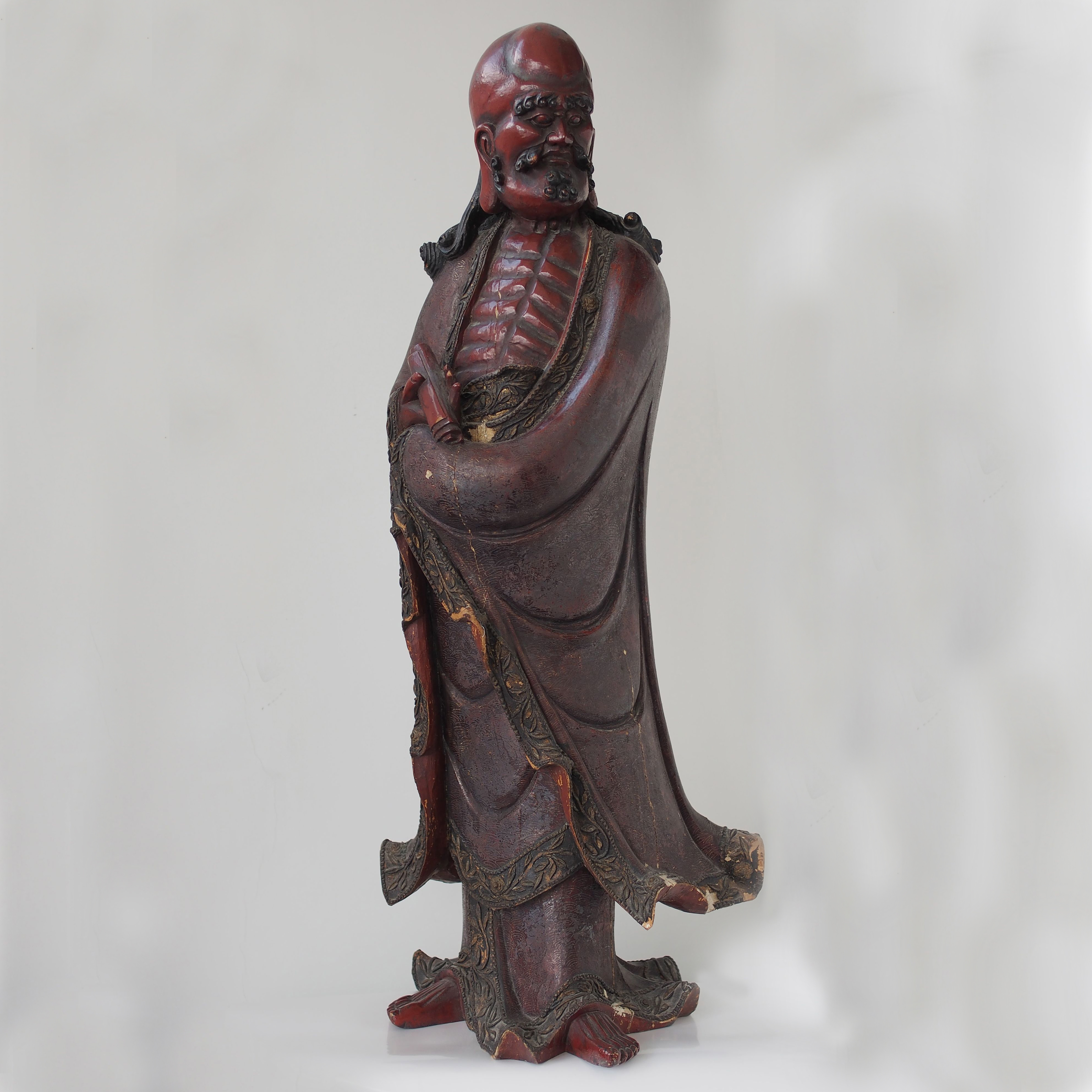
This is a statue of the Bodhidharma, the Buddhist monk who is accredited to have introduced Buddhism to China. It is believed that he is the third son of King Tamil Pallava of Kanchipuram and arrived to the now Guangzhou area in Southern Northern Dynasty (470AD). The most famous legend about Bodhidharma is his wall glazing. After felling out with Emperor in the Southern State, Bodhidharma travel up Yang Tze River, arrived at Shao Lin Temple and meditated by glazing on the wall for 9 years.
He is also believed to have introduced the 72 Shao Lin super kung fu and here is one of them.
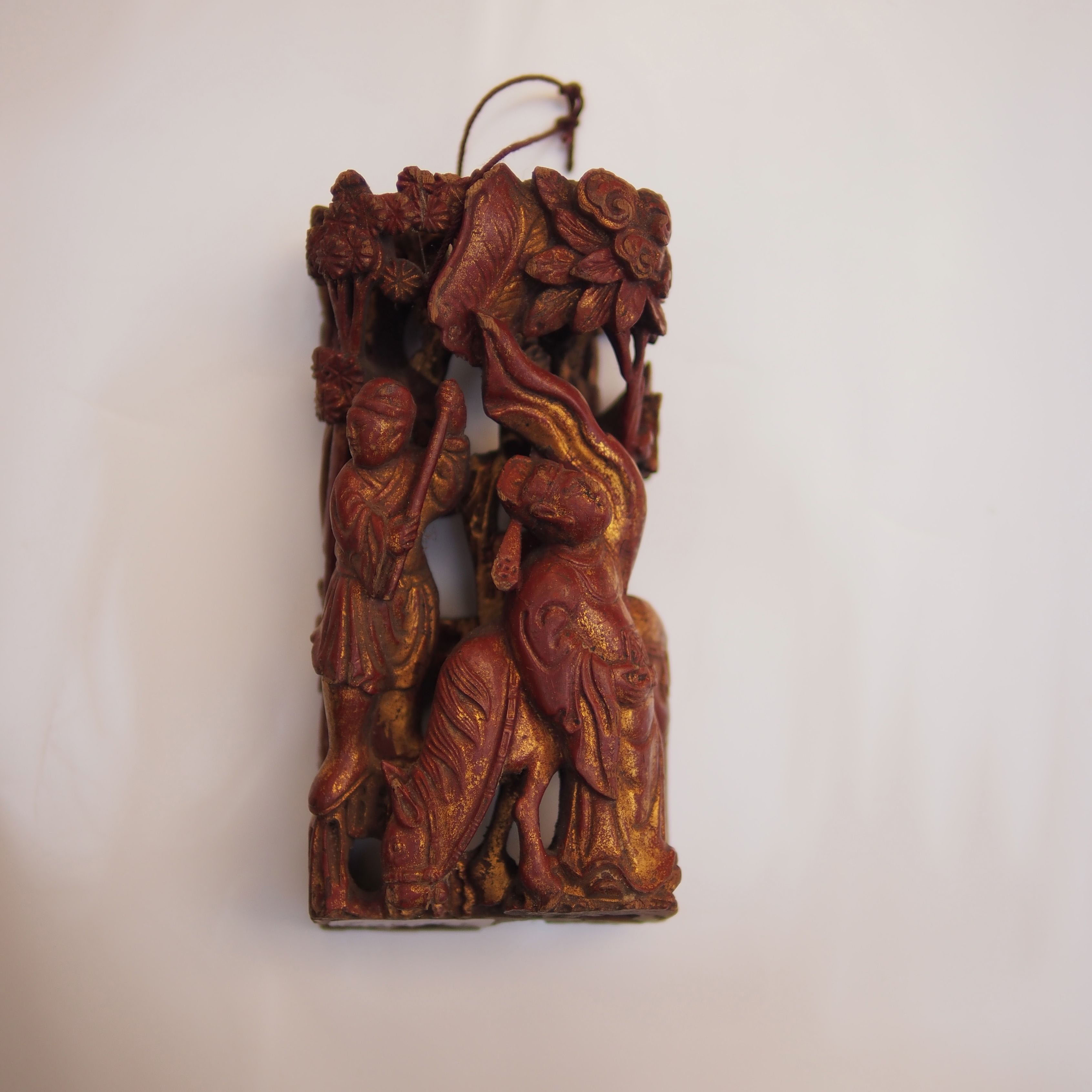
This wood carving is depicting the event of the top scholar of the year, Zhuang Yuan, a parade showing off his achievement. Early on the Chinese has established a strong examination system for the selection of her court officials. The procession started inside the Jin Luan Dian, one of the three main courts of the forbidden city, this is here the Emperor will announce the top 3 scholars, their name will be sang out. After thanking the Emperor, the Zhuang Yuan will depart the Jin Luan Dian, passing the Tai He Men, Wu Men, Duan Men, Cheng Tian Men, Ta Ming Men then head back to Chang An Zho Men to exit the forbidden city and continue his celebratory journey home. Chang An Zho Men, now demolished, is the single entrance for “non-emperor”. On the day of the results, after names of the Zhuang Yuan and others have been sang out in Jin Luan Dian, their names will be written on two yellow piece of paper, one to be kept as a record inside the court and the other larger piece to be posted inside a a temporary scaffolding hut outside Chang An Zho Men. The examination system was a attempt to find the most capable regardless of the social background, it is similar the Chinese legend of the carps jumping up the sky in belief that they will become dragons. For this the Chang An Zho Men (left door by Chang An Street) is also known as the Dragon Gate.
Chinese figurine of the lion are more often friendly and friendly rather then fierce, this might be because there are no lions originated from China. The image of lion was brought to China by word of mouth from traders of the Western Region, as a tribute from Persia to the Emperor and as the symbolic “suan ni” from the Buddhist culture. The worship of lion is thus mainly as a mystic protection of evil rather than the fierce forceful animal.
Black glaze pottery was first developed in China as early as the Jin dynasty (400 A.D.), it was a popular glazing in the Tong and Sung dynasty and further refined in the Qing dynasty.
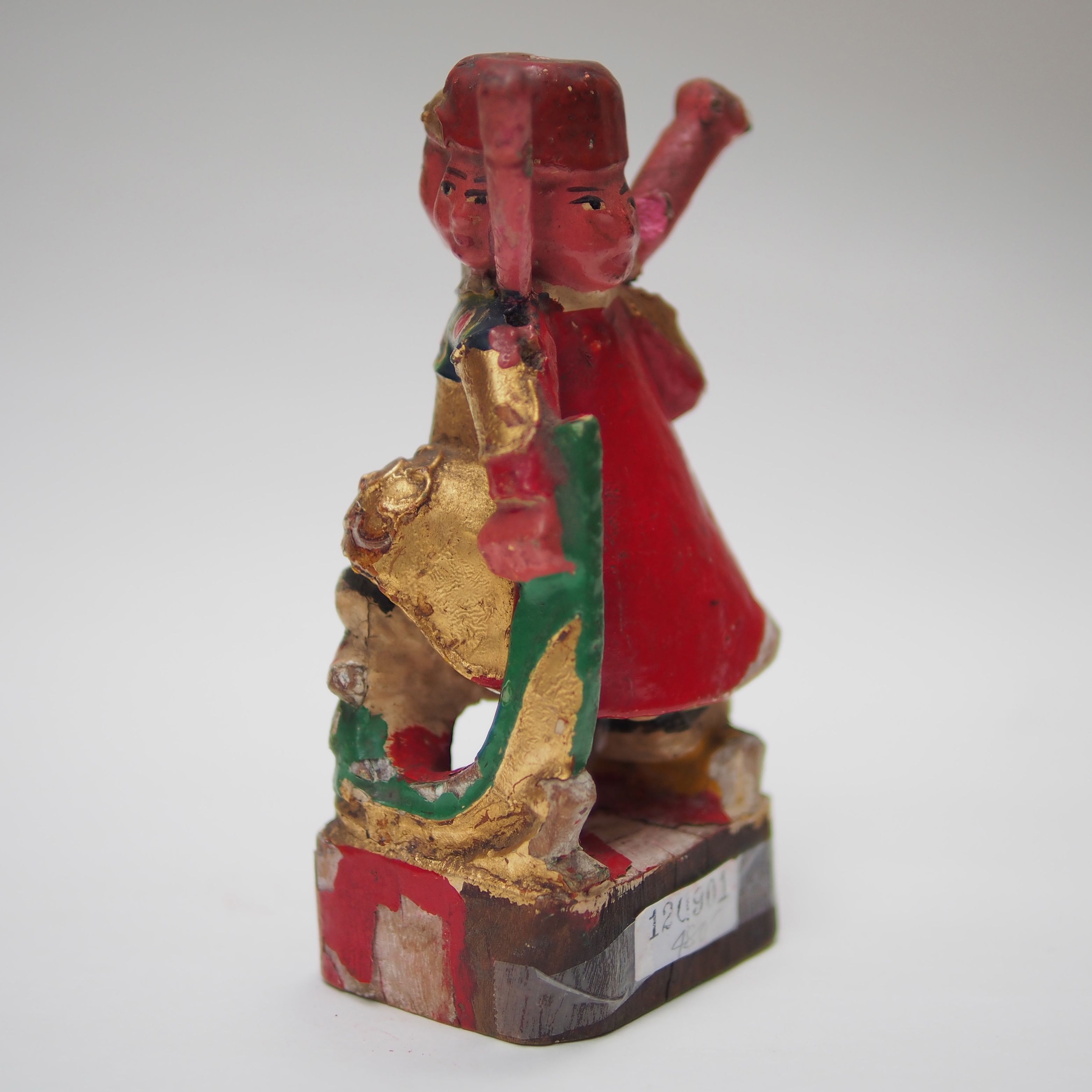
This dragon and tiger rider was an ancestral saint that was kept at the alter of the junk boat for keeping the fisherman’s journey safe. The multiple faces offer a supernatural power for this ancestral saint which is an usual expression for these figurines. Or would the fisherman had been to Bangkok on one of their fishing spree and got their inspiration from the famous Erawan Shrine?
 W270xD180xH600mm, China





 Mountain Folkcraft