Archives for category: lacquer

golden wood carvingW60xL90xH130mm, China

This is a figurine of the character Fan Li Hua, one of the four famous Chinese female warriors (Hua Mu Lan, Mu Gui Ying and Qiu Jin).

Fan Li Hua is the beautiful daughter of a border general, well treated in military tactic and martial art, married to General Xue Ding Shan, she was also a general herself and pacified the western counties in the Tang dynasty.  The story of Fan Li Hua has been made into opera, “Fan Jiang Guan”.  The story began with Emperor and General Xue’s father trapped by the enemy in the town, Suo Yang Cheng.  The mother of General Xue has send a message for Fan to help with situation, at the same time, the twin sister of Xue has arrived with the army supply.  At this point, Xue’s sister has a strategic dispute with Fan Li Hua (who by then is already a General).  The spoiled sister-in-law started a fight, though no match against Fan wanted the upper hand.  Fan uses her wit and managed to calm the household as well as rescuing the Emperor.

bamboo lacquer basket OLYMPUS DIGITAL CAMERA

DIA260xH320mm, China

A lacquered bamboo weaved basket which forms part of the dowry of the young bride and an essential household object.  These form of baskets are used for storing food before the arrival of the refrigerator.  Precious food item like fresh vegetables, fruits, eggs, would be placed inside the basket and hung under the beam of the kitchen.  The basket provide good airing and being suspended will stopped vermin from reaching the food.

OLYMPUS DIGITAL CAMERA OLYMPUS DIGITAL CAMERA

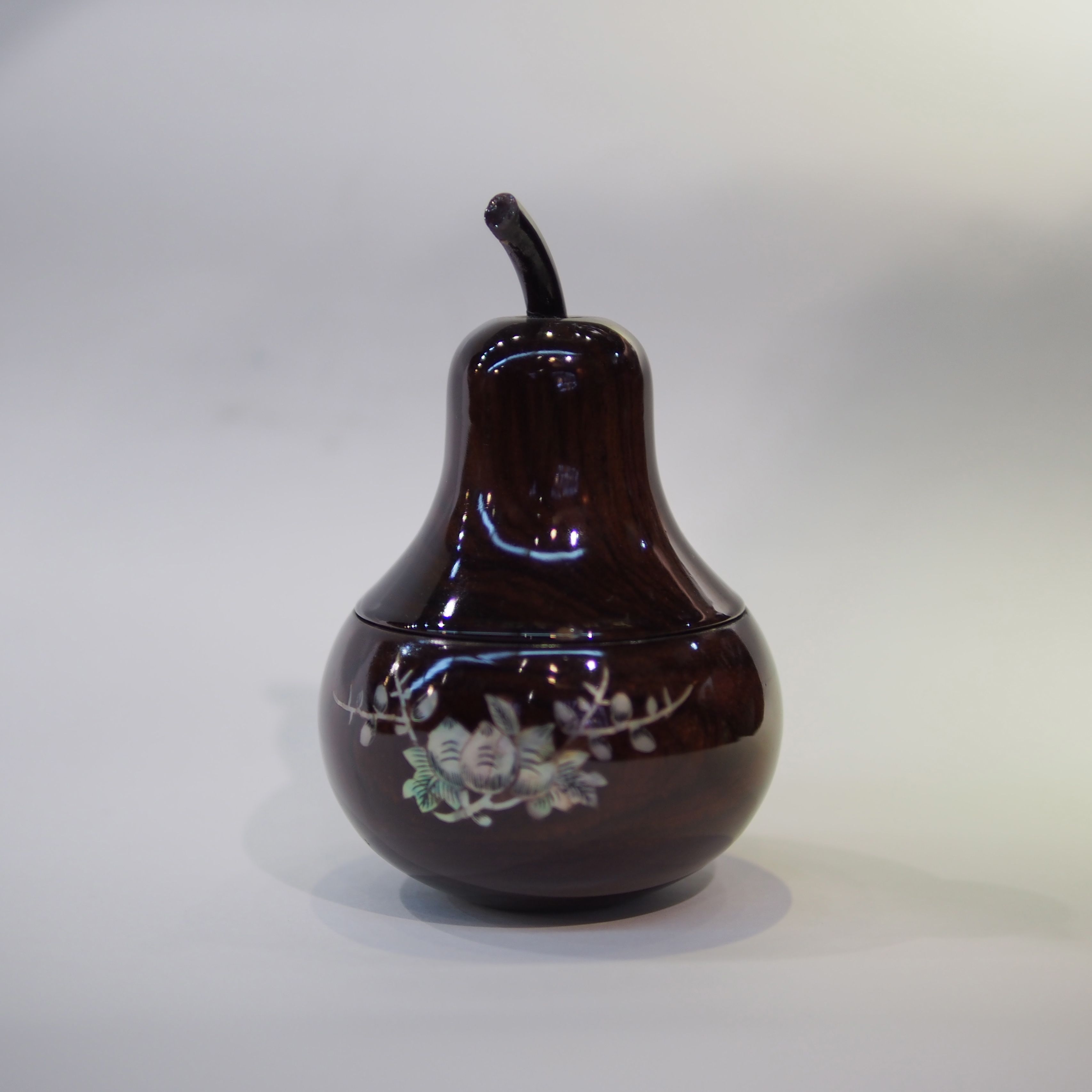
pearDIA90xH140mm, China

The craft of mother of pearl inlay on lacquer began in the Sung dynasty.  Turbo marmoratus (great green turban) shell are polished down to a thickness of 0.5mm, then cut into point, lines and planes, these are then inlay onto the container before lacquer is applied.  Click here to see the elaborated process.

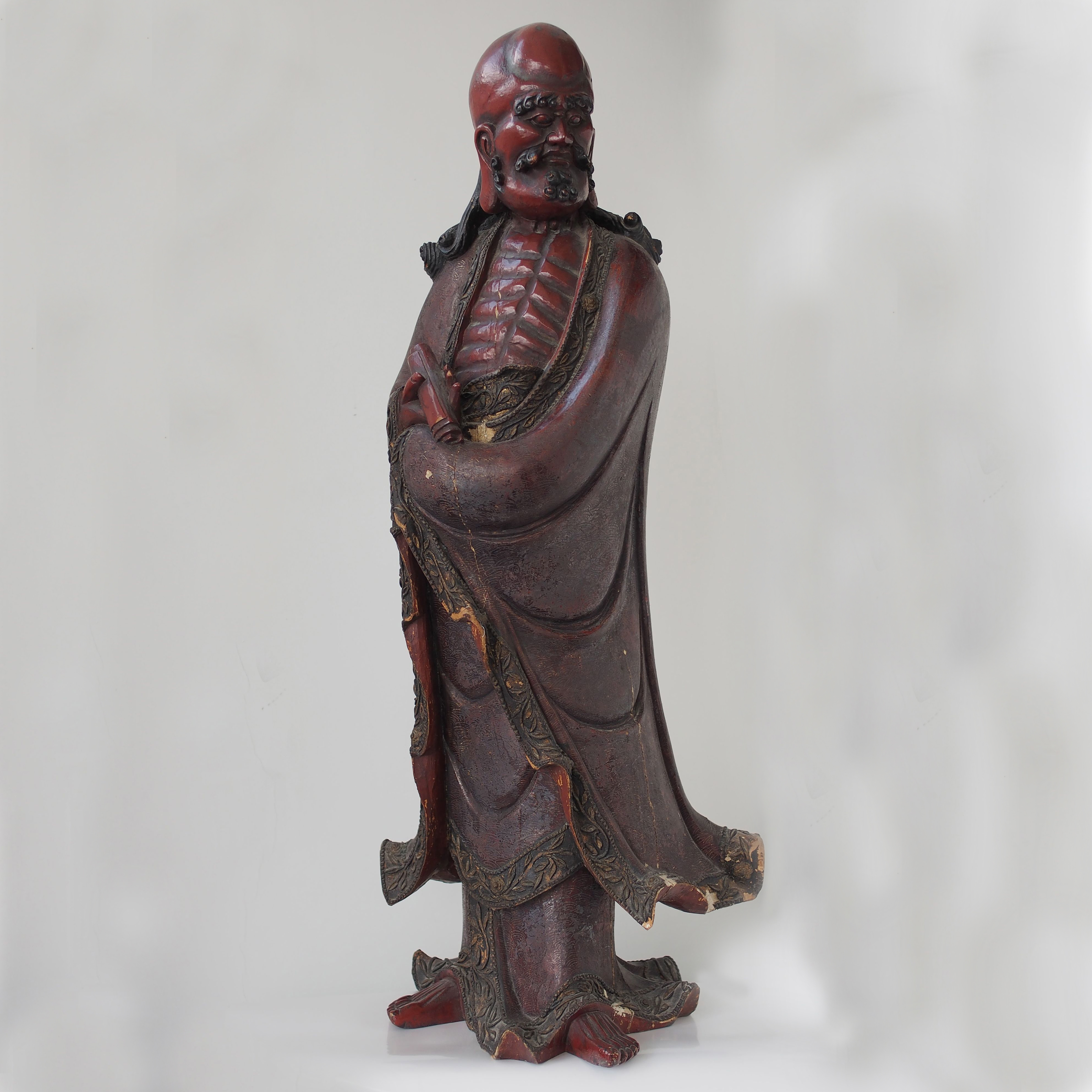
lacquer Bodhidharma

W300xD200xH800mm, China

This is a statue of the Bodhidharma, the Buddhist monk who is accredited to have introduced Buddhism to China.   It is believed that he is the third son of King Tamil Pallava of Kanchipuram and arrived to the now Guangzhou area in Southern Northern Dynasty (470AD).  The most famous legend about Bodhidharma is his wall glazing.  After felling out with Emperor in the Southern State, Bodhidharma travel up Yang Tze River, arrived at Shao Lin Temple and meditated by glazing on the wall for 9 years.

He is also believed to have introduced the 72 Shao Lin super kung fu and here is one of them.

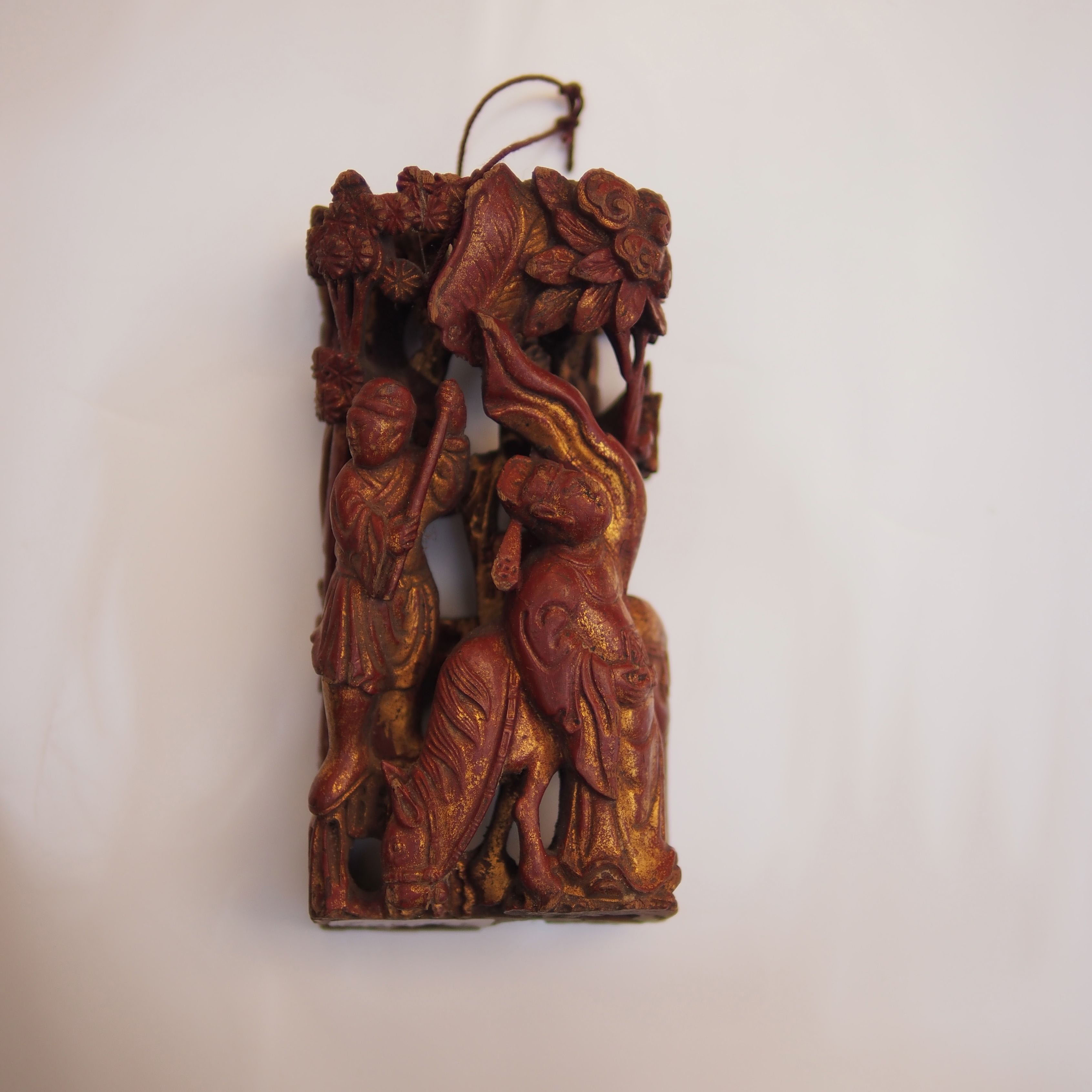
wood carving

W70xD50xH140mm, China

This wood carving is depicting the event of the top scholar of the year, Zhuang Yuan, a parade showing off his achievement.  Early on the Chinese has established a strong examination system for the selection of her court officials.  The procession started inside the Jin Luan Dian, one of the three main courts of the forbidden city, this is here the Emperor will announce the top 3 scholars, their name will be sang out.  After thanking the Emperor, the Zhuang Yuan will depart the Jin Luan Dian, passing the Tai He Men, Wu Men, Duan Men, Cheng Tian Men, Ta Ming Men then head back to Chang An Zho Men to exit the forbidden city and continue his celebratory journey home.  Chang An Zho Men, now demolished, is the single entrance for “non-emperor”.  On the day of the results, after names of the Zhuang Yuan and others have been sang out in Jin Luan Dian, their names will be written on two yellow piece of paper, one to be kept as a record inside the court and the other larger piece to be posted inside a a temporary scaffolding hut outside Chang An Zho Men.  The examination system was a attempt to find the most capable regardless of the social background, it is similar the Chinese legend of the carps jumping up the sky in belief that they will become dragons.  For this the Chang An Zho Men (left door by Chang An Street) is also known as the Dragon Gate.

See the journey on map.

wood carving

Click here to see a embroidery version of this theme and below is a puppet version.


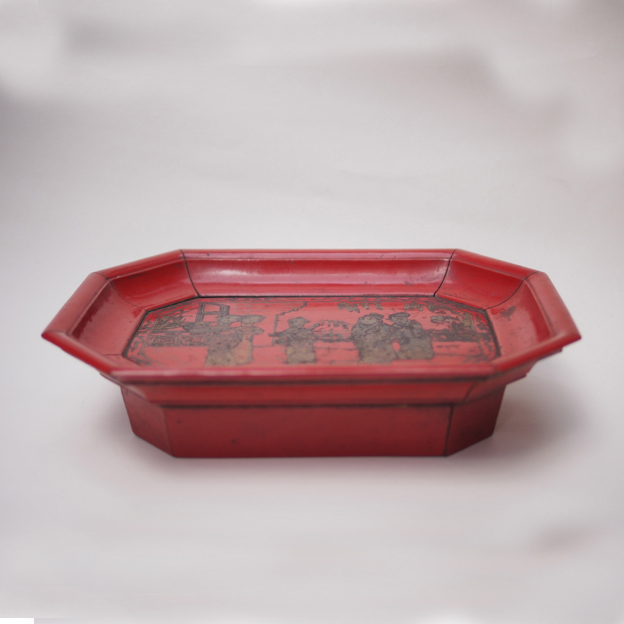
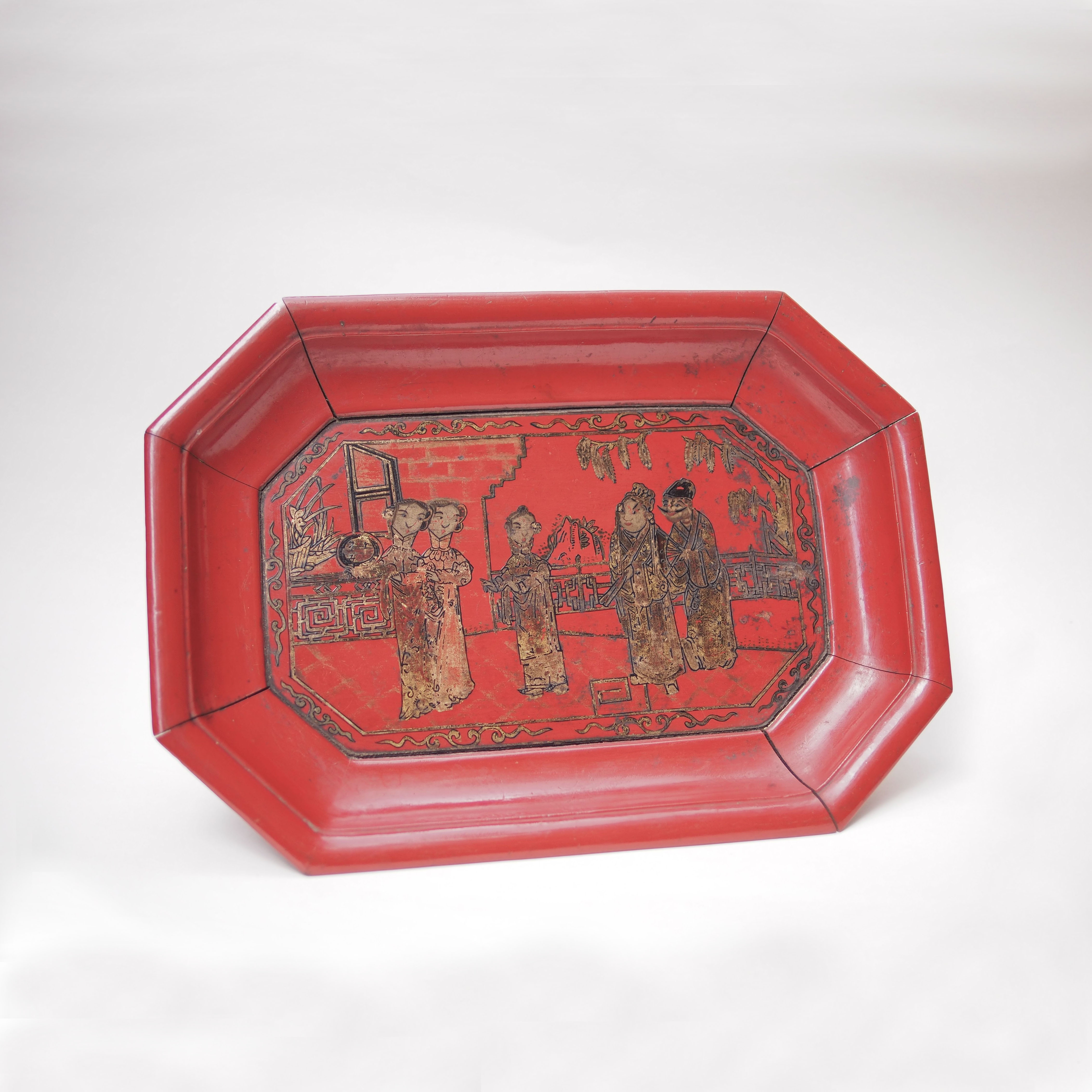
lacquer tray

lacquer tray

L320xW230xH75mm, China

The story depicted on this lacquer tray is from the same book, Jing Shi Tong Yan, as the Madame White Snake legend featured a couple of days earlier. The story about the flamboyant artist scholar Tong Yin; one day on a boating trip he sensed that a maid on another boat was smiling to him.  Electrified he ordered the boatman to followed the other boat and found out it belonged to the family of a court scholar.  Tong Yin disguised himself and applied for a job as a scholar assistant for the family and named himself Hau An.  Being over qualified for the job, he soon got promoted and trusted by the family and meanwhile he managed to find out the maid was called Qiu Xiang who directly serves the lady of the house.  The family wanted to promote Hau An as the person in charge but was weary of his single statue and suggested to arrange a marriage for him.  When Hau An found out about this, he proposed to pick one of maid as his wife.  The family agreed and on the same night, all the maids were there to be chosen but Hau An did not make a decision.  It turned out that Qiu Xiang was not there, the lady of the house then sermon her personal maid also to be present.  Hau An picked Qiu Xiang, married and lived happily ever after.

This story however, has nothing to do with the history of Tong Yin who got married three times; his first wife passed away at the age of 24, second wife left him and the third wife was a famous prostitute called Chen Jiu Niang.

go to 1 hour 23 minutes to see the same screen

Bodhisattva Manjusri on Lion

L460xD180xH650mm, China

This antique lacquer figurine is that of the Bodhisattva Manjusri (文殊菩薩).  Bodhisattva Manjusri and Maitreya are the often depicted with the Gautama Buddha with Manjusri on the left and Maitreya on his right, representing wisdom and teaching receptively.

Mantra of Manjushri

The creature Bodhisattva Manjusri is riding is a green lion (suan ni), the 8th son of the dragon.  He adores the incense and sitting so you will also be able to find him as a decoration for the feet of the incense burner.

Mother of Pearl lacquer box

DIA40xH25mm, China

The use of mother of pearl in lacquerware has been dated since the Zhou dynasty 1000 B.C. and matured in the Sung dynasty.  The pearl inlay into the black lacquer box creates a dream like magical colour, perhaps some the magic comes from the pain sticking workmanship that goes behind its creation.

buddha's birthday

W130xD70xH400mm, Thailand

Tomorrow is the 2557th birthday of the Buddha, Vesakh, a holy day that commensurate the birth, enlightenment and death of  Gautama Buddha by Buddhist all over the world.  The date of the celebration differ slightly throughout the different countries, 8th of lunar April, in Thailand for example, Vesakh is on the 24th May. 

On this special day, the devoted Buddhist will observe the 8 Precepts:

  1. I undertake the precept to refrain from destroying living creatures.
  2. I undertake the precept to refrain from taking that which is not given.
  3. I undertake the precept to refrain from sexual activity.
  4. I undertake the precept to refrain from incorrect speech.
  5. I undertake the precept to refrain from intoxicating drinks and drugs which lead to carelessness.
  6. I undertake the precept to refrain from eating at the forbidden time (i.e., after noon).
  7. I undertake the precept to refrain from dancing, singing, music, going to see entertainments, wearing garlands, using perfumes, and beautifying the body with cosmetics.
  8. I undertake the precept to refrain from lying on a high or luxurious sleeping place.

If you happen to be in Hong Kong, join in the celebration.

ASIAN FOLKCRAFT COLLECTION
SOIL X MOUNTAIN FOLKCRAFT

tray

W200xL310xH20mm, Myanmar

According to Burmese astrology, there are eight days in a week. They are Sunday, Monday. Tuesday, Wednesday (till noon), Rahu (Wednesday afternoon till the next morning), Thursday, Friday and Saturday. Burmese people believe that the astrological day a person was born is a great determinant in his or her personality and life. For example, a person born on Monday would be jealous; on Tuesday. Honest; on Wednesday, short tempered but soon calm again; the trait being intensified on the so called eighth day of Rahu; on Thursday, mild; on Friday, talkative; on Saturday, hot tempered and quarrelsome; and on Sunday, miserly.

Burmese also believe that interpersonal relation between people is also determined by the day they were born. For example, Monday born and Friday born would not get along well while Monday born and Wednesday or Rahu (Wednesday evening) born would get along very well. At the pagodas in Myanmar, there are always eight planetary posts build into the pagoda structure, with the representative animal symbols, where the believers could donate offerings at their respective planets to influence the appropriate powers.

These astrological symbols are often depicted on traditional Burmese lacquerware. The lacquered tray shown here is decorated with brass wire and the symbols are delicately made by palm skin.

This is one of the many Burmese lacquer ware from the SOIL collection, come check it out at the Asian Folkcraft event on at Mountain Folkcraft!