Archives for posts with tag: lacquer

golden wood carvingW60xL90xH130mm, China

This is a figurine of the character Fan Li Hua, one of the four famous Chinese female warriors (Hua Mu Lan, Mu Gui Ying and Qiu Jin).

Fan Li Hua is the beautiful daughter of a border general, well treated in military tactic and martial art, married to General Xue Ding Shan, she was also a general herself and pacified the western counties in the Tang dynasty.  The story of Fan Li Hua has been made into opera, “Fan Jiang Guan”.  The story began with Emperor and General Xue’s father trapped by the enemy in the town, Suo Yang Cheng.  The mother of General Xue has send a message for Fan to help with situation, at the same time, the twin sister of Xue has arrived with the army supply.  At this point, Xue’s sister has a strategic dispute with Fan Li Hua (who by then is already a General).  The spoiled sister-in-law started a fight, though no match against Fan wanted the upper hand.  Fan uses her wit and managed to calm the household as well as rescuing the Emperor.

bamboo lacquer basket OLYMPUS DIGITAL CAMERA

DIA260xH320mm, China

A lacquered bamboo weaved basket which forms part of the dowry of the young bride and an essential household object.  These form of baskets are used for storing food before the arrival of the refrigerator.  Precious food item like fresh vegetables, fruits, eggs, would be placed inside the basket and hung under the beam of the kitchen.  The basket provide good airing and being suspended will stopped vermin from reaching the food.

OLYMPUS DIGITAL CAMERA OLYMPUS DIGITAL CAMERA

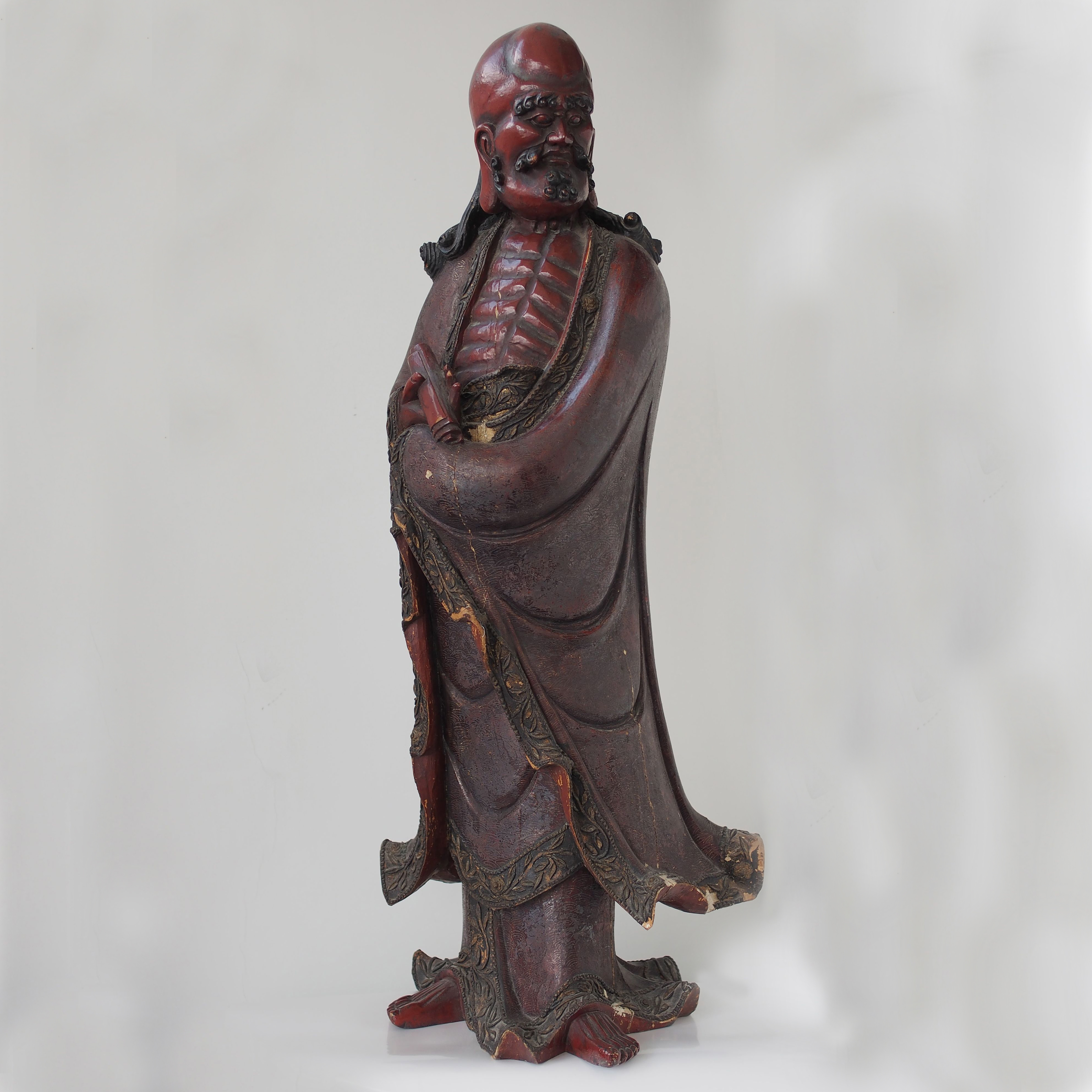
lacquer Bodhidharma

W300xD200xH800mm, China

This is a statue of the Bodhidharma, the Buddhist monk who is accredited to have introduced Buddhism to China.   It is believed that he is the third son of King Tamil Pallava of Kanchipuram and arrived to the now Guangzhou area in Southern Northern Dynasty (470AD).  The most famous legend about Bodhidharma is his wall glazing.  After felling out with Emperor in the Southern State, Bodhidharma travel up Yang Tze River, arrived at Shao Lin Temple and meditated by glazing on the wall for 9 years.

He is also believed to have introduced the 72 Shao Lin super kung fu and here is one of them.

Bodhisattva Manjusri on Lion

L460xD180xH650mm, China

This antique lacquer figurine is that of the Bodhisattva Manjusri (文殊菩薩).  Bodhisattva Manjusri and Maitreya are the often depicted with the Gautama Buddha with Manjusri on the left and Maitreya on his right, representing wisdom and teaching receptively.

Mantra of Manjushri

The creature Bodhisattva Manjusri is riding is a green lion (suan ni), the 8th son of the dragon.  He adores the incense and sitting so you will also be able to find him as a decoration for the feet of the incense burner.

Mother of Pearl lacquer box

DIA40xH25mm, China

The use of mother of pearl in lacquerware has been dated since the Zhou dynasty 1000 B.C. and matured in the Sung dynasty.  The pearl inlay into the black lacquer box creates a dream like magical colour, perhaps some the magic comes from the pain sticking workmanship that goes behind its creation.

buddha's birthday

W130xD70xH400mm, Thailand

Tomorrow is the 2557th birthday of the Buddha, Vesakh, a holy day that commensurate the birth, enlightenment and death of  Gautama Buddha by Buddhist all over the world.  The date of the celebration differ slightly throughout the different countries, 8th of lunar April, in Thailand for example, Vesakh is on the 24th May. 

On this special day, the devoted Buddhist will observe the 8 Precepts:

  1. I undertake the precept to refrain from destroying living creatures.
  2. I undertake the precept to refrain from taking that which is not given.
  3. I undertake the precept to refrain from sexual activity.
  4. I undertake the precept to refrain from incorrect speech.
  5. I undertake the precept to refrain from intoxicating drinks and drugs which lead to carelessness.
  6. I undertake the precept to refrain from eating at the forbidden time (i.e., after noon).
  7. I undertake the precept to refrain from dancing, singing, music, going to see entertainments, wearing garlands, using perfumes, and beautifying the body with cosmetics.
  8. I undertake the precept to refrain from lying on a high or luxurious sleeping place.

If you happen to be in Hong Kong, join in the celebration.

ASIAN FOLKCRAFT COLLECTION
SOIL X MOUNTAIN FOLKCRAFT

tray

W200xL310xH20mm, Myanmar

According to Burmese astrology, there are eight days in a week. They are Sunday, Monday. Tuesday, Wednesday (till noon), Rahu (Wednesday afternoon till the next morning), Thursday, Friday and Saturday. Burmese people believe that the astrological day a person was born is a great determinant in his or her personality and life. For example, a person born on Monday would be jealous; on Tuesday. Honest; on Wednesday, short tempered but soon calm again; the trait being intensified on the so called eighth day of Rahu; on Thursday, mild; on Friday, talkative; on Saturday, hot tempered and quarrelsome; and on Sunday, miserly.

Burmese also believe that interpersonal relation between people is also determined by the day they were born. For example, Monday born and Friday born would not get along well while Monday born and Wednesday or Rahu (Wednesday evening) born would get along very well. At the pagodas in Myanmar, there are always eight planetary posts build into the pagoda structure, with the representative animal symbols, where the believers could donate offerings at their respective planets to influence the appropriate powers.

These astrological symbols are often depicted on traditional Burmese lacquerware. The lacquered tray shown here is decorated with brass wire and the symbols are delicately made by palm skin.

This is one of the many Burmese lacquer ware from the SOIL collection, come check it out at the Asian Folkcraft event on at Mountain Folkcraft!

Green lacquerware

DIA200xH150mm, Myanmar

ASIAN FOLKCRAFT COLLECTION
SOIL X MOUNTAIN FOLKCRAFT

It is almost certain that Burma acquired the technique of lacquer production from China where it has a three-thousand year history. However, the use of lacquerware was not confined to royalty and the monkhood in Burma. Lacquer objects were used daily by commoners. Food, refreshments, clothing, cosmetics and flowers are all put in lacquer receptacles.

The importance of lacquer to the Burmese is probably equivalent to the modern uses of porcelain, glass and plastic combined. Indeed, lacquer has many of the characteristics of modern plastic. It is light, waterproof, easily moulded and dries to a hard state.  It can be applied to virtually any surface: plain or carved wood, bamboo, paper, fabric, even metal and stone.

This fruit bowl is made by coiled bamboo, covered by over 20 layers of lacquer and decorated with the Burmese astrological symbols. Process of producing green lacquer ware is rather time consuming: One part indigo was added to ten parts of orpiment to produce a traditional green color. With age, many such green lacquer wares have come to assume appeasing opaque turquoise hue.

horse hair bowlDIA130xH90mm, Myanmar

Veronica Gritsenko is a British-Ukrainian artist and scholar. In 2000 she set up the Black Elephant studio in Bagan, Burma and eventually developed her own unique technique and designs based on ancient methods and materials.  Black Elephant Lacquer is collected by private connoisseurs and was acquired by the British Museum and The Royal Botanic Gardens Museum.

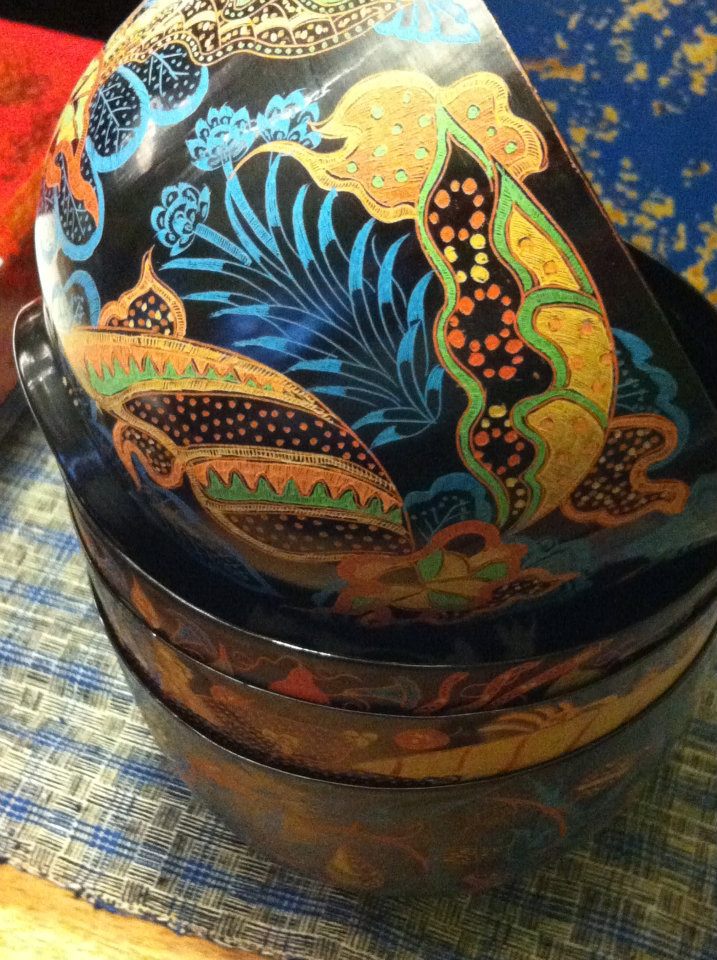
These bowls are made with horsehair woven in between very thin bamboo splints, with further application of lacquer mixed with rice husk ashes.  Burma is famous for a special type of incised lacquerware called “yun” – It’s engraved with a sharp iron stylus and the incisions are filled with colouring matter to create a design.

Item from SOIL for the ASIAN FOLKCRAFT COLLECTION

burmese betel boxDIA60xH50mm, Myanmar

For the first item of the Asian Folkcraft Collection, we have a miniature of Burmese’s traditional lacquer betel box from SOIL.

 Betel, tobacco and pickled tea is an expression in Burmese language that speaks of hospitality and welcomes a visitor to one’s home.

 The circular betel box at first glance, looks solid, but is in reality nicely fitted with a lid over a small container for holding betel nut. The top of the bowl is fitted with two shallow trays, one on top of the other. The upper tray has four little cups to hold ingredients for making betel nuts: cloves, cutch, and seeds, shredded wild Licorice or sweet creeper.

 In the second tray is a layer of dried tobacco leaves. Only when the tray is taken out of the main bowl are green fresh betel leaves revealed.