Archives for posts with tag: lacquer

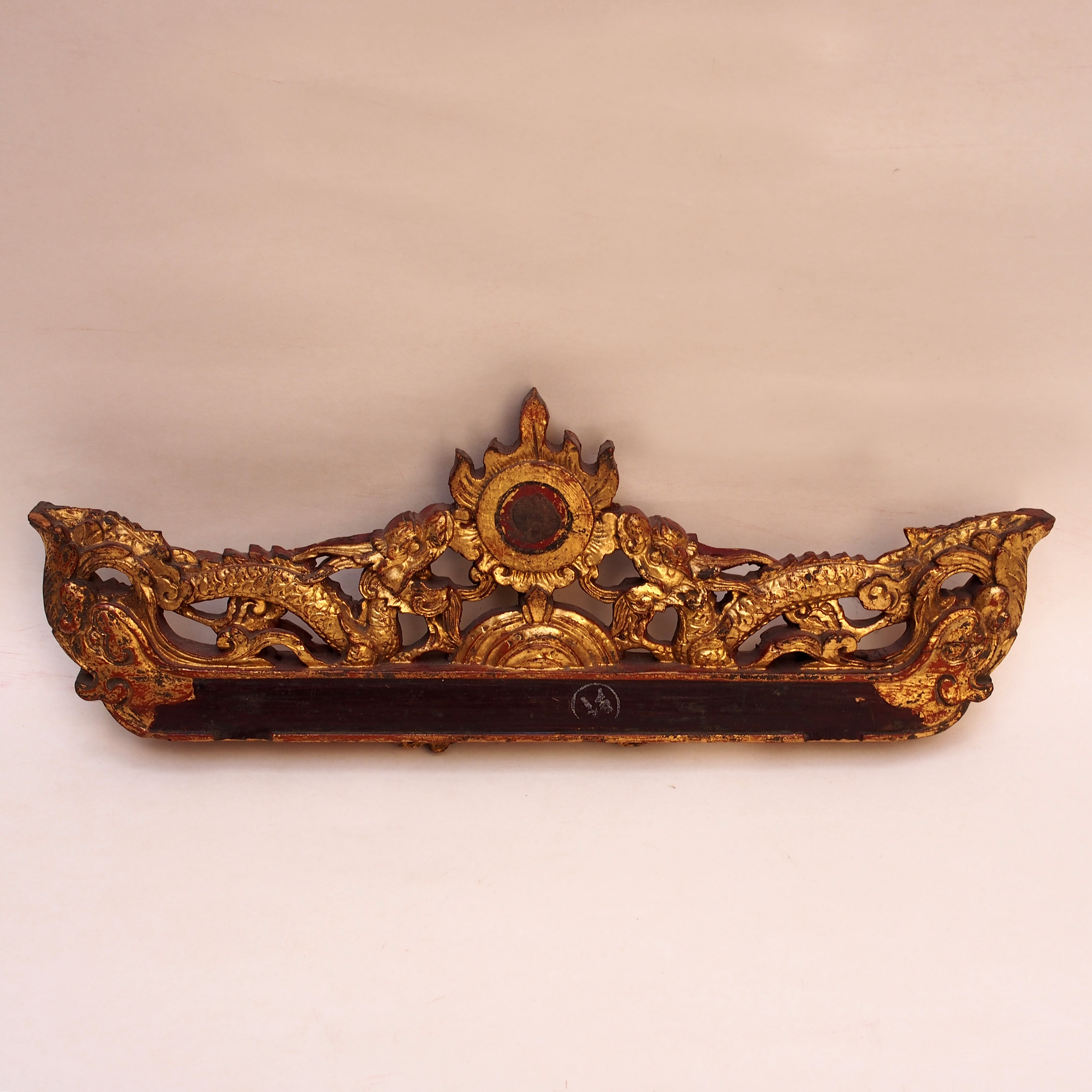
golden wood carvingL350xD25xH130, China

This golden wood carving used to be center pediment of an ornamental object, perhaps on small shrine in a temple.

On the carving, there are 2 dragons chasing after a pearl.  Dragons are believed to be mythical creatures from the sky, they need to attain a certain quality to become a saint.  After a few hundred years, the essence of what they have learnt from nature would become a pearl like pellet.  The dragon would spit out the pearl for it absorb the spirit of nature and the bigger the pearl would grow.  One day while a dragon was practicing with his pearl, another dragon decided to take this pearl to speedup his own attainment. The bad dragon spit out his pearl hoping it would absorb the other, the two pearls melted and became one giant pearl, both dragons wanted to take it in and started using all their tricks.  Their fight upset the nature of the universe and the Jade Emperor took them in and set the pearl on the temple which would be protected by the dragons for good
golden wood carving

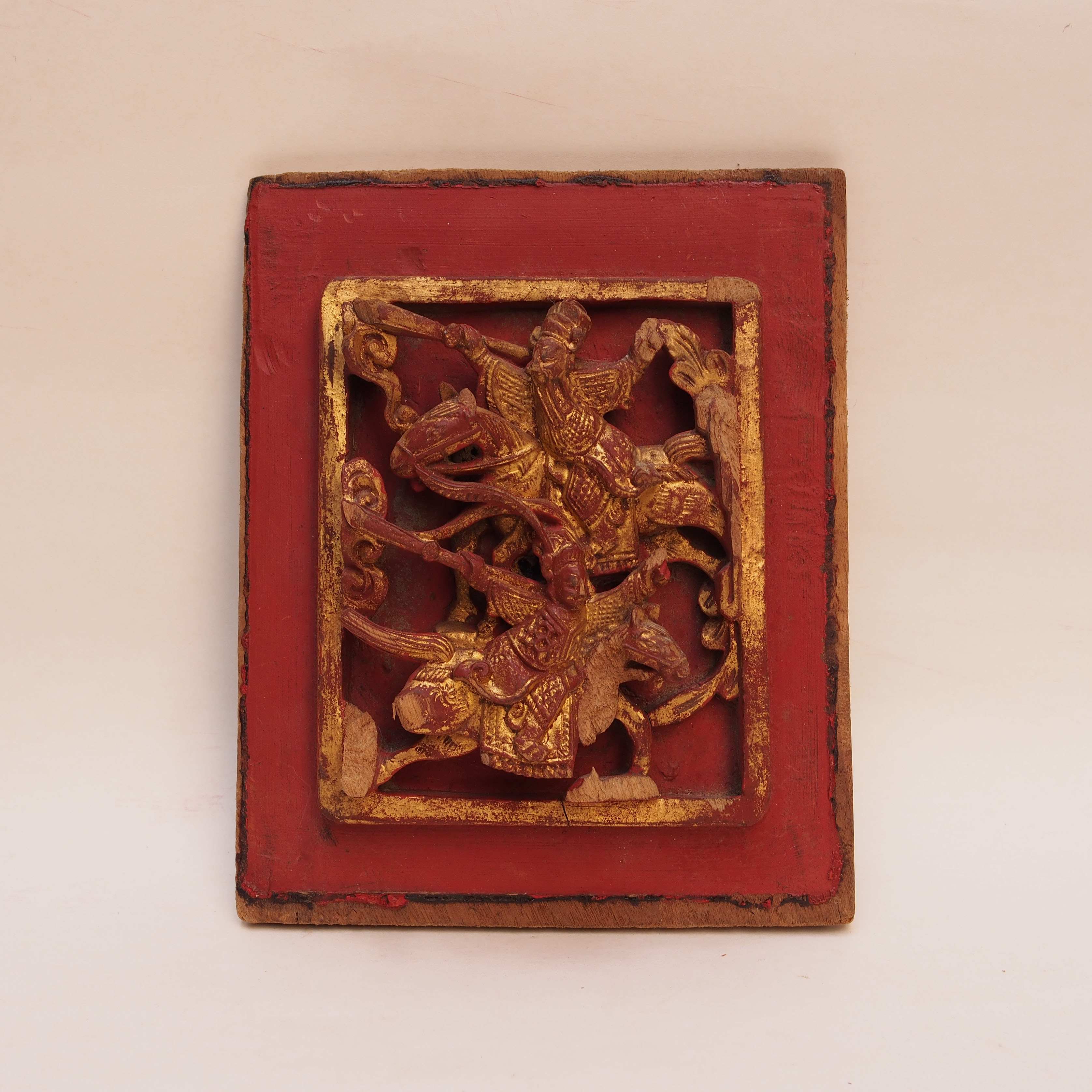
W150xD40xH180mm, China

The two character on this wood block carving is Fan Li Hua and Xue Ding Shan.  The story of the two are in opera, movies and on telly with Fan Li Hua being the famous female warrior of the Tang dynasty.  Fan was the daughter of the general of the country name Onog, both beautiful and with superb martial skills.   General Xue was in charged of expanding on the western territories; Fan was assigned to aid his father at the battle by  her mother who also told her that she was destined to marry Xue.  Without effort Fan defeated her enemy and requested for a battle with General Xue and quickly defeated Xue as well.  Her terms for ending the war was for him to marry her, three times she captured him and released him and .  General Xue was moved and the two was married, Fan then pretended to loss the battle and was captured by Xue.  Fan then help Xue to conquer the western frontier.

Here is another carving of Fan Li Hau.

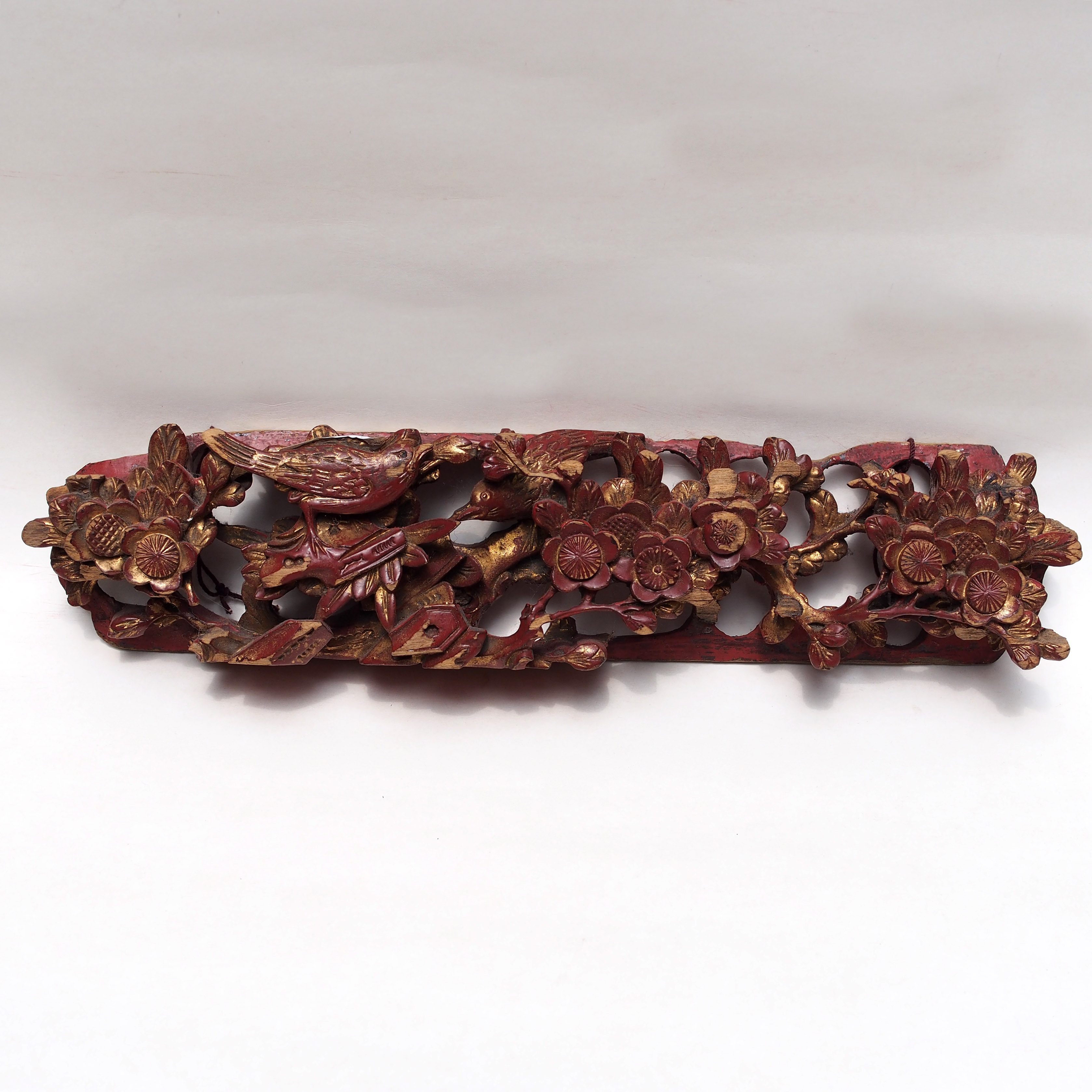
golden wood carvingL300xD45xH65mm, China

The composition of plum blossom and bird is a popular theme for Chinese crafts.

Not only it this a yearly event when the birds come to party and feast when the plum blossom, it also has a symbolic meaning.  A play on the phase 喜上眉梢 (xi shang mei shao), one is so happy that joy is expressed when in the eye brow.  You might wonder what a facial express has to do with plum blossom and bird.  The bird is 喜鵲 pica pica (magpie), its climbing on the plum branch 喜上梅梢 (xi shang mei que) has the same pronunciation has this uncontrollable joy.

golden wood carving

L230xD30xH90mm, China

This golden wood carving makes a perfect birthday present.

The four figurines are full of blessing, Fu Lu Shou and Ma Gu.  They are all Taoist saints, representing blessings and happiness.

Fu (far right) – the planet Jupiter which was also attributed to Yang Cheng of the West Han period.  Yang, after being nominated to be the Daozhou official, abolished the practice of present contribution to the Emperor, relieving the stain for the people and therefore seen as a blessing.

Lu (left of Fu) – god of prosperity.  The stars Ursa Majoris humanized as Zhang Xian of the Shu dynasty, a brave general who was respected by the Emperor and worshiped by the people.

Shou (left of Lu) – god of longevity.  The stars of Canopus, translated as Peng Zu who is believed to have livd to an age of 767!!

Lady (at the far left) is Ma Gu, goddess of longevity – with the appearance still being in her teens, she has witnessed 3 times the sea turned into fields (judging its not from any dramatic climatic changes, she has been around for a long long time).  Her immortality and her yearly birthday tribute to the Queen Mother of the West is seen as a blessing and so Ma Gu is a popular subject for pritns, figurines, embroidery and alike.

OLYMPUS DIGITAL CAMERAfigurine

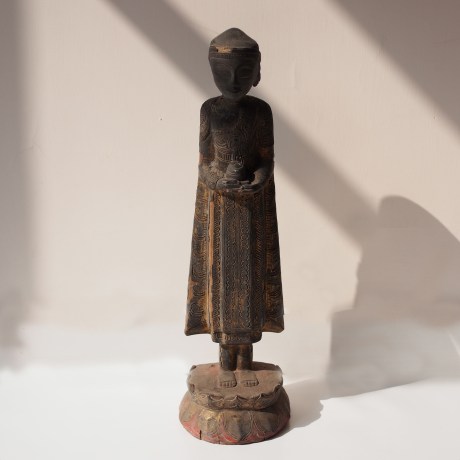
W120xD100xH480, Burma

This is a figurine of the Buddha with an alms bowl standing on a lotus flower.

In Theravada Buddhism, “pindacara” a daily alms collection of food “pindapata” is practiced by the monks (and nuns).  The word for monk “bhikkhu” means one who lives on alms, while “pindapata” means dropping a lump.  The monks would leave their monastery, in a group they walk barefooted in single file according to seniority, their robe formally arranged covering both shoulders.  The route will go through the village house by house, accepting but never requesting food that is dropped into the bowls.  This figurine, the Buddha, is leading figurine of a group which consists of monks of different heights which unfortunately is not with us.

Monks in Burma

the second film has a more in depth view of a monk’ life.

opium scaleL200xW90xD250mm, Thailand

The container is beautifully painted lacquer.
Inside is a scale for measuring opium,
with the weights on one side and the opium on the other.

lacquer tray

DIA115xH65mm, Thailand

This curious circular lacquer tray has been a puzzle for me, I cannot figure out what was the original usage for such item.  The material of the tray is very delicate, made with paper and a semi transparent lacquer.

If anyone know of the origin and usage of this tray, please let me know!
Other unsolved mystery.

This is going to be my next Something Old Something New project, stay tune!
Previous items: Coconut Lid Containers, Lotus Leaf Vessel.

Thai Buddha

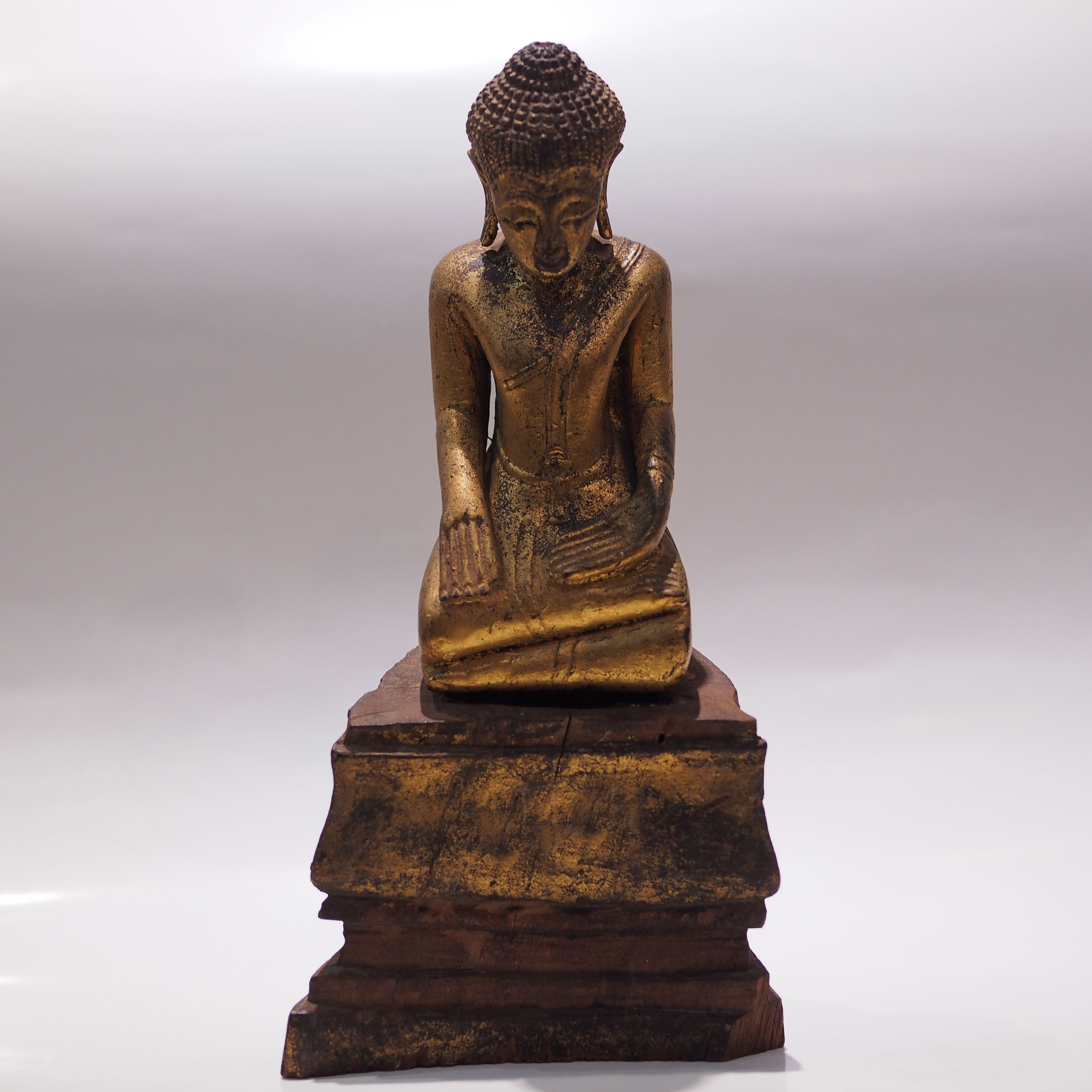
W100xD70xH220mm, Thailand

Mudras are symbolic hand gestures, without the use of words it communicates the mind’s idea which is more powerful than language.

This is a Buddha statue in the Bhumisparsha Mudra posture, with his right hand resting on knee while reaching toward the earth and the left hand lies on the lap facing upward.  This gesture is also known as the “earth witness” which is the most iconic image of Buddhism.  This gesture symbolizes unshakability and steadfastness; the legend goes just before Siddhartha Gautama was enlightened to become the Buddha, demon Mara called upon his armies of monster to attacking, hoping to scare him away from his meditation under the bodhi tree.  Siddhartha stayed unshaken and  continued his mediation.  The demon claimed the enlightenment for himself and called for his monsters to give witness to his superior spiritual achievements, Mara then asked Siddhartha if anyone could give witness for him.  Siddhartha simply extended his hand to reach the ground and the earth responded and giving witness for him.  Mara was defeated at his own challenge and vanished.  The next day Siddhartha Gautama enlightened to become the Buddha himself.   The serene expression of this figurine best captured this moment of enlightenment.

Here is a monk practicing more mudra gestures.

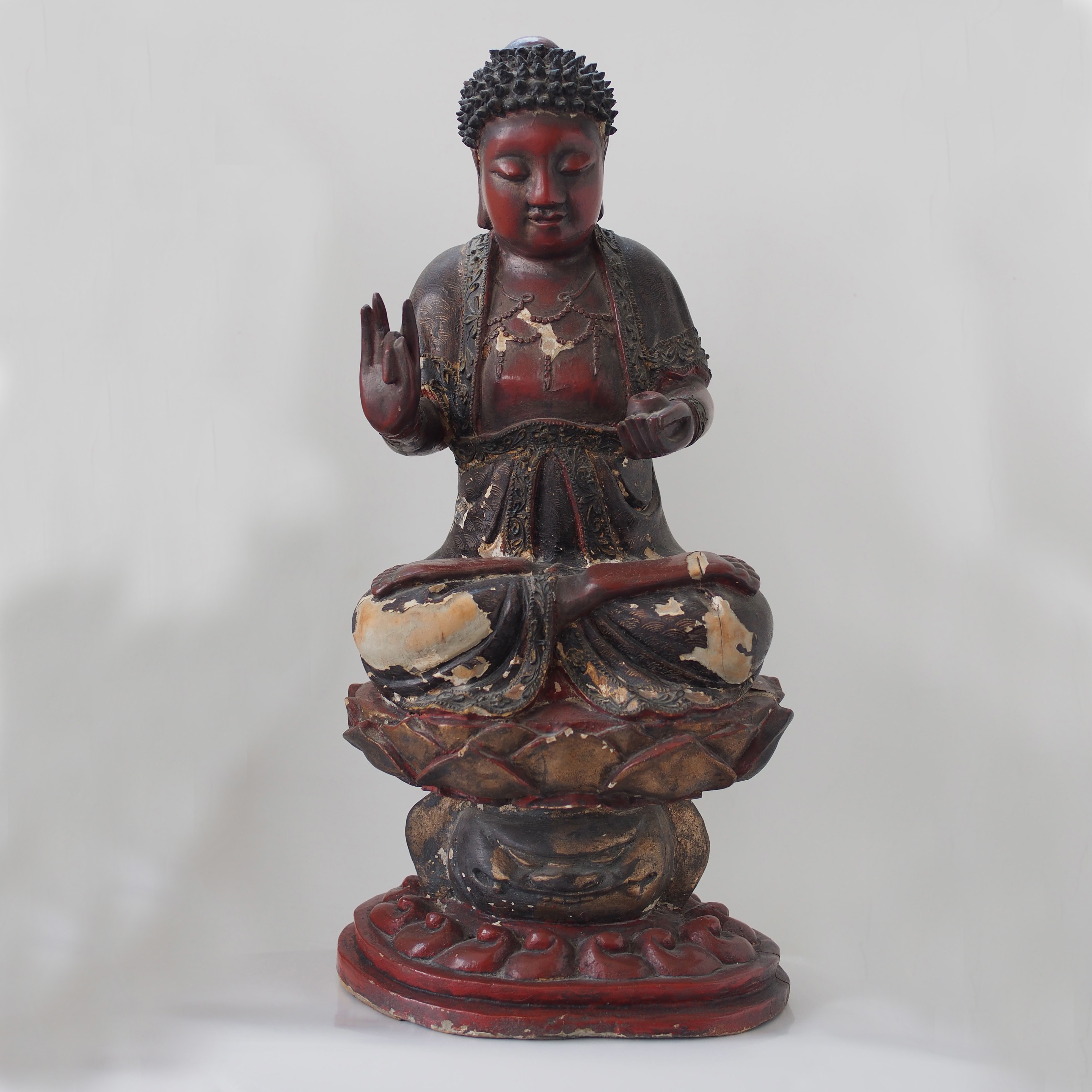
lacquer buddha on lotusW270xD180xH600mm, China

This is an old lacquer figurine of the Gautama Buddha.  He is sitting on a lotus blossom which symbolizes purity of the mind and body.  Though the lotus is rooted from the mud, its leaves naturally repel dirt and water, its blossom raises well above the muddy pool.  Under the lotus blossom sits a lion; lions are symbolic of bodhisattvas, being that have attained enlightenment.

The hand gesture of the Buddha indicating the banishing of evils (karana) and the gesture of leisure (avakasha).

At the back of the figurine is a secret compartment for storing scripts.

OLYMPUS DIGITAL CAMERA
W360xD190XH360mm, China

This fine lacquered cabinet was a household shrine for worshiping the ancestors in the Chaozhou area.  Ancestral tablets would be kept inside of the cabinets, with the higher ranking ancestor on the upper stage and the others on the lower level.  The decoration of the exterior of the doors are blessing figures of warriors and top scholars (zhuang yuan) while in the interior are scholarly plants, all a blessing for the descendants of the family.

The ancestral tablets are made of word with the name of the ancestor.  The legend goes like this; a long time ago there lived a poor widow and her son.  The son was a brute, abusive to the mother verbally and sometimes even physically, but the mother took care of him all the same.  One day, while the son was collecting logs in the mountain he saw a mother bird busy looking for food to feed her young, so tired is the bird that she collapsed in the nest after feeding the nestling.  Seeing this the young man realized he had been wrong of how he had treated his mother and felt terrible.  Right about the same time, his mother arrived with his lunch, the young man hurried to greet his mother.  Not knowing his intention, the mother told she would get another beating, she put down the food and started to run down the hill.  The son yelled behind her and the mother hurried, tripped, hit a tree and died.  Unable to tell his mother how sorry he had been, he took a piece of the tree, wrote on it his mother’s name and worship it on her birthday.  The character of the son changed and became a very successful man and the idea of ancestral tablets were adopted by others.

worship cabinet