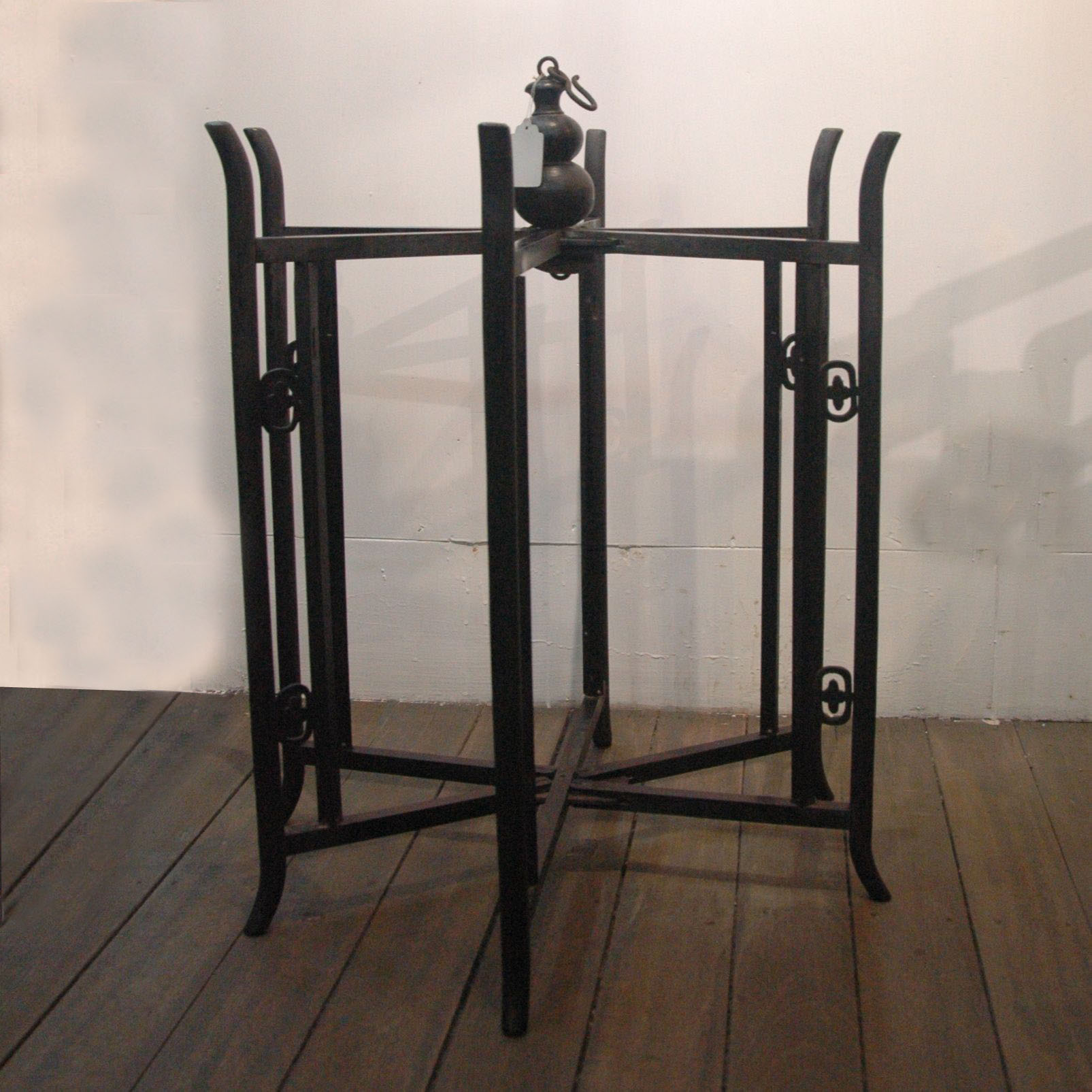
It is believed that the first court lantern was made for Emperor Liu Xiu, 23 A.D., after successfully unifying the country he held a large banquet in the palace, decorated with ribbons and lanterns. Until the Sui dynasty, the court lantern is restricted for the use in the palace. On the coronation of Emperor Wen, 590 A.D., the city Lou Yang held a bit celebration with nightly banquets, operas and court lanterns hanging throughout. Since then, on the day of Yuan Xiao every family will hang up court lanterns on the main beam of the living room.
This is the wooden frame of the lantern, a decorative silk or glass panels. The frame can be folded up nicely for storage till the next Yuan Xiao festival.
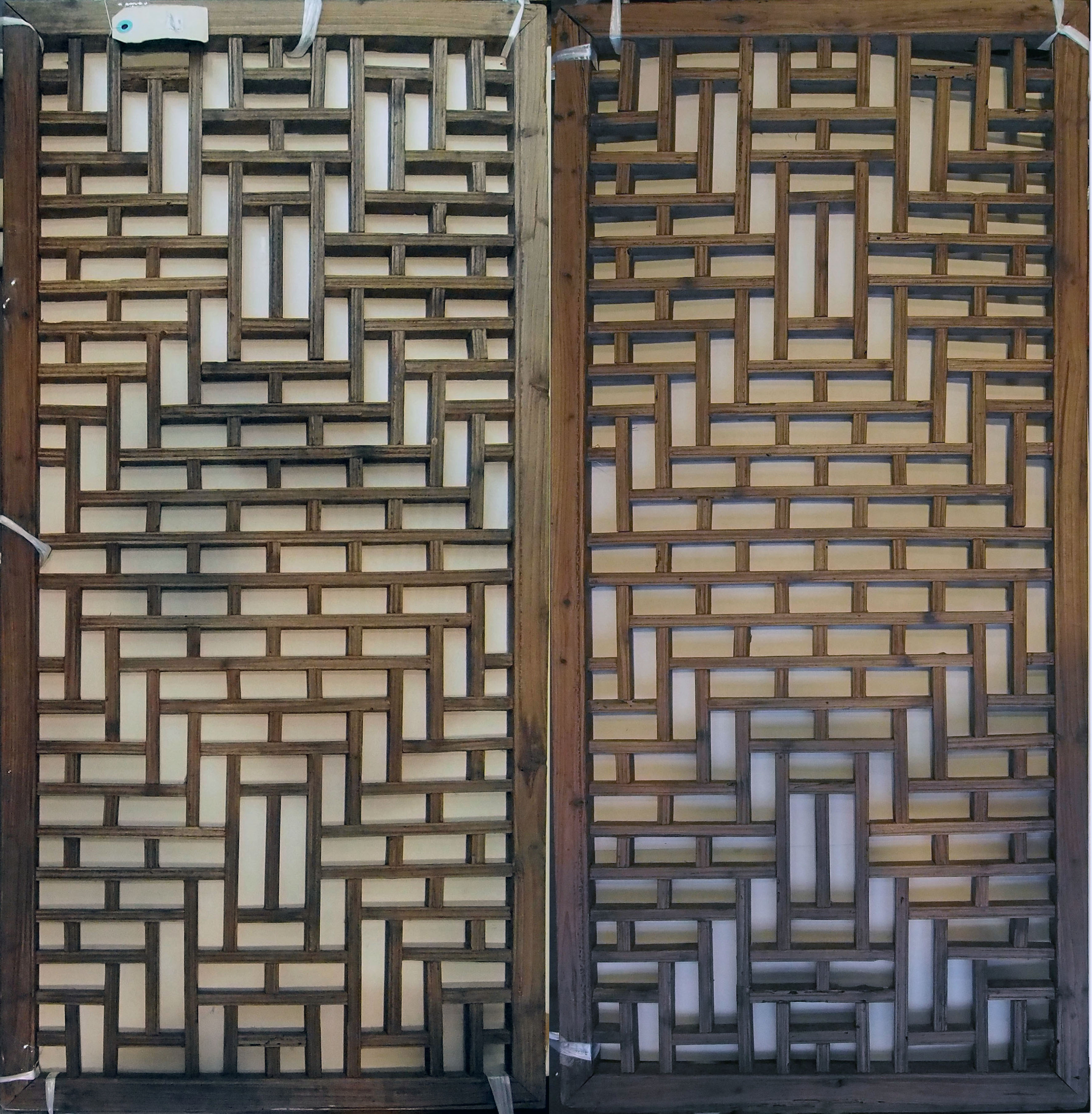
These wooden window lattices belonged to the houses of Hui Zhou, an area with elaborated civilian architecture brought on by the wealth of the successful merchants in the area. The Hui style architecture is unique, a combination of the local stilt houses and official northern courtyard houses, suiting to the southern climate, resulted in 2 stories courtyard houses with the living area directly opened to the inner courtyard with no wall or door in between, hence the courtyard which open up to the sky becomes part of the living area. This pair of window lattice would have been used for the ground floor bedroom facing the living area. They would have belonged to a humble family, though the craftsmanship is not as elaborated as that of the Yin Yu Tang, it is entirely put together by notches and without the use of a single nail.
See the Yin Yu Tang, a house transported from Hui Zhou to the Peabody Essex Museum.
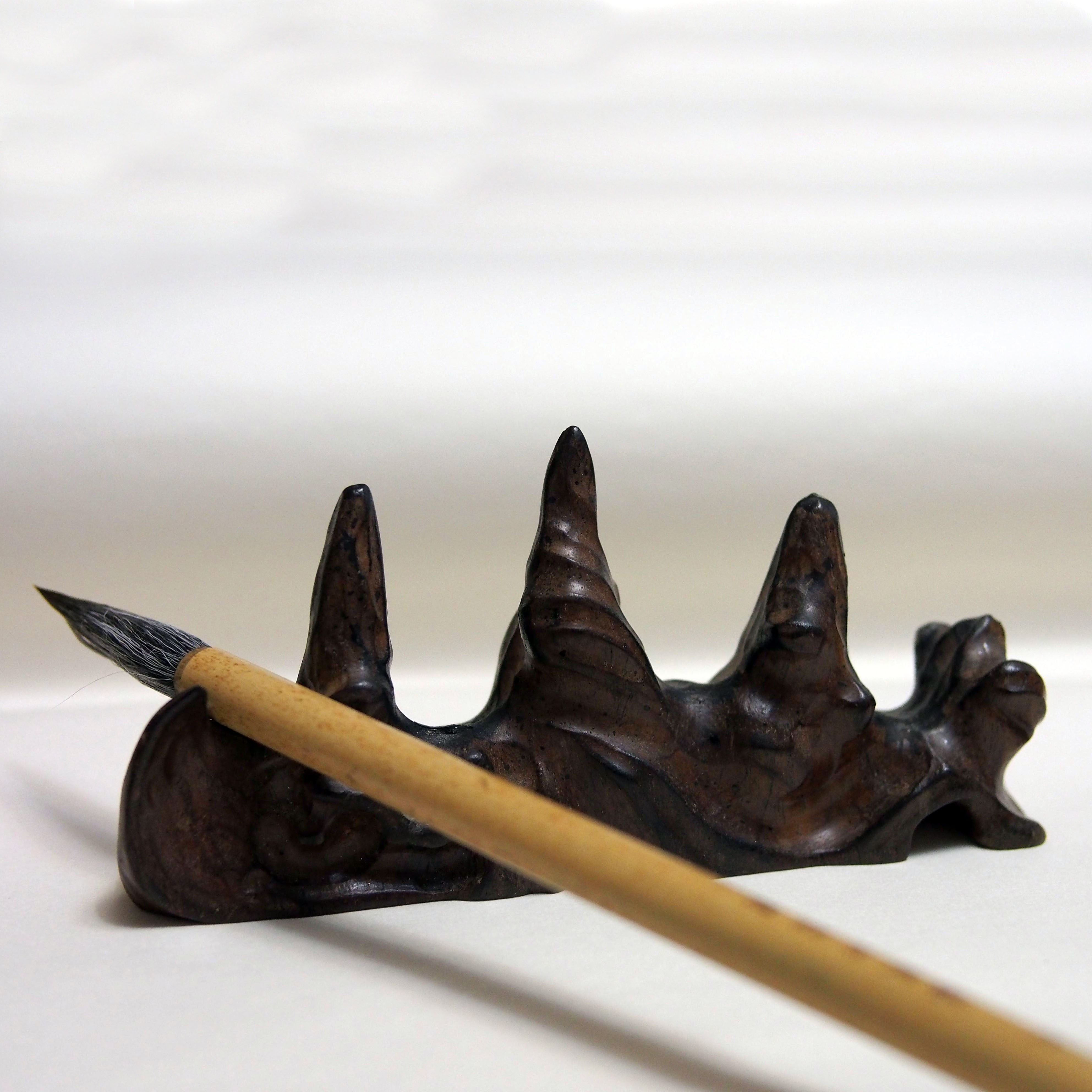
An essential stationary for the scholar, a brush rest for the temporary resting of the brush, as well as the mind. When the job is done, the brush will be hung vertically to let gravity dry up the brush evenly. There are many shapes for the brush rest but the mountain is one of the popular form, they can be made from coral, agate, crystal, jade to more common material such as wood and ceramic.
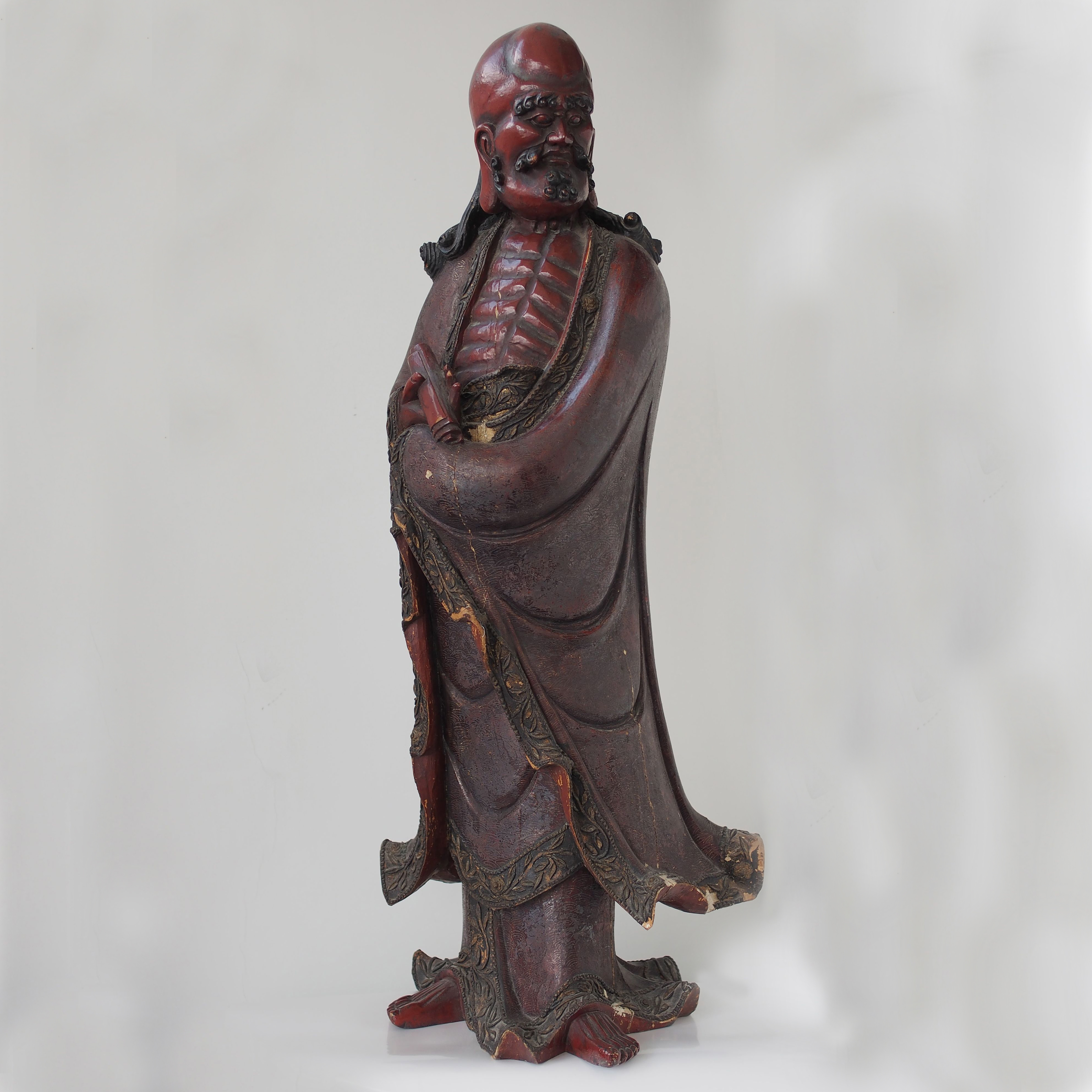
This is a statue of the Bodhidharma, the Buddhist monk who is accredited to have introduced Buddhism to China. It is believed that he is the third son of King Tamil Pallava of Kanchipuram and arrived to the now Guangzhou area in Southern Northern Dynasty (470AD). The most famous legend about Bodhidharma is his wall glazing. After felling out with Emperor in the Southern State, Bodhidharma travel up Yang Tze River, arrived at Shao Lin Temple and meditated by glazing on the wall for 9 years.
He is also believed to have introduced the 72 Shao Lin super kung fu and here is one of them.
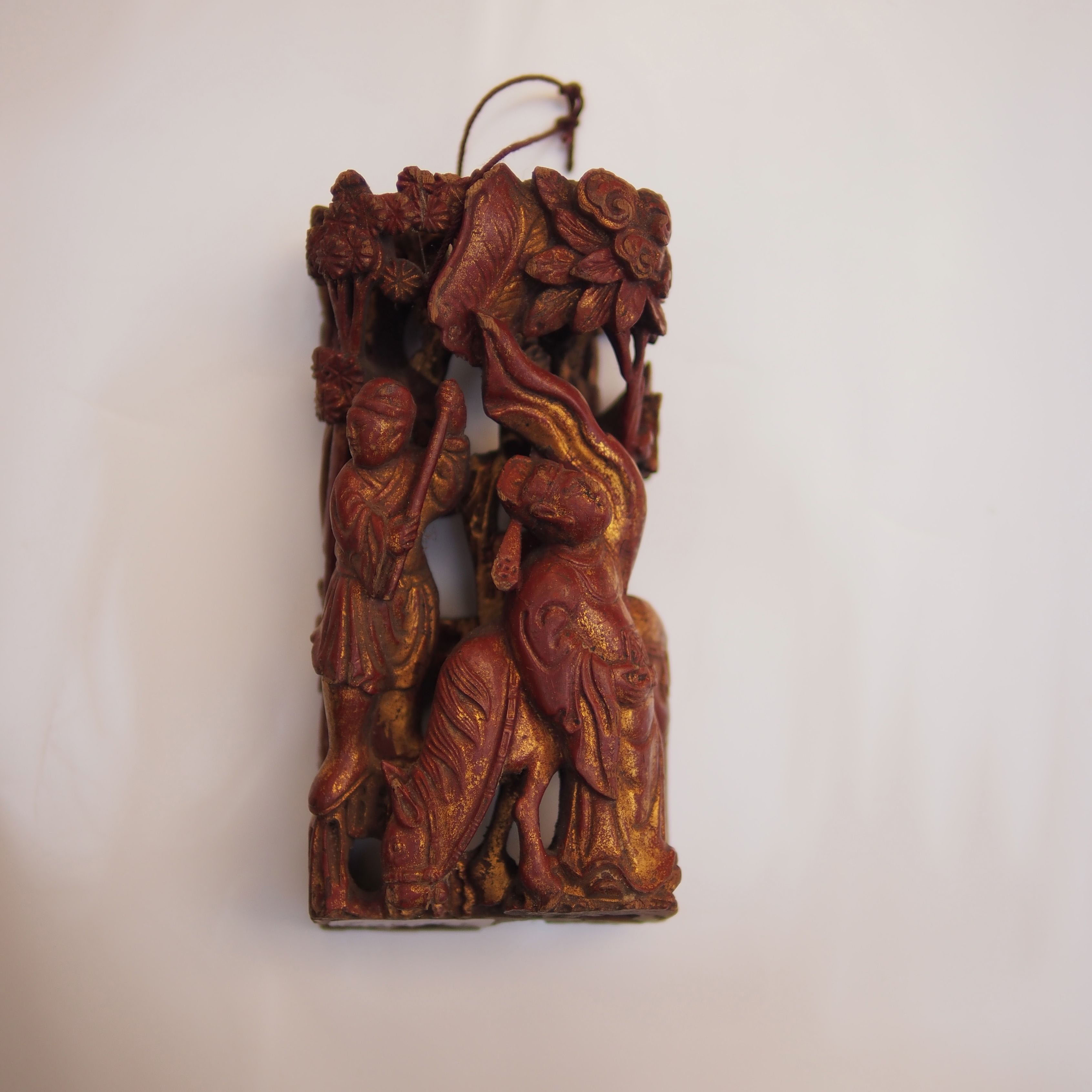
This wood carving is depicting the event of the top scholar of the year, Zhuang Yuan, a parade showing off his achievement. Early on the Chinese has established a strong examination system for the selection of her court officials. The procession started inside the Jin Luan Dian, one of the three main courts of the forbidden city, this is here the Emperor will announce the top 3 scholars, their name will be sang out. After thanking the Emperor, the Zhuang Yuan will depart the Jin Luan Dian, passing the Tai He Men, Wu Men, Duan Men, Cheng Tian Men, Ta Ming Men then head back to Chang An Zho Men to exit the forbidden city and continue his celebratory journey home. Chang An Zho Men, now demolished, is the single entrance for “non-emperor”. On the day of the results, after names of the Zhuang Yuan and others have been sang out in Jin Luan Dian, their names will be written on two yellow piece of paper, one to be kept as a record inside the court and the other larger piece to be posted inside a a temporary scaffolding hut outside Chang An Zho Men. The examination system was a attempt to find the most capable regardless of the social background, it is similar the Chinese legend of the carps jumping up the sky in belief that they will become dragons. For this the Chang An Zho Men (left door by Chang An Street) is also known as the Dragon Gate.
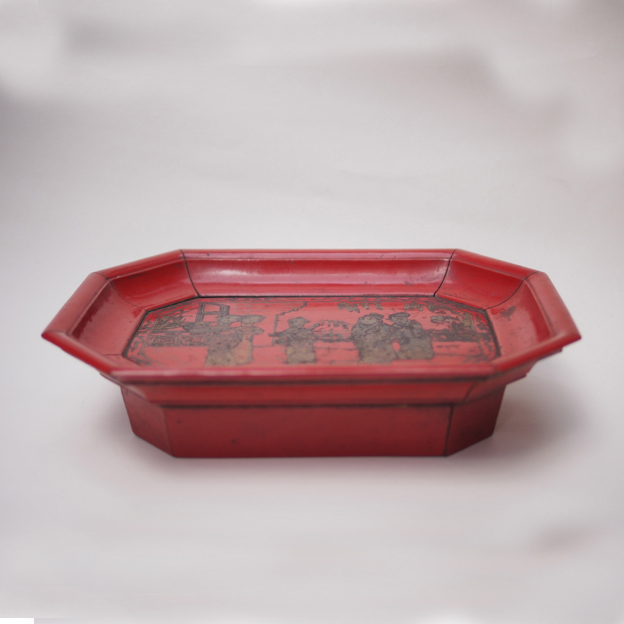
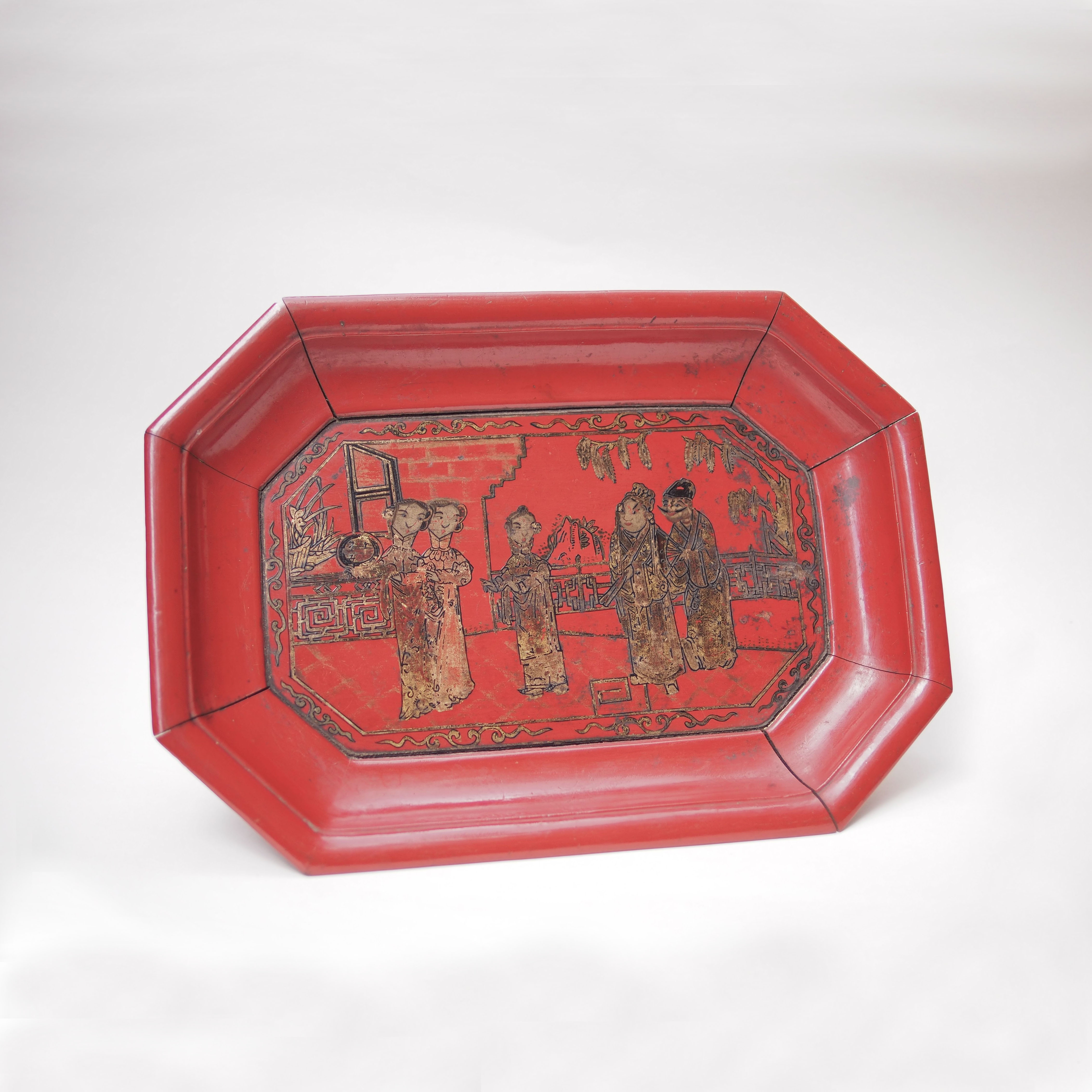
The story depicted on this lacquer tray is from the same book, Jing Shi Tong Yan, as the Madame White Snake legend featured a couple of days earlier. The story about the flamboyant artist scholar Tong Yin; one day on a boating trip he sensed that a maid on another boat was smiling to him. Electrified he ordered the boatman to followed the other boat and found out it belonged to the family of a court scholar. Tong Yin disguised himself and applied for a job as a scholar assistant for the family and named himself Hau An. Being over qualified for the job, he soon got promoted and trusted by the family and meanwhile he managed to find out the maid was called Qiu Xiang who directly serves the lady of the house. The family wanted to promote Hau An as the person in charge but was weary of his single statue and suggested to arrange a marriage for him. When Hau An found out about this, he proposed to pick one of maid as his wife. The family agreed and on the same night, all the maids were there to be chosen but Hau An did not make a decision. It turned out that Qiu Xiang was not there, the lady of the house then sermon her personal maid also to be present. Hau An picked Qiu Xiang, married and lived happily ever after.
This story however, has nothing to do with the history of Tong Yin who got married three times; his first wife passed away at the age of 24, second wife left him and the third wife was a famous prostitute called Chen Jiu Niang.
This is a warrior mask of the Chinese Ground Theatre (Di Xi). A form of theater which based on the warring theme.
The character of the masks can be broadly divided into 4 catagories; generals, saints, clowns and animals. The generals would wear helmets, like this one; and consists of warriors, intellectuals, female, old and young generals. This particular mask belongs to the warrior general which the blue face symbolizes bravery and a strong character. The saint types are masks with a weird features, e.g. a beak; they are powerful figures which comes to assist the generals on wars. As in all theatres, di xi cannot be without the clowns, often character of distorted faces. Lastly, the animals; the fierceful lion and tiger, the tamed horse, the stipid pig, hard working ox, endearing dog and the cheeky monkey.
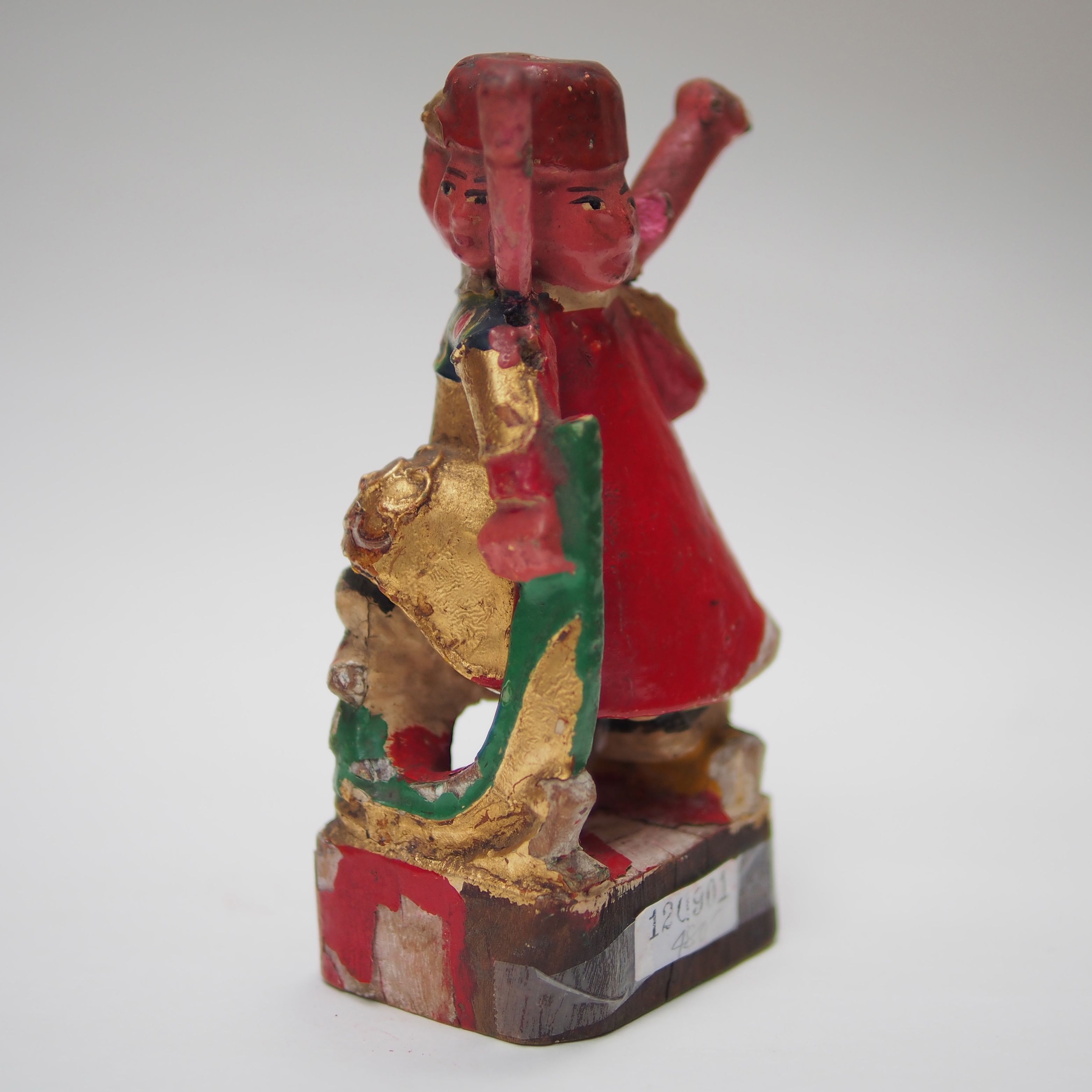
This dragon and tiger rider was an ancestral saint that was kept at the alter of the junk boat for keeping the fisherman’s journey safe. The multiple faces offer a supernatural power for this ancestral saint which is an usual expression for these figurines. Or would the fisherman had been to Bangkok on one of their fishing spree and got their inspiration from the famous Erawan Shrine?
This antique lacquer figurine is that of the Bodhisattva Manjusri (文殊菩薩). Bodhisattva Manjusri and Maitreya are the often depicted with the Gautama Buddha with Manjusri on the left and Maitreya on his right, representing wisdom and teaching receptively.
Mantra of Manjushri
The creature Bodhisattva Manjusri is riding is a green lion (suan ni), the 8th son of the dragon. He adores the incense and sitting so you will also be able to find him as a decoration for the feet of the incense burner.
Like other forms of Chinese theater, the glove puppet follows the same cast catagories. This puppet head belongs to the Jing category (painted face), a forceful character and the sub category of Black Flower (Hei Hua) which denotes a strong temperament but integrity (a bit like Captain Haddock in the Tin Tin comic). Junior means a younger character, hence there is also Black Flower Senior who comes with beard. Hei Hua Junior is often cast as the talented officers for a respected official







 Mountain Folkcraft
