
D120xW120xH240mm, Hong Kong
This is a small marine masthead navigation light which uses an oil lamp. It is made by an old Hong Kong marine light company called Tung Woo which unfortunate is no long in business.
D120xW120xH240mm, Hong Kong
This is a small marine masthead navigation light which uses an oil lamp. It is made by an old Hong Kong marine light company called Tung Woo which unfortunate is no long in business.

W70xL140xH50mm, China
Dont be mislead by the tabloid title, this is in fact a piece of stationary, a copper box for keeping seals and seal paste. In China seal was the form of identification, a bit like the rubber stamp which is officially recognized. The seal of the Emperor would represent the Emperor himself. In the old days, most people will at least own a set of personal seal, but for artist and intellectuals they will own also a leisure set and a studio set, for each set there will be a collection of a seals. There are a long culture for seals; the stone, the text, the design and the craftsmanship are all refined and specialized.

L550xW80mm, China
This is a chinese traditional scale used for measuring light weight items such as gold or herbs. The scale work by the concept of a lever; the item to be weight on one end and the weight on the other. The weight is slide along until the scale is balanced and from the markings of on the rod, the weight of the item can be told. The small red tassels are the points for pivots, changing the pivot points will give provide a different range for the scale. This is a portable scale with a custom made bamboo casing. The earliest found scale was dated around 700BC; the unit weight for the scale has been changing since, this scale is based on 16 tael to 1 catty, 1 tael = app 37.8g which is the current unit used for the hong kong wet market.
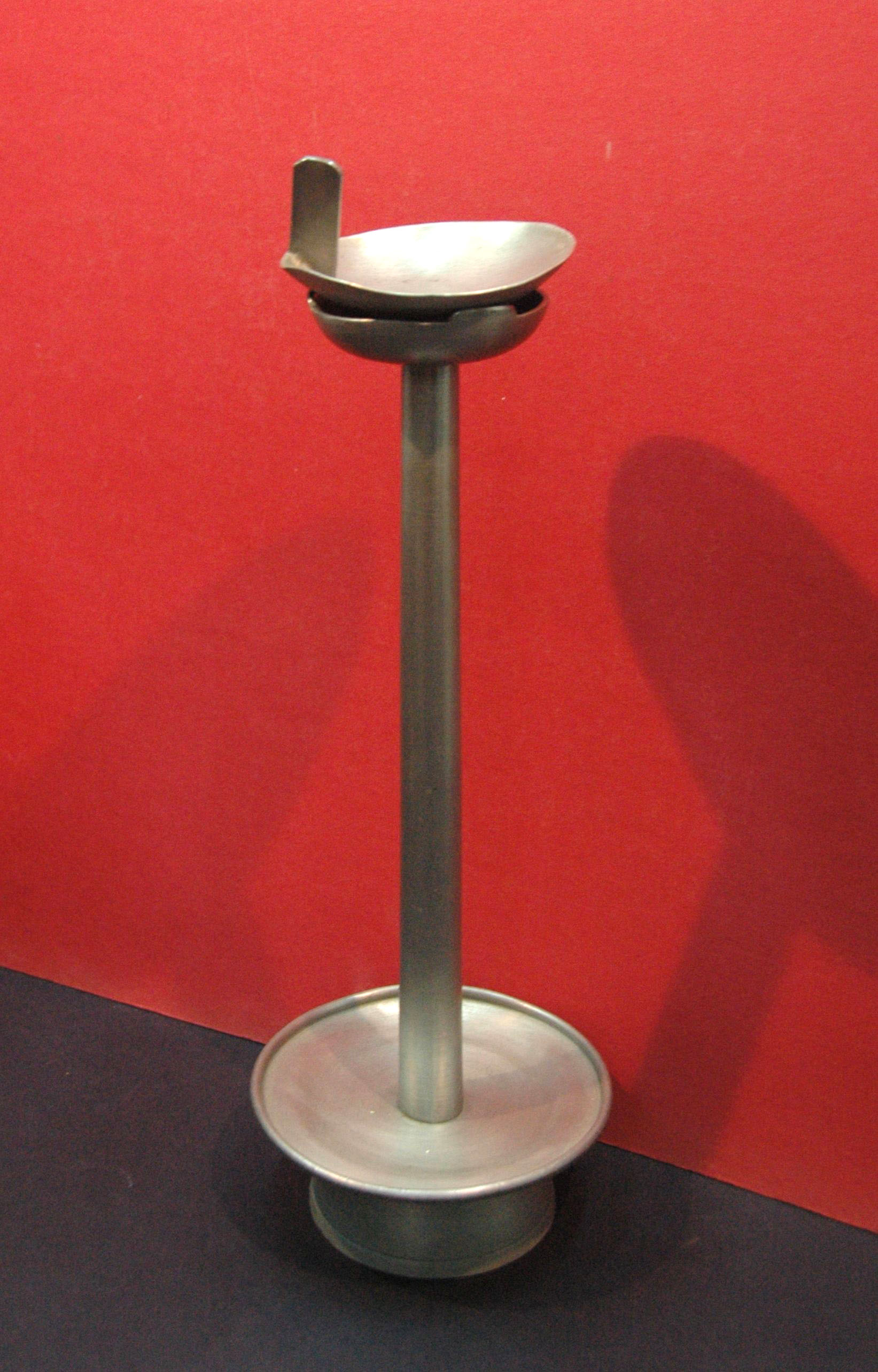
DIA100xH350mm, China
Oil lamp was the source of lighting in old China, as the technology advance metal lamps became more common by the Qing dynasty. It quickly became popular because of its durability over the ceramic oil lamps. This is one of a pair of the standard pewter lamp used in the old days in the Chinese wedding ceremony.

L220mm, China
Chopstick has been around in China for more than 3000 years; there has been many material used for making them, wood, bamboo, ivory, bone, lacquered, silver, gold, jade and of course the recent plastic and stainless steel version. It is commonly believed that silver is used as a material for its ability to detect poison. Perhaps it is the tarnishing of the silver from the sulphur in arsenic that made the name of the silver chopstick. Please dont be alarmed by the tarnished silver on this pair of chopstick, it is due to natural oxidation from its age and not from any poison. The legend of the silver chopstick goes like this; the famous politician of the Zhou dynasty Jiang Zi Ya was once only interest in fishing (with a straight hook) and nothing else. His wife got fed up with his idleness and decided to kill him and to marry someone else. One day as usual, he came home empty handed after fishing, his wife had prepared a spiked up meat dish for his supper, just as he tried to grab the meat a bird flew in and packed on his hand. The bird did it again and again as he tried to go for the meat, sensing something is out of the ordinary, he pretend to chase the bird and left the house. Up a hill, the bird told him only to eat with the two sticks on the ground where it stood. Jiang return home and pick up the meat with the sticks as he was told, smoke appears and his wife fainted. His eating sticks got famous and everyone started eating with chopsticks. The moral of the story …. men, dont go fishing too often + remember to bring at least a fish home (even if you have to buy it from the supermarket).

L60xD20xH50mm, China
The longevity lock, a tradition for the Chinese babies hundred day celebration, the child will keep it on till his 12th birthday. The Chinese believes that life will be locked just as a door or a trunk. In a way its a kind of blessing given to the child by the elders of the family. Its history started from the Han dynasty, on the 5th of lunar May, every household would hang a 5 colour rope on the door as a blessing against the plague. By the Jin dynasty, the 5 colour rope would be tied on to the arms of women and the children as a blessing. The tradition extending into the empirical court in the Han dynasty, the Emperor would give out the rope to all his ministers on the 5th of lunar May. The rope became more elaborated by Ming dynasty and became the silver locket we have here.
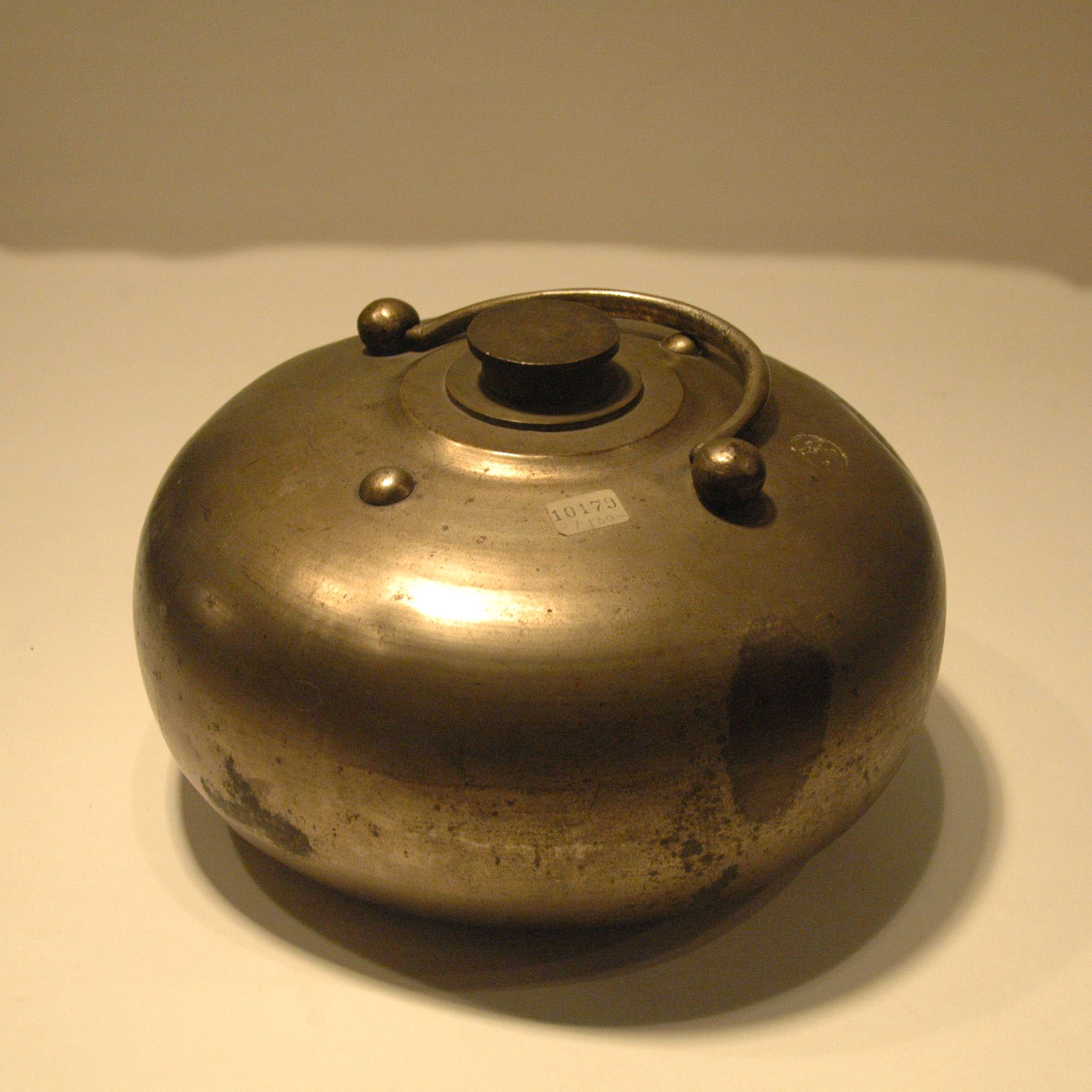
DIA250xH150mm, China
For these cold nights, here is a Chinese version of the hot water bottle known as the “hot water mistress”. It is made with a good conductor (such as copper nickle, pewter or porcelian) and once hot water is filled in through the small screw up opening, it will be enclosed with a thick cloth bag and put in to warm the bed.
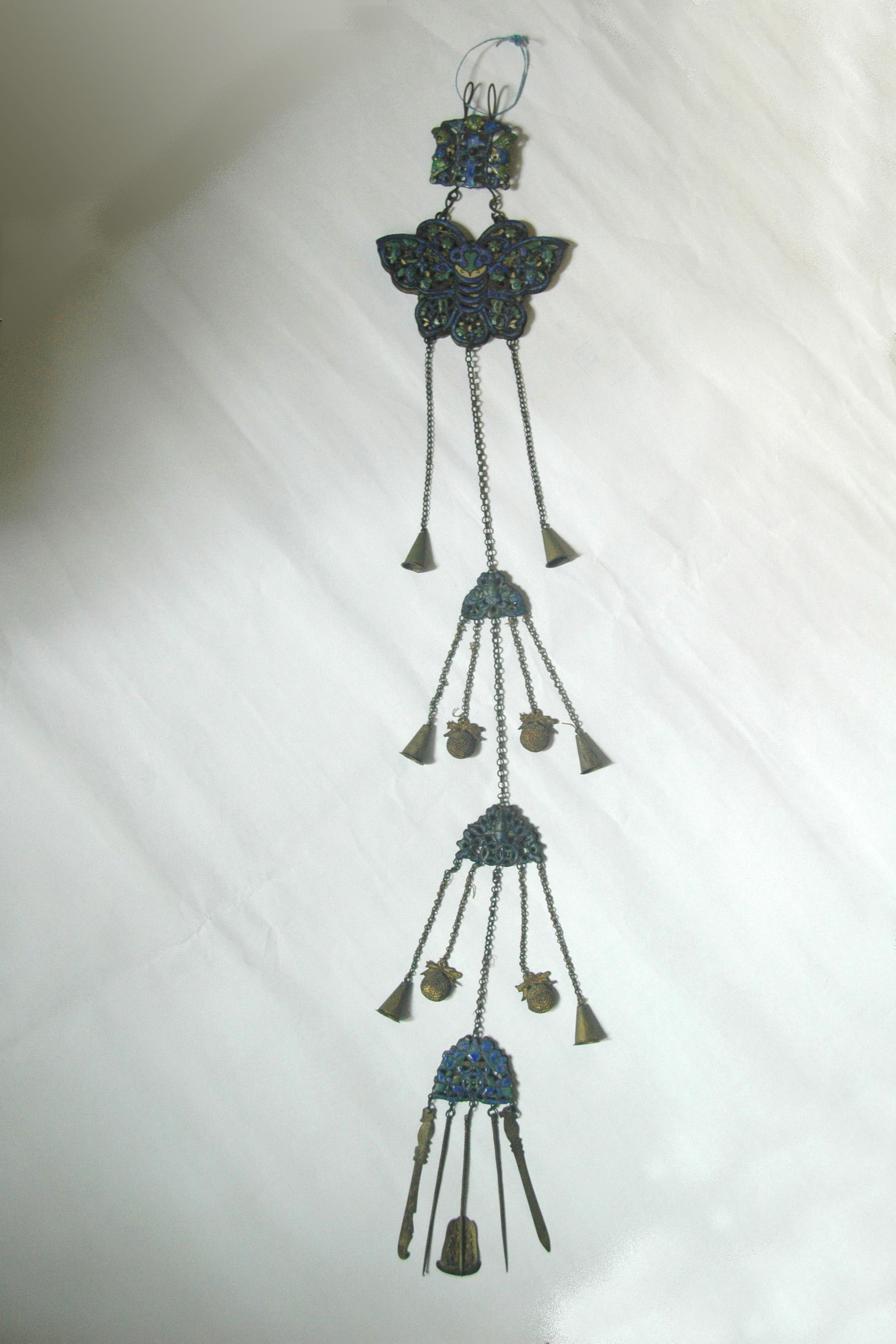
L650xW100mm, China
This is a ladies’ silver waist hanging ornament, highlighted with enamel pendant pieces. On the top three layers, small bells are hang making a delightful charm as one move around. At the bottom hung 5 accessories; 2 type of knive, a shove, toothpick and earpick (a traditional Chinese style Swiss army knife).

W150xH300mm, China
The traditional Chinese beds are almost like rooms on their own; there is an entrance through a gate at the front, the sides and the back are filled with wood carving panels or balustrade, even the roof are paneled. Unlike the western bed where the user can get on from 2 sides and the end if they so want to, the chinese bed can only be entranced from one side. If a couple were on the bed, the one sleeping inside will have to squeeze pass from the foot of the other person to get out of bed by the gate. The gate is covered by a curtain which is drawn open in the day time and close at night. This is the metal hook for holding apart the curtain over the bed, they come in a pair.

 Mountain Folkcraft