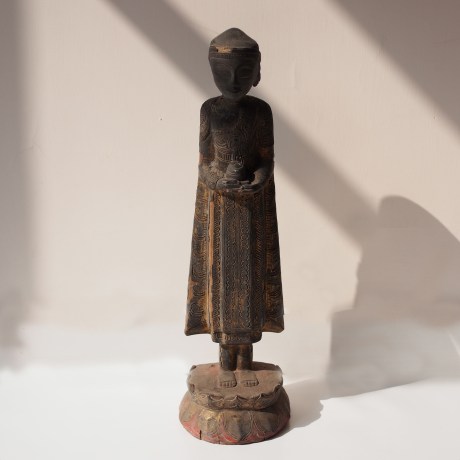
This is a figurine of the Buddha with an alms bowl standing on a lotus flower.
In Theravada Buddhism, “pindacara” a daily alms collection of food “pindapata” is practiced by the monks (and nuns). The word for monk “bhikkhu” means one who lives on alms, while “pindapata” means dropping a lump. The monks would leave their monastery, in a group they walk barefooted in single file according to seniority, their robe formally arranged covering both shoulders. The route will go through the village house by house, accepting but never requesting food that is dropped into the bowls. This figurine, the Buddha, is leading figurine of a group which consists of monks of different heights which unfortunately is not with us.
Monks in Burma
the second film has a more in depth view of a monk’ life.
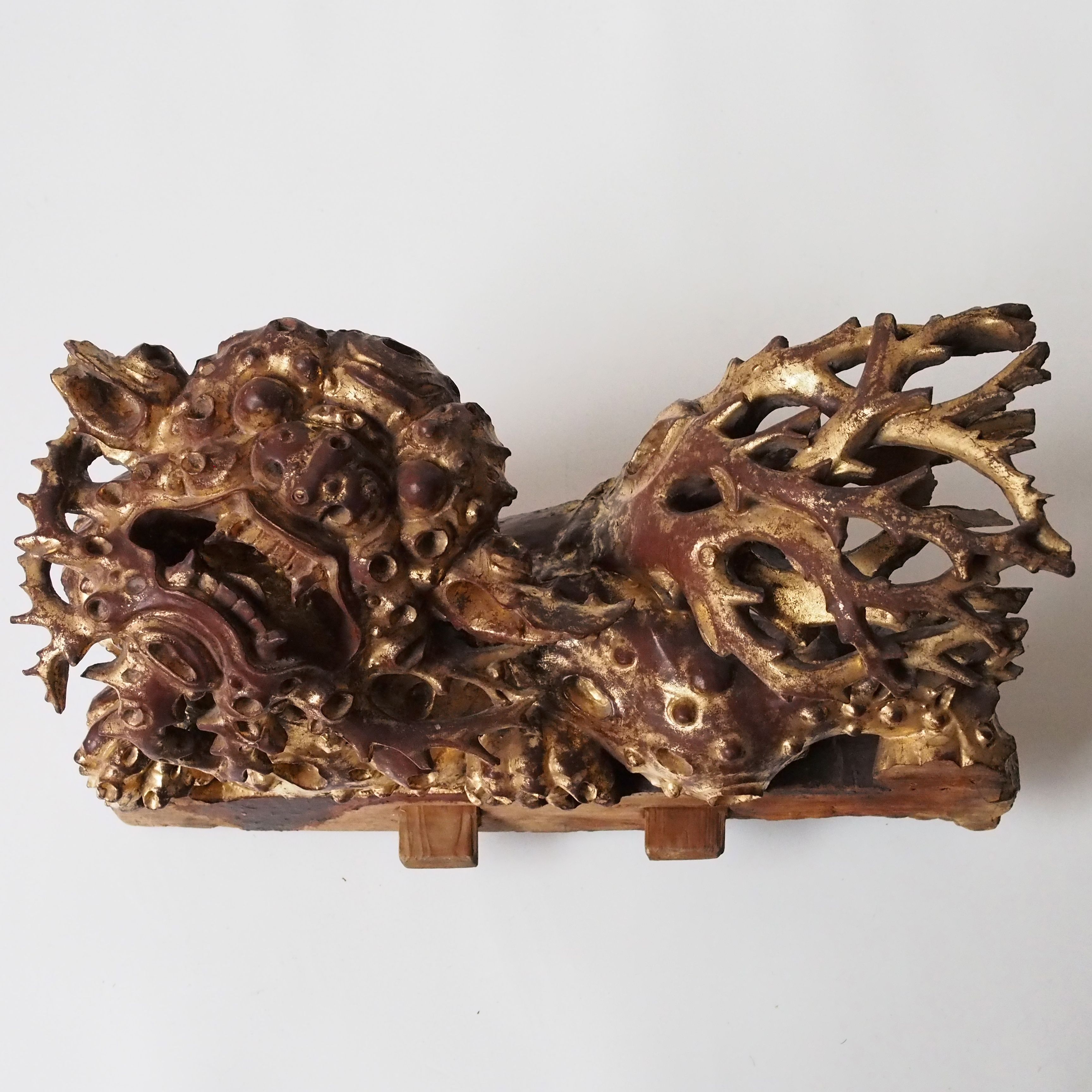
Chi Wen, the second son of the dragon, like the Tao Tie and the Suan Ni. The Chi Wen loves enjoying the vista and fire eating, because of this it is often found on the ridges of traditional buildings as a protection against fire. The Chi Wen has a head of a lion but the tail of a fish, the legendary owl fish (which was likely to be the whale)
This beautifully carved golden wood carving is used as a decoration for the company logo.
You can take a glimpse of it in the film below, a documentary about a traditional cake shop in Hong Kong. In the first episode, the decoration construction for the Mid Autumn festival starts at 3:34″. The pair can be seen under the logo at 5:05″, closed up at 5:10.
This series of documentary “May Food Keep Us Together” is one of my favorite, it examines the tradition, the generations of the family who runs these food places that are quickly replaced by the chain fast food outlet.
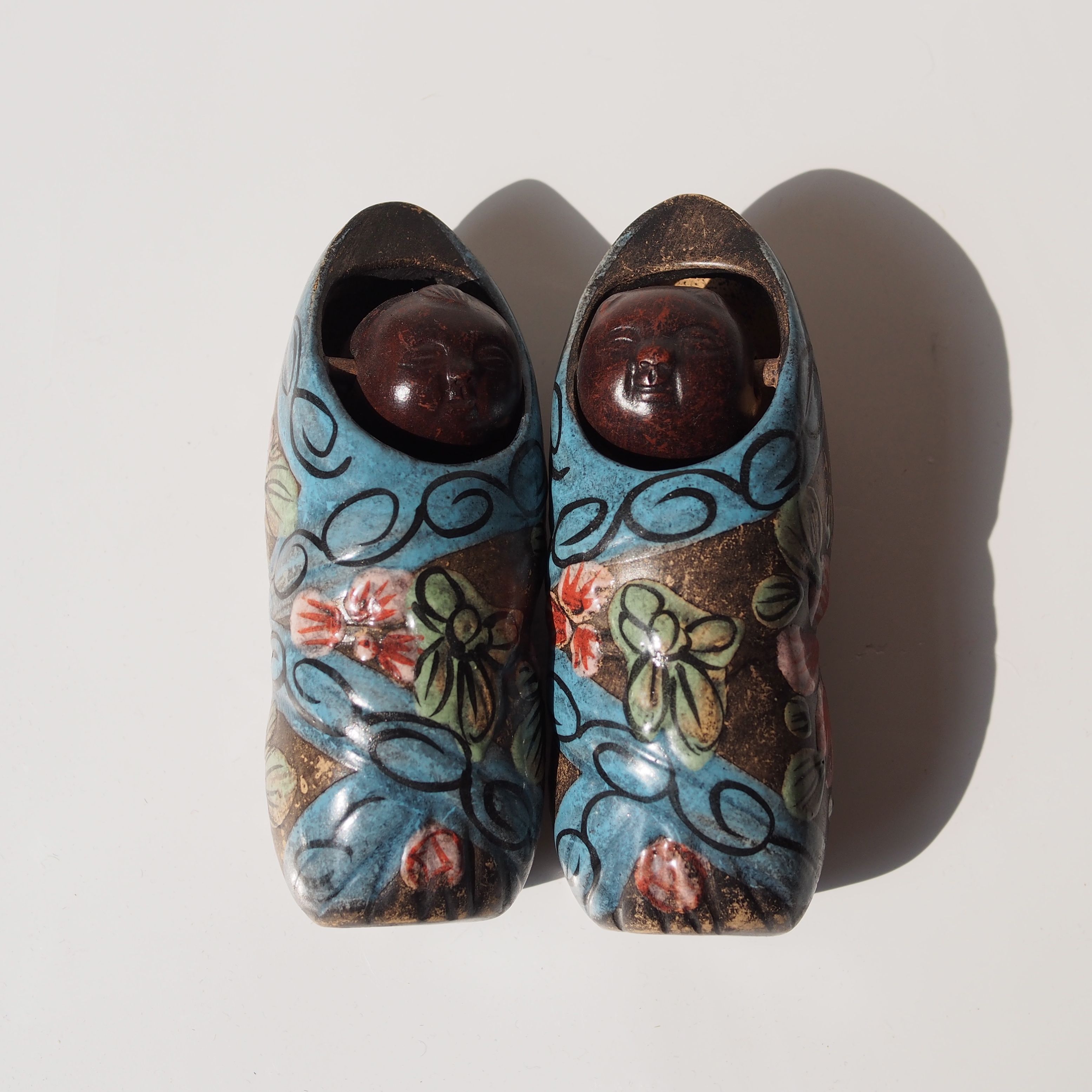
This figurine is by the famous pottery area Shi Wan; their figurines are typical to have a glazeless delicate facial and hand depiction while contrasting with an expressive and bold glazing on the clothing.
The drunken poet, Li Bai, is a popular subject for figurine, paintings, etc., apart from his literary stature, his love for drinking also give a character for the artisan to express.
The poem “Drinking Alone under the Moon” by Li Bai, translation by W. Bynner
From a pot of wine among the flowers
I drank alone. There was no one with me—
Till, raising my cup, I asked the bright moon
To bring me my shadow and make us three.
Alas, the moon was unable to drink
And my shadow tagged me vacantly;
But still for a while I had these friends.
To cheer me through the end of spring . . .
I sang. The moon encouraged me.
I danced. My shadow tumbled after.
As long as I knew, we were boon companions.
And then I was drunk, and we lost one another.
. . . Shall goodwill ever be secure?
I watch the long road of the River of Stars.
A pair of suan ni, with smoke coming out of their mouths!
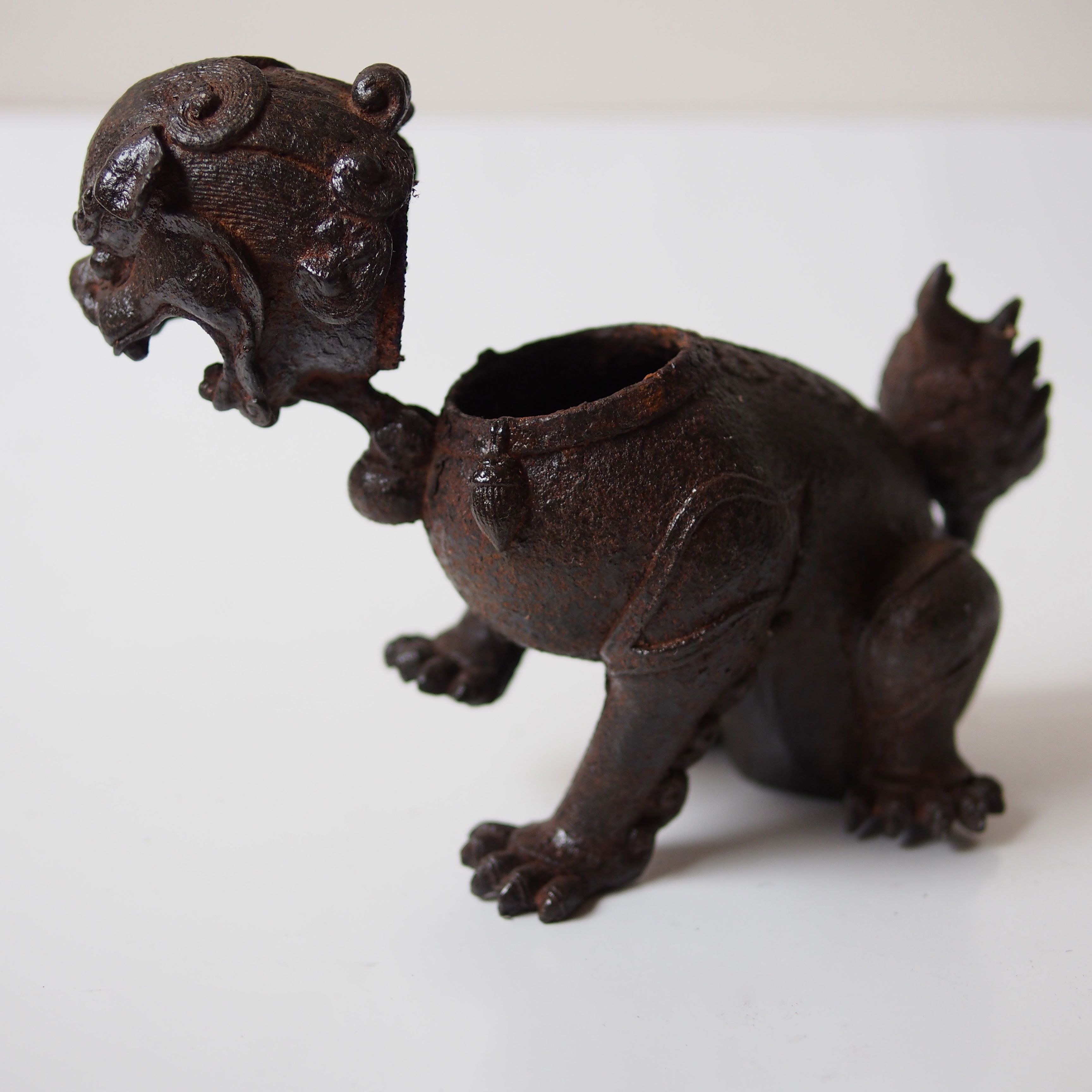
Like the Tao Tie, Suan Ni is one of the sons of the dragon (the 8th son). Unlike the Tao Tie who adores food, the Suan Ni is a patient creature that loves the smoke from the incense. He can be found on the large incense burners and also as a carrier for the Bodhisattva Manjusri.
These Suan Ni are a pair of incense burners, flip open the head, place the incense, light it, flip the head back and enjoy their smokey conversations.
On Chinese New Year (31st Jan 2014) begins the Year of the Horse.
It is quite easy to work out one’s zodiac animal, snake is 2013, goat is 2015 and back to the horse again in 2026. So it is also easy for someone to work out your age too, for the ladies who don’t want to tell everyone your age, when you are prompt with the question what is your Chinese zodiac sign, you can always say that you are a Cat…
According to the legend, the Jade Emperor has a Flying Horse that he adores. The Flying Horse was full of himself, one day he went fooling around at the Dragon palace, he killed the Turtle Saint who came to stopped him. When the news traveled back to the Jade Emperor and the Flying Horse was punished with his wings cut off and press under the Kun Lun mountain. The poor Horse was all alone under the mountain until 200 years later when the human walked passed, the Horse swept and said, “please help me, kind human, in return I will work hard for you.” Out of pity, the human cut down the peach tree that was on top of the mountain and the Horse was released. A bond was developed between the two species, the Horse became a carriage for the human, paired up and went to war. When the selection for the zodiac animals came up, the human voted for the Horse.
For the Year of the Horse, we have a horsey toy made of cotton felt.
Li Bai, the famous Romanticist poet of the Tang dynasty which brought poetry to a new height during his time. In the “300 Tang Poems”, now seen as the canon of poetry, Li Bai had 34 entries. Equally famous was his enjoyment of the Chinese wine. He enjoyed a carefree life in youth, worked briefly for the court he was cast away for being out spoken, in later years he came a Taoist and continue a life of wandering. He wrote over a thousand poems, on the subjects of nature, solitude, friendship and drinking.
Li Bai’s character was portrayed in a Beijing opera “Tai Bai Zeoi Se”
The story begins with the 2 corrupted generals, Yang and Gao who are in charged of the court examination, both were hoping to make some money out of it. Li Bai had been recommended by the court scholar He to enter the exam. Upon seeing the scruffy clothes Li Bai was wearing, sensing there would be no money out of him, the examiners gave him a hard time. Without looking at his paper, he was teased and mocked; feeling unjust Li Bai vowed to give equal humiliation to the two and walked out of the examination hall.
Then one day, the Tang Emperor received a letter from the neighboring country, the letter was written in their own language and nobody in court could read it. Feeling embarrassed by their own failure, the officials wanted to take the blame out on the messenger. The messenger replied, if the Emperor wanted to be friend with their country, he should seek a way to read the letter, then the two countries could become friends, otherwise they would be at war. Among the hundred scholars at court, nobody could read a word of it and Li Bai was recommended by scholar He. “But Li Bai was not an official.”, said Yang, “and he drinks too!”. The Emperor said he himself drinks as well and award Li a grand title so he can help out in the palace. Li finding his new earned power, took his chance to played tricks on the two. Here is what happened.
We have a large bamboo steamer in yesterday’s blog and today a miniture one is featured. This small tea container is a Yi Xing pottery, the famous teaware province. As all Yi Xing teapots are hand built instead of made by on the potter’s wheel, the artisan are extremely crafted with their hands. This miniature has all the details of the real bamboo steamer.
When one think of Yi Xing pottery, the dark brown colour clay (Zi Sha) comes to mind. The brown colour of the Zi Sha comes from the high content of iron. In the same area apart from the Zi Sha are other types of clay and the white clay is one of them.






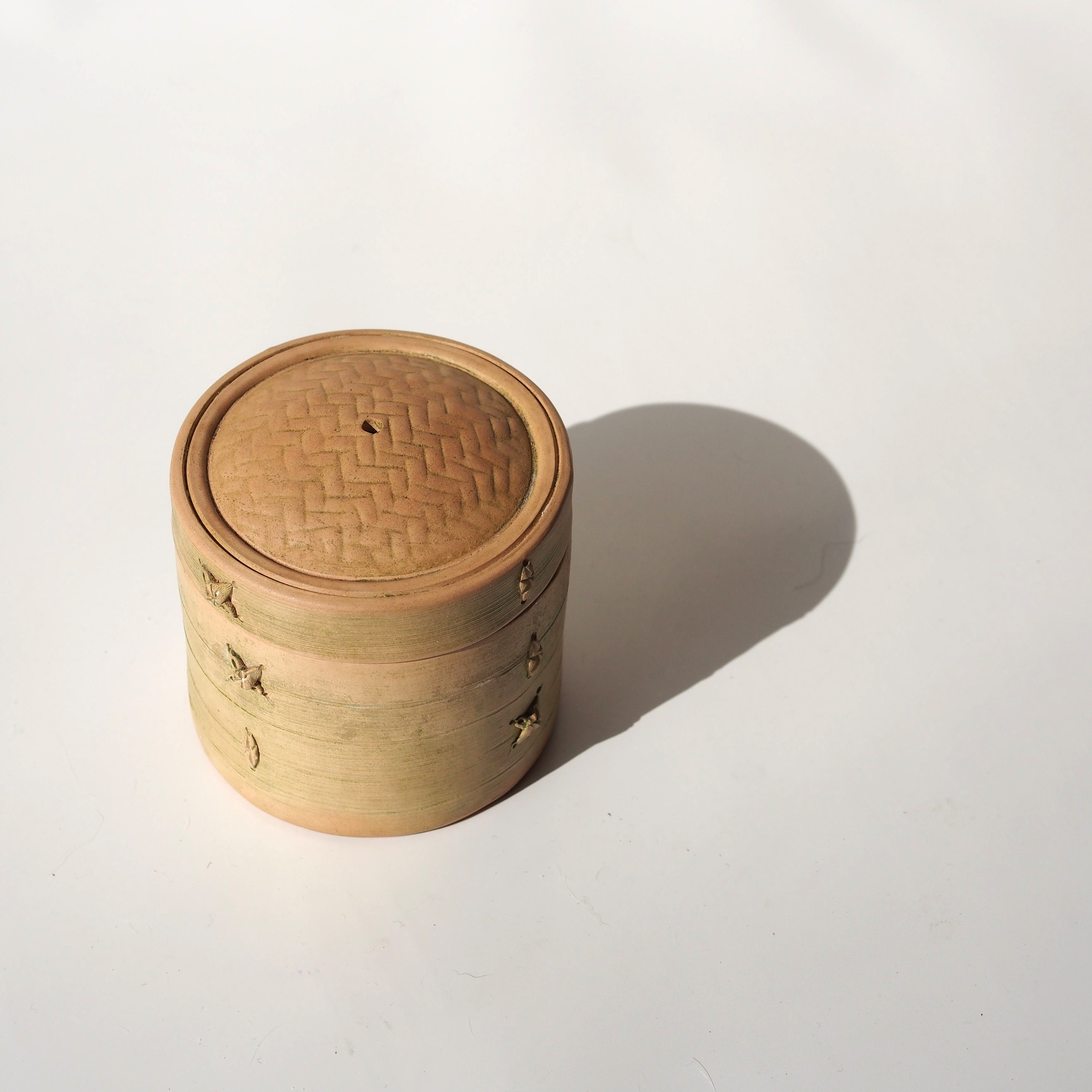
 DIA95xH100mm, China
 Mountain Folkcraft