Archives for posts with tag: chinese

H250xW90xD30mm, China

Tobacco has been introduced to China in the Ming dynasty; imported from the Philippines, Japan and locally from Fu Jian.  Water pipe has been a  popular pass time in the Qing dynasty.  Empress Dowager Ci Xi is a lover of the water pipe and a has a large collection.  This is a peasant’s water pipe, made with bamboo as a material; the bamboo are natural in its smooth finish and in the shape, true to nature without any alteration.  The fancy type will be made of copper-nickel, copper, bronze, pewter with the mouth piece with jade or agate.  The Chinese believed that water is a good filter for the impurity and toxin of the tobacco.  However, the water is not changed often, after a while the water are filled with tar and becomes gluey (and possibly toxic), peasants will apply a few drop to ticks which would let go of their bite, the ticks will drop off instantly.

TOBACCO SERIOUSLY DAMAGES HEALTH
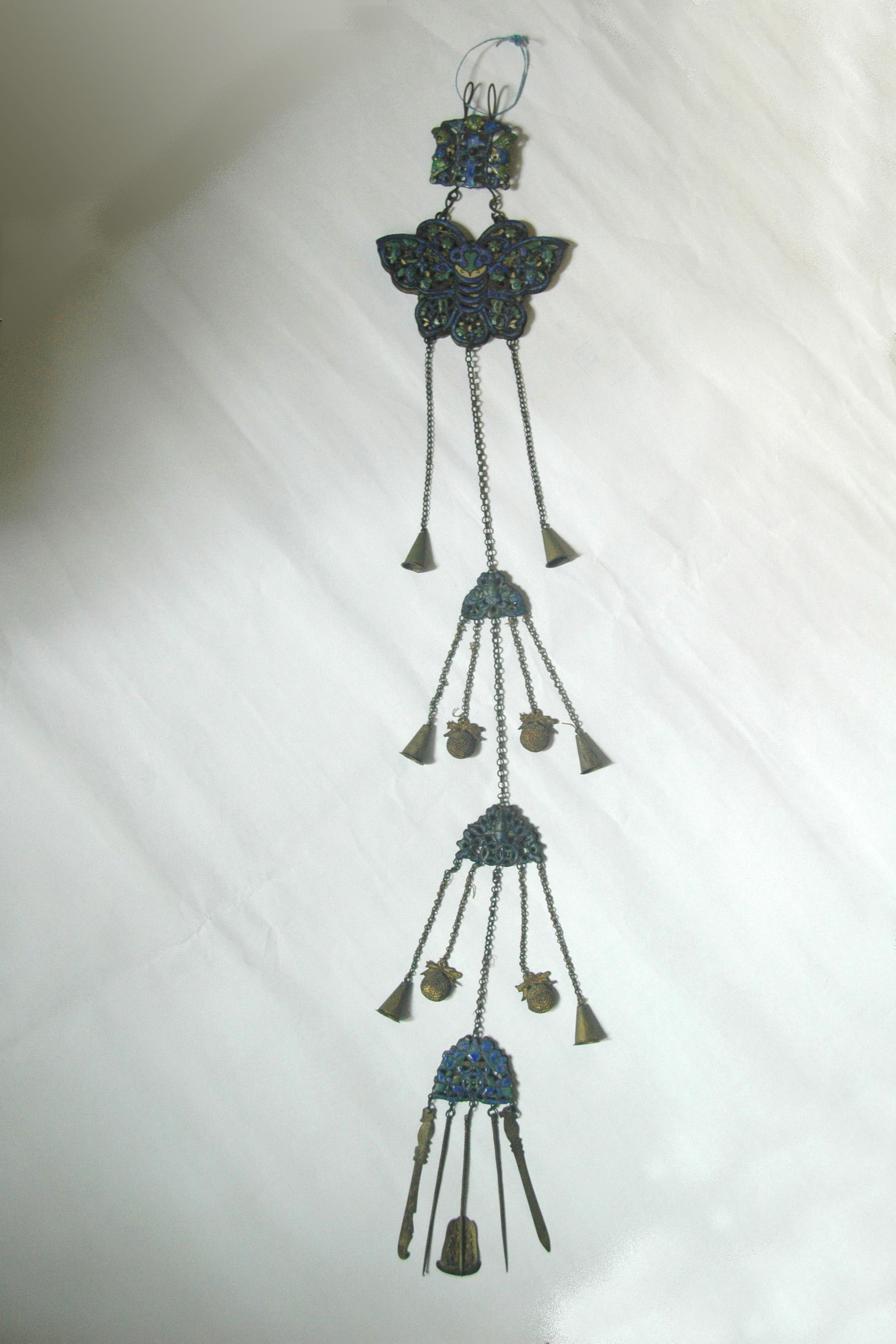
L650xW100mm, China

This is a ladies’ silver waist hanging ornament, highlighted with enamel pendant pieces.  On the top three layers, small bells are hang making a delightful charm as one move around.  At the bottom hung 5 accessories; 2 type of knive, a shove, toothpick and earpick (a traditional Chinese style Swiss army knife).

W600xH600, China

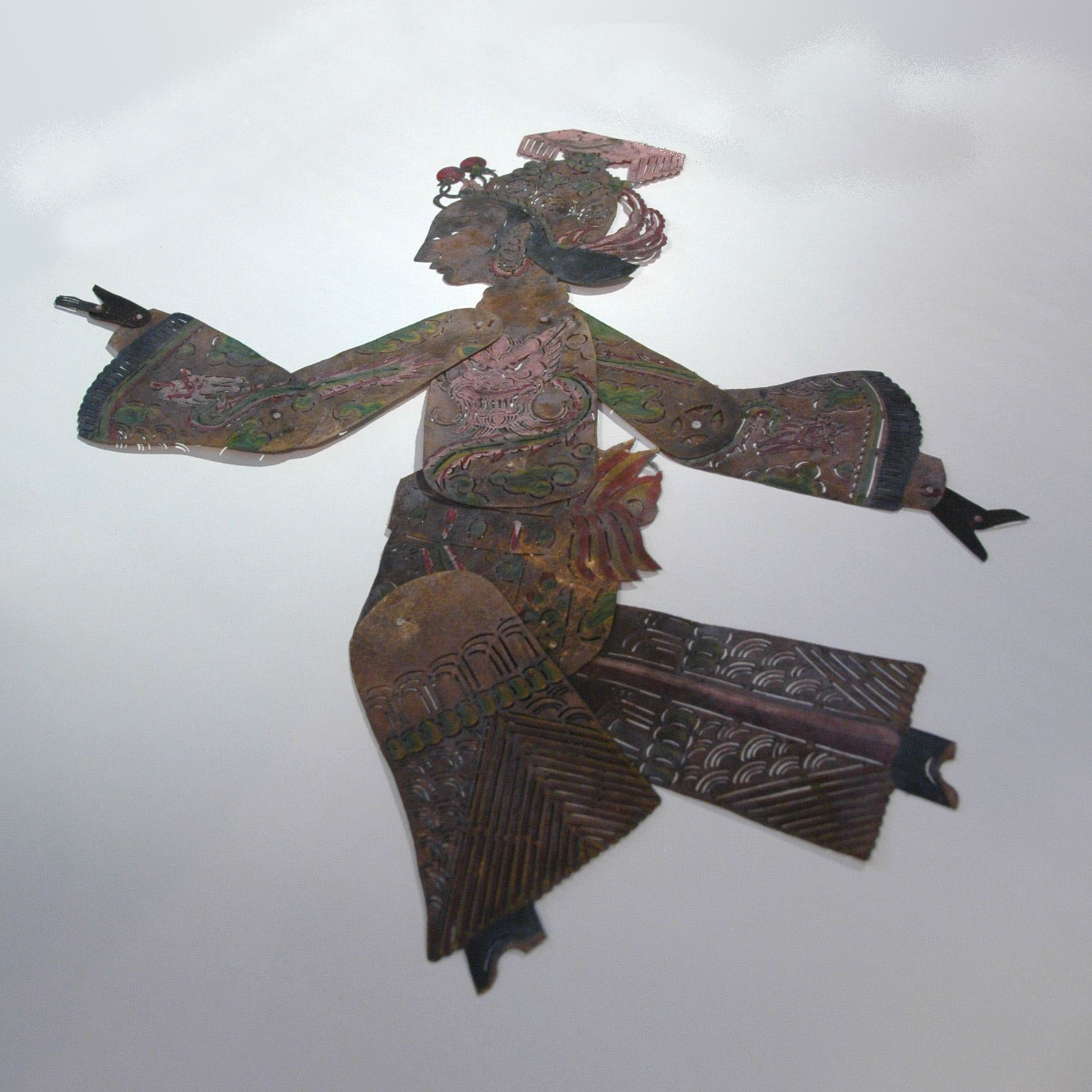
This is a shadow puppet from the province of Luo Shan.  The written history of shadow puppet in China dated back over 1000 years and spread all over the country, slowly each region has their own characteristic, in terms of the puppet, its control and of course the singing (as each area has a different dialect).  450 year ago in Ming dynasty shadow puppet theatre arrived Luo Shan from Luan Zhou.  Unlike the other region that uses donkey skin, Luo Shan’s puppets are with buffalo skin.  Each puppet are controlled by 3 bamboo rods and cast over a white cloth screen of 1.8x1m. The puppet theatre group would consist of 8 people (3 puppeteers), the puppet “cast” are huge (300 odd heads to match with 80 odd bodies), apart from characters there are also sets of  mountain, forest, vehicles, animals, furniture, etc!

W200xH300m, China

This is a mask of the Di Xi (Ground Opera); this form of opera is practice by the farmer villages in Gui Zhou area.  The folks will perform the opera passed on by the previous generation on Chinese New Year for around 20 days.  Unlike the other mask dances in China, apart from deterring away the evil spirit, the Di Xi only consist of fighting or war themes.  This specific themes can be explained by the its history; in early Ming dynasty,  tribal attacks along the border and by Mongols from the previous dynasty  has not be settled.  Military base were formed in the Gui Zhou area, these soldiers were known as the fort men (Tunpu), Di Xi was their opera, a way of introducing military and culture into the rural area.  Ceremony will be performed for the blessing of the mask, before the masks are blessed they are appreciated merely as wood carving objects, however once the blessed with prayers and scattered with the blood of a rooster they became sacred. The Di Xi masks are also worn differently from other Nuo masks; performers would covered their head with black muslin and wear the masks on their forehead.  The mask in the photo is General character, the colourful ornament on his head is in fact a helmet.

W100xD40xH110mm, China

This whiskey flask shaped cage is for keeping crickets.  Chinese have been keeping crickets since the Tang dynasty, however, very few of them as been kept as pet but rather as fighters.  Cricket has a life span of around 100 days, cricket match traditionally take place in autumn, it is said that the word “autumn” 秋 represented 2 crickets.  Cricket fight is banned in Hong Kong, so good to say that those raised here are only as pets for admiration.   This cage has 3 compartments, 2 small ones on the upper deck and 1 at the lower deck.  As each male cricket need to be  isolated to avoid conflicts, 3 can be raised in this single cage.  As in all the Chinese bamboo cage design,  if you look closely at a gate, one of the bars is shorter, this acts as a safety lock so that the gate cannot open accidental.

For a more natural cricket cage, see the entry gourd cricket cage.

W60xH120mm, China

These opera dolls have been a popular toy in Beijing since the Qing dynasty. The head and the base of the doll is made of clay, the structure with the stem of millet covered with a beautifully painted paper.  However, the most important construction of the dolls are the 2mm tall bristle at the bottom of the base.  They will be played on a bronze tea tray.  By tapping lightly on the tray, the figurines would move in a rhythmic fashion just as they would in the beijing opera.  Apart from being a toy, they are also used for performance, “bronze tea tray opera”; the required characters for the opera would be put on the tray, matched with real life opera singing.

H110xW90xDIA70mm, China

Drinking game started in China as a form of a disciplined for the banquets, a discipline to enhance the atmosphere for drinking.  The first recorded game is one of archery, the loser drinks (kind of dangerous if you ask me).

Here is a popular game: Rod Tiger
in the order cycle of  Rod > Tiger > Chicken > Worm > Rod
the 2 players say at the same time starting with Rod-Rod then 1 of the 4 words, e.g. Chicken,  so it will be “Rod-Rod Chicken”, the player of the immediate higher ranking wins, the loser drinks.

 W110xL80xH50mm, China

This box is entirely made out of bamboo, even using the natural cross section of the bamboo to create this pattern.

W80xL250xH140mm, China

We have cowboys in China too and this is a very famous cowboy.  At the end of the Ming dynasty, a time when the capital was under the attack of revolts, the Qing army, the Ming  capital moved south to Nanjing.  The courageous General Zheng  led the Ming navy defended against the Qing at the north, deterred the pilots from the Netherlands and claimed back Taiwan.  Before his return from Taiwan the Qing army took over the ruling of China and Zheng died unsettled in Taiwan.  When Qing took over, the folks were still reminiscent of the previous dynasty, not knowing Zheng’s death was longing for his return to bring back the Ming empire.  At his hometown Fujian, as a discreet statement, the craftman made variation of sculpture with a cowboy on a screaming buffalo; the first Ming emperor Zhu was in fact the famous cowboy.  Now nearly 400 years on, this design has gained his own name.

W220xL300mm, China

This is a wood block print of the Kitchen God (Zao Jun) which traditional would be placed in the kitchen. He has been worshiped by the Chinese since about 1050BC!  The Kitchen God is believed to control the fortune of the household; at the end of the year (form 23 to 30 December of the lunar calender) he will report to the Jade Emperor all the kindness and evil deeds the family has done over that year.  The two assistant gods by his side, one hold a can with the record of the kind deeds and the other the evil record can.  Before the Kitchen God depart for his yearly duty, the families (usually on the 23rd) would make offering to thank him.  The offering are all sweet and gluey food, hoping it would stick to his mouth and sweet things would be said in his report.  Others would add a pair of couplet note to remind him, wine to to make him drunk etc.  hmmm … (also see The Return of the Kitchen God-01/26/2012)