Archives for category: metal

DIA 40mm, China

This is one of the gift for the Chinese baby’s shower (normally on the 100th day of its birth), a silver bracelet with the pendent of Budai and a peanut.  You must be wondering why these 2 items would be selected for a child as an ornament.  Budai, the laughing buddha, is an incarnation of Maitreya, however, this image of Maitreya is only found in China but not in India.  It is believed that the image of the laughing monk with a belly and a bag originated from a monk in the Five Dynasties, an incarnation of Maitreya and known for his joyfulness, forgiveness and kindness, for this he is always depicted to be followed with a group of children.  For a child to be wearing Budai would be giving her the blessing and a hope that his character would rub in a little.  As for the peanut, it is known as the fruit of longevity, bringing health and fertility.  In old rural China when medical and hygiene was poor, this blessing to the child is a wish of parents for some extra help for his well being.

This item selected by Furze for the Something Old Something New exhibition and is available at both Mountain Folkcraft and Soil.

W50xL120xH50mm, China

Its really a surprise to find this tin toy, it is intriguing in a couple of sense.  First, thought China has been a major manufacturer or tin toy since the 1920s, the design of the toy has broadly based on the original western themes (robots, cars, ships, objects which for the Chinese would have been deemed western).  This toy, a lion, has departed from the normal tin toy design.  For those who has seen a lion (photo, on telly, zoo or safari) would have said that this look at best a silly green monster and nothing like a lion at all.  This however has all the features a Chinese lion would have.

Now for the second surprise; there are no lions in China (not naturally there).  The idea of lion come together with Buddhism as an animal of power, the lion is as mythical as the kirin.  Since there are no lions, the Chinese do not see it as a predictor but as a protector against evil.  They can be seen guarding the front doors, on the ridge of a building, lion dances for New Year.  So fond of it that the male lion will normally been given a xiu qiu to play with.

W40xL60x10mm, China

This pendant is made from a piece of broken ceramic, from the shape of the piece it is likely to be of a medium size jar or a vase.  The figure on the piece is part of the a war story, these figures or themes are known as Knife-Horse-People which is a popular theme in the Qing dynasty.  See here for the clay version of Knife-Horse-People.

Though completely different, this ring seems like part of the portrait jewellery collection.

W180xD90xH130mm, China

This neat container has 2 compartments for storing tea leaves.  Pewter has traditionally been material used the tea leaves storage, it is an alloy which oxidized more slowly then metal like iron or bronze and less reactive to the tea leaves which organic.  Tea leaves is known to absorb the smell in the environment, pewter being an odorless also has an advantage over other materials.  Last of all, it is easily shaped to create an air tight container.

CIR 55mm (UK size O), China

I had a similar ring when I was a teenager, it was one of my favorite.  It has a “pure silver” mark in Chinese (but as a human guinea pig I can verify that it is really pure silver as I suffer badly with metal allergy, only pure gold and silver would pass the test, how posh is that!)

Enamel was brought into China from France in the Qing dynasty (17th century) and was immediately adored by Emperor; workshops for the court were set up in Imperial Court in Beijing and in Guangdong.  It then became popular throughout the country during the reign of the next 2 emperors.  The type of enamel produced in China was mainly cloisonne, where a thin wire is applied to form cells to hold the enamel.

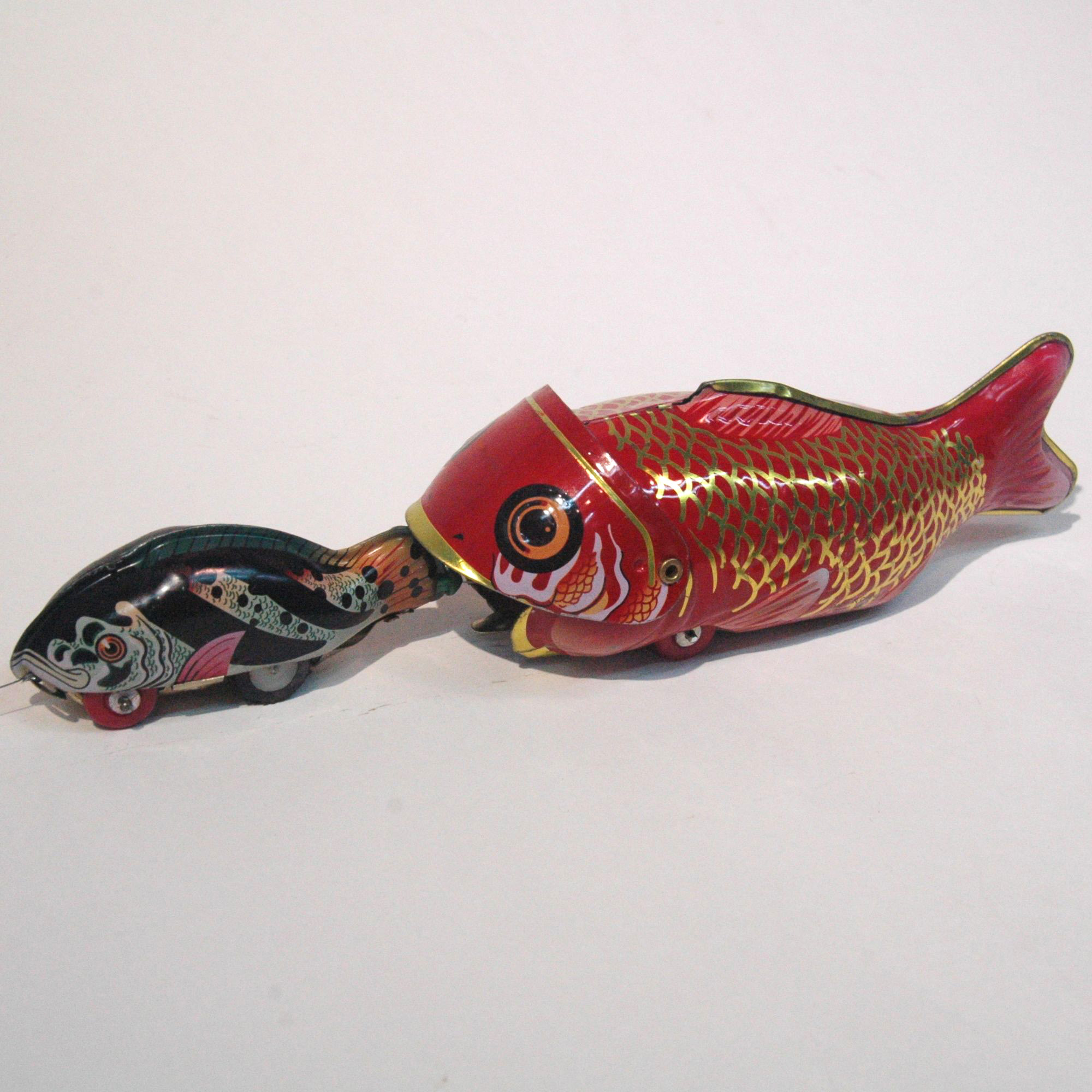
W70xL160xH60mm, China

For something much lighter today is a tin toy of a carp swallowing a smaller fish.  Wind it up and you will see the carp chasing the other fish which finally disappear altogether inside the bigger fish.

Something of a similar theme, see out post fish bag.

DIA100xH40mm, Cambodia

This silver box is part of a betel set.  Betel chewing, a tradition since prehistorical time, was a popular past time all over Asia, enjoyed by men and women alike, in all social levels.  Betel leaf, areca nut, lime paste, camphor, cinnamon, nutmeg, tobacco etc are ingredients for betel chewing; they are stored in separate containers ready for consumption.  These container can be made of ratten, wood, lacquered, copper, silver and even gold.  In Cambodia, for common people silverware are not used as daily utensils, they are prized object used only for entertaining important people or in ceremonies.

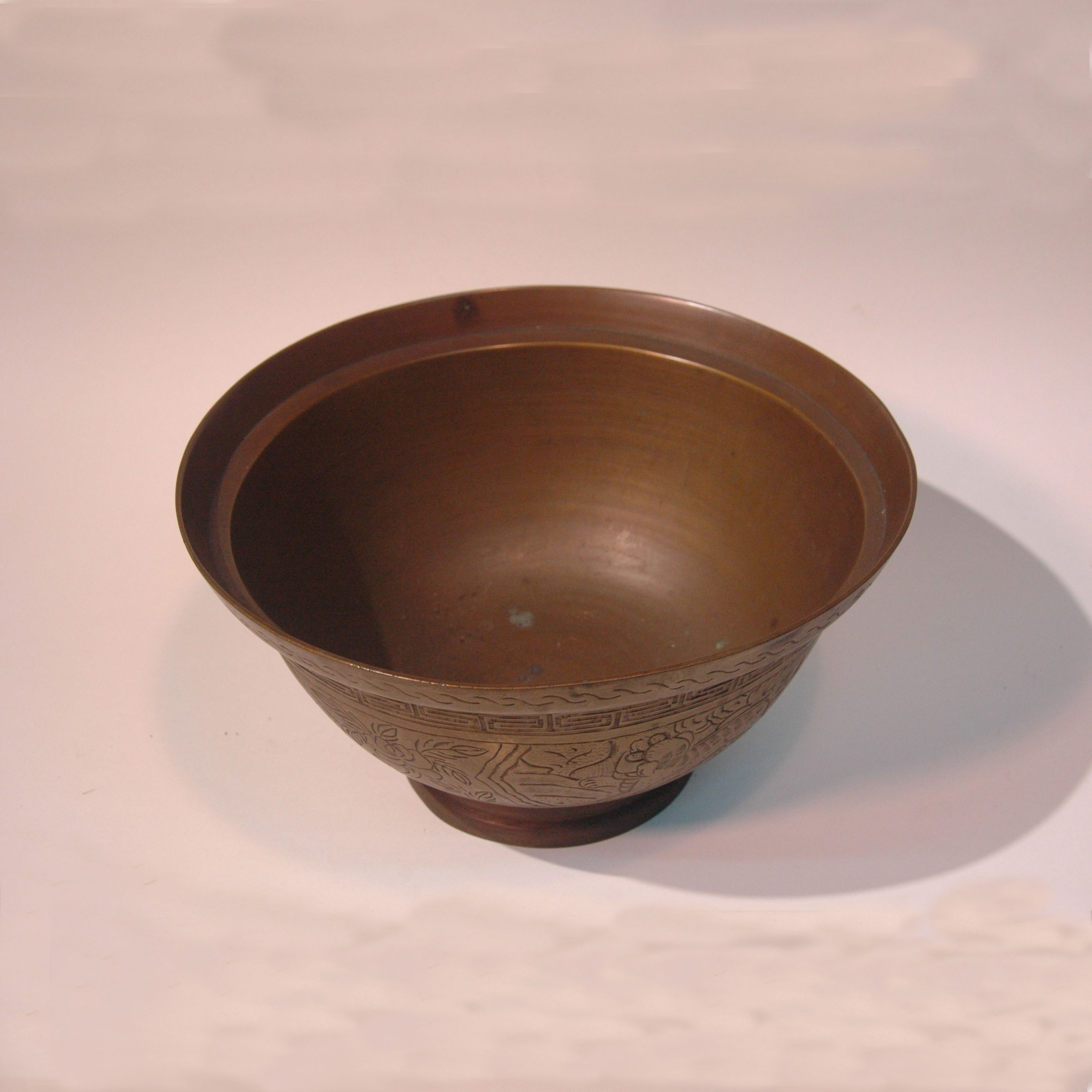
DIA280xH150mm, China

This bronze bowl is engraved with pattern of flowers and the blessed kirin; the art of bronze engraving was first founded in the Spring and Autumn period (722-476BC), it was then used to document important events and notables.  The craft of bronze engraving is most popular in Beijing where all the famous engravers reside,  these craftmen are also known for their calligraphy and seal engravings.

Just found out from goggling about bronze bowl that bronze is suppose to help with curing vitiligo, hmm, wonder if i should bring the bowl back and give it a try.  Will keep you updated on the progress.

 L380xW100xD20mm, China

This was an opium scale, I believed that this is only a bolder name for a scale of measuring items that are small and expensive (precious was the original choice of word but would be a wrong one if this were indeed an opium scale). The scale packed neatly into a custom carved out wooden case with the pivot rod is made out of elephant bone.
For how a Chinese scale works, please see the earlier post Scale which fits in a bamboo case.

DIA270mm, China

This is a set of bronze plate which is believed to be used for food offering to the gods.  The Chinese uses ceramic for dinnerware, it is uncommon to use food using bronze or metal ware (well, now we have cast iron casserole, stainless steel bowls, enamel dishes, etc) .