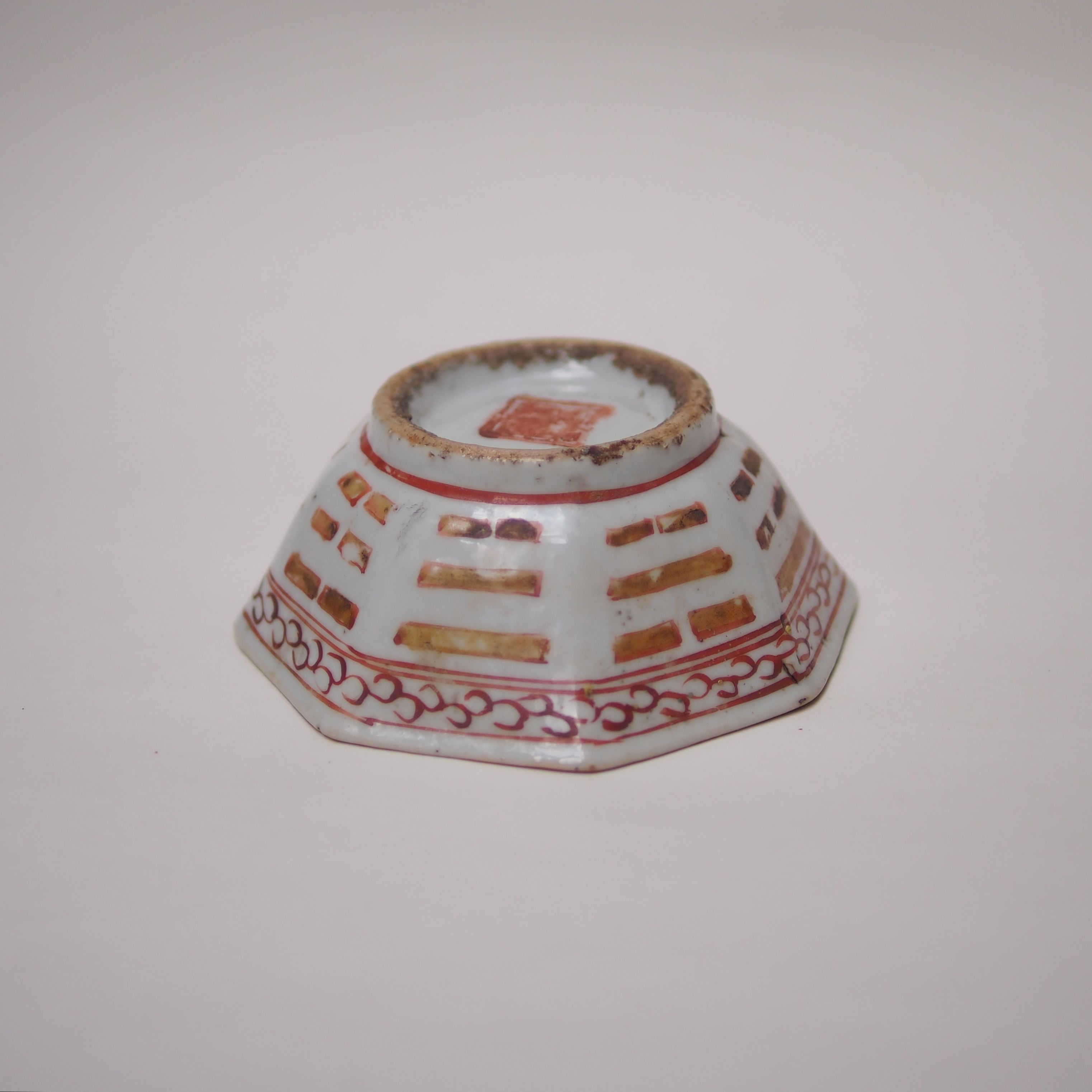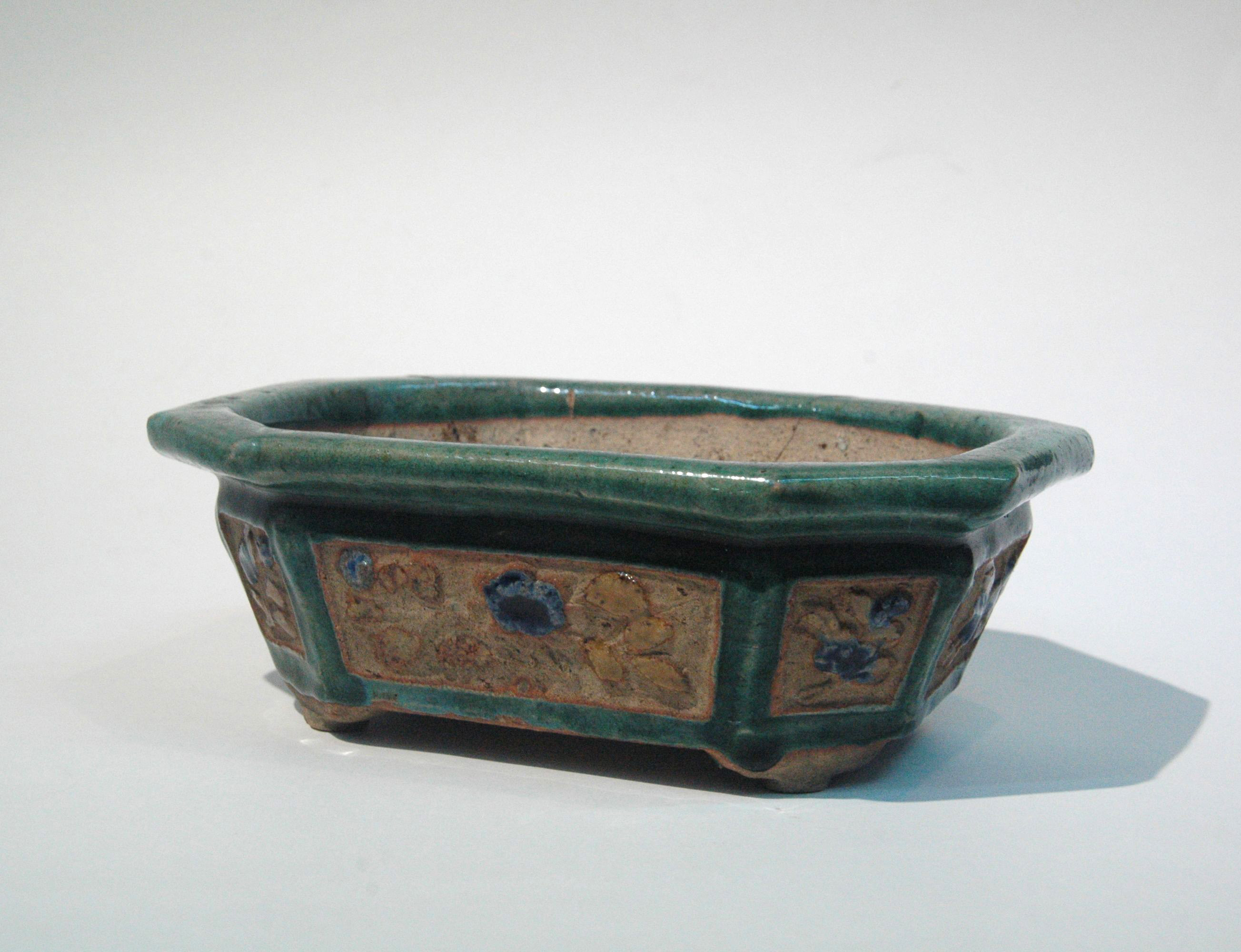
This pottery bowl was used as a container for Taoist offering. The horizontal line pattern on the bowl are trigram figures from the I Ching, on each face of the octagon bowl are the pattern; 乾 Qian, 兑 Dui, 离 Li, 震 Zhen, 巽 Xun, 坎 Kan, 艮 Gen, 坤 Kun. These 8 trigrams correspond to 8 nature phenomenon, namely, Sky, Lake, Fire, Thunder, Wind, Water, Mountain, Earth. From the 8 trigrams found by Fu Hsi, 64 hexagrams was developed capturing more natural phenomenon and human events,it was later used for prediction of events. From the Yuan dynasty, trigrams pattern were introduced to ceramic decoration and flourished in the Ming dynasty.
L320xW230xH75mm, China
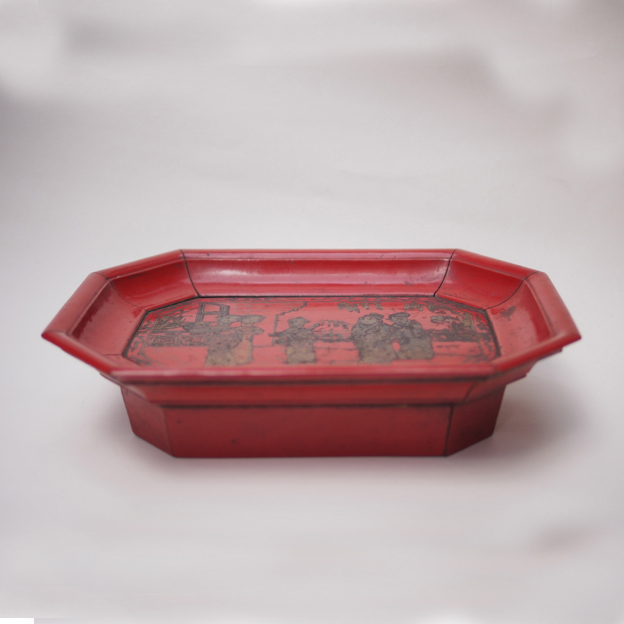
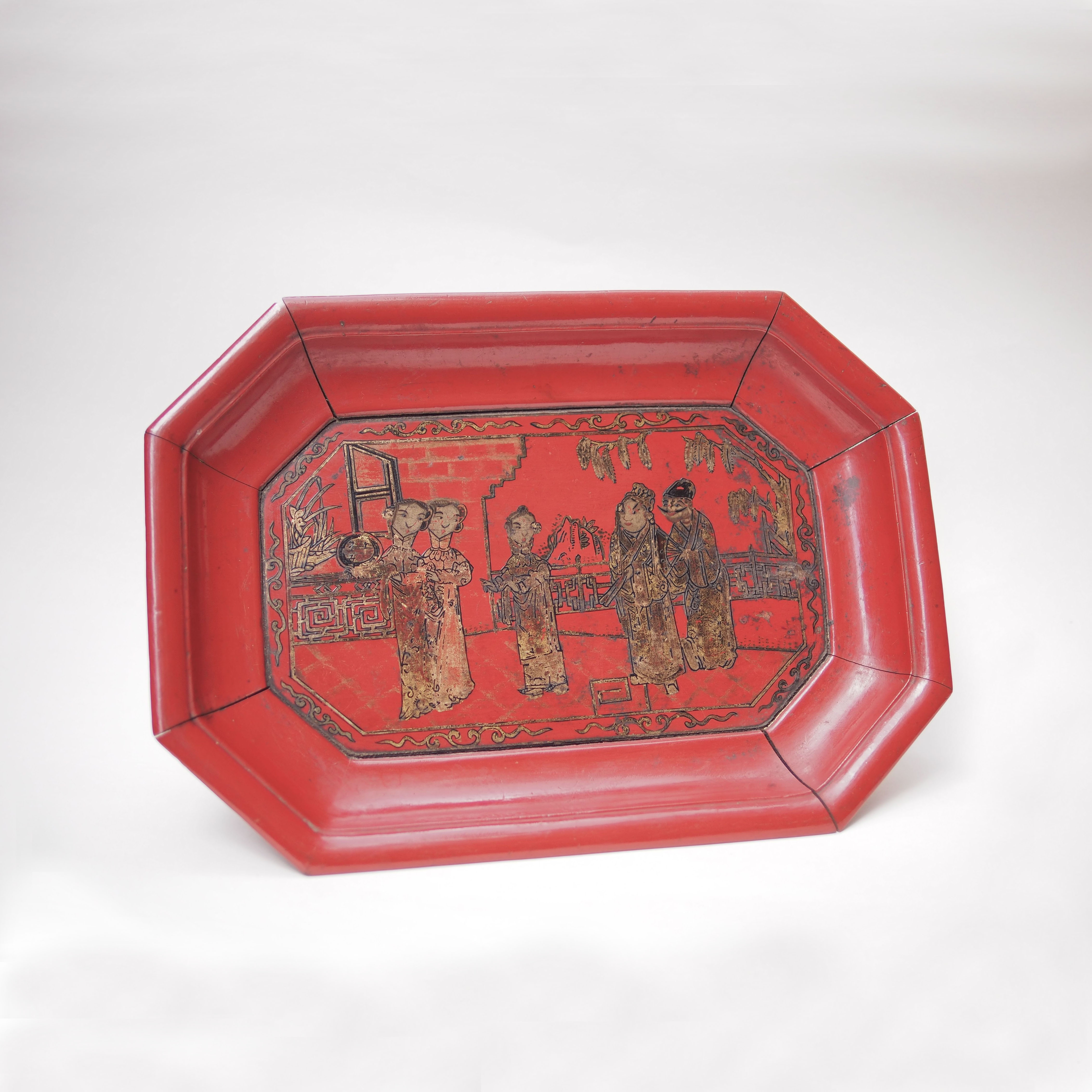
The story depicted on this lacquer tray is from the same book, Jing Shi Tong Yan, as the Madame White Snake legend featured a couple of days earlier. The story about the flamboyant artist scholar Tong Yin; one day on a boating trip he sensed that a maid on another boat was smiling to him. Electrified he ordered the boatman to followed the other boat and found out it belonged to the family of a court scholar. Tong Yin disguised himself and applied for a job as a scholar assistant for the family and named himself Hau An. Being over qualified for the job, he soon got promoted and trusted by the family and meanwhile he managed to find out the maid was called Qiu Xiang who directly serves the lady of the house. The family wanted to promote Hau An as the person in charge but was weary of his single statue and suggested to arrange a marriage for him. When Hau An found out about this, he proposed to pick one of maid as his wife. The family agreed and on the same night, all the maids were there to be chosen but Hau An did not make a decision. It turned out that Qiu Xiang was not there, the lady of the house then sermon her personal maid also to be present. Hau An picked Qiu Xiang, married and lived happily ever after.
This story however, has nothing to do with the history of Tong Yin who got married three times; his first wife passed away at the age of 24, second wife left him and the third wife was a famous prostitute called Chen Jiu Niang.
go to 1 hour 23 minutes to see the same screen
W40xD25xH70mm, China
The blue rabbit on the transparent glass gives this bottle a dream like quality, it reminds me of legendary jade rabbit on the moon.
For the rabbits, this is perhaps their dream place to be, Okunshima, the rabbit paradise where rabbits runs free with no predators. However, back in 1925 this island was a hell hole for the rabbits, they were used to test the poisonous gas that was produced on the island by the Japanese Imperial army. The poisonous gas is now commissioned and a museum has been set up to alter the people of the effect of poisonous gas and war.
See click here to see our other snuff bottles.
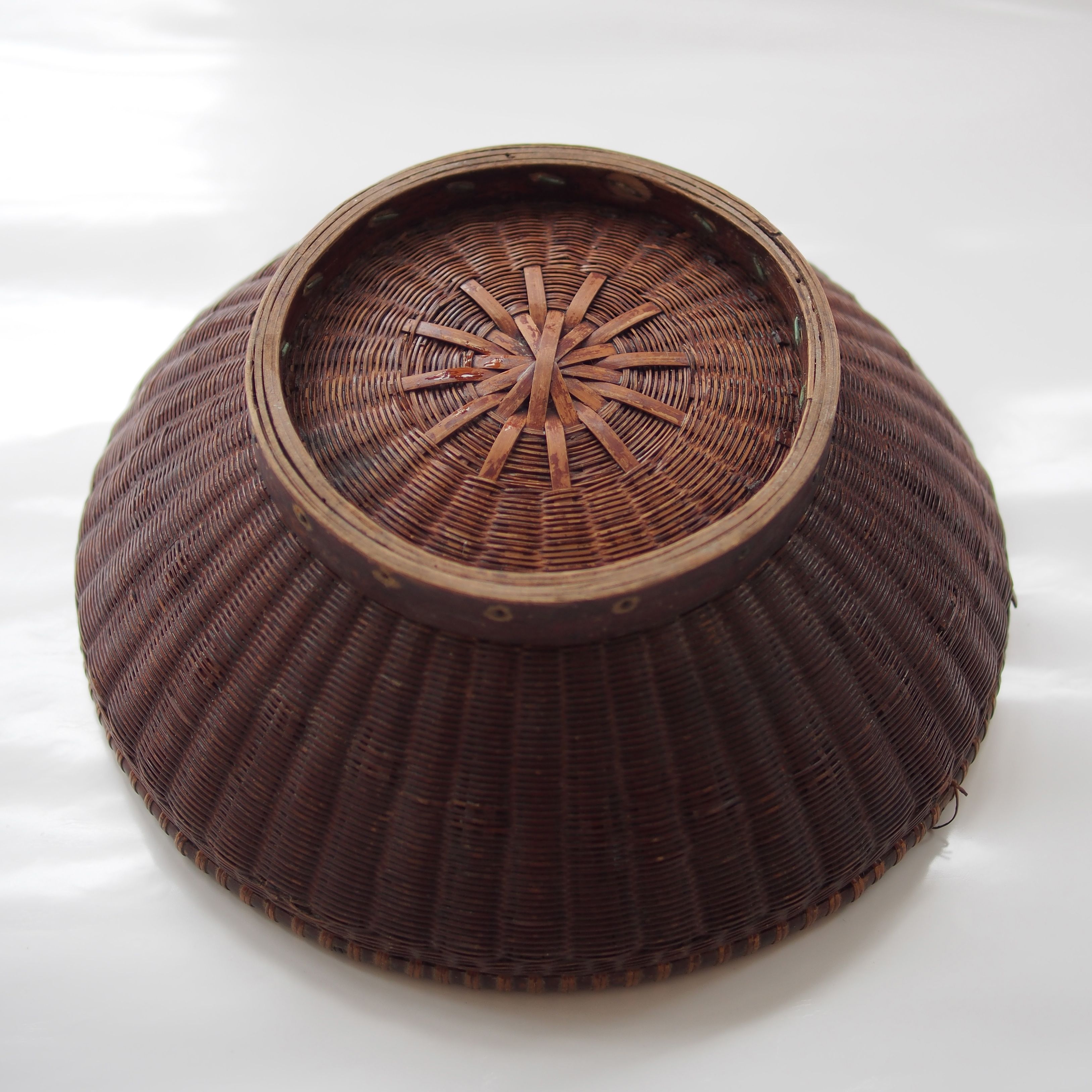
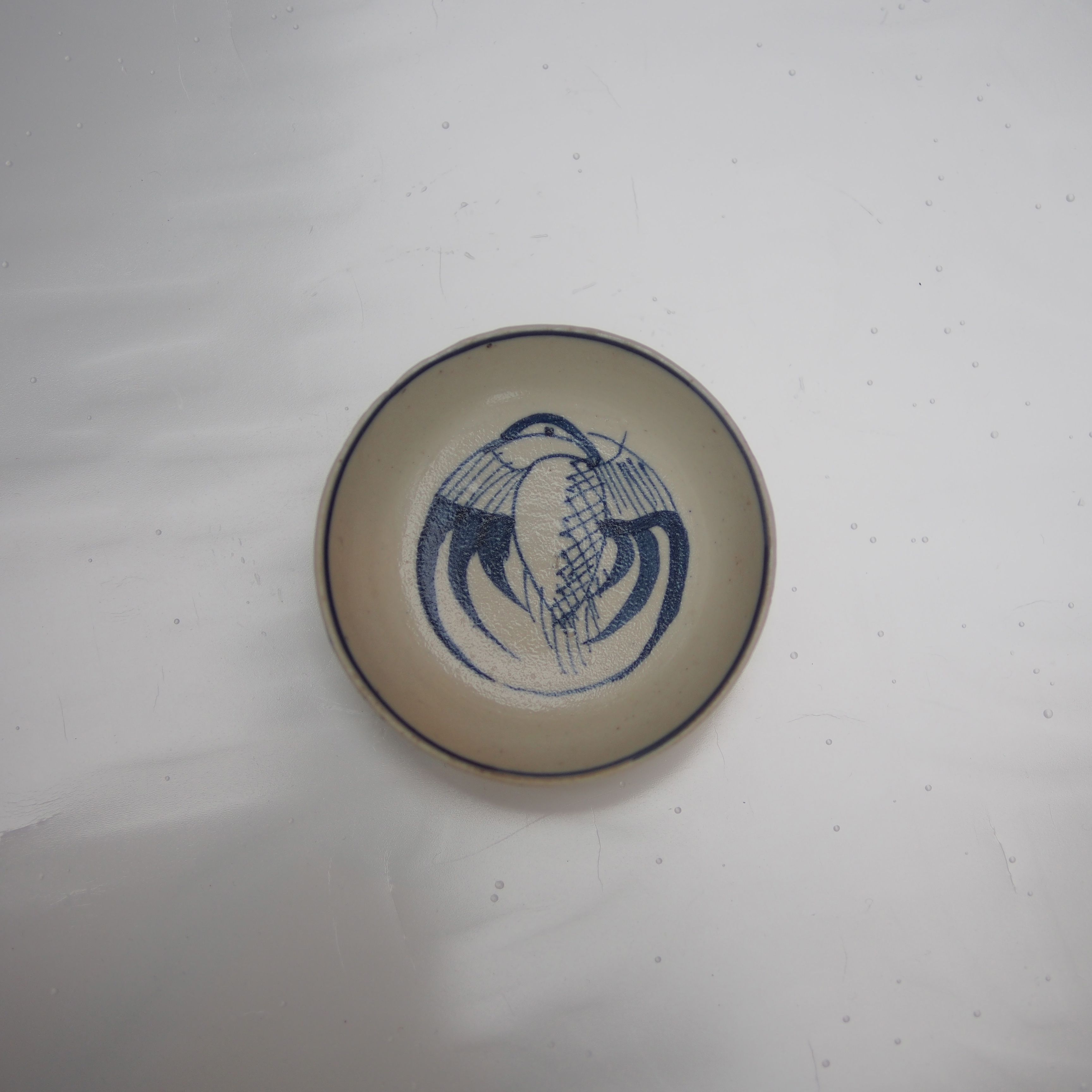
The circular crane is a traditional Chinese pattern which symbolizes longevity and satisfactions; it was originally used as the emblem on military flags in the Warring State period but by the Ming dynasty as Taoism becomes prominent their chosen saint carrier – the crane starts appearing on pottery and garments.
L210xD170xH80mm, China
The daffodil plant was first recorded in the China’s History of Plants (花史) as a gift from Tang emperor to the sister of his beloved imperial concubine Yang Gui Fei. The bowls for the imperial gift was of course made of gold, jade and 7 other jewels. The daffodil bowl we have today is one for the common folks, a ceramic bowl with green glaze from the Shi Wan kiln.
And here is super cute cats with daffodil.
DIA40xH25mm, China
The use of mother of pearl in lacquerware has been dated since the Zhou dynasty 1000 B.C. and matured in the Sung dynasty. The pearl inlay into the black lacquer box creates a dream like magical colour, perhaps some the magic comes from the pain sticking workmanship that goes behind its creation.
W120xL120mm, China
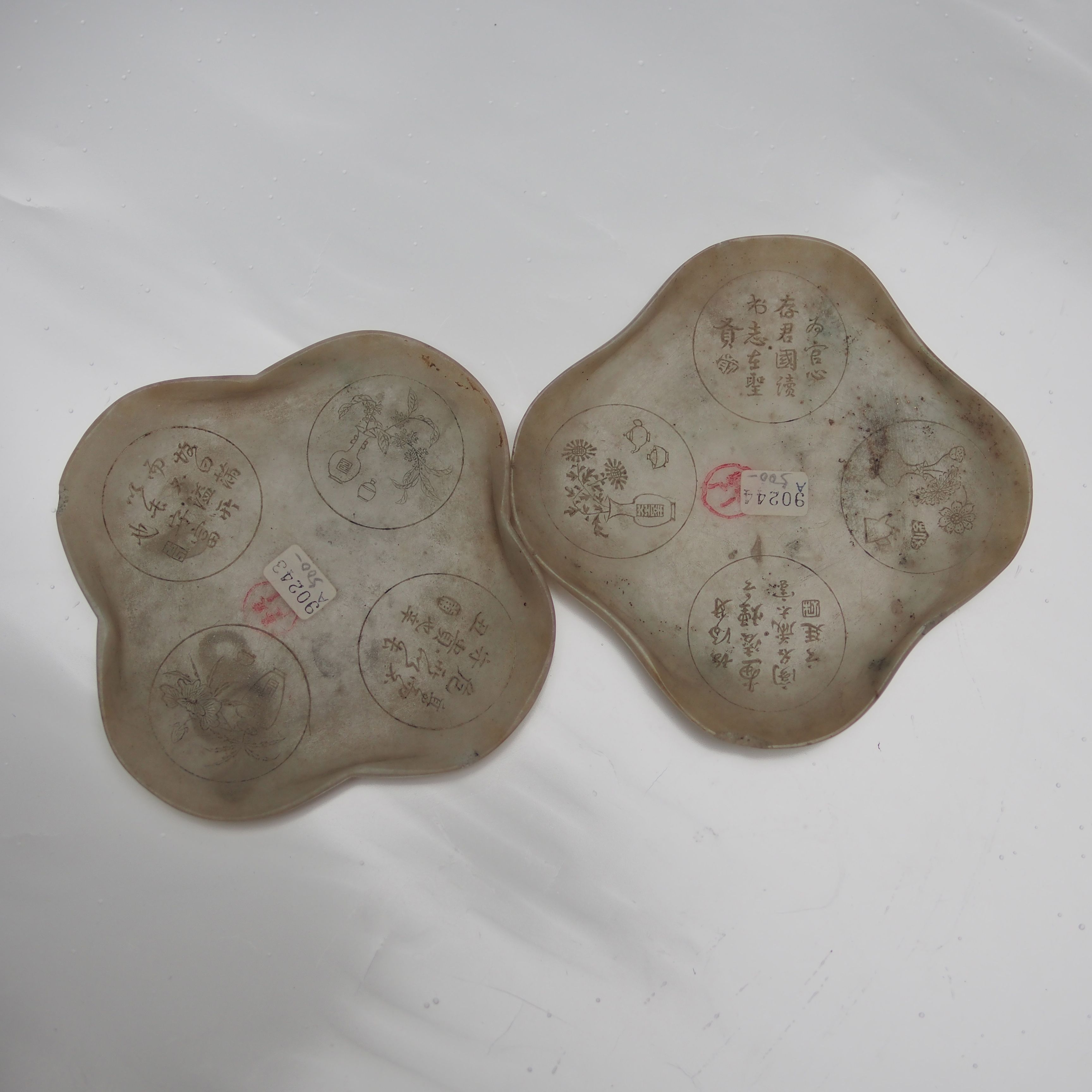
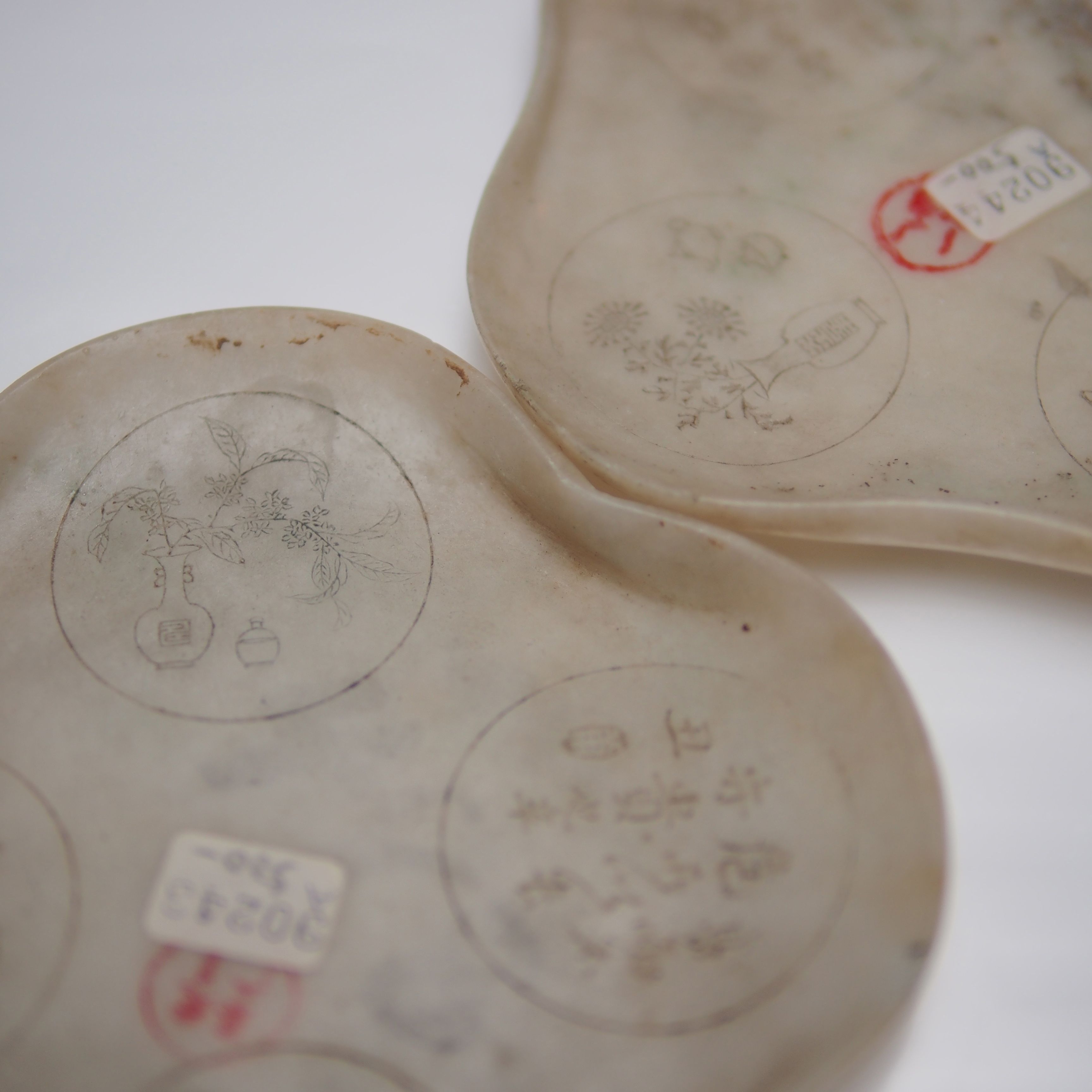
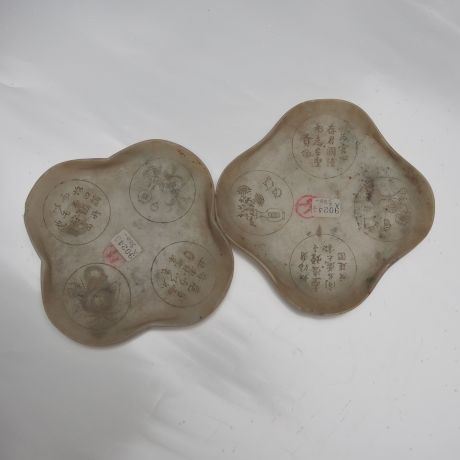
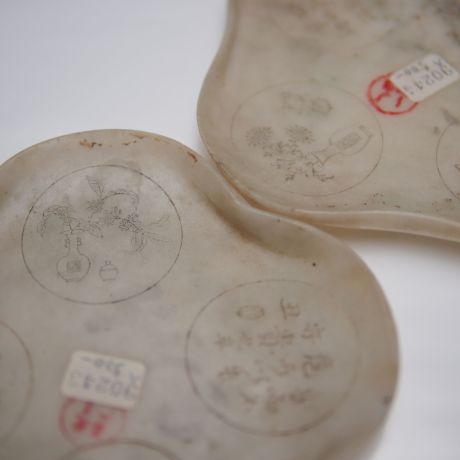
Calcite alabaster is known as commonly as the Han Jade as this type of white marble was used for fine architectural carving since the Han dynasty. This pair of alabaster plates would have been used as part of the utensils for serving tea outdoor. Carving on top of the plates are flowers of the 4 seasons; Narcissus, Lotus, Chrysanthemum, Plum Blossom.
On the other corners are verses taken from the draft letter from the calligrapher Yan Zhen Qing to corrupt general Guo Ying Yi in 764 AD. This draft letter is famous for the caoshu calligraphy and is learnt by younger calligraphers as the “争座位帖” (Zheng Zuo Wei Tie – The Struggle For a Seat). In this letter of criticism towards the general, the calligrapher concentrate more on his wording and thoughts rather than the calligraphy itself, however his emotion was naturally expressed in the strokes.

… 岂不以才为世出,功冠一时。挫思明跋扈之师,抗回纥无(?)之请,故得身凌烟之阁,名藏太室之庭,吁足畏也!然美则美矣,而终之始难。故曰:满而不溢,所以长守富也,高而不危,所以长守贵也,可不儆惧乎?!…
“故得身画凌烟之阁,名藏太室之廷”
Having a portrait at the hall of fame, the name recorded in palace
From the book of “Xiao Jing” (Classic of Filial Piety)
孝经 – “高而不危,所以长守贵也。
满而不溢,所以长守富也”
Dwelling on high but without peril, nobility can be preserved.
Being affluent but not wasteful, wealth can be preserved.
From the book of (Chinese Code of Success, a classic and not one of those self help book)
朱子治家格言 – “讀書志在聖賢,(非徒科第);為官心存君國,(豈計身家)?”
To study with the aspiration to be a man of virtue (and not for official ranking).
An official ought to have the interests of the Emperor and the nation at heart (and not his own pocket).