Archives for posts with tag: pottery

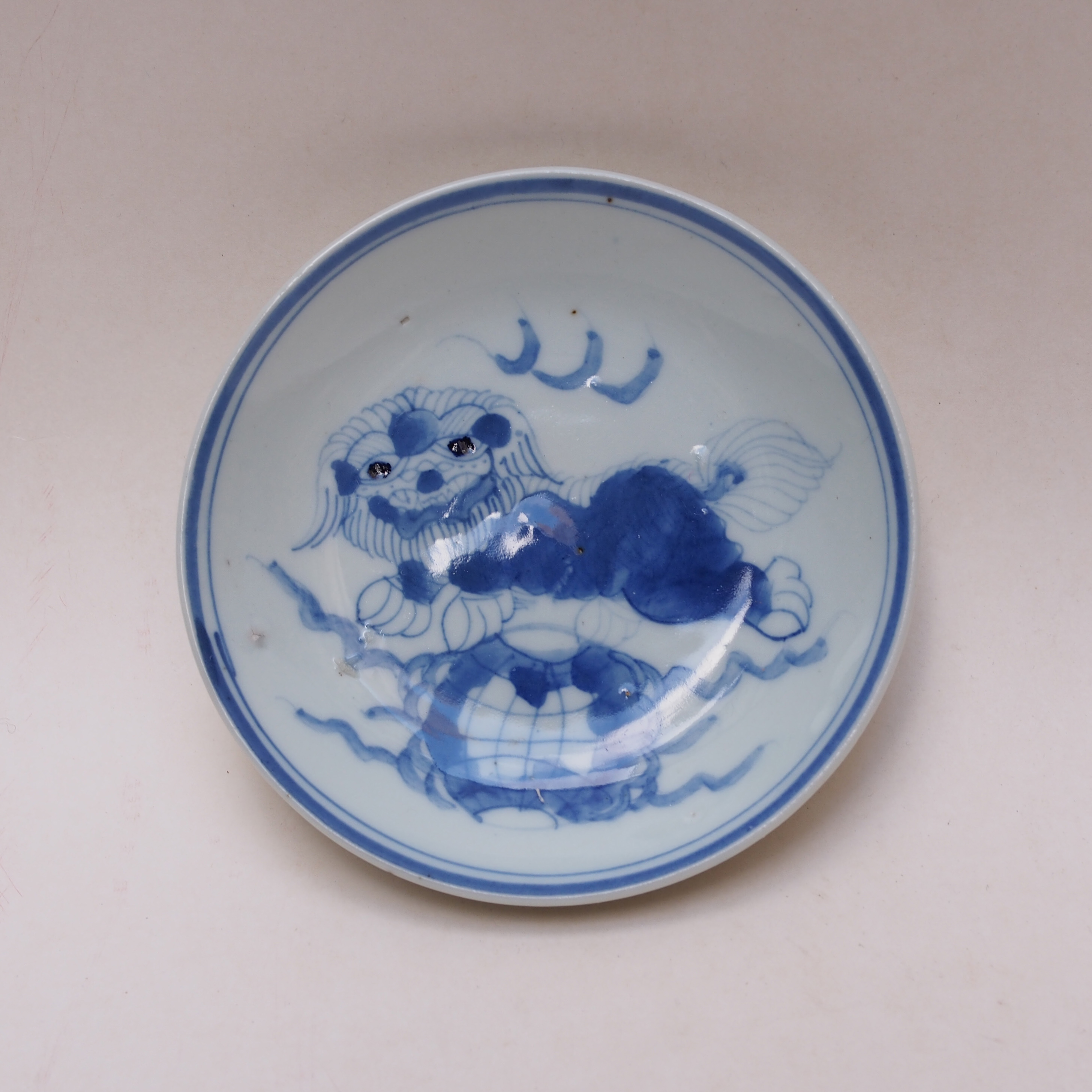
plate

DIA150xH20mm, China

To celebrate the victory of  Germany winning the World Cup, here a plate with the lion playing with a xiu qiu.

The composition of the lion playing with the ball is a traditional blessing pattern.  The lion being nonnative in China was a mystical creature, not only is it the symbol of power and strength, it is also the carrier of the Manjusri Bodhisattva.    Lions sculptures are often found outside buildings as the guard against evils.  Here is the legend of how this supreme creature start getting addicted playing with balls; during the Southern and Northern dynasty, there is a general named Zong Que who was in a losing battle.  Zong thought of a way to breaking out of the surrounding enemy, he had the soldier build a figure of the lion, put on a mask and dressed in yellow fur, from a distance the enemy thought the lion has arrived and flee, enabling Zong’s army to escape from the situation.  The army celebrated  with the local villages and the tradition went on, to humanize the lion more movements were added as well as the xiu qiu ball.  The pattern of the lion and the xiu qiu is a blessing of strength and energy.

Click here to see our other items of the lion and the xiu qiu.

Small CupsDIA40xH20mm, China

After a feast of  Chao Zhou food, trays of Kang Hu Te would be served in tiny cups.  They are equivalent of espresso for  coffee, a strong and flavorful tea best take in small dosage.  They are so tasty and perfect for the digestion that one would often have one too many and end up counting sheep.

Talking about Chao Zhou food, particularly missed the local joint on the building as our shop.  Unpretentious, a 4 meter square kitchen, one chef and one waiter, serving the amazing food for 40 guests cramped into the small rooms.  Sadly, the chef has retired and the drawnwork yarn shop at the same premise was no longer there.  Thinking about it is making my mouth water.

potDIA230xH250mm, China

An old wine jar, one that would have been use at home, with the wine taken out from a ladle.

I particularly like the glazing on this jar, there seems to be a metallic gloss that is similar to the shine of a car’s body and of course the beige brush stroke on the lip of the jar.  Both of these seems to enhance on the texture of the wine.

teapot

W140xD70xH120mm, China

A Yi Xing teapot made in the form of a traditional hessian sack.  When I was a child,  the hessian sack was the equivalent of the popular red white blue nylon bag.  They were used to hold anything from rice grain to jumping sack game.  Most memorable of all, is a sack that was supposedly kept at the roof top.  As a discipline measure, us kids were told that if we were to misbehave, we will be brought to the roof top, put in a sack and lock up in the store room.  None of us were naughty enough to have seen the back but to this day its still a horrible thought.  That’s the power of imagination.

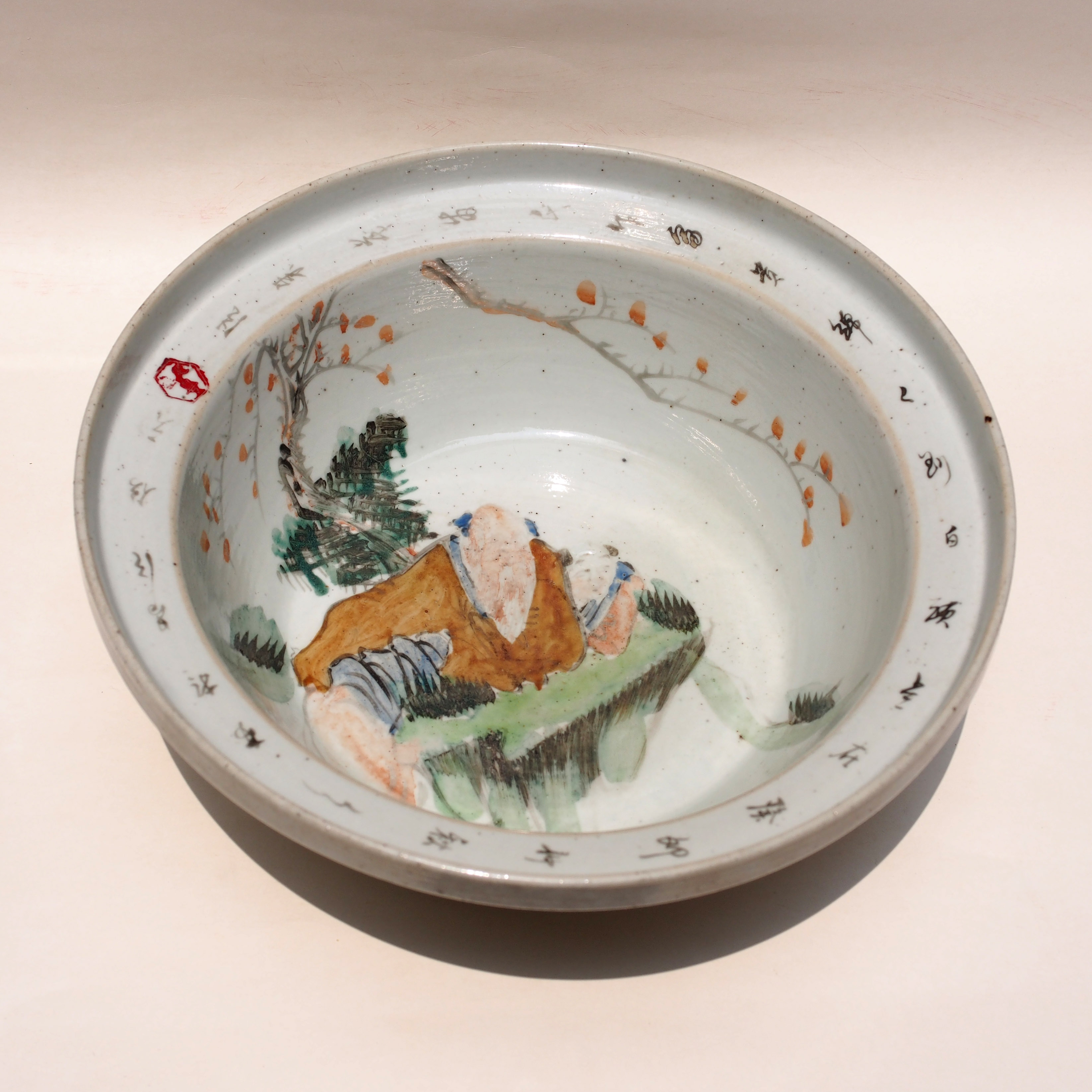
dishDIA200xH100mm, China

A wash bowl from the past.

The painting on the bowl of an old man and a child with a background of plum blossom and pine tree.  The words around the bowl describe a time of meeting and the wishes for the other to be affluent and a long life, seems to be by the same hand.   Could it be a gift from the pottery to his friend or was it a commission work.  It would be quite funny if I were to present a wash basin at someone’s birthday party.

jarDIA200xH230mm, China

When I think of a jar, my association would goes to food.  Cookies.  A glass jar filled with cookies.  Though I have never really bothered putting cookies in a jar … they are usually finished and there is nothing else to store.  Chinese jars are also made to store food stuff; dry goods such as tea, mushroom, charred rice, moist food like pickles, condiments etc.  Jars are a necessary for any kitchen.

figurineL160xD100xH120mm, China

A Shi Wan figurine of a gentlemen admiring a piece of inkstone, on the bench is an armrest for calligraphy.  He is Su Dong Po, a very known scholar of the Sung dynasty, also well known is the recipe for double cooked pork belly.  Amongst the inkstone collectors, Dong Po is a inkstone fanatic and his dispersed collection is well thought after by many today.

A good sword is well treasured by a martial artist, like a mirror to a beauty and an inkstone for a calligrapher.   When Dong Po was a boy, he found a green piece of stone which is perfect for testing ink, realizing its a rare find his father had it made into an inkstone for his son.  Dong Po had it by his side throughout his career and treasured it so much that he inscribed a piece of writing on the back of the stone, the famous “sky stone”.  Knowing of his hobby, the emperor also rewarded him with other good pieces of inkstones.

wine cupDIA60xH50mm, China

A small wine cup with the word “壽” – longevity.

With every sip, every bottoms up, every toast, may we wish you good health and longevity!

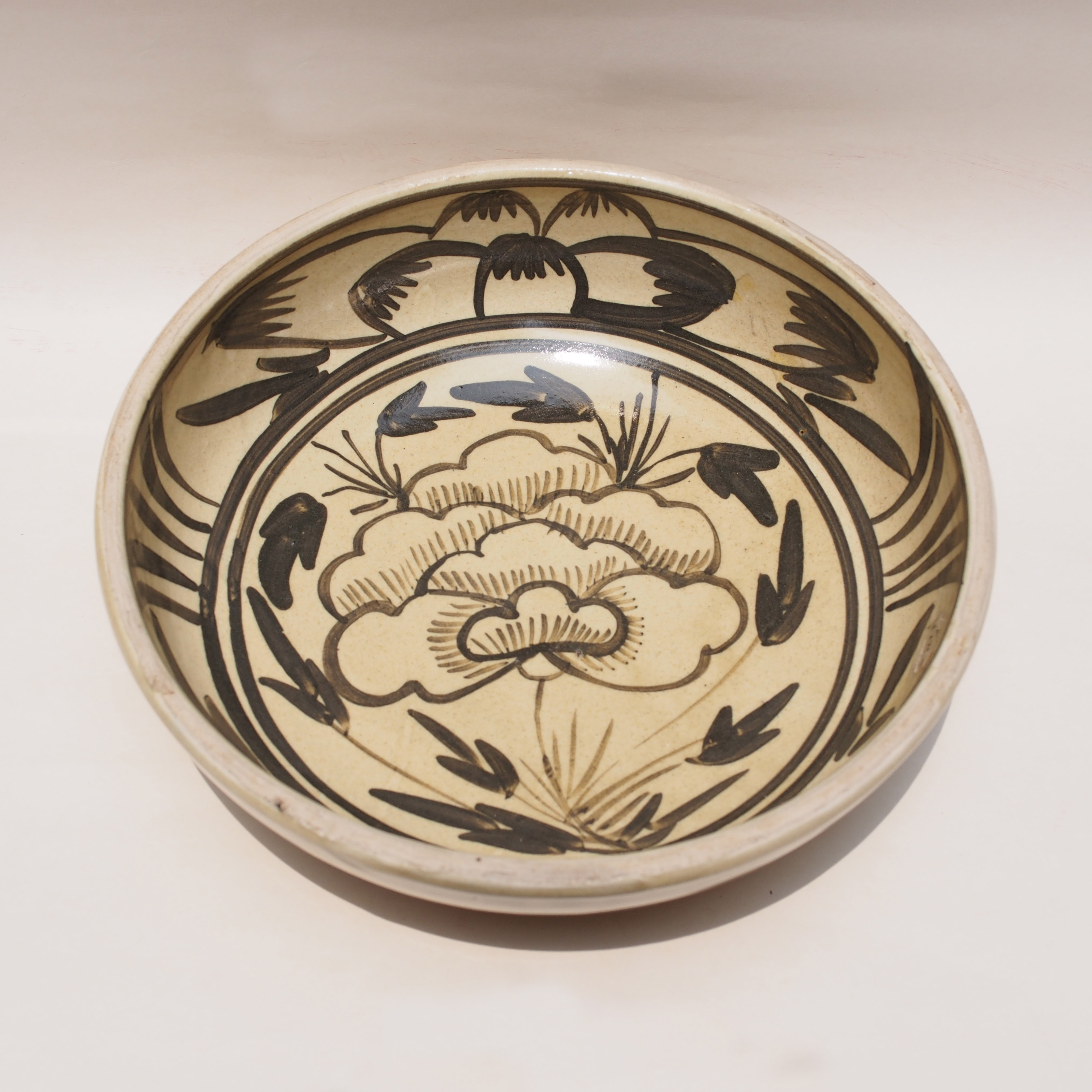
dishDIA275xH90mm, China

We are used to seeing blue and white porcelain, the black and white pottery is equally famous, dated back to the Sung dynasty.  Originated from Ci Zhou, He Bei (north eastern China), at the end of Sung dynasty, to escape from the war in the north, artisan and craftsman moved to the south and brought along the technique with them.  Ci Zhou pottery is not only rooted in Ci Zhou but Ji Zhou in the south.

Unlike blue and white porcelain, the white background of hte Ci Zhou ware is made by coating the pottery with a white slip.  In this particular item, under glaze is then painted after bisque firing and coated with transparent glazing.  In some Ci Zhou ware the idea of the slip is push to the extreme where strokes and carving comes into play.

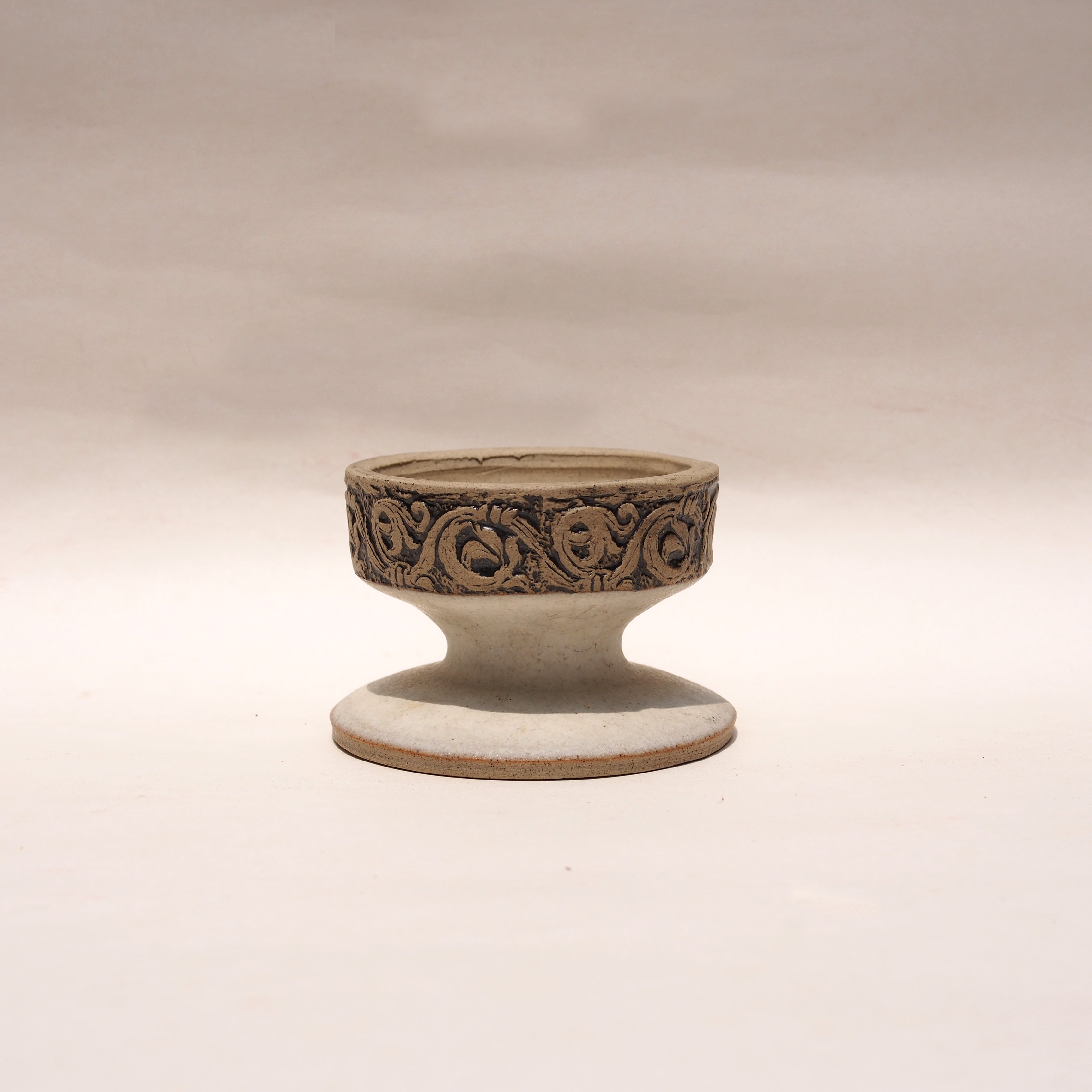
candle wickDIA60xH80mm, United Kingdom

A stoneware candle holder with engraved pattern.

Sorry for the mis-posting earlier, but if you like what you saw, please visit
http://spiketang.wordpress.com/