Archives for posts with tag: figurine

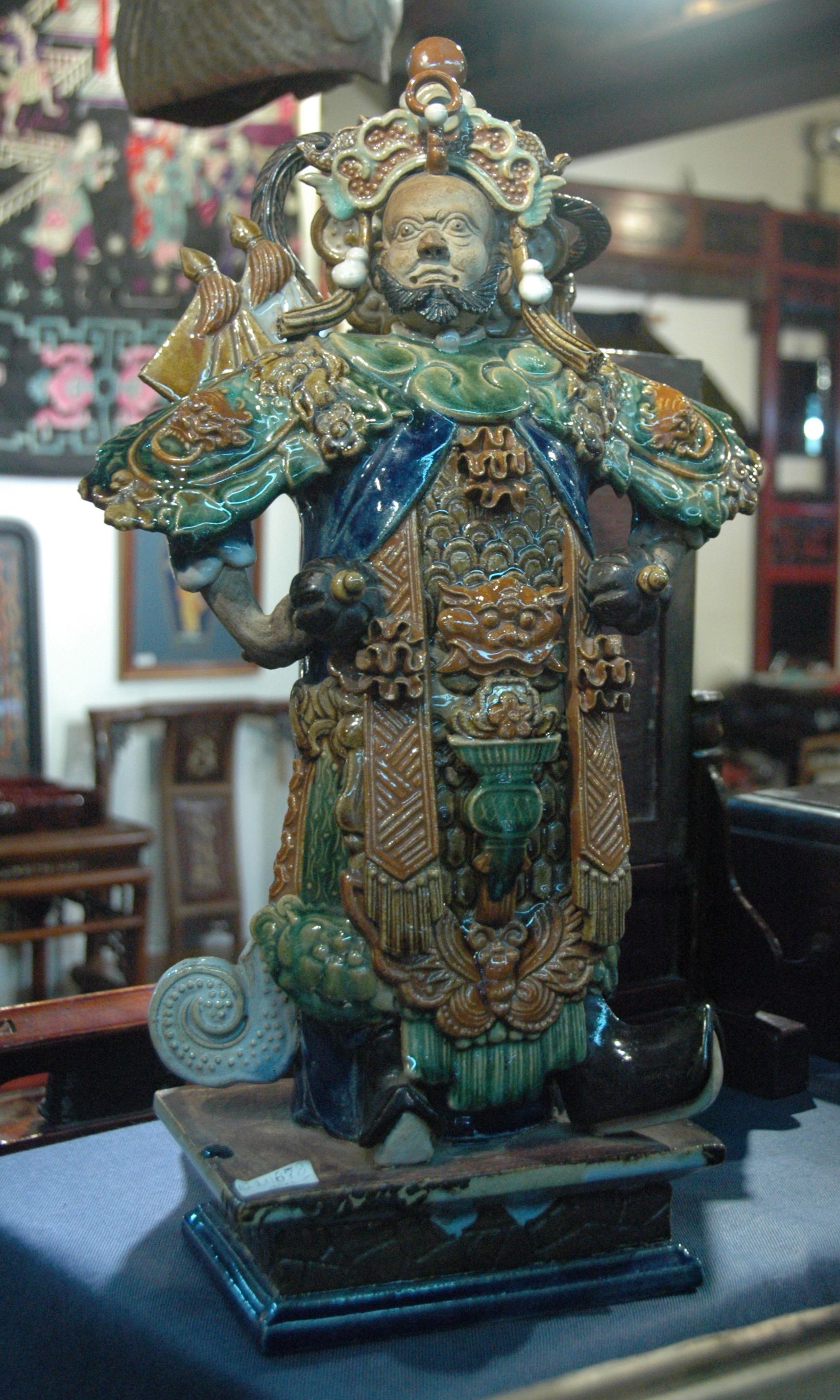
W200xD150xH500mm, China

This figurine was made from the famous Shi Wan pottery town in the Guang Dong region.  Their figurines are typical to have a glazeless delicate facial and hand depiction while contrasting with an expressive and bold glazing on the clothing.  Another example can be seen in an earlier post, “Shi Wan Figurines“.

The general depicted here is one of the “3 good blokes” of the Tang dynasty, Pei Yuan Qing, his weapon is a pair of golden melon hammer.

You will be seen in this clip how the weapon  is being used (well at least in the Beijing opera).  This is a graduation show from the students of the Beijing opera school.

My dog spike has started sighing, ok ok, I promise no more Chinese opera reference for a while.

H100xW50xD60mm, China

Wonder what a villain looks like?  This is a typical villain of the Chinese glove puppet, all villains have a white painted face with black features.  A word of caution: the white face villains came in all different ages, from a young chap to the bad government official and finally the elderly villain.  The shown in the photo here is one of the main villain in a puppet show, someone who has high power and no fear, for example, a prime minister who gave manipulate the emperor  etc.

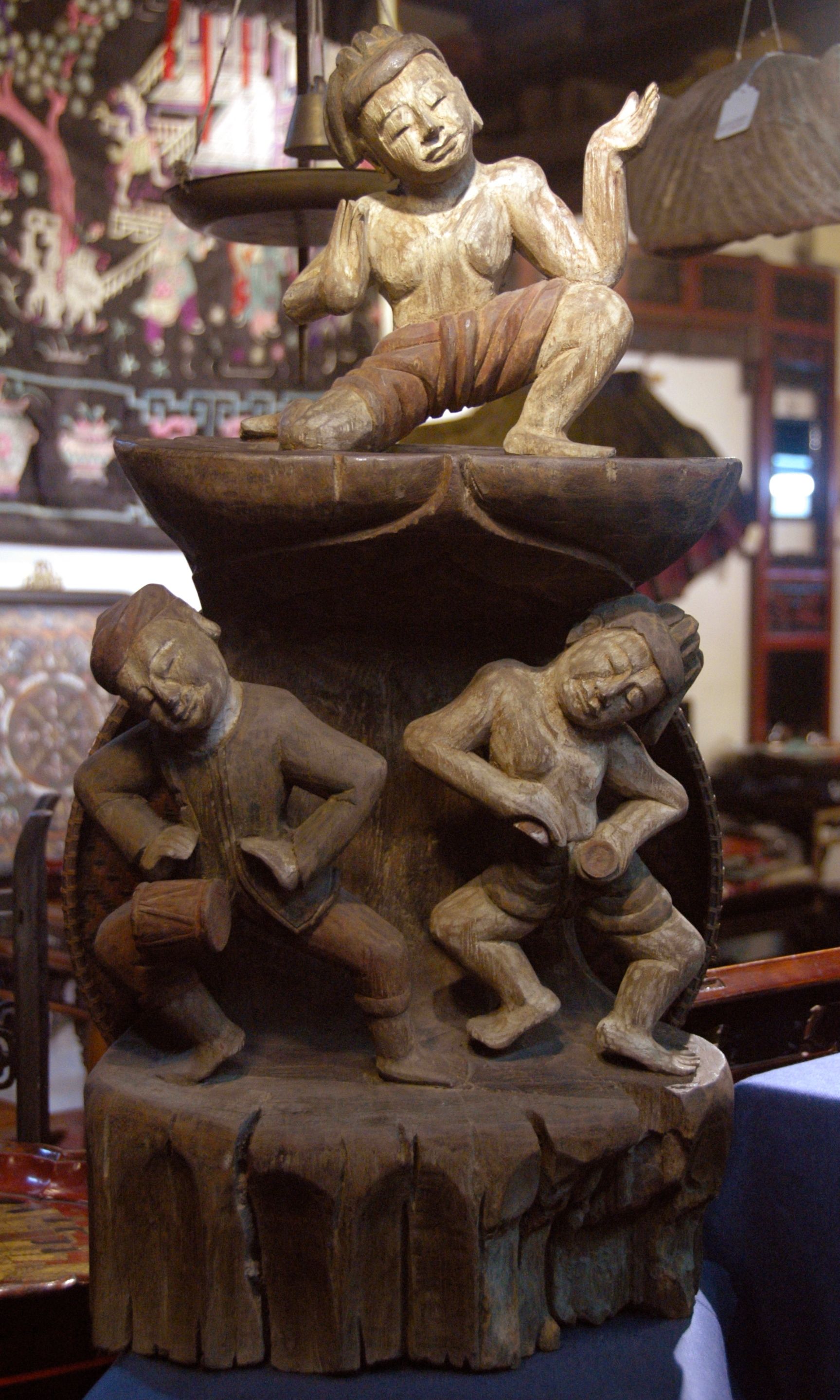
W350xD150xH700mm, Indonesia

This wooden figurine depicted the some of the instrument used in a Balinese gamelan.  Gamelan is the traditional Indonesian musical ensemble which is accompanied by dances, puppet performances or rituals, a dancer is also represented on this carving.

The player on the right is playing a castanet.  The drum played by the figurine on the left is known as a kendang, a two sided drum, which is made from hollowing out from the trunk of a tree.  The kendang player is the leader of the gamelan, giving clues to the other players.  Here is how it sound like solo;

D60xW120xH150mm, China

To continue with the chicken theme, we have a flower vase from the Ci Zhou kiln.  Ci Zhou kiln is the largest folk kiln in northern Chinese which dated back to the Song dynasty; it is famous for its black on white pottery (no, I did not set the camera to nostalgic tone) which was a break through in glazing tradition at the time, some believed that it set the foundation for the now well known blue and white porcelain ware.  White slip is applied to the semi dried clay work, a iron based black slip that contained iron is painted over to add detail to the vase, a clear glaze is applied after the first firing.

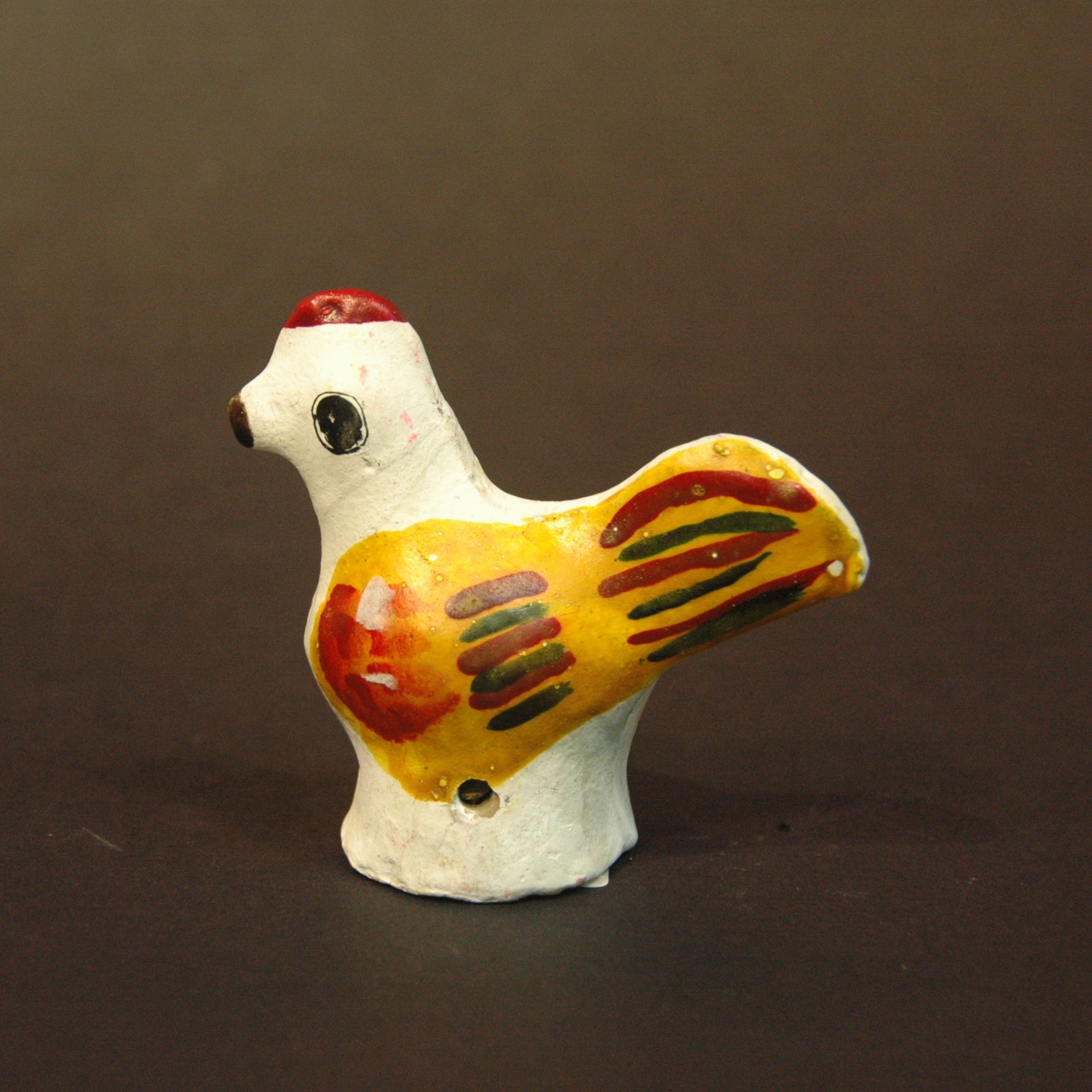
L50xW20xH50mm, China

The Chinese name for this cute little chicken is “the loud crowing rooster” which was originated from the “rooster crowing pillow”.  The rooster shaped pillow was believe to offer blessing to the child; better sleep and a wiser child.  The Chinese believed that the rooster is responsible for pulling the sun out of the darkness, a god that extinguish the ghosts (rooster being associated with the sun and light while the ghosts with darkness).  Nowadays, the symbolic meaning of the rooster is faded, this is seen as rooster toy more than a protector symbol.

W80xL250xH400mm, Thailand

The most famous rooster in Thailand is perhaps the one which belonged to King Naresuan.  King Naresuan was the King of Ayutthaya between 1555 – 1605, he was most famous for freeing the Siam of Ayutthaya from Burmese rule and subsequently the expansion of his empire.  Now how does the roost come into the picture?  It is believed in popular legend that the young Prince Naresuan wagered a bet with the Burmese Prince of Ayutthaya that if Naresuan’s rooster would won the cock fight, Ayutthaya would be freed from Burmese rule and of course the rooster being as couragous as his master won fiercelessly.  Ceramic rooster statues can be seen as offering to King Naresuan in a few temples in Ayutthaya.

L160xW50xH160mm, China

This clay toy is of the god of  longevity who began his legend as Canopus, the brightest star  in the southern constellation of Carina and Argo Navis.  In the Qin dynasty, temples were erected for the worship of  the Canopus star, it is believed that when the star shines brightly the world would be peaceful and vice versa.  Canopus is also known as the “elderly star”, apart from peace, it also upheld the ethic of the respect for the elders.  In the East Han dynasty, the ceremony for Canopus worship consist of a stately banquet that included all the over 70, nobleman and commoners.

Besides the astronomy aspect, the god of longevity also has a human figure, Peng Zu.  Legend has it that Peng Zu has mastered the art of longevity and lived to an age of  767 years old!

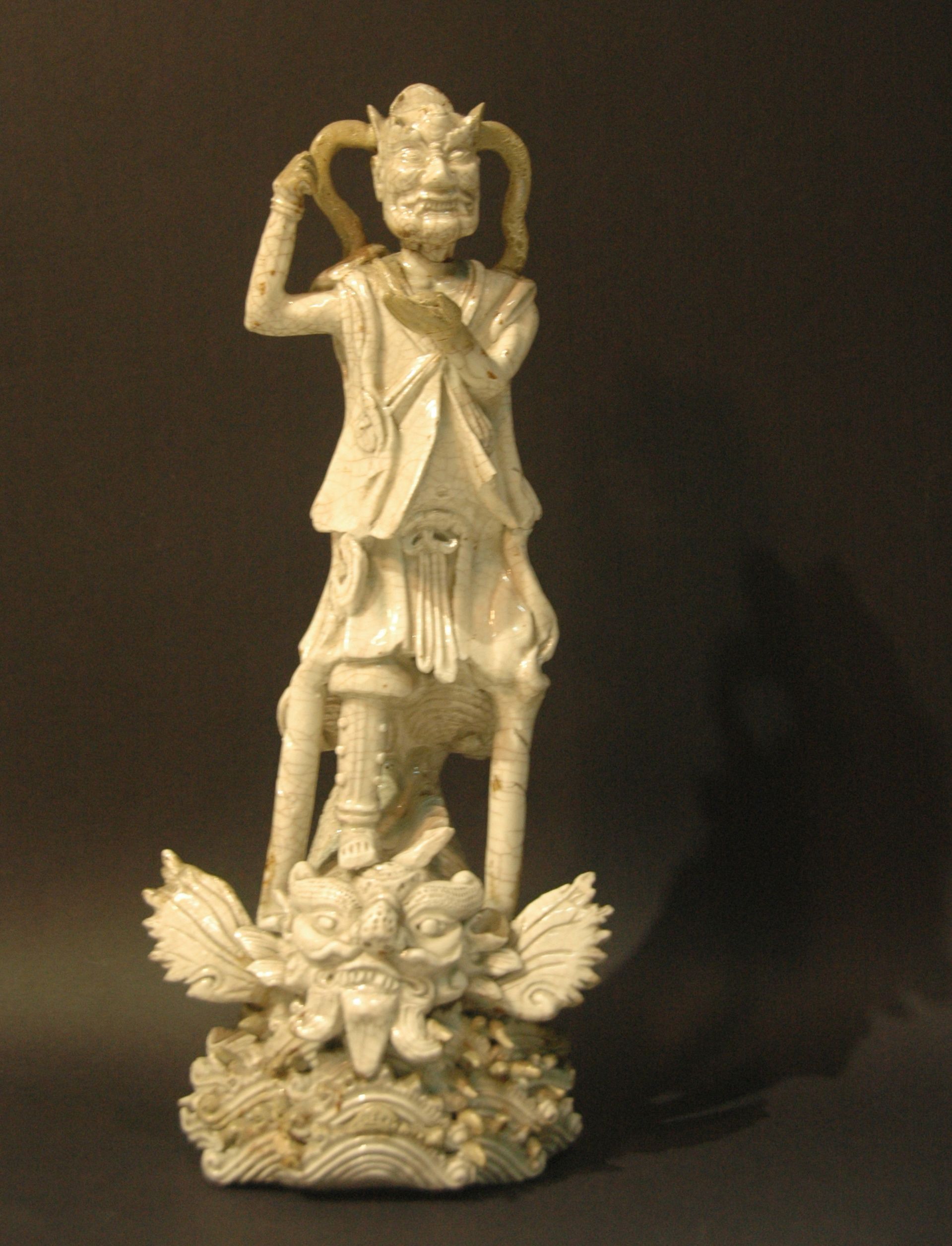
W100xD100xH300mm, China

This is a figurine of Kui Xing, a well respected figure amonst the Confucius intellectuals, he is believed to have the power to control the fate of all literature.  The legend has it that before being a god, Kui Xing was a scholar who took the Zhuang Yuan examination 3 times but failed, it was not because of his intellect but his ugly appearance.   Furious and frustrated, he kicked the box that held his books, jumped into the river and committed suicide … those were the days before we have plastic surgery …  Despite not being recognized officially by the court for his literary skills, his intellect was well acknowledged by the commoners, figurines of him were made for getting his blessing in examinations.  On the figurine he held a brush and ink, he is believed to write down the names of those who will success in the examination.  Under his feet is an Ao fish, a creature with a fish head a dragon body, a step carving outside of the palace where the Zhuang Yuan (the person who came top of the exam) will stand to wait for the emperor’s blessing.

W50xD40xH120mm, Macau

We have posted this form of wooden figurine (Junk Boat God, Junk Boat God, god?) twice already in the blog, but this time with a new understanding.  Last week I was at the Hong Kong Heritage Museum visiting the Picasso Exhibition (Masterpieces from Musée National Picasso, Paris), if you are visiting Hong Kong try to prebook a ticket to see, its well worth the trip.  Now I have got you all excited, well, the effigy has nothing to do with Picasso, I found similar  figurines in the local history section of the museum and here is the describsion;

“Wooden Effigies – People who lived on land worshipped wooden tablets with the names of their ancestors written on them.  Fishermen worshiped wooden effigies instead.  the appearances of the effigies vary according to the status and sex of the deceased.  The usual practice was for a family to hire a spirit medium to conduct a ceremony, and sculpt a wooden effigy of the deceased according to her instuction.  As time passed and fishing families became better educated, wooden effigies were replaced by wooden tablets.”

If this is correct, I wonder if the person this effigy is made for had an ambition to become a concert conductor.  The explanation from the museum is quite different from the one told me by the old Tanka gentlemen in the Tai O fishing village (see Junk Boat God, god?).  Would a Tanka person help me to clarify this?

H500xW150mm, China

This puppet is called a Chaozhou wire puppet, the body of the puppet is supported by a main wire attached to the back of waistline of the puppet while the 2 arms are controlled by 2 wires attached to the waists, hence wire puppet, all the 3 wires are controlled by the puppeteer at the back stage.

There are over 2000 repertoires for the chaozhou wire puppet, these are roughly divided into 3 main themes; adaptation from the southern Chinese opera, local legends and historical stories.  This puppet has the warrior helmet featured in the blog a couple of days ago, a female warrior figure.