Archives for posts with tag: chinese

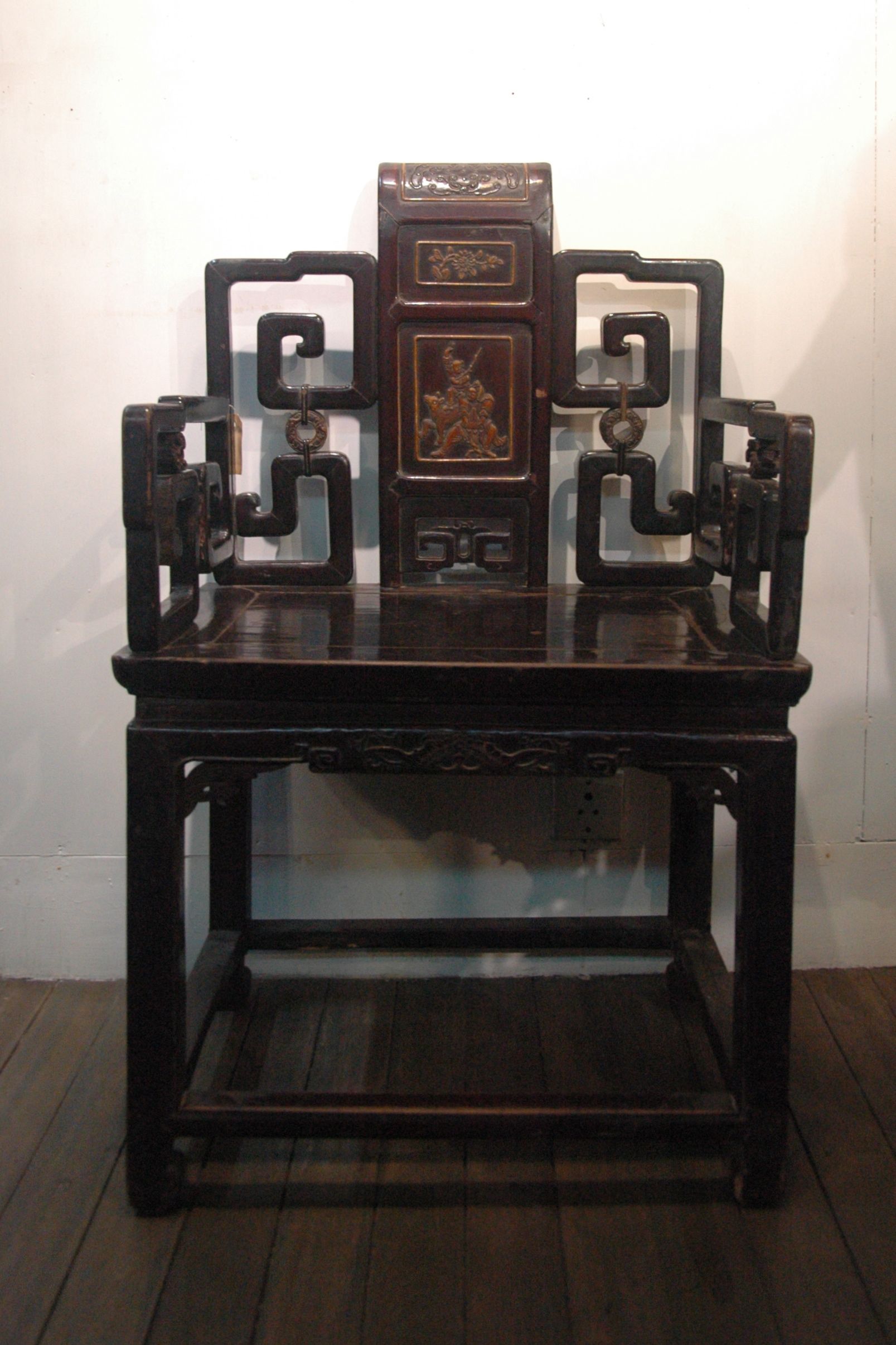
W470xD370xH950mm, China

This is one chair from a pair.  This type of chair is known as “chair with armrest, scroll style headrest with guai zi dragon pattern”, my translate is not perfect but believe me the Chinese name is equally as long.  The armrest need no explanation, the scroll style headrest refers to the top of the head board that turns in at the back similar to that of the old Chinese scroll.  The head board is decorated with relief carving panels of blessing symbols.  The guai zi dragon is the pattern that forms the back and the armrest of the chair, it is also echoed as a decoration on front of the seat and at bottom of the legs.  Guai zi dragon is a pattern that is commonly used in furniture and architectural decoration; it is broadly divided into 2 styles, a more realistic type where from pattern one can tell the head and claws of the dragon where the dragon is usually quite animated and a more conceptual style (as on this chair).

This type of chair was popular from the middle Qing dynasty, particularly in the Southern region of China.  It is normally placed in the study, on the 2 sides of the table or facing the table.

DIA350xH200mm, China

Before the invention of the disposable paper gift boxes and wraps, there were these lacquer boxes for transporting and presenting gifts.  This particular one is for cakes and confectionery gift.  After the gift is received, the boxes will be returned to the sender.  A red packet will be placed inside the boxes as a thank you gesture to the giver, they should never be returned empty.  For bigger celebrations like wedding, the bride’s family will send out boxes of the bridal cake for friends and family as an announcement of the wedding.  The boxes will be rented out from the cake shop, though the wealthy family would have custom made the lacquer boxes for these occasion.  Nowadays the custom is replaced by a cake gift voucher … I must say I would be much happier to receive the gift from a beautiful box like one then a paper voucher, I think it will make the cake taste better and share more of the joy of the happy couple.

L160xW50xH160mm, China

This clay toy is of the god of  longevity who began his legend as Canopus, the brightest star  in the southern constellation of Carina and Argo Navis.  In the Qin dynasty, temples were erected for the worship of  the Canopus star, it is believed that when the star shines brightly the world would be peaceful and vice versa.  Canopus is also known as the “elderly star”, apart from peace, it also upheld the ethic of the respect for the elders.  In the East Han dynasty, the ceremony for Canopus worship consist of a stately banquet that included all the over 70, nobleman and commoners.

Besides the astronomy aspect, the god of longevity also has a human figure, Peng Zu.  Legend has it that Peng Zu has mastered the art of longevity and lived to an age of  767 years old!

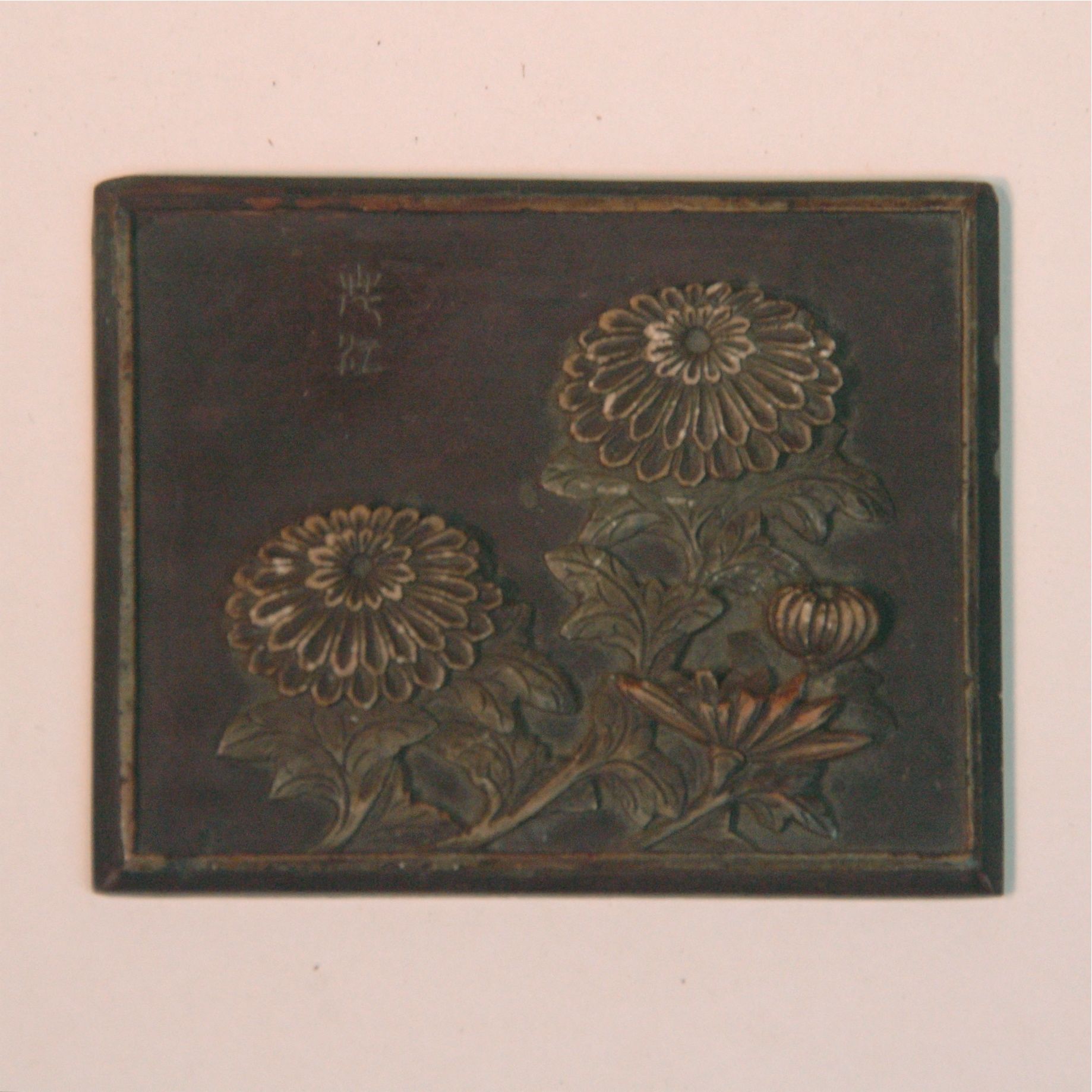
W80xL60mm, China

This is a stone carving use for the decoration of a small yan ping (see our other entries; yan ping and again yan ping).  Yan Ping is part of the Chinese stationary, it is designed to be used as a screen for shielding the ink well from drying.  The carving is a relief of the chrysanthemum flowers from a small piece of stone, the slight polish gave the flower its shading and tones.

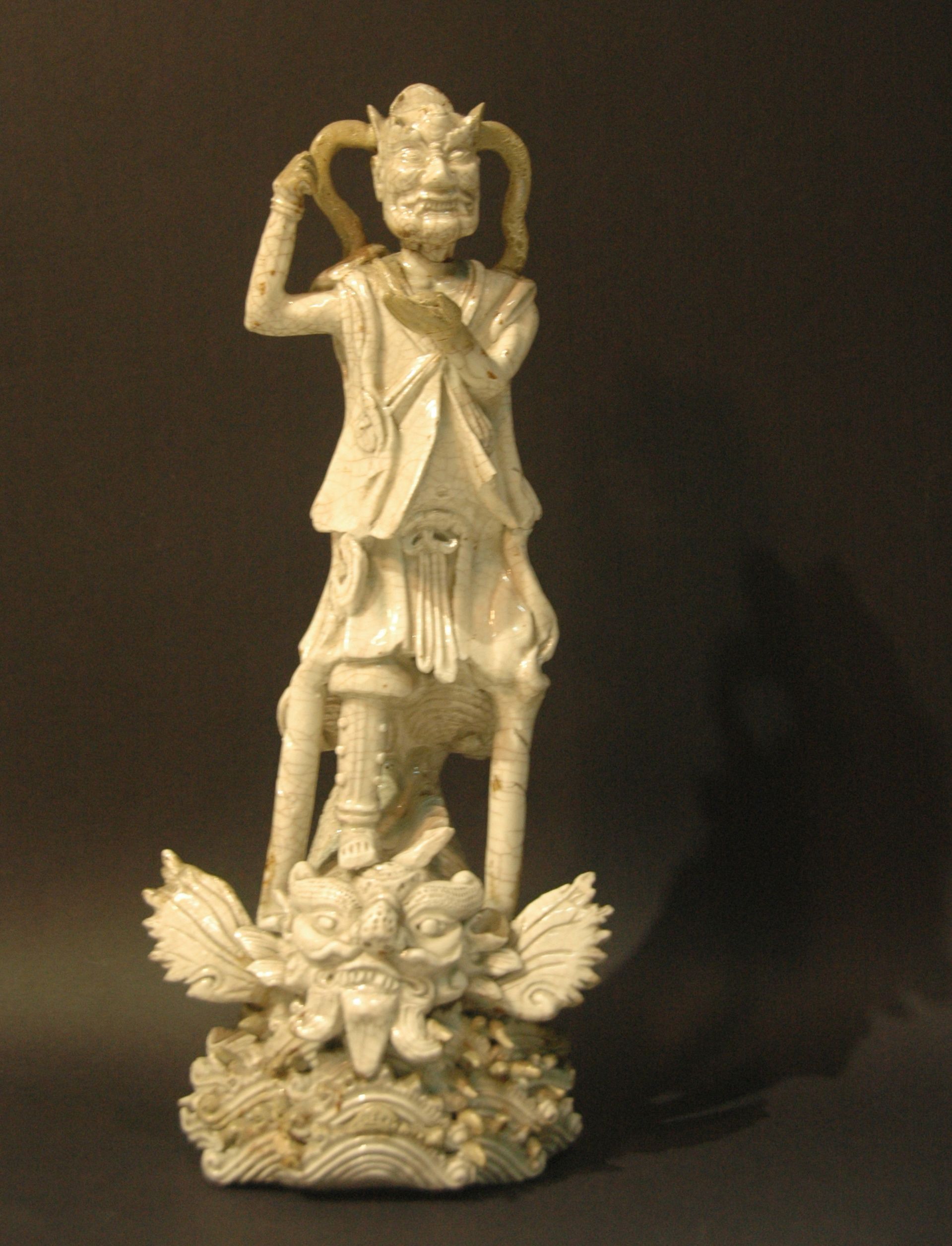
W100xD100xH300mm, China

This is a figurine of Kui Xing, a well respected figure amonst the Confucius intellectuals, he is believed to have the power to control the fate of all literature.  The legend has it that before being a god, Kui Xing was a scholar who took the Zhuang Yuan examination 3 times but failed, it was not because of his intellect but his ugly appearance.   Furious and frustrated, he kicked the box that held his books, jumped into the river and committed suicide … those were the days before we have plastic surgery …  Despite not being recognized officially by the court for his literary skills, his intellect was well acknowledged by the commoners, figurines of him were made for getting his blessing in examinations.  On the figurine he held a brush and ink, he is believed to write down the names of those who will success in the examination.  Under his feet is an Ao fish, a creature with a fish head a dragon body, a step carving outside of the palace where the Zhuang Yuan (the person who came top of the exam) will stand to wait for the emperor’s blessing.

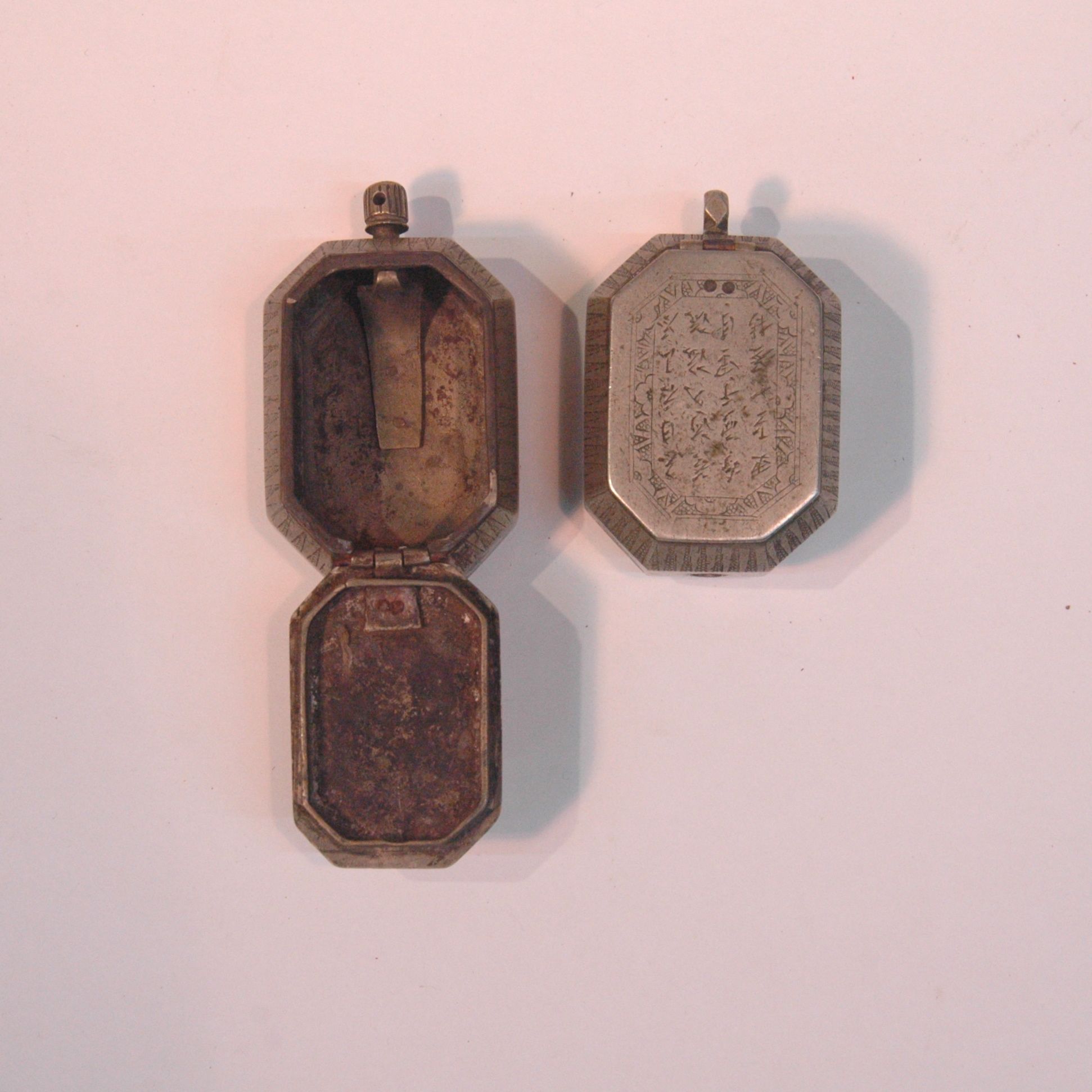
W50XD40XH70mm, China

This copper-nickle silver boxes are used in the late Qing dynasty for storing opium.  On the top of the box is a button for releasing the cover and also for attaching a string which can be tied to the waist.  The boxes are well used and worn, as if they were something treasured by the owner.  Knowing the history, its kind of sad looking at them, but at the same time they are a sharp reminder of what drugs can do to a person and a country.

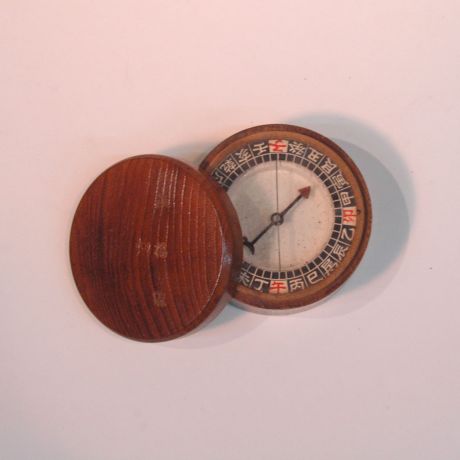
DIA100xH60mm, Hong Kong

This is a compass used by Tanka clan, a clan who lived on junk boats along the coast of Southern China and worked as fisherman.  As it is a day to day object, their compass is more simple then the traditional geomancers’ compass.  The compass for the Chinese is not only for telling the direction but related to space (direction extending to the universe) and time (past and future) as a whole

The Chinese Compass Points

Chinese navigators reduced the compass they inherited from the geomancers to its simplest form, using only 24 points, or even reducing them to 12 or 8.  The dial itself is divided into segments of 15 degrees each, represented by 24 Chinese characters.  These are the compass points, which scholars say were the basis for calculations by diviners and geomancers in ancient times.  These compass points were stabilized in their present system by at least the early 8th century.  These characters used on the compass dial are not the characters commonly used in China to represent directions.  Their origin or etymology is, for the most part, lost in the mists of antiquity.  But scholars have traced many of them back to over 4000 years ago when they appeared on “oracle bones” used to look into the future.  12 of the characters ;  子 zi, 丑 chou,  寅 yin,  卯 mou, 辰 chen, 巳  si, 午 wu, 未 wei,  申 shen, 酉 you,  戌 xu, 亥 hai, have been traditionally grouped together and referred to as the 12 branches.  8 of these character 甲 jia, 乙 yi, 丙  bing, 丁 ding, 庚 geng,  辛 xin, 壬 ren,  癸 gui,  are part of the traditional grouping knon as the 10 stems.  The remaining 4 乾 qian, 坤  kun , 艮 gen,  巽 xun derive from one of the earliest Chinese works on divination, the I Ching.  In very ancient times, the 12 branches were applied to the months of the tropical year and the 10 stems were used to name the ten day week.  Diviners used the stem/ branch combinations of the day, month and year of birth as basis for their calculations and conclusions.  The 12 brances are also associated with the Chinese zodiac; the rat, ox, tiger, hares, dragon, serpent, horse, gost, monkey, cock, dog and bear.  Each of htese creatures is supposed to exercise an astrological influence over a particular 2 hour period of the day, and one year out of every 12.

子 zi – North, rat, 23:00-01:00
癸 gui – N15°E
丑 chou – N15°E , ox, 01:00-03:00
艮 gen – NE
寅 yin – N60°E, tiger, 03:00-05:00
甲 jia –  N75°E
卯 mou – East, hare, 05:00-07:00
乙 yi –  S75°E
辰 chen –  S60°E, dragon, 07:00-09:00
巽 xun – SE
巳  si – S30°E, snake, 09:00-11:00
丙  bing –   S15°E
午 wu – South, horse, 11:00-13:00
丁 ding – S15°W
未 wei – S30°W, sheep, 13:00-15:00
坤  kun – SW
申 shen – S60°W, monkey, 15:00-17:00
庚 geng – S75°W
酉 you – West, cock, 17:00-19:00
辛 xin – N75°W
戌 xu – N60°W, dog, 19:00-21:00
乾 qian – NW
亥 hai – N30°W, pig, 21:00-23:00
Big Fish – L200xH120mm, China

A modern bag for childern, a small red fish for pocket money and a big fish for all the other goodies.  The small fish is like to the big fish, so however hard its tries it will always be swallowed by the big fish …

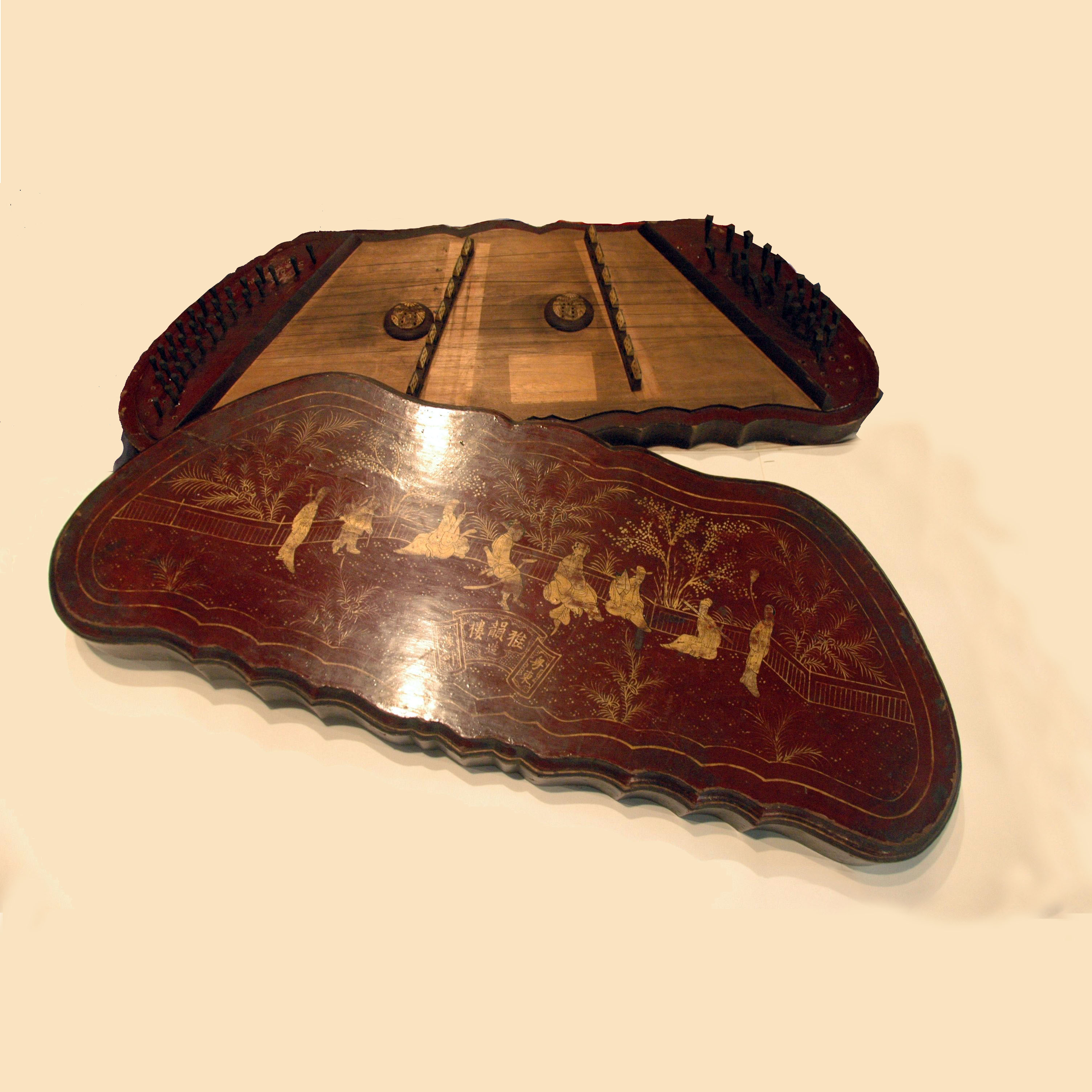
L770xW300xH120mm, China

The Yangqin is Chinese hammered dulcimer, however, the original  instrument was imported from Persia in the Ming dynasty (around 1580).  A similar instrument was very popular in Europe during the 14th century which later inspired the invention of the harpsichord, clavichord, piano forte, and eventually the piano.  There are many different types of Yangquin, the one we have here is a Butterfly Yangqin which is similar to the origin version, it is smaller and only has 2 bridges.  Its sound range is limited to the natural note (the sound from the white keys of the piano).  This yangqin has a lacquered box with beautifully gold painting of the 8 Saints, the instrument  is a bit worn out and would require some fixing and tuning before it can be played.  The instrument was made the the Guangdong Ya Yun Leu.

Performance of the Ode to Yellow River with the Yangqin

Same piece performed on the piano by Lang Lang

W75xH200mm, China

This small piece of silk embroidery (which we have framed) was taken from a children’s underwear (Du Dou).  The Du Dou is an undergarment for cover the chest and tummy, its a rectangular or square piece of cloth to be worn diagonally with the top corner trimmed for the neck.  2 strings affixed to the top corner is tied around the neck while the 2 strings attached to the side corners are tied around the back.  The embroidery patterns for children are of the theme of blessing; tiger is one of them.  Tiger is seen as an animal of strength and power, it has been worship for its protection; it is believed that evils will be frighten away when embroidery that has been wrapped around a child.  The tiger Du Dou is traditionally worn by all the children and babies on Duan Wu (the day of ills).