Archives for posts with tag: chinese

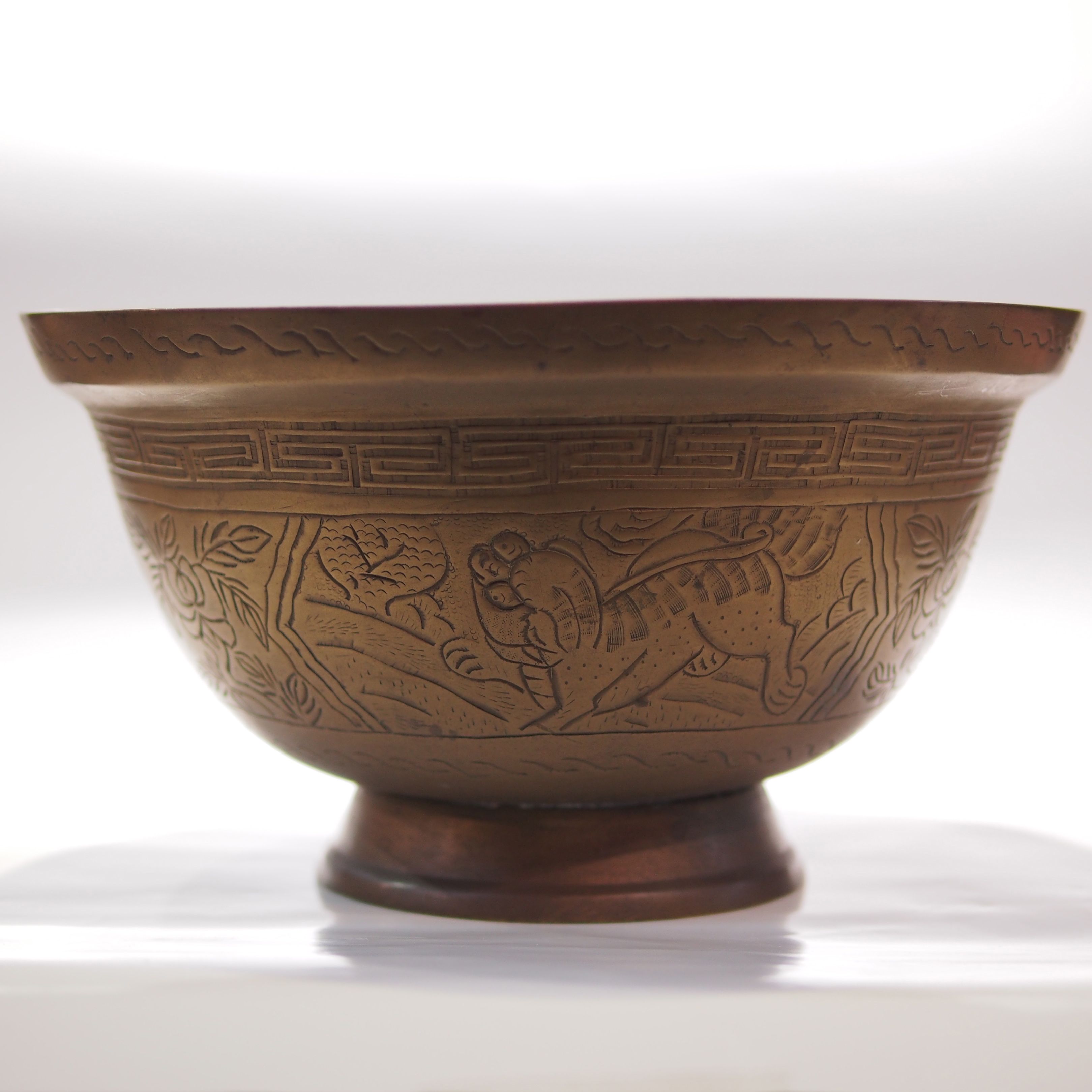
bronze bowlDIA270xH150mm, China

Perfect for beating egg white, melting of chocolate or just as a fruit bowl.

In the old days this bronze bowl would have been uses to provide offering in a Chinese temple.
See our other offering containers; offering bowl, eight trigram bowl, bronze plate, lacquer dish.

OLYMPUS DIGITAL CAMERA

cheeky maskW150xD70xH220mm, China

This is a mask for the female role (Dan) in the Chinese theatre.
The diva.
Strangely, it is not portrayed as a beautiful female but a rather comical.  This is because the mask is that of a Cai Dan (the clown).  Like all good theatre, the clown is essential.

Within the dan catagory there were the Gui Men Dan (known for the singing), the Hua Dan (specialized in movement and speech), the Wu Dan (the Chinese version of Laura Croft), Lao Dan (the older women) and Cai Dan (the clown).

In this clip you will the beautiful Xi Shi (Hua Dan), followed by the comical Dong Shi (Cai Dan) and mother (Lao Dan)


blue rock  W130xD20xH80mm, China

A curious blue object.

This is no modern art but a carving of the Shou Shan stone.  The blue, without the artistic symbolism of Western art of the sacred, the heaven, the ideal, the escape etc etc was a mean of disguise.  During the cultural revolution, all objects of art and decoration were target to be destroy and its owner punished.  The owner must have treasured this object, instead of destroying it like many art object at the time, a layer of blue paint was applied to escape the prying eyes of the red guards.

Odd at it is, we have kept the blue paint on, as it is part of the history of this object.

Tea Pot

DIA120xH150mm, China

This is our family teapot, though it might look very modern or even muji like, the form has been around since the late Qing dynasty.

My first association of a teapot was from a drawing, then the nursery rhyme. When I was old enough to go to restaurants that I met the first teapot in a tea house (the place where they serve Chinese tea and dim sum).  It was a comical looking object, perfectly fitting to the first two descriptions I had learn, rounded short and stout.  It was not until later when I was trusted to pour tea for myself that I realized it is impossible to maneuver this typical Chinese teapot.  The design is appalling, the pot is short and long, the momentum pivoted from the handle made it heavy to hold, then the handle to small making your fingers scorch by the side of the pot.  It is made worse by the dripping spout and the lid that keep falling off.  If the Chinese love to drink tea then why would this become the standard teapot for tea houses and restaurants?  Looking at the history of Chinese teapot where the form was influenced mainly by the development of tea brewing method, design of teapots were sophisticated and refine, it would seems that there is no place for an object like this to survive.  My only guess is that it has been modeled after one of the miniature zi sha teapot, the special teapot where the fragrance of the tea is celebrated.  Tea leave packed, brew for seconds with small amount of hot water which is completely drained out for consumption.  The whole design evolve around the power of the smallness, scaling it up loses all its meaning whatsoever.

OLYMPUS DIGITAL CAMERA OLYMPUS DIGITAL CAMERADIA140mm, China

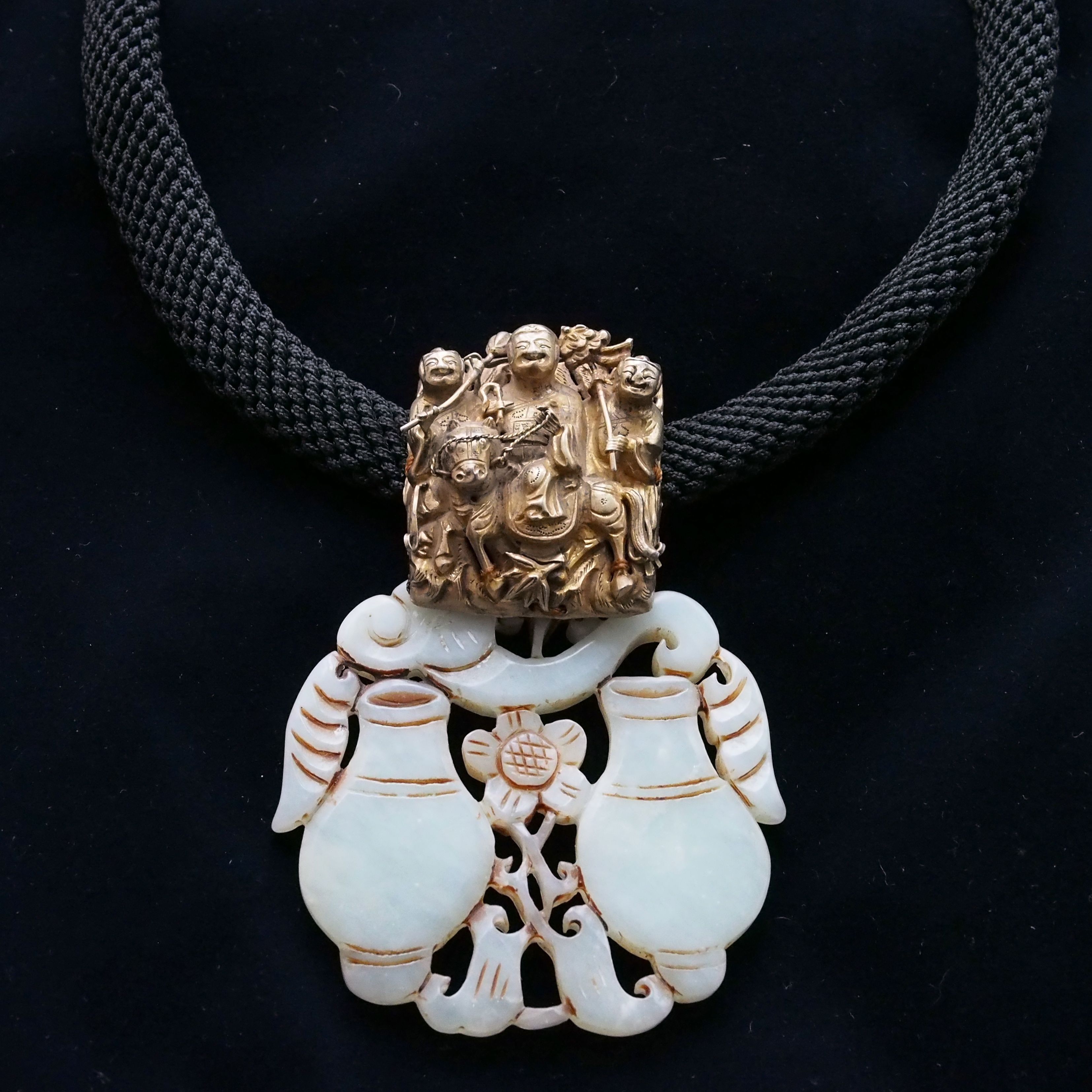
This delicate gold plated carving used to be a hat decoration.  Until the Qing dynasty hat was seen as a status symbol, worn by only the Emperor and the high ranking officials, commoners are forbidden to wear hats and usual tie their hair with a piece of cloth.  It was until the Qing dynasty that hats became an item for all, though their style and details are still well defined by the social levels.  On its hundredth day birthday, a baby would be given a hat which is constructed a bit like the beach ball, bind by 6 equal wedges of cloth.  The 6s represented the sky, the earth and the four directions.  On this hat a decorative ornament would be place over the forehead, an ornament of good wishes; the eight immortals, longevity, luo han, etc.

This particular decoration has the theme of a Zhuang Yuan, the scholar who came top in the examination.
A wish for scholarly, prosperity, loyalty to the country, everything parents would wish for their child.

Something Old Something New
Collectible Jewellery Collection

OLYMPUS DIGITAL CAMERADIA120mm, China

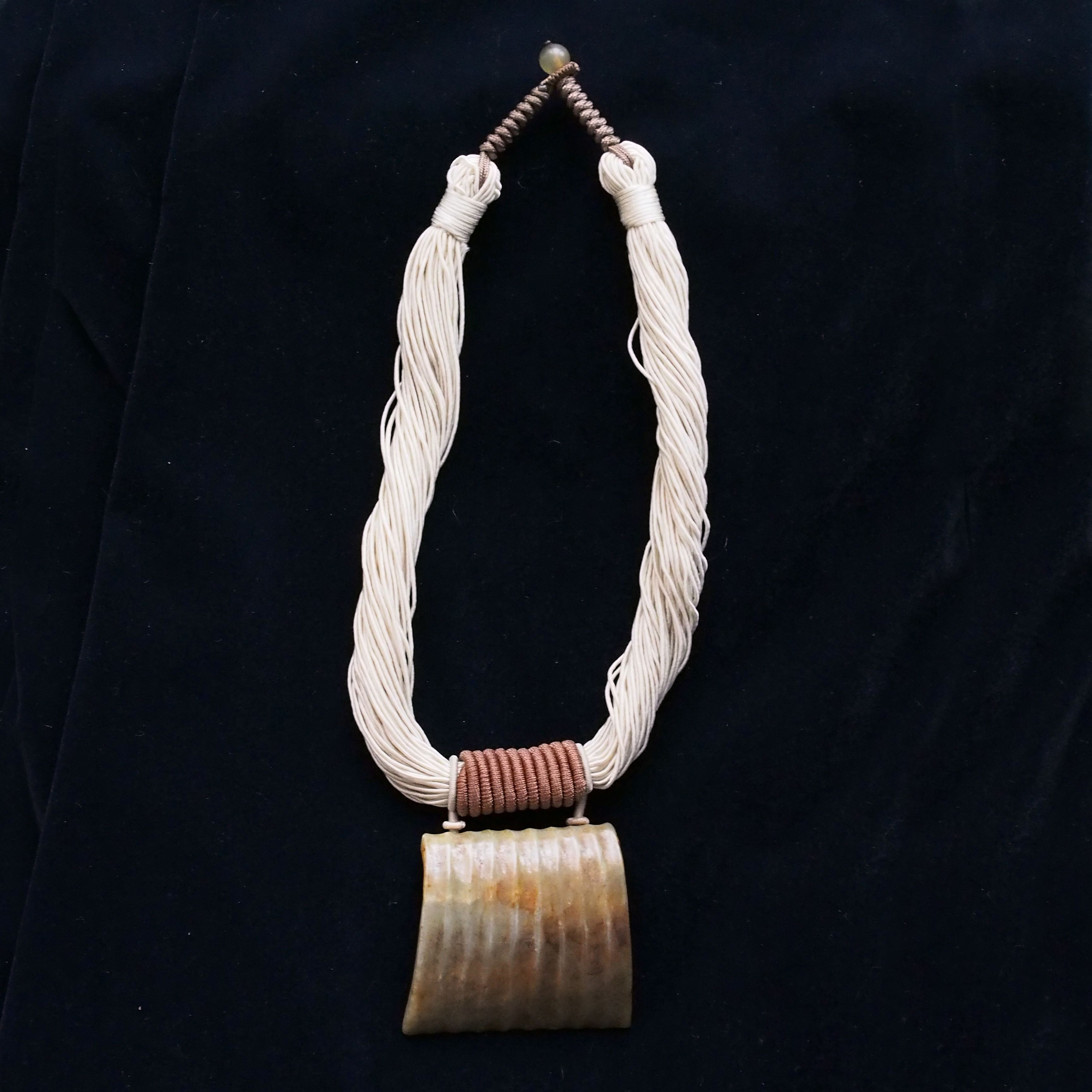
These fine strings which looks like rice noodles are hand woven strings.
Click on the photo and you can see the details of the knots carefully tied together.

The jade pendant of the necklace came from the form of an ancient head piece.

Something Old Something New
Collectible Jewellery Collection

OLYMPUS DIGITAL CAMERAL400mm, China

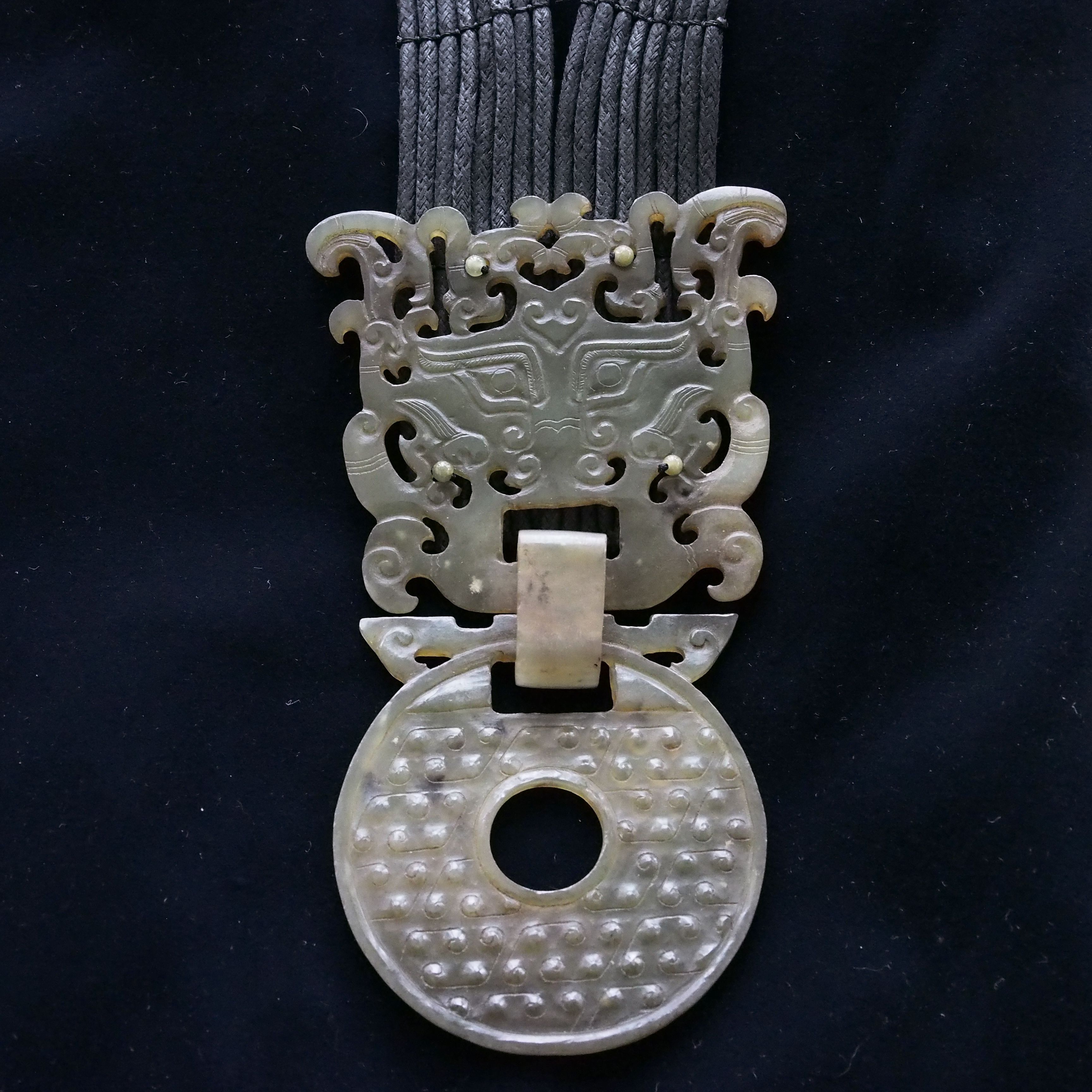
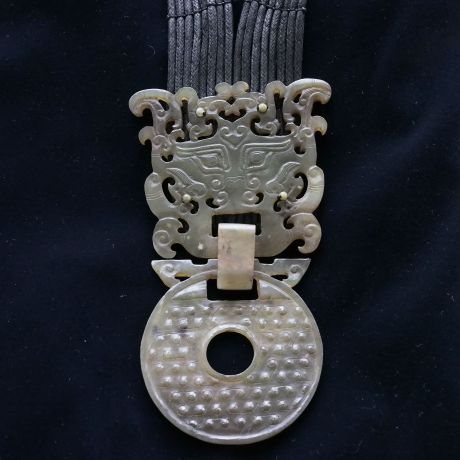
 A beautiful jade carving pendant of a Tao Tie with a yu bi hanging from his mouth.

According to the book Sheng An Wai Ji, the poet Yang Seng, described the nine sons of the dragon, Tao Tie is one of them.  They are;

Bi Xi, one who like carrying heavy stuff and often found with a stone tablet on his back.
Chi Wen, one who enjoys the vista, often found one the ridges of buildings.
Pu Lao, love music, found on bells.
Bi An, one who hates criminals, found on the lintel of the prison.
Tao Tie, one who loves to eat, found on lids and the side of cauldrons; sometimes found on the middle of the beam, it is believed that he can drank all the water and keep the flood away.
Gong Fu, love to play with water, found on bridges.
Ya Zi, a fierce creature with weapons.
Suan Ni, loves smoky fire, found on the lid of incense burner.
Jiao Tu, hates trespassers, oftern found on the main door.

This mythical creature, the fifth son of the dragon, is one who loves to eat made a perfect ornament for festive season.
OLYMPUS DIGITAL CAMERA

Something Old Something New
Collectible Jewellery Collection
OLYMPUS DIGITAL CAMERADIA140mm, China

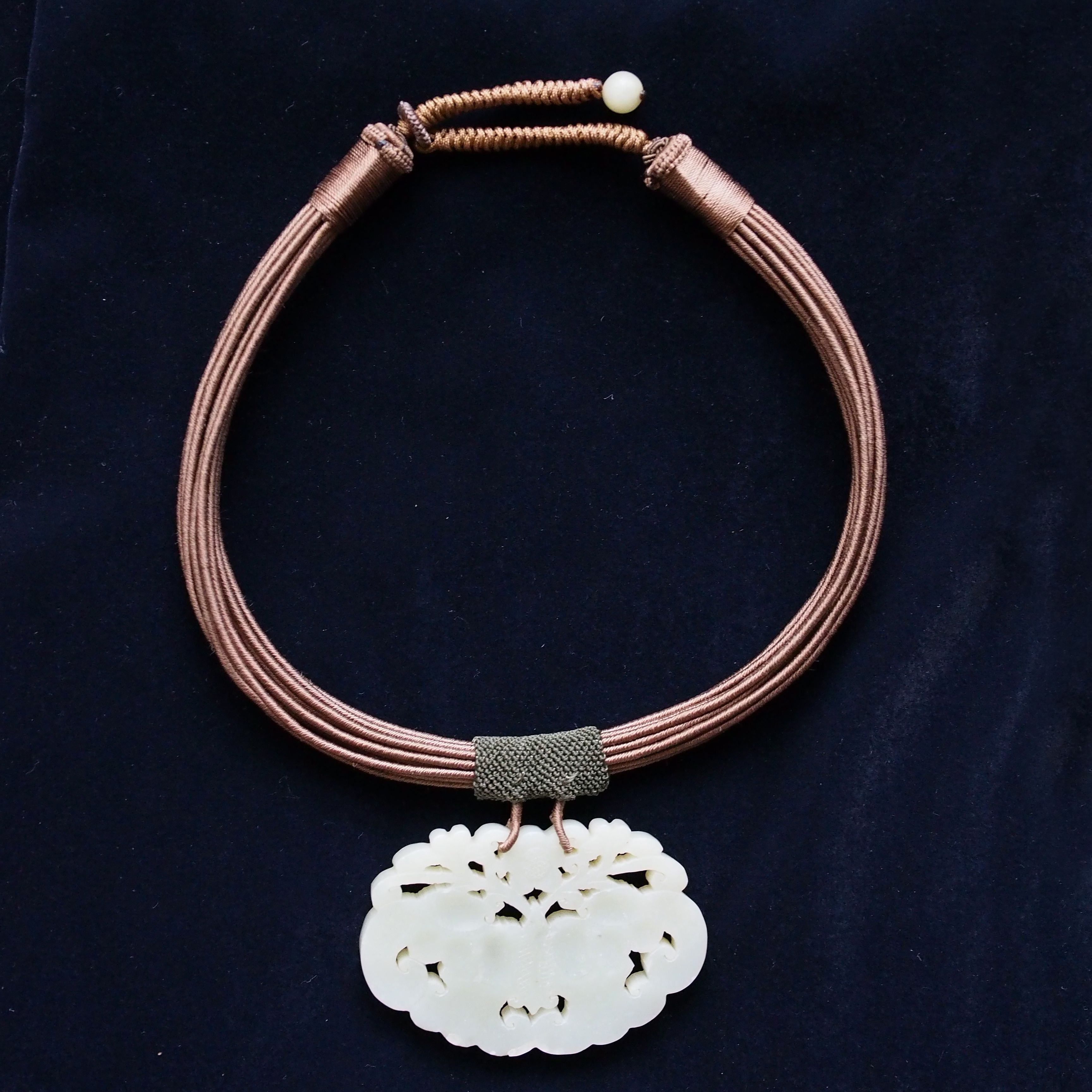
A  hetian jade butterfly pendant on beautifully hand woven necklace.

OLYMPUS DIGITAL CAMERA

Something Old Something New
Collectible Jewellery Collection

OLYMPUS DIGITAL CAMERADIA130mm, China

The pendant is of a different version of the Ye Le Li featured earlier in the blog.  Ye Le Li was used as a status identification object, a decoration that is hang by the waist.

Something Old Something New
Collectible Jewellery Collection

OLYMPUS DIGITAL CAMERADIA120mm, China

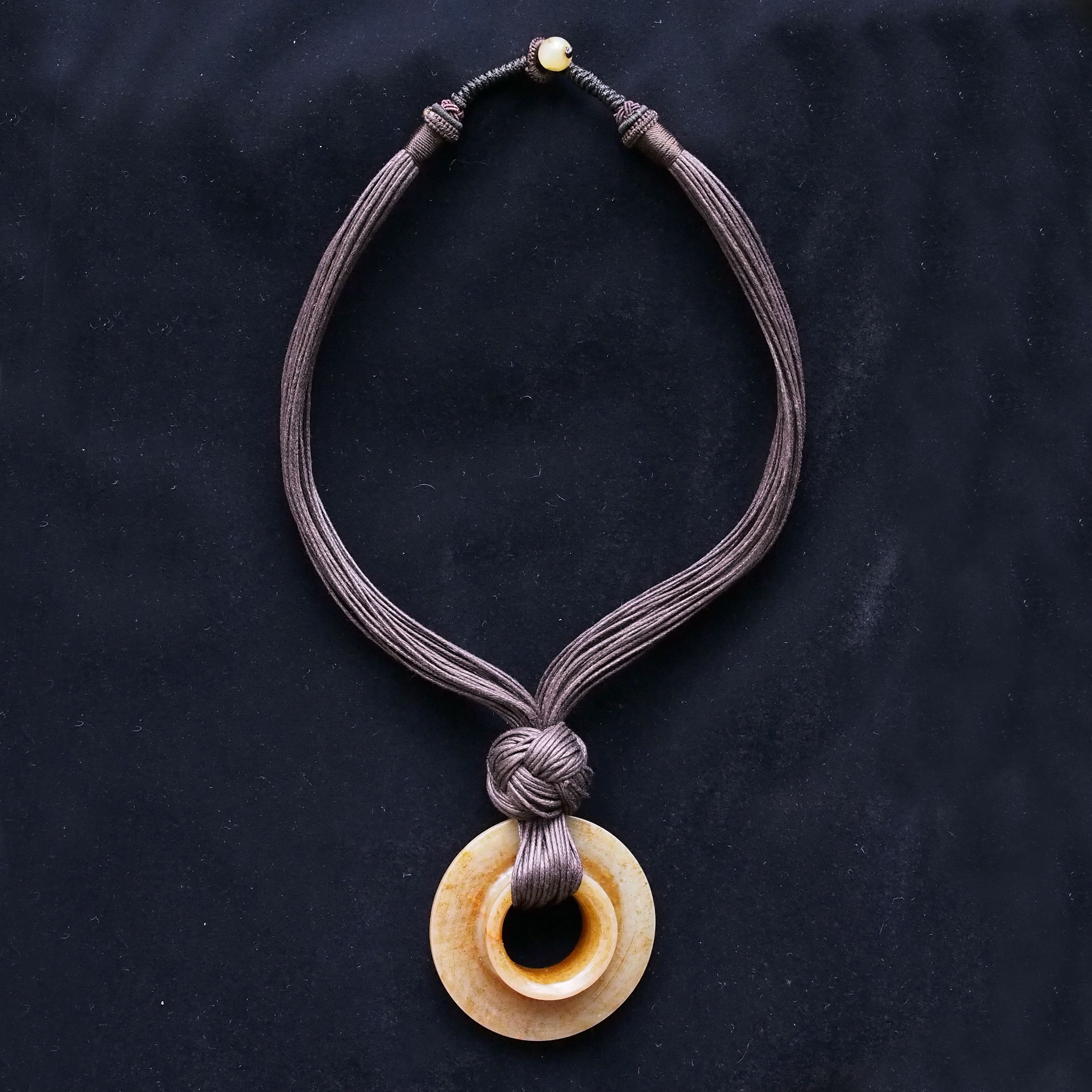
 Yu Bi is a form of jade that is used for ceremony, like the jade huang it is one of the 6 forms of jade that is used for ritual ceremony and later identification.  Yu Bi generally describes a piece of circular jade with a hole in the middle, as they sometimes come with pattern, this particular would be known as a Su (plain) Yu Bi, its being raised up in the center is known as a collar hence You Ling (collar) Su Yu Bi.   This form of Yu Bi was for the late Shang dynasty, like the iphone in the 20th century, it was an high tech object, a status symbol that became so popular that it can be found in various parts of China.

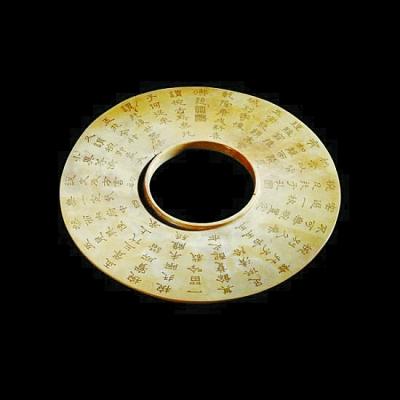
This is Emporer Qian Long’s favourite, he wrote several poems about it and asked for the poem to be engraved onto the jade.  The item is now part of the British Museum Collection.

Something Old Something New
Collectible Jewellery Collection