ReindeerDIA165mm, China

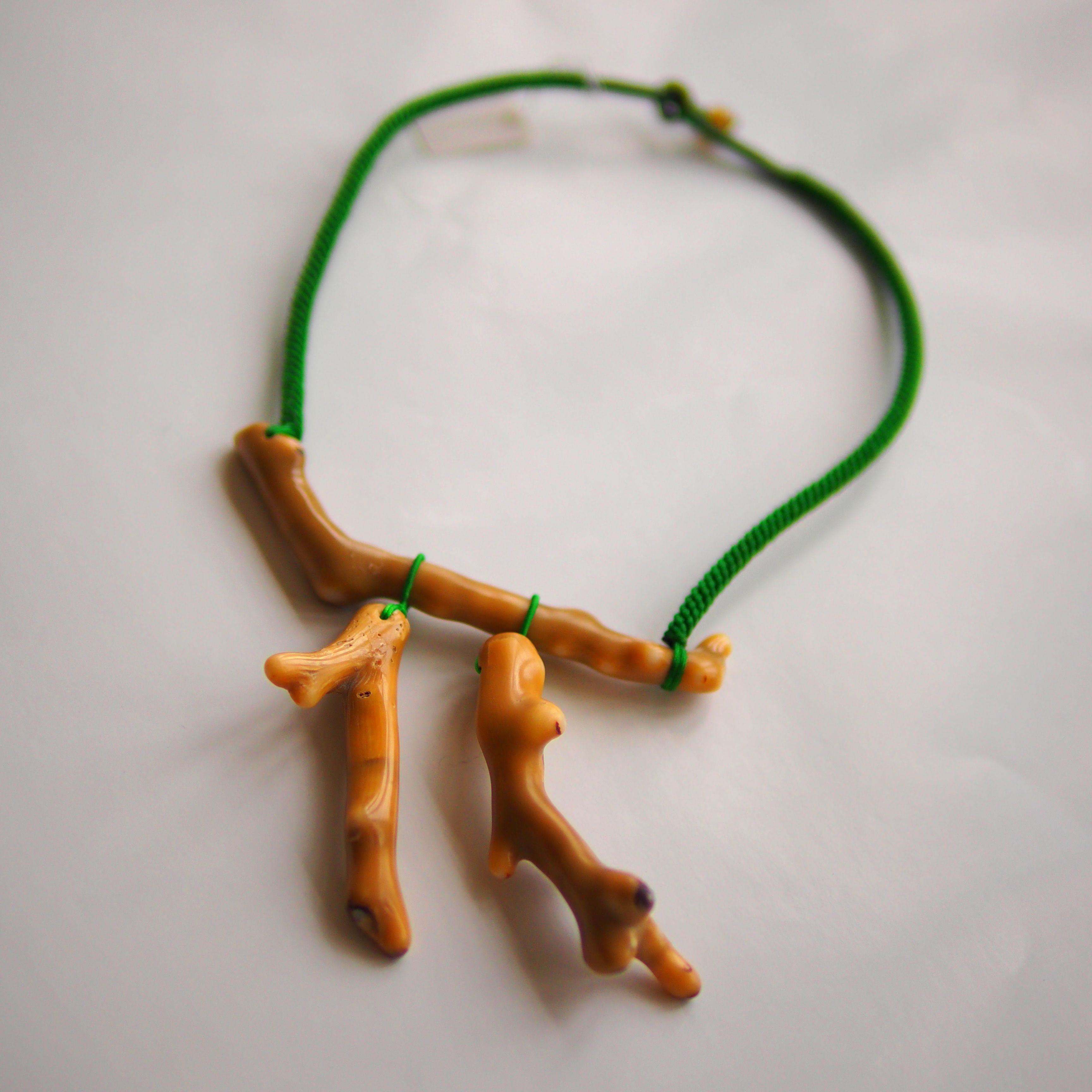
Nothing to do with reindeer at all, this piece of coral necklace just reminds me Christmas.  This minimal design has been put together by hand with a hand woven string using the traditional art of Chinese knotting.

Collectable Jewellery
Something Old Something New

pony

DIA165mm, China

This neckware is made up of two ponys old silver pendants.  These pendants have little bells attached attached at the bottom, similar to the previous Bell Necklace these were used as a child monitor.  The colourful band of the necklace has been put together by hand.

Something Old Something New
Collectable Jewellery

burmese owl

W45D30H60mm, Mynmar

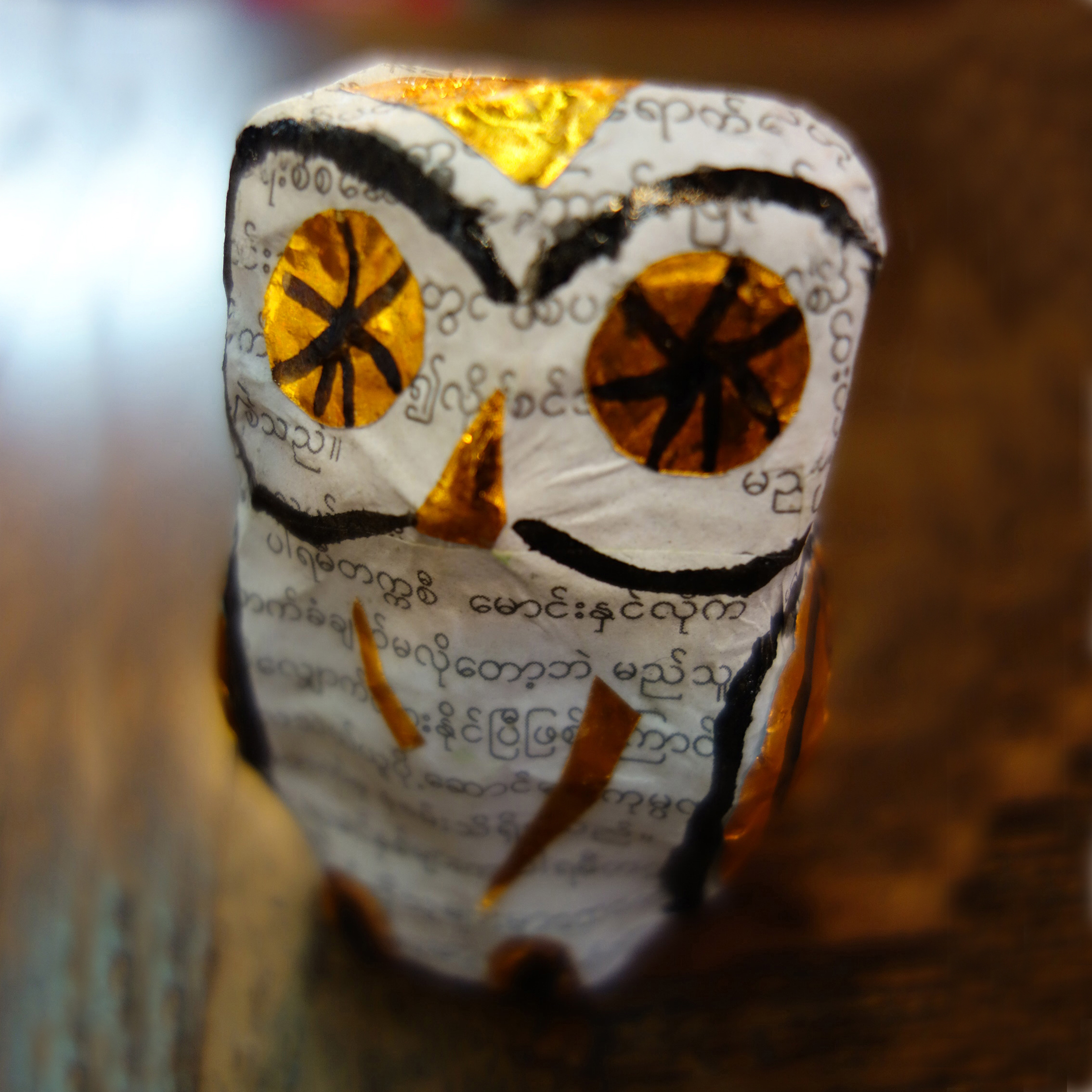
The Zee Kwet (or) the Myanmar Owls are believed to bring luck and prosperity to a family.  The owls usually comes in pairs, a male owl and a female owl.  But there is something more. At the base of the female owl, a tiny owl is also painted on it, to make it looks like a family.

SOIL X MOUNTAIN FOLKCRAFT
ASIAN FOLKCRAFT COLLECTION

 H250xW150xD50mm, Indonesia

This is one of the topengs which appear in the introductory of the performance, they are archetype of the character in the show.  In the solo act, the dancer will perform pure dance to show off their dancing skill.  This particular mask is that of the Dalem, the handsome king who is intelligent, noble and strong, an ideal ruler.  The actual performance will begin with the entrance of the king’s servants who wear a half mask as the narrator of the show.  The dalem then re-enter and tackle the political or religious problems of his kingdom.

Asian Folkcraft Collection

Burmese Note Book

L200xW130mm, Myanmar

This note book is made entirely by hand in Shan State, eastern sector of  Burma.  About 11 miles from Hsipaw in Shan State South lies Kyinthi Village beside Mandalay-Lashio Union Highway.  Farming and orange is the economic mainstay of the village.  Besides, there is a traditional cottage industry there which is production of Shan paper or Mongkai paper in which every house in the village is engaged for extra income.

Shan paper is made from the bark of tree called “Sar”.  Such trees grow wild naturally.  Shan paper or Mongkai paper is manufactured over one million sheets per month.  Some Shan villages make the paper to be thick enough to use as bed sheets whereas some use it as waterproof wear after coating with lacquer.

Item from Soil for the ASIAN FOLKCRAFT COLLECTION

indonesian puppet

W150xD150xH550mm, Indonesia

Wayang golek is the traditional West Javanese performance of the wooden rod puppet.

Here is a wonderful documentary about the Wayang golek.

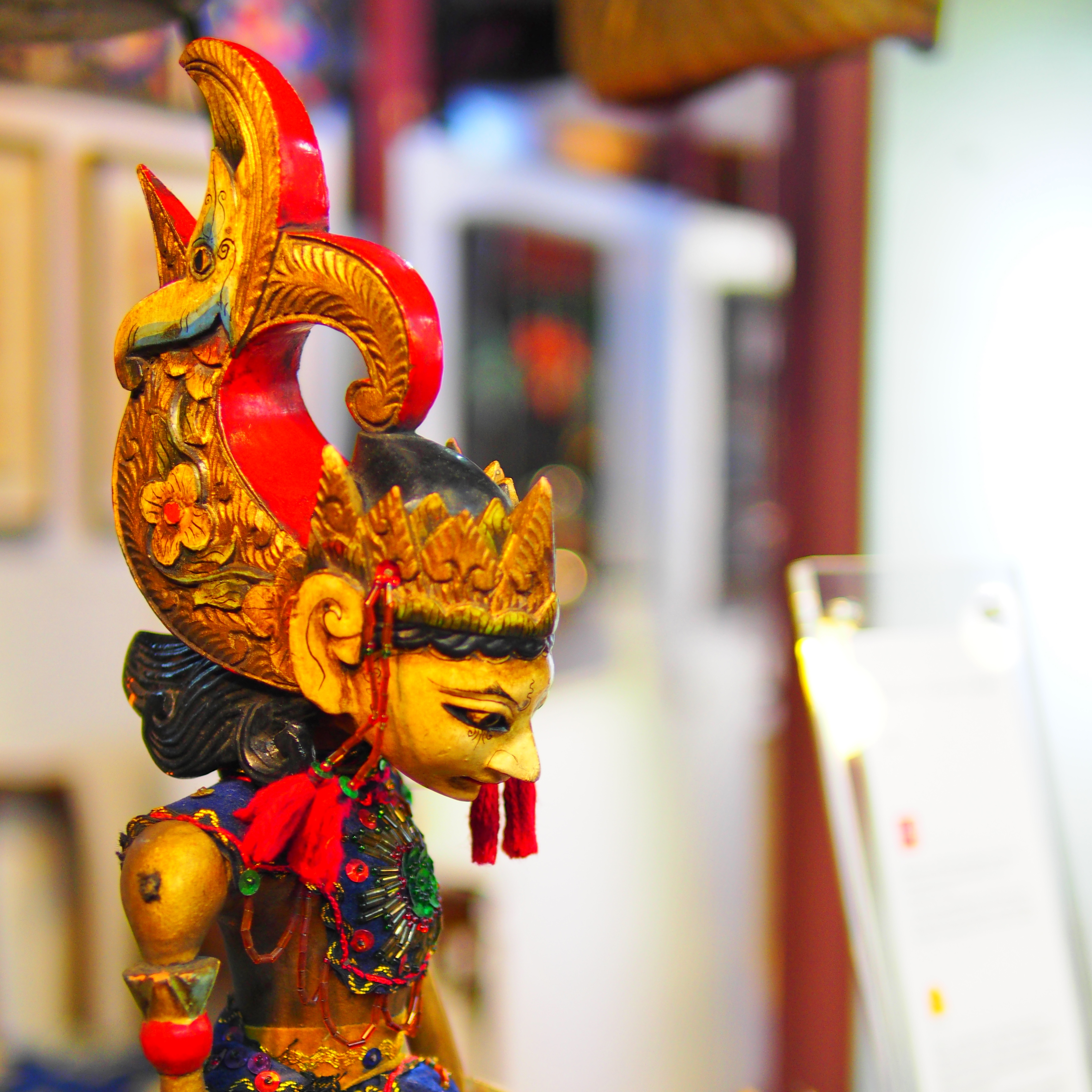
The character of this puppet is Abhimanyu, the tragic hero in the Hindu epic Mahabharata.  Son of Arjuna and Subhadra, like his father he was both courageous and a good fighter.  Abhimanyu’s education of becoming a warrior started when he was still in womb of  Subhadra, his father would go through in length different battle formation.  Unfortunately at Subhadra has fallen asleep when it came to the exiting of Chakravyuha and Abhimanyu failed to gain the knowledge and there on the 13th day of the battle he was killed.

Come to see the Asian Folkcraft Collection!

DIA165mm, China

All the jewellery featured this week has been string with hand woven strings and put together with the technique from the art of Chinese knotting.  This particular piece is one of the elaborated design with each jade beads carefully placed.  The art of knotting is believe to have started as a function for early form of clothing, then as a memo on a string.  By the Zhou dynasty, 800 B.C., knotting has found its use with jade ornaments.  Since then till the end of Qing dynasty, the art of knotting was a craft practiced by the young girls in China (where 20/20 vision and crafty fingers are minimum requirement).

beads

DIA165mm, China

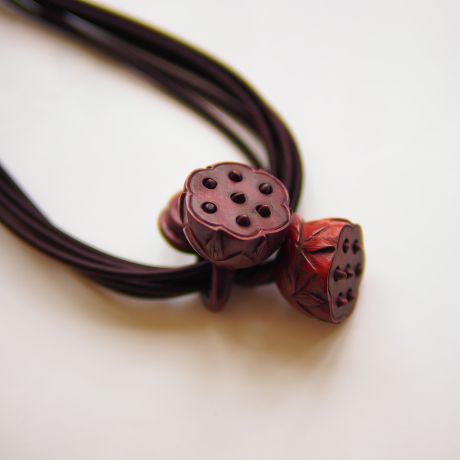
This is a necklace with a wood carving of a lotus pod.  Like the real thing seeds are movable but cannot be taken out unless you break open the pod.  These fresh lotus seeds were one of my favorite childhood snacks, what can be better  than a soft package with refreshing sweet capsules.  Sadly, they are not as easily found markets of  Hong Kong anymore.

lotus necklace

DIA165mm, China

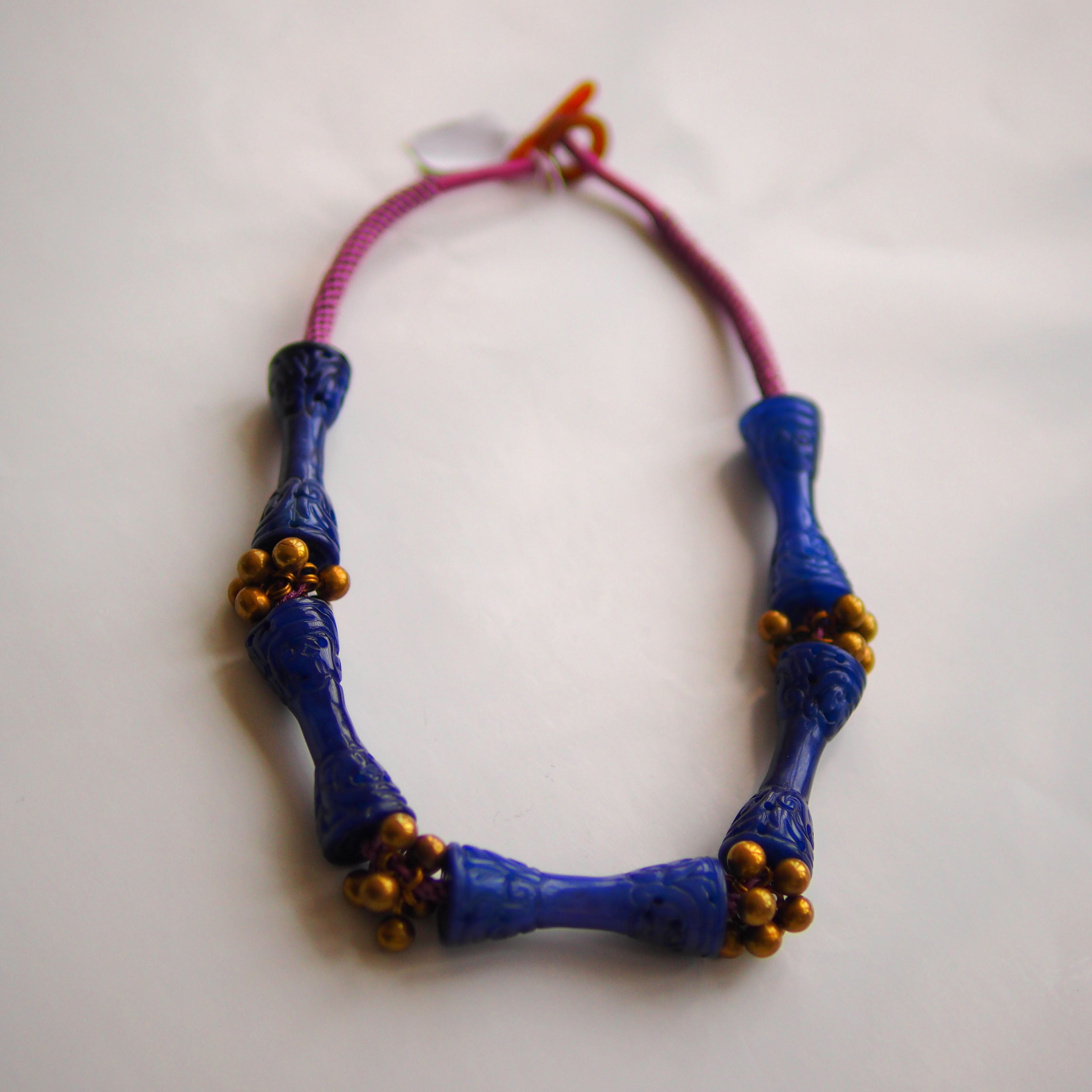
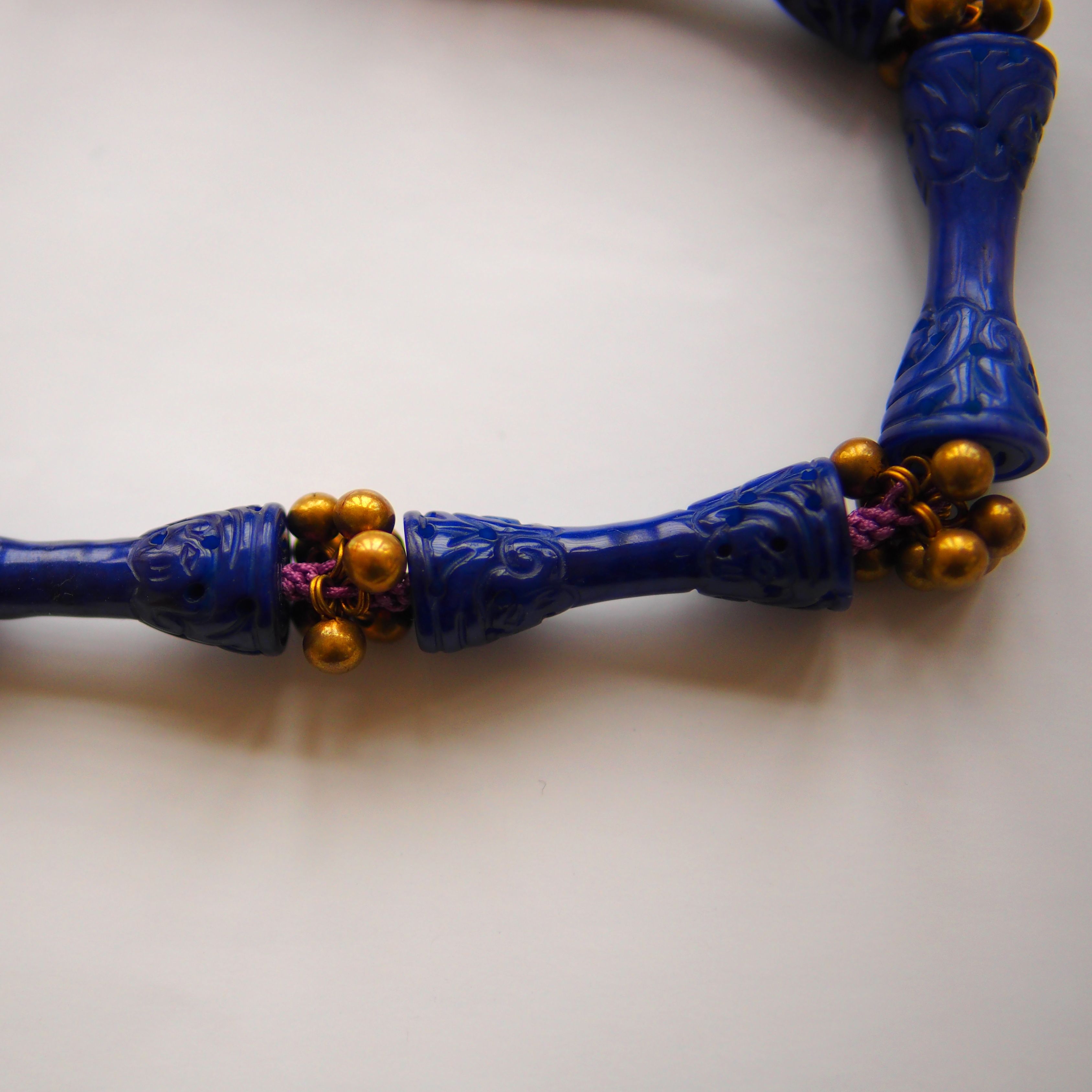
This beautiful blue beads are jade beads dyed with a technique which dated back to the Han dynasty.  Unlike today where a lot of  jade are dyed to imitate the perfect shade of green in order to fetch a better price, in the previous dynasties jade are dyed simply for a desired colour.  The material is treated almost the same as a piece of cloth.

According to the book Yu Ji (The Record of Jade) of the Qing dynasty jade can be divided into 9 Se and 13 Cai.
“Se” refers to the intrinsic colour of the jade;  still ocean black, indigo blue, moss green, peacock feather green, steam chestnut yellow, cinnabar red, clot blood purple, ink black, white as snow to lard.

The 13 “Cai” refers to the dye colour;
chestnut yellow from using earth with a darker shade when using rosin,
sky to sapphire blue from indigo,
peach red from lime,
coal black from mercury,
date red from blood,
parrot green from copper,
other dye colours include cinnabar red, chicken blood read, palm fiber purple, aubergine purple, pine cone green, ginkgo green, okra yellow, wine yellow, fish belly white, brown rice white, shrimp roe green, snot green.

Apart from the colour, the book also describe patterns, textures and even fragrant can be achieved.

blue bells

DIA165mm, China

 This necklace featured a piece of antique jade huang.

Jade huang is a form used for jade  pieces dated all the way back to the Neolithic Age, some 8000 years ago.  The arch shaped form started as a part of the costume for the sorcerer when practicing black magic.  By Shang dynasty, 1000 B.C., it has developed into a costume ornament which acted as a symbol of social status.  The fashion of jade huang ended and took over by the jade pei, a more decorative pendent.

This jade huang has a carving of a dragon pattern.