Archives for category: wood

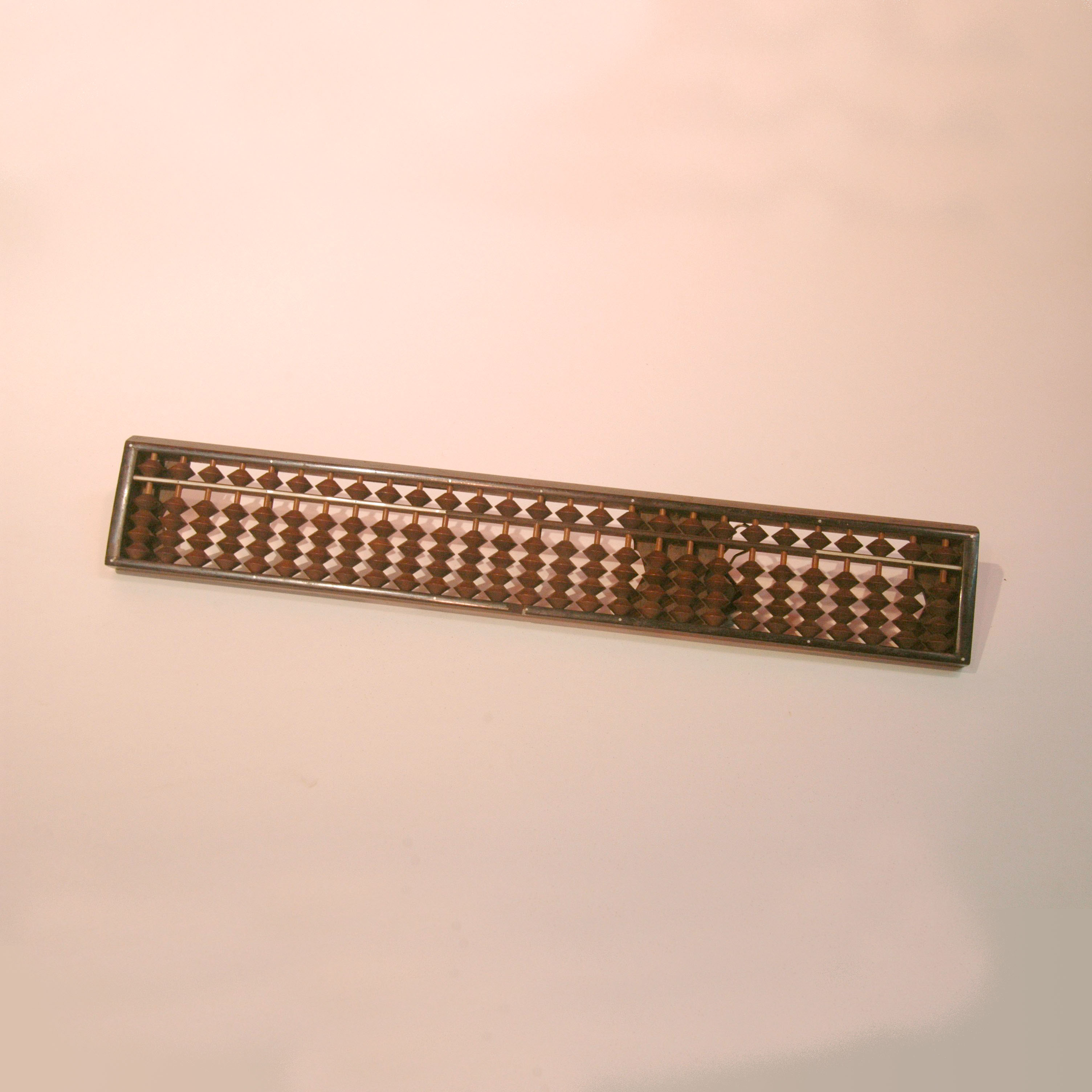
W390xL70xH20mm, Japan

This is a Soroban.  A calculation device.  The Japanese version of the abacus.  The number of rods are always of odd number, starting from 13, then 21, 23, 27 (this one) and going up all the way to 31.  The more rods will allow for more digits in the calculation.  The beads on the rods are separated in 2 rows by the reckoning bar; on each rod below the bar are 4 earth beads, above it there is 1 heaven bead.  Each rod represent the same digit, with 1 heaven bead = 5 earth beads, so each rod can go up to 9 before moving to the next digit.  The Soroban is still currently in use in Japan, it is reinforced by being taught at school and as part of the entrance requirement to public cooperation.

W150xH150xL250mm, Thailand

A Korean legend about the tiger lily; once upon a time … there was a hermit who save a tiger by removing a arrow from his wound.  The tiger requested the hermit to use his magic to extend their friendship after his death.  After the death of the tiger, where his body lay sprouted a tiger lily.  The hermit got drown by the river and his body was washed away, tiger lily spreaded along the river bank as though the tiger was looking for his missing friend.

These are the first fake flower that I can appreciate, each petal are carved out from wood.

W530xH1020mm, China

This wooden lattice was part a building, these lattices featured in all traditional Chinese buildings, temples, courts, residential house, etc.  They are the upper part of the door which is responsible for letting light into the house.  Its a kind of a window, you could say.  Buildings are measured by the unit of Jian, and for each jian there will be 4 lattice door.  The whole door is of the proportion 1:3 or 1:4.  The door is divided into 3 parts, the top is the lattice Ge Shan, the middle is Yao Chuan, the lower part is Zhang Shui Ban.  The lattice is constructed by joinery and most often with a miter joint.  Danial Sheets Dye’s Chinese Lattice Design has a lot of information regarding the Chinese lattice, it was first published in 1937!

W300xH450mm, China

The head, feet and hands of the glove puppet is made of wood and its body and arms in a fabric formed glove.  For the right hand control puppet, with the whole hand in the glove, the thumb would go into the left arm of the puppet, the index finger in the head and the remaining 3 fingers in the right arm of the puppet.  As the puppet is directly control by the hand, fine mechanism can be built into the head for the control of the eye, the mouth etc.  As in all theatre, the characters of the glove puppet show can be classified into 7 category and each with its many subtypes;  the Sheng (male role), the Dan (female role), the Jing (the painted face strong character), the Chou (clown), the Xian (saint), the Guai (monster).

The puppet here is of the saint category,  Ling Guan, he is a Taoist saint who used to be bad temple god who would eat children for a meal.  A powerful wizard tamed him with a flying fire charm and set his eyes on fire.  Ling Guan was upset and filed a complaint to the Jade Emperor who compensated him with a golden whip and a third eye of wisdom, he was also allowed to follow wizard and take his revenge if he found the wizard doing a bad deed.  12 years he followed the wizard and the wizard only do good and no wrong, Ling Guan was moved, instead of hoping for his revenge he became a disciple of the wizard.

W140xH180mm, Indonesia

This is a Balinese topeng for the masked dance.  Bondre Bues is a comical character who loved drinking, with a blurry speech and a drinken mind, he loved to pick on fights.  This when not drinking, this rowdy bully practices martial art and looking for the next drink. Sounds familiar?

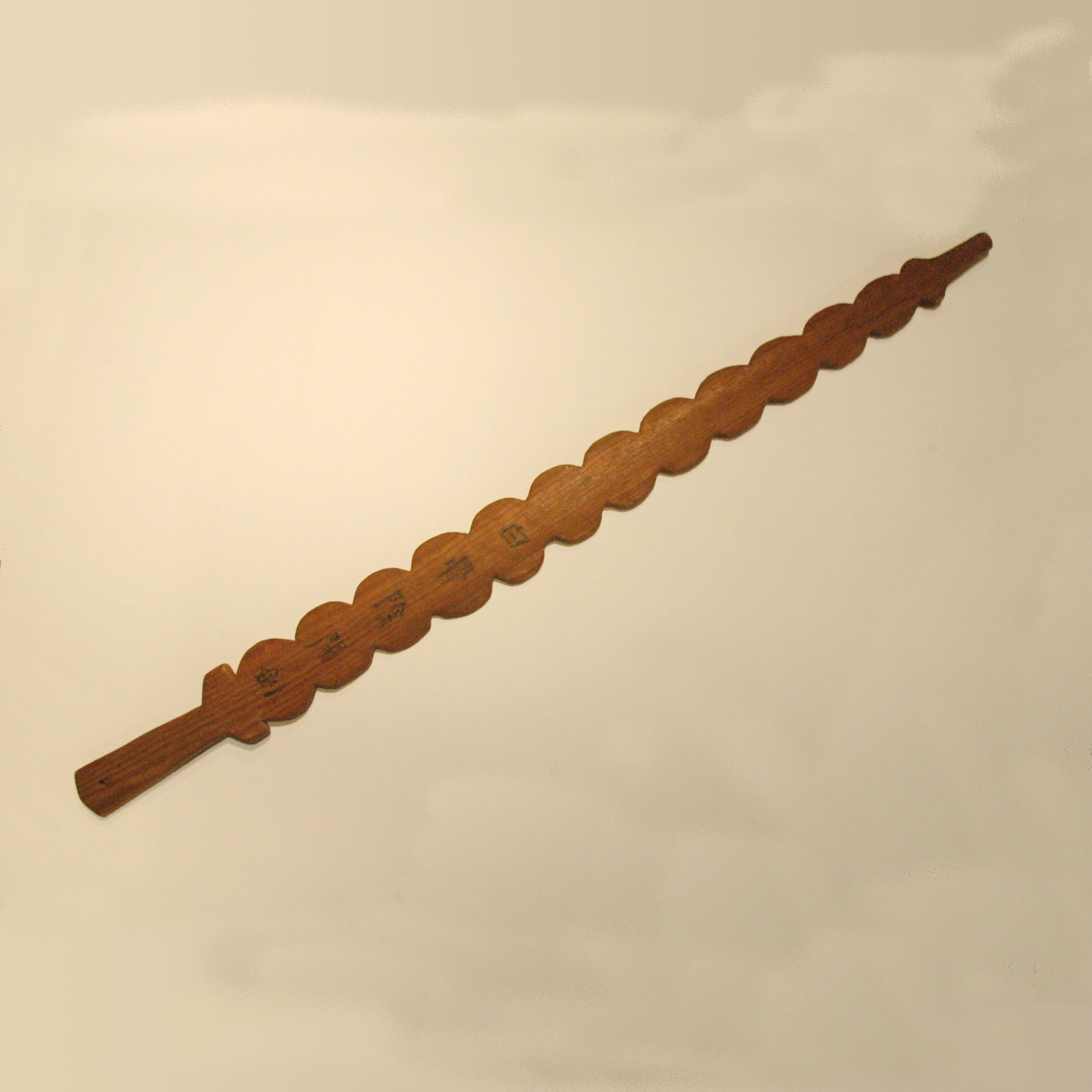
L800xW60mm, Hong Kong

This is the famous “White Bone Yin Yang Sword” which I believe belonged to my cousin.  It was made at the time when fathers would still make toys for the kids then giving them psp, ipad or nds.  The sword is based on the one in the movie “White Bone Yin Yang Sword” staring the teen idol Connie Chan Po Chu.  I am sure many of you would have the Lightsaber, the Star War version of the handmade toy.

L550xW80mm, China

This is a chinese traditional scale used for measuring light weight items such as gold or herbs.  The scale work by the concept of a lever; the item to be weight on one end and the weight on the other.  The weight is slide along until the scale is balanced and from the markings of on the rod, the weight of the item can be told.  The small red tassels are the points for pivots, changing the pivot points will give provide a different range for the scale.  This is a portable scale with a custom made bamboo casing.  The earliest found scale was dated around 700BC; the unit weight for the scale has been changing since, this scale is based on 16 tael to 1 catty, 1 tael = app 37.8g which is the current unit used for the hong kong wet market.

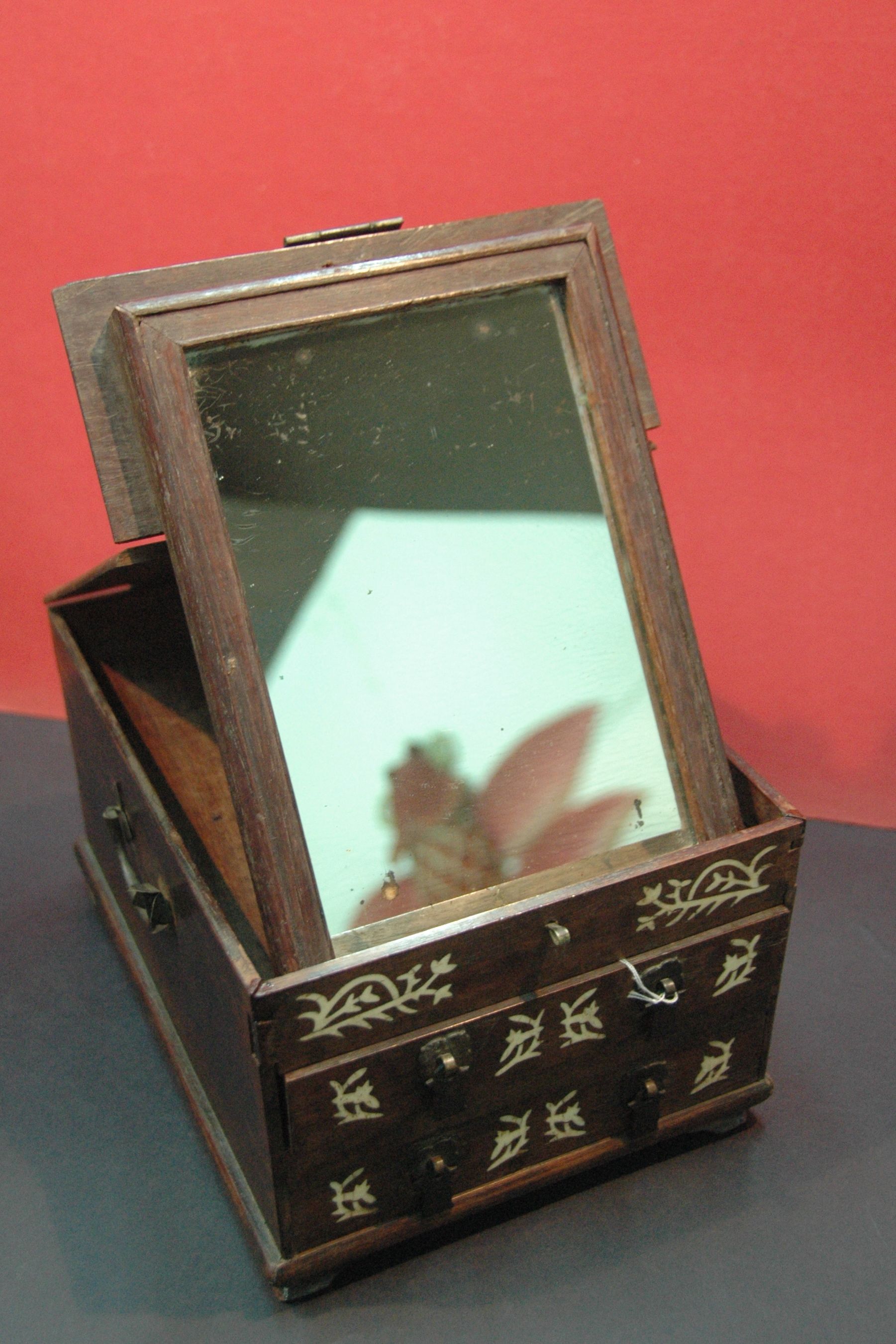
W180xD230xH140mm (300mm when opened), China

Ladies like to put makeup on and look pretty and the Chinese ladies are no difference.  The concept of the Chinese vanity box has been around since the Sung dynasty; the mirror being part of the lid, can be folded away inside the box.  The little drawers store all the essential rouge, eye liners etc.  This box is decorated with the mother of pearl inlay.

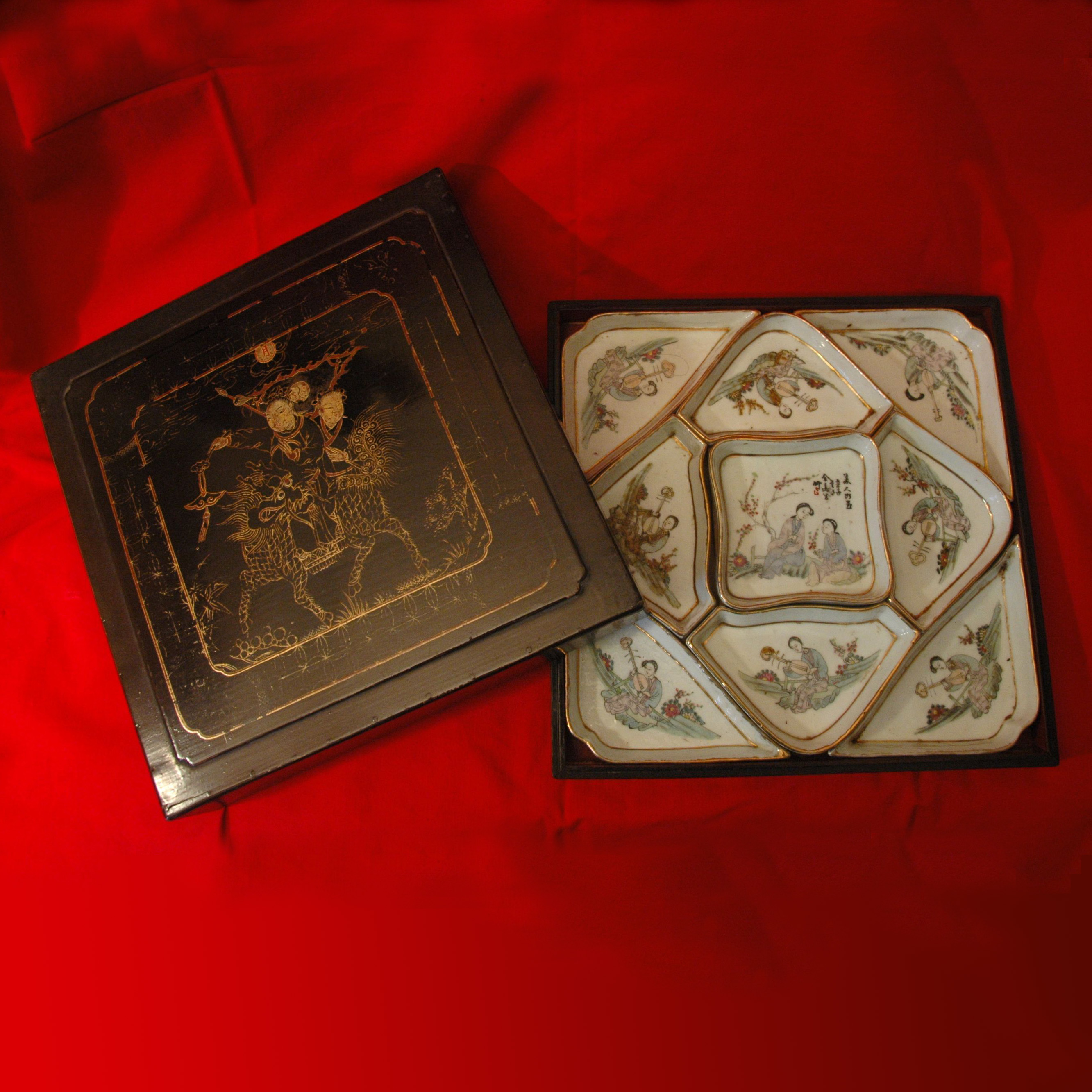
W300xL300xH80mm, China

On Chinese New Year and the few days after, it is traditional to visit family and friends to give them good wishes in person.  Every household would prepare a box filled with goodies to entertain their guests.  The box would contain a set of porcelain dishes so that an assortment of snacks and sweets can be displayed.  The common items to be kept are, melon seeds, sugared melon, coconut, lotus seeds, lotus root, candied kumquat, fried dumpling, sweets, nuts, etc.

L220mm, China

Chopstick has been around in China for more than 3000 years; there has been many material used for making them, wood, bamboo, ivory, bone, lacquered, silver, gold, jade and of course the recent plastic and stainless steel version.  It is commonly believed that silver is used as a material for its ability to detect poison.  Perhaps it is the tarnishing of the silver from the sulphur in arsenic that made the name of the silver chopstick.  Please dont be alarmed by the tarnished silver on this pair of chopstick, it is due to natural oxidation from its age and not from any poison.  The legend of the silver chopstick goes like this; the famous politician of the Zhou dynasty Jiang Zi Ya was once only interest in fishing (with a straight hook) and nothing else.  His wife got fed up with his idleness and decided to kill him and to marry someone else.  One day as usual, he came home empty handed after fishing, his wife had prepared a spiked up meat dish for his supper, just as he tried to grab the meat a bird flew in and packed on his hand.  The bird did it again and again as he tried to go for the meat, sensing something is out of the ordinary, he pretend to chase the bird and left the house.  Up a hill, the bird told him only to eat with the two sticks on the ground where it stood.  Jiang return home and pick up the meat with the sticks as he was told, smoke appears and his wife fainted.  His eating sticks got famous and everyone started eating with chopsticks.  The moral of the story …. men, dont go fishing too often + remember to bring at least a fish home (even if you have to buy it from the supermarket).