Archives for category: tools

DIA150xH220mm, China

This pesto was used as be a medicine grinder; in the old days every household would have a grinder like this for grinning the certain Chinese medicine, herbal, shells, mineral, hones, bones, etc.

The most famous figure for medicine grinding is however not a doctor as we might have thought, it is in fact a rabbit, the Jade Rabbit (see earlier post) that lived on the moon.  Can you spot the rabbit?  This image on the moon can be seen on lunar 15th of every month.

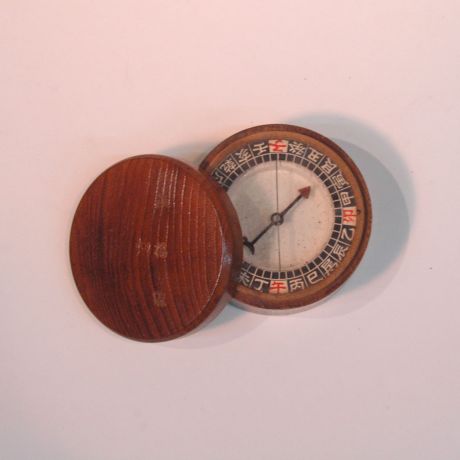
DIA100xH60mm, Hong Kong

This is a compass used by Tanka clan, a clan who lived on junk boats along the coast of Southern China and worked as fisherman.  As it is a day to day object, their compass is more simple then the traditional geomancers’ compass.  The compass for the Chinese is not only for telling the direction but related to space (direction extending to the universe) and time (past and future) as a whole

The Chinese Compass Points

Chinese navigators reduced the compass they inherited from the geomancers to its simplest form, using only 24 points, or even reducing them to 12 or 8.  The dial itself is divided into segments of 15 degrees each, represented by 24 Chinese characters.  These are the compass points, which scholars say were the basis for calculations by diviners and geomancers in ancient times.  These compass points were stabilized in their present system by at least the early 8th century.  These characters used on the compass dial are not the characters commonly used in China to represent directions.  Their origin or etymology is, for the most part, lost in the mists of antiquity.  But scholars have traced many of them back to over 4000 years ago when they appeared on “oracle bones” used to look into the future.  12 of the characters ;  子 zi, 丑 chou,  寅 yin,  卯 mou, 辰 chen, 巳  si, 午 wu, 未 wei,  申 shen, 酉 you,  戌 xu, 亥 hai, have been traditionally grouped together and referred to as the 12 branches.  8 of these character 甲 jia, 乙 yi, 丙  bing, 丁 ding, 庚 geng,  辛 xin, 壬 ren,  癸 gui,  are part of the traditional grouping knon as the 10 stems.  The remaining 4 乾 qian, 坤  kun , 艮 gen,  巽 xun derive from one of the earliest Chinese works on divination, the I Ching.  In very ancient times, the 12 branches were applied to the months of the tropical year and the 10 stems were used to name the ten day week.  Diviners used the stem/ branch combinations of the day, month and year of birth as basis for their calculations and conclusions.  The 12 brances are also associated with the Chinese zodiac; the rat, ox, tiger, hares, dragon, serpent, horse, gost, monkey, cock, dog and bear.  Each of htese creatures is supposed to exercise an astrological influence over a particular 2 hour period of the day, and one year out of every 12.

子 zi – North, rat, 23:00-01:00
癸 gui – N15°E
丑 chou – N15°E , ox, 01:00-03:00
艮 gen – NE
寅 yin – N60°E, tiger, 03:00-05:00
甲 jia –  N75°E
卯 mou – East, hare, 05:00-07:00
乙 yi –  S75°E
辰 chen –  S60°E, dragon, 07:00-09:00
巽 xun – SE
巳  si – S30°E, snake, 09:00-11:00
丙  bing –   S15°E
午 wu – South, horse, 11:00-13:00
丁 ding – S15°W
未 wei – S30°W, sheep, 13:00-15:00
坤  kun – SW
申 shen – S60°W, monkey, 15:00-17:00
庚 geng – S75°W
酉 you – West, cock, 17:00-19:00
辛 xin – N75°W
戌 xu – N60°W, dog, 19:00-21:00
乾 qian – NW
亥 hai – N30°W, pig, 21:00-23:00

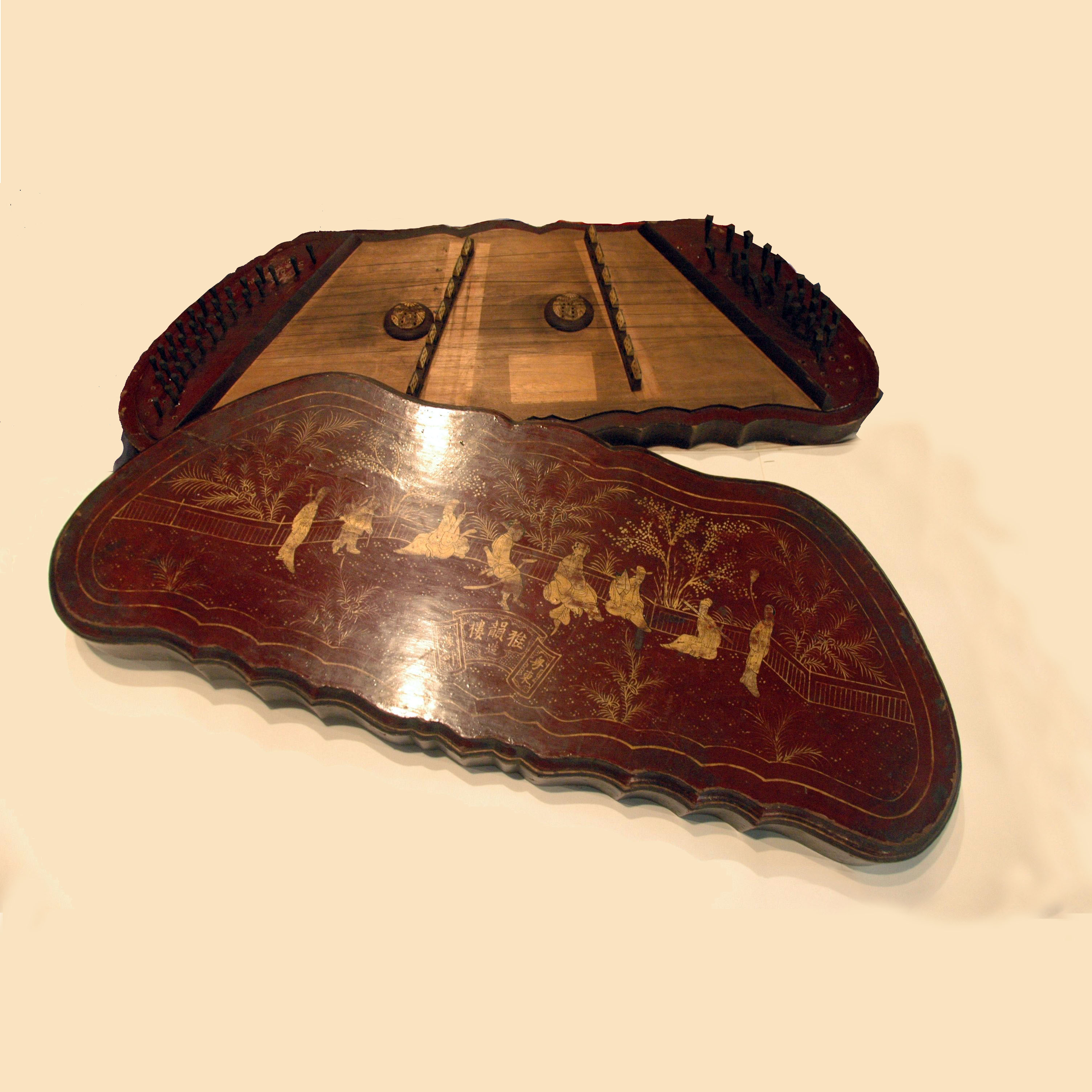
L770xW300xH120mm, China

The Yangqin is Chinese hammered dulcimer, however, the original  instrument was imported from Persia in the Ming dynasty (around 1580).  A similar instrument was very popular in Europe during the 14th century which later inspired the invention of the harpsichord, clavichord, piano forte, and eventually the piano.  There are many different types of Yangquin, the one we have here is a Butterfly Yangqin which is similar to the origin version, it is smaller and only has 2 bridges.  Its sound range is limited to the natural note (the sound from the white keys of the piano).  This yangqin has a lacquered box with beautifully gold painting of the 8 Saints, the instrument  is a bit worn out and would require some fixing and tuning before it can be played.  The instrument was made the the Guangdong Ya Yun Leu.

Performance of the Ode to Yellow River with the Yangqin

Same piece performed on the piano by Lang Lang

W50mmxD30mmxH70mm, China

In the old days, every morning the ink will be grind on the inkstone.  Water will be added so the ink stick will be dissolved, water is also added during the day to dilute the ink on the stone.  For the ease of controlling the flow water, the water drip was invented.

This water drip of child and carp figurine which would have been made for children; the composition is a traditional one of blessing, carp being resilient and full of vitality which is what every parents would wish for their child.    Also see our earlier entry for a different form of  water drip .

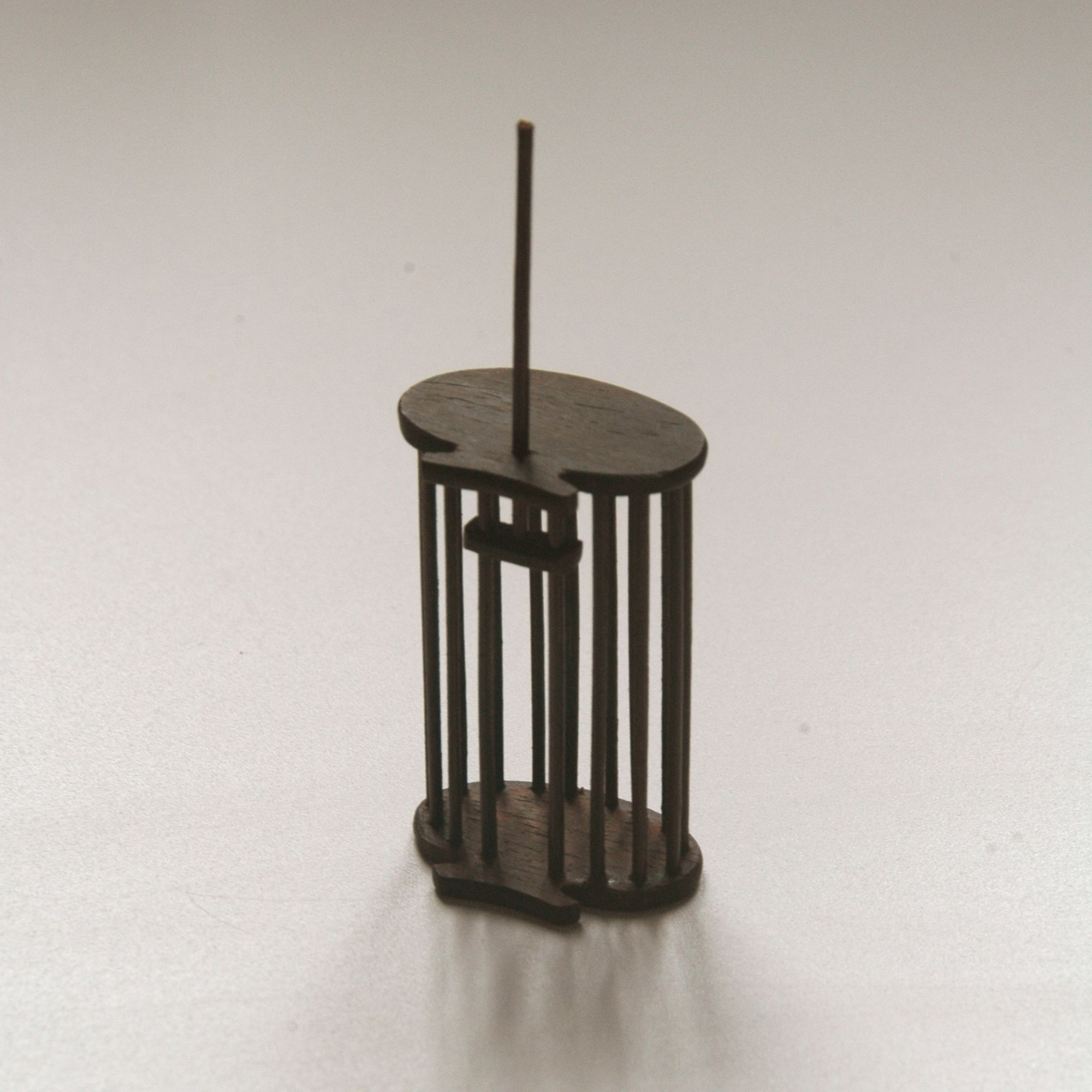
W40xD20xH50mm, China

This is another type of bird feeder, a slight cruel one.  A live cricket or insect treat is put inside the cage which is then attached to the side of the bamboo bird cage, the gate is opened from the outside and here comes “dinner”!  The detail by the gate is for the attachment of the bamboo bar of the bird cage.

Click here for a more traditional bird feeder.

W220xH440mm, China

The fan the matchmaker was holding is made from the leave of a palm tree, this instead is a goose feather fan and its most famous owner is no other than Zhu Ge Liang, the strategist of the San Guo period around 200AD.  Zhu Ge Liang is also known as Kong Ming, not only is he good at military strategy, he is also an inventor and literati, a symbol of intellect (apparently he is real handsome too).  Zhu Ge Liang, despite of the seasonal change, is never without his fan, they are almost inseparable from this gift from his wife.  Once upon a time there is a literati called Huang Cheng Yan, he has a beautiful daughter, to keep her safe from the men around, he named her ugly and she her to learn all sorts of martial arts.  When she completed the martial art apprenticeship her master gave her a goose feather fan.  On the fan is the word Ming and Liang and strategic military plans, her master told her the future husband will have the word Ming and Liang (shiny) in his name.  She married Zhu Ge Liang and gave him the fan as a present, he then had it everywhere he goes, even going with it to war.  It seems the fan is not only representing the love between the couple but a bible for military strategy.

DIA40xH200mm, China

Ever wonder how to clean the cast iron wok?  Here is a Chiu Shu, Chiu anything related to cooking while Shu is the plant sorghum.  The hair of the brush is indeed made with the tip of the sorghum stalk.  In China the gain of the  plant is most famously use to made into a strong wine.

L130xH30mm, China

Tobacco was imported to China in the 17th century through Spanish trading.  The smoking pipe soon developed into different Chinese variations (see entry Pipe, Water Pipe).  This dragon shaped ceramic pipe is probably made for export to the West, it is made by slip case.

TOBACCO SERIOUSLY DAMAGES HEALTH

W160xD55xH90mm, China

Anyone know what is function of this tool?  Advice needed!
A small gift will be sent to the person with a convincing answer.

What I have been thinking so far;

  • the bottom curve is similar to that of a rolling machine (e.g. fire cracker roller)
  • a rod can be fixed through the circular hole with a wooden pin then attached through the top opening
  • the pin will be limited the rolling extend of the rod

My idea has came from the fire cracker roller machine where the bottom curve acted as a roller producing hollow paper tubes for the fire cracker.

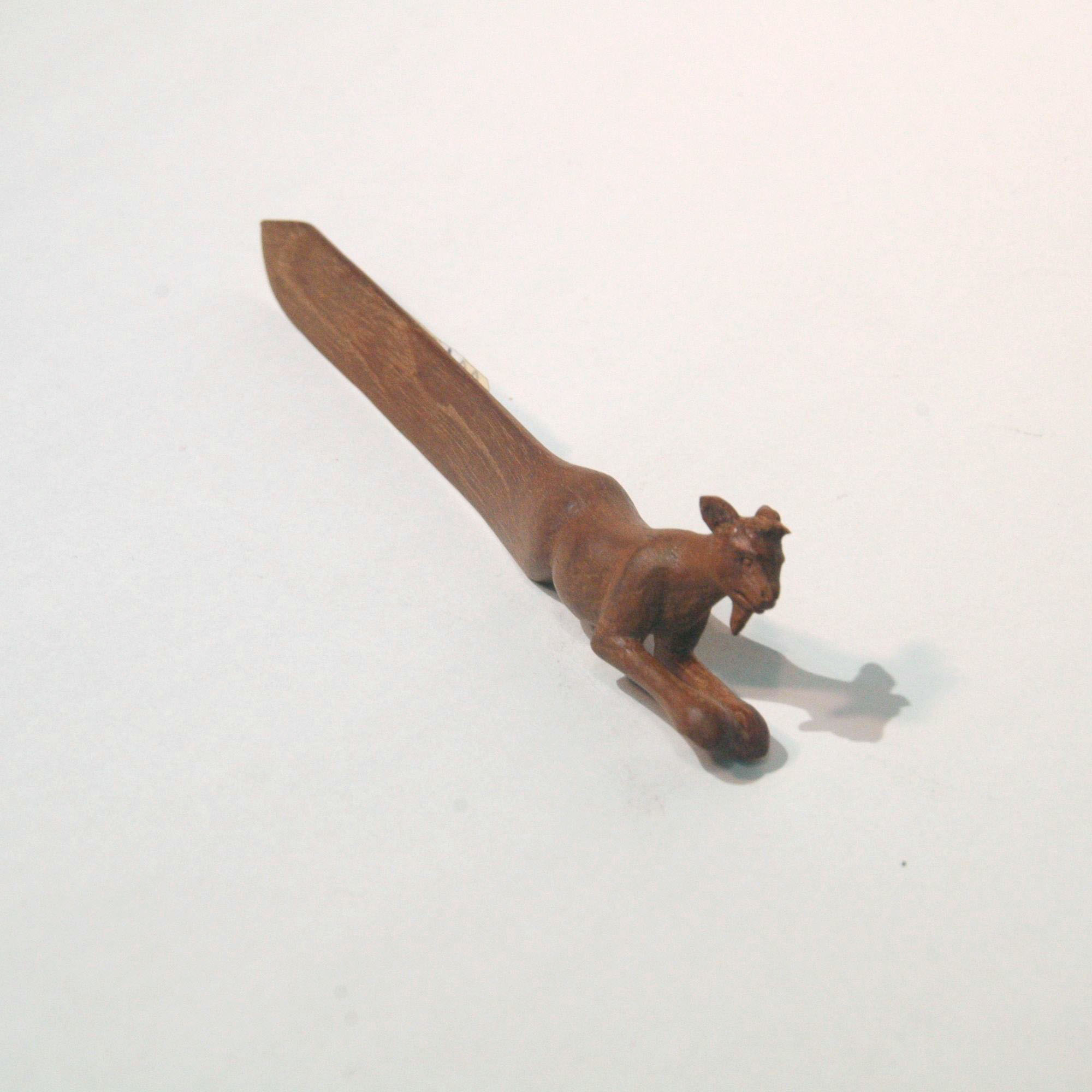
L150mm, Indonesia

This is a wooden letter opener with a goat figurine as a handle.

I would like to share with you a lamb satay recipe.

SATE KAMBING (make 15 skewer)

INGREDIENTS

  • 500g spring lamb (cut into W25xT20mm slices)
  • satay sticks
  • diced cucumber
  • peanut sauce
MARINADE
  • 6 shallots (chopped)
  • 3 cloves garlic (chopped)
  • 2 lime leaves (chopped)
  • 100ml soya sauce
  • 1tsp chili powder
  • 1.5tsp ground coriander
  • 1.5tsp ground cumin
  • 1.5tsp cayenne pepper
  • 1tbs brown sugar
  • 2tbs peanut oil
  • salt
METHOD
  1. marinate the lamb slices in the fridge for 10-12 hours
  2. grill the shewered meat, ideally over charcoal, until cooked
  3. dipped in peanut sauce and enjoy with the cumcumber