Archives for category: pottery

DIA130xH30mm, China

This was at the one time the most common bowl in the Guang Dong and Min Nan area, a bowl that is used in homes, street hawkers and local eateries, now a days they have been replaced by the durable plastic ware   Each bowl is hand printed with rooster, plantain and a flower.  There are a reasons of how the rooster made it to be the decoration for this popular bowl.

For the Chinese, the rooster is a protector of evil (see post Clay Rooster Whistle), it has also contained the 5 Chinese virtues (Knowledge = comb, Strength = footing distance, Bravery = fighting its enemy, Benevolence = calling others to feed, Credit = crowing every morning).  And finally, in the old days meat is a scarcity for common people, dishes are often decorated with chicken or fish to spice up the meal.

This item selected by Furze for the Something Old Something New exhibition and is available at both Mountain Folkcraft and Soil.

DIA 150xH50mm, China

This item selected by Furze for the Something Old Something New exhibition and is available at both Mountain Folkcraft and Soil.

This is a folk version of the double happiness bowl; on the refined version the bowl is decorated with the word 囍 (double happiness) and a winding stem pattern that is popular in the Qing dynasty.  While the design is passed down from an official kiln to a commoner’s kiln, the design is abstracted over generation of craftsman.  This is likely to be due to that the craftsman are mostly illiterate and the design was taught to the young apprentice almost as a symbol from their master who has learnt it the same way.  Nevertheless, this abstracted bowl is known to them also as the double happiness bowl, equivalent to the original item.  The painter Wu Kuan Chung made this observation about the under glaze decoration of commoner’s kiln; some ideas which was inspired by daily life, they can being transformed into another type of art form by subtraction, multiplication or other means as long as it is still tied to the origin of living.

Can you spot the work 囍 and the scrolling foliage pattern?

Here are some hints;
the first 2 are folk version of a less simplified bowl and the last being a more refined version.  (I somehow preferred the abstracted version)

Answer: the pattern that looks like # is the word 囍 and the three circle is part of the scrolling foliage  pattern.

春 023

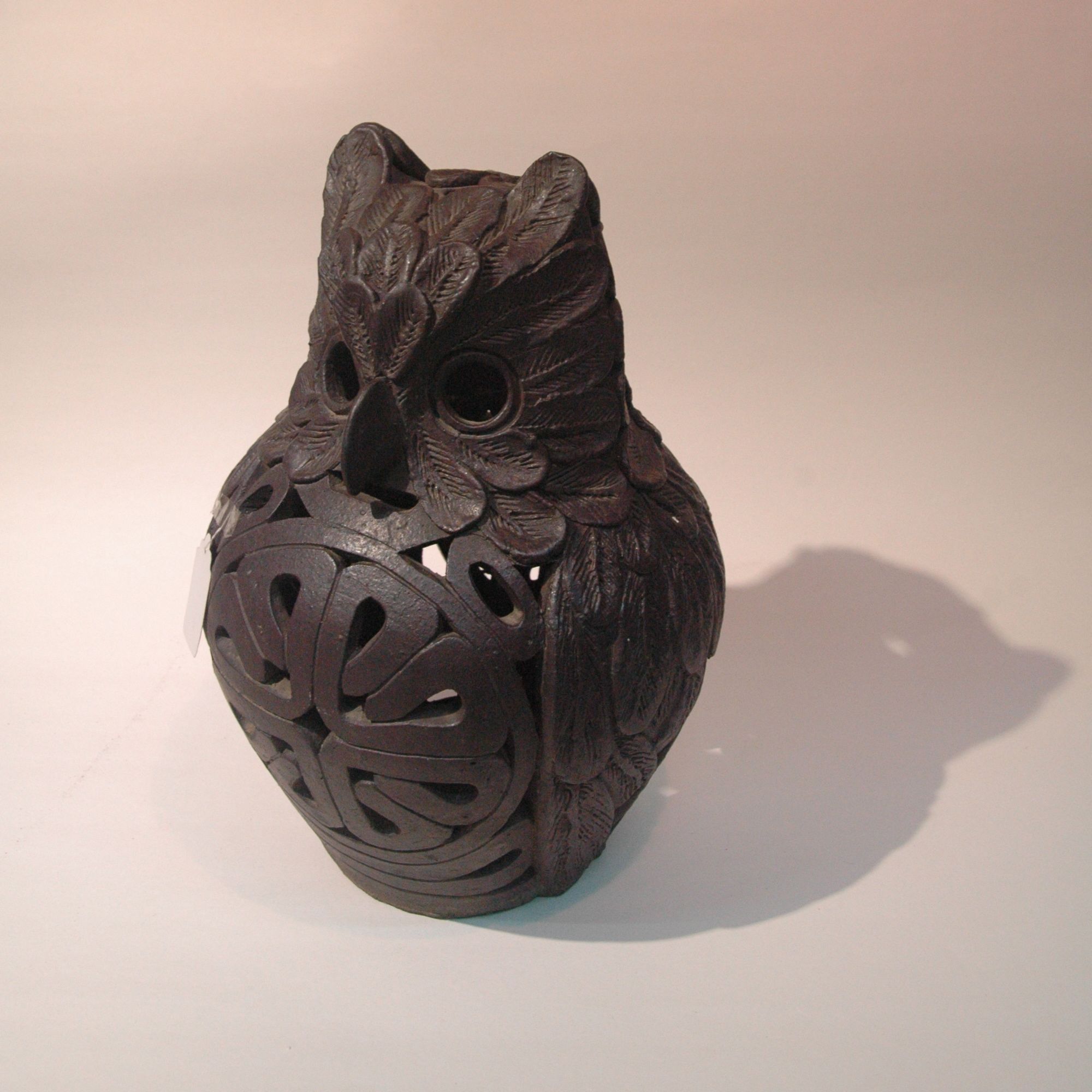
DIA220xH350mm, Thailand

This earthenware is from Dan Kwian, the pottery village in Thailand.  The pottery there is known for its rust like colour which is the result from the high iron oxide content in the clay that were used.  The clay are collected from the nearby Moon River where the Kha tribe used to live, it is believed that they were the original potter of the area.  The style and shape of the pottery has been passed down and even now traditional technique are still used by the potters.

L210xD130xH60mm, China

This is a celadon daffodil bowl, yes celadon is not limited to the pale jade green glaze, it also can be white, grey, blue or yellow.  The cracks on the bowl are only on the glazing itself and has no impact to the bowl, this characteristic is known as crackle glaze.  This effect for the randomness which mimic nature has been appreciated by the Chinese since the Sung dynasty.  However, this texture started off as a defect in the firing process; the clay and the glaze having a different expansion ratio.  This crackle style is known as “a hundred broken pieces”.

For more about daffodil, click on Blue Glazed Narcissus Bowl.

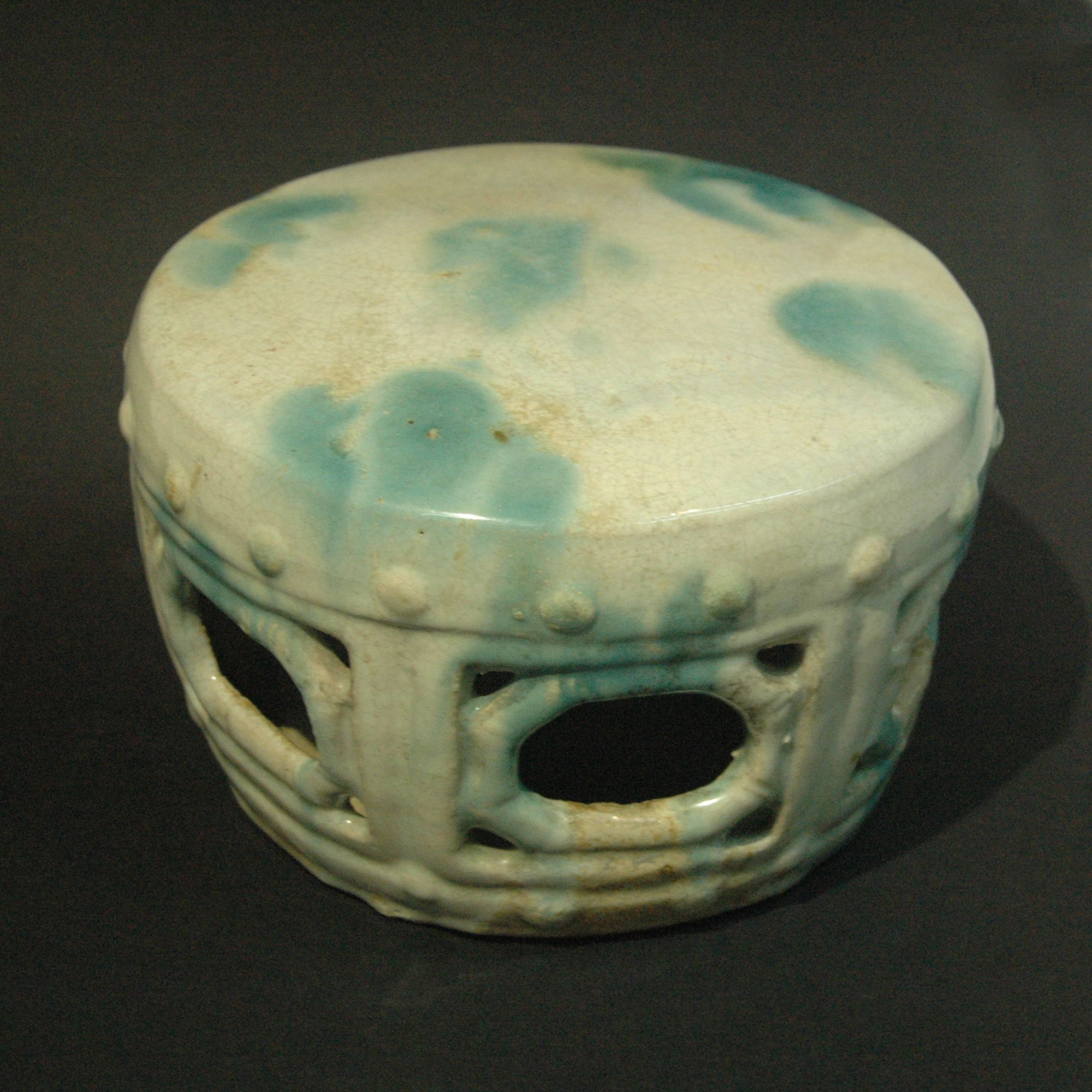
DIA190xH120mm, China

You have probably seen a larger version of this in a Chinese garden before, a stool for sitting on for the ladies.  It is called a Gu Dun, the word “Gu” means drum and as you can see the top of this pottery has decoration resembling a piece of leather held taut like a drum.  The Gu Dun was originally made in wood and later also made with pottery, porcelain, stone and lacquer.   You can see in the Sung painting below that it is already a popular chair at that time and the most recent design is perhaps Philip Starck’s Bonze Stool.

The one featured in the post today is a miniature decoration piece which is made in the form of a Gu Dun.

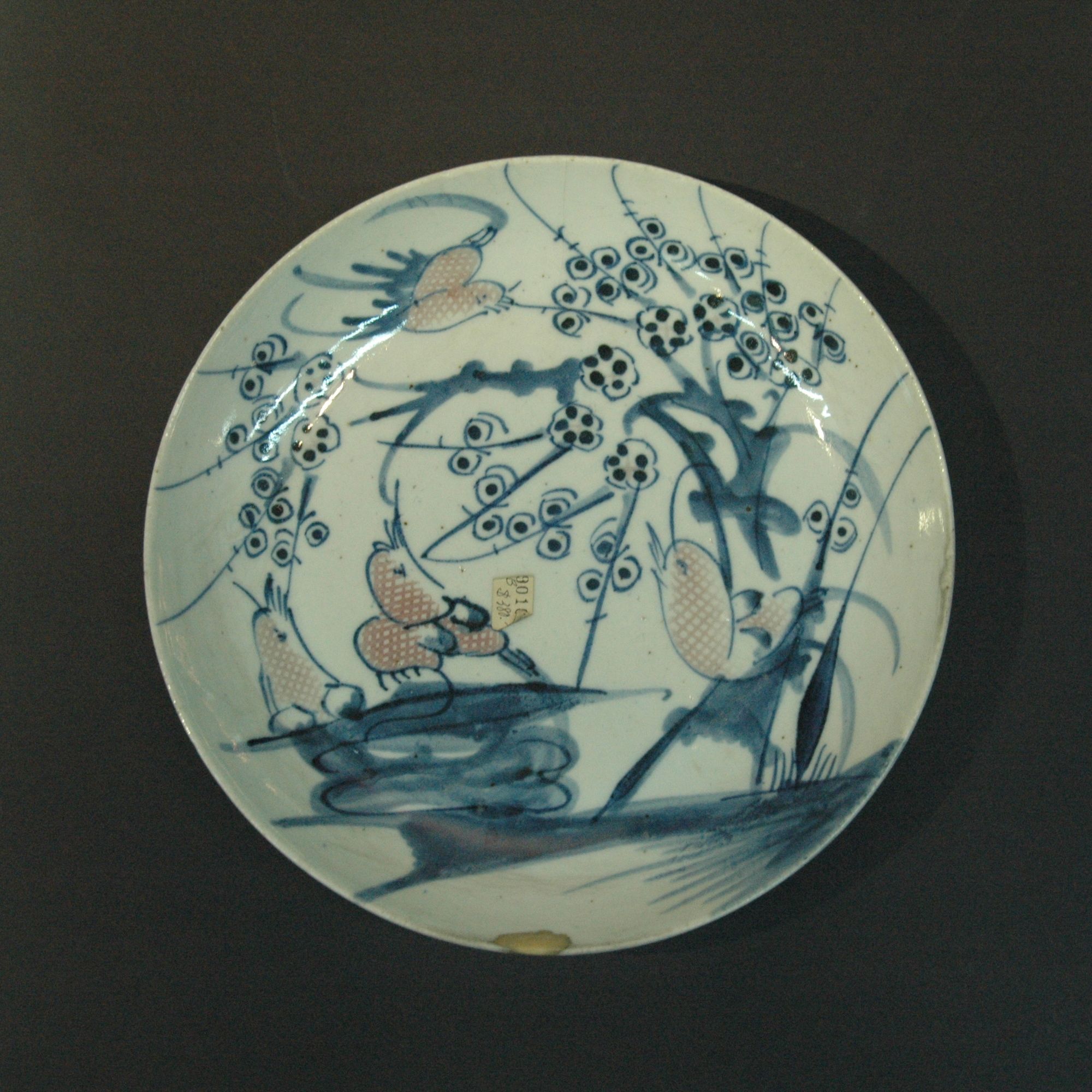
DIA250mm, China

The composition of this plate of the bird and the plum blossom which gave the plate its name – plum & bird plate.  The theme of bird and plum tree can be found on painting, pottery, jewellery, stationary, etc.  The pair sometimes are fighting for the attention of spring and sometimes delivering good news, they are often seen together.  Plum tree blossoms in the spring time, a start of a new year, both a sense of joy and happiness.  The bird, pica pica, is a special bird, according to the Chinese “Book of Birds” (around 500B.C.), the pica pica is capable of telling the weather – “If it sings with its head upwards it will be sunny, if it cries with its head facing down it will rain, people will be happy just listening to it sing”.  Looking at the plate, it seems weather will be good tomorrow, have a nice day everyone!

Though it is not a pica pica (magpie) and it didnt sing, nevertheless its a nice clip.

W40xL60x10mm, China

This pendant is made from a piece of broken ceramic, from the shape of the piece it is likely to be of a medium size jar or a vase.  The figure on the piece is part of the a war story, these figures or themes are known as Knife-Horse-People which is a popular theme in the Qing dynasty.  See here for the clay version of Knife-Horse-People.

Though completely different, this ring seems like part of the portrait jewellery collection.

W200xD100xH250mm, China

Although the god of longevity originated from the stars, his large and elongated brain has nothing to do with the alien and the outer space.  The form of his head is associated with longevity, like that of  the mystical bird, the red crown crane (grus japonensis).  The red crown crane lives to 50-60 years old  which is consider to be very long when the average life span of birds are about 10-15 years.  Another association is queen mother god’s longevity peach which the plant only flower and bear once 3000 years.  Combining both of these longevity forms his head took on the exaggerated shape.

Click  to see our clay and stone version.

DIA180xH270mm, China

The Chinese started making wine some 5000 years ago and the container developed from bronze to lacquer, then to clay and porcelain.  This blue and white porcelain is one that is used by regular folks, this kind of flagon are bold in form and in the pattern different from the usual blue and white porcelain ware.

The traditional Chinese unit for alcohol are measure in sheng, dou, dan.
1 dan = 10 dou
1 dou = 10 sheng
1 dou = app. 6000ml

This flagon holds about 2 dou.

If you can also hold 2 dou of Chinese wine, check our the Wine God wood block print!

DIA80xH60mm, China

No, this is not rudolph.  Yes, the red nose is missing.  For the Chinese, not only does the deer symbolizes longevity, it also represented success as an official.  This cute container is a the base of a mortar, its small size suggest its for grinding medicinal seeds or nuts, e.g. garlic, pepper etc.