Archives for category: paper

wood block printW220xL300mm, China

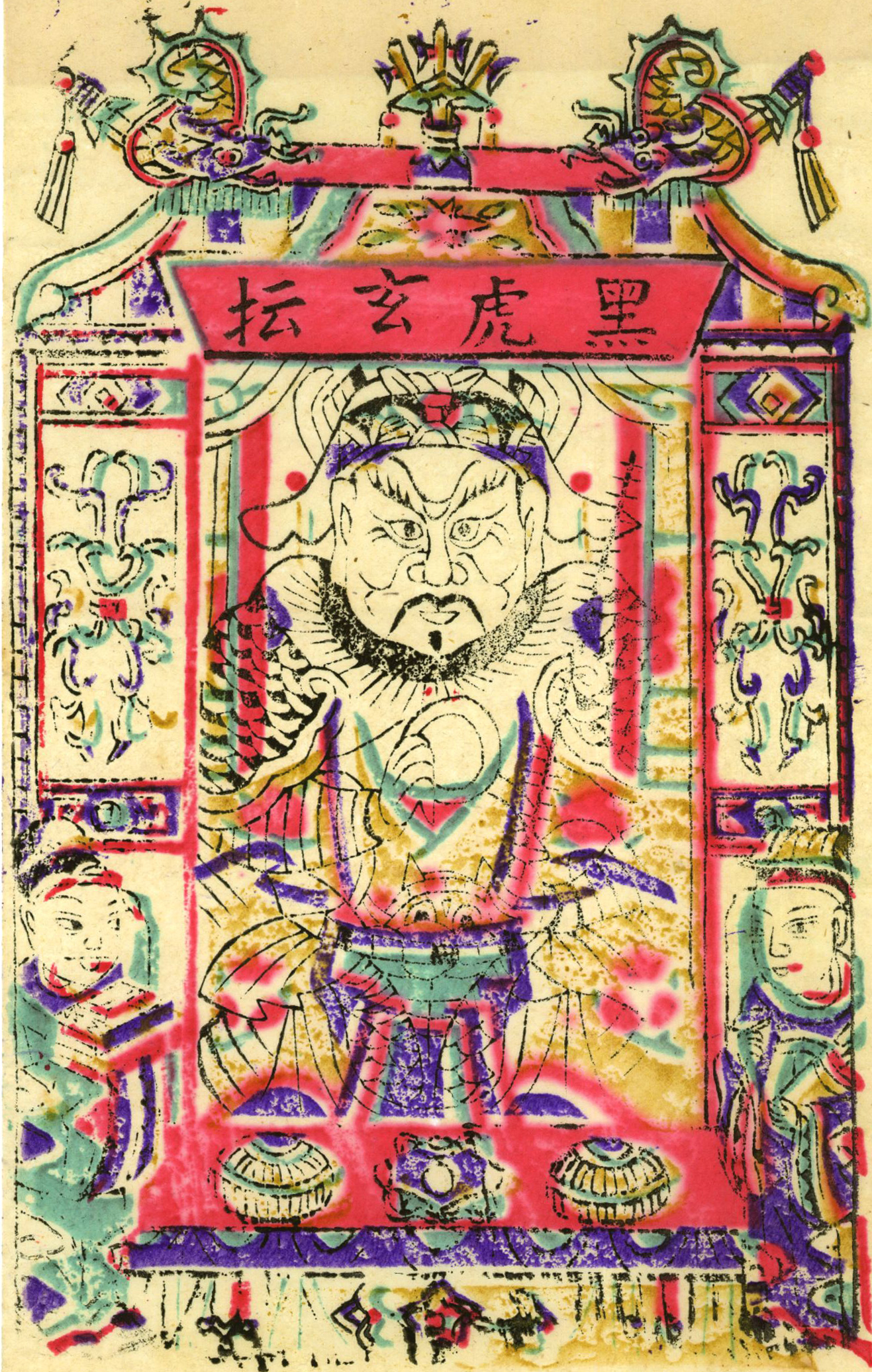
A new year wood block print of the God of Wealth, Zhou Gong Ming.  It is believed that Zhou was born in humble family in the Qing dynasty.  As a young he worked as a labourer for a wood merchant, being honest, generous and hard working he was popular.  Soon he was able to start his own wood business and accumulated a good deal of wealth.  Zhou would lend money to those who need them; one merchant borrowed some money and made a lost at a natural disaster, Zhou only asked him to return a pair of chopstick for the money owned.  At time of war, Zhou used his own money to fund an army in support of his country and headed the army himself.  He bravery was well known and even tamed a troubled tiger as a pet.  In most of the God of wealth icon, this black tiger is at his company, here you can see it half hidden inside his coat.  Because of his generosity and bravery he was worshipped after his death and named the God of Wealth.

Click here to see our other items of the God of Wealth and the mystical version of his life.
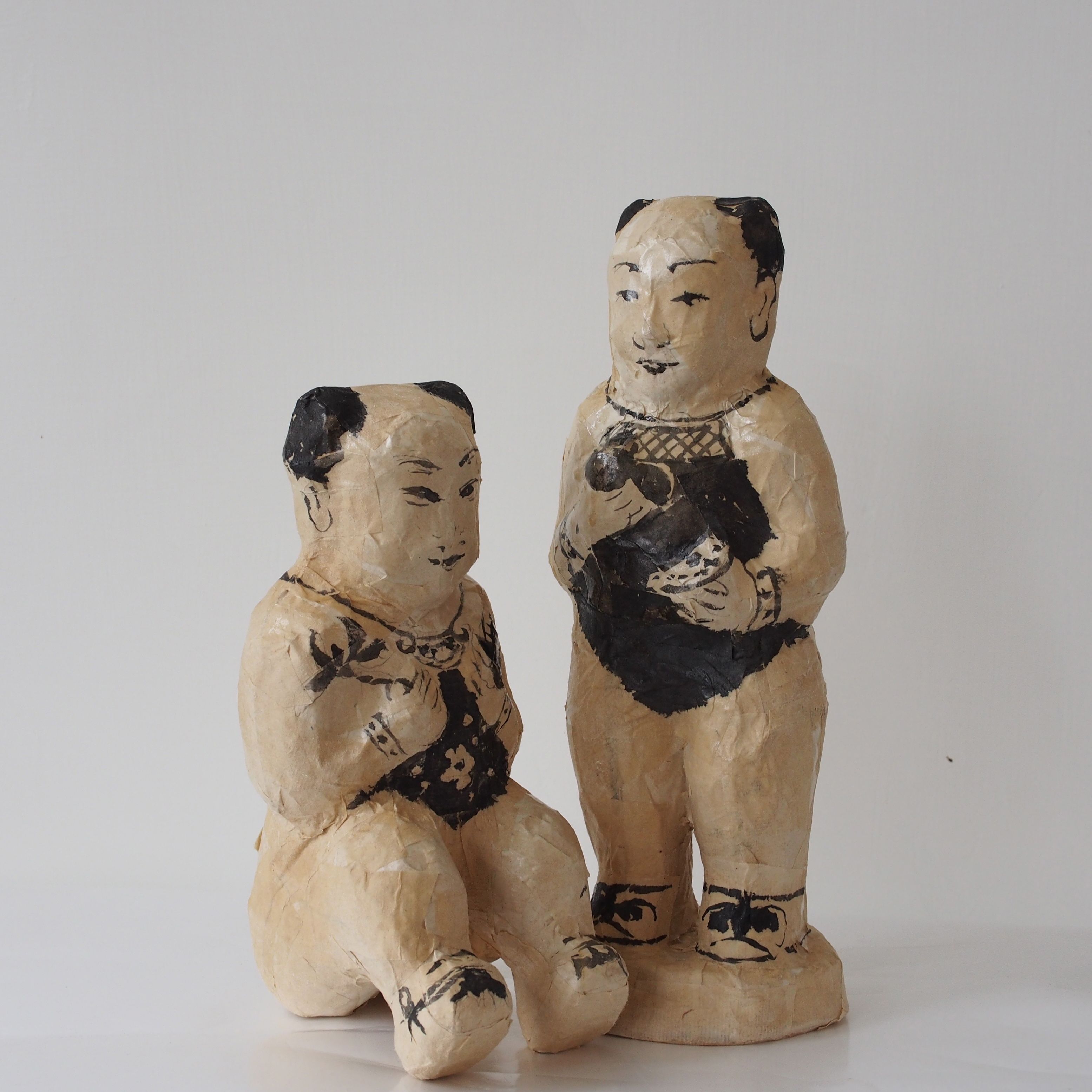
paper mache dolls

sitting W110xD140xH220mm, Hong Kong

Cute pairs of paper mache dolls inspired by the Ci Zhou kiln dolls.

They are the first in the series, stay tune for their transformation!

yang liu qingL1140xH660mm, China

This Yang Liu Qing print is about the story “Wenji Reurning to Han”.

Wenji, was the daughter of the scholar Cai Yong, equally well learnt she was tributed to have revived some important ancient literature that was lost during the war.  Wenji though has a rather tough life; her first husband Wei passed away and during the war she was kidnapped by the Huns tribe and made to be the queen of the Hun king.  The king treated her well, they had children and soon Wenji though missing home was well settled in Hun.

Meanwhile her father Cai Yong was jailed and died for his support of a declined politician.  The story would have ended here if  emperor Cao Cao has not suddenly missed his friend Cai Yong and thought of his daughter.  Emperor Cao requested for her return to Han, though unwilling the Hun king dared not disobey and reluctantly send the mother of his child home to Han.  Feeling the sorrow as she departed her Hun family, Wenji wrote the poem “Eighteen Stanzas for a Barbarian Reed Leaf Pipe”

Happy to see her, Emperor Cao Cao felt bad that she is all alone and without a family so he arranged for her to be wedded to an official named Dong.  Unfortunately, Dong committed some crime and received a death sentence.  Wenji fearing she will lose yet another husband went to see Cao Cao and begged for his pardon.  Moved by her action, Cao Cao ordered for Dong’s release and chatted with her about her father’s literature.  Wenji told him that all the 4000 odd books were destroyed during the war but she could still recite 400 out of the 4000. Cao Cao was excited to record the lost literature and Wenji wrote them down word for word.

Click here to see our other Yang Liu Qing prints.

fan

DIA600mm, Hong Kong

心經  The Heart Sutra

bō rě bō luó mì duō xīn jīng
般若 波羅 蜜多心 經
guān zì zài pú sà, xíng shēn bō rěbō luó mì duō shí,zhào jiàn wǔ yùn jiē kōng
觀自在菩薩, 行深般若波羅蜜多時, 照見五蘊皆空,
dù yī qiē kǔ è 。 shè lì zǐ, sè bú yì kōng ,kōng bú yì sè,
度一 切苦 厄。舍利 子,色不 異空, 空不 異色,
sè jí shì kōng ,kōng jí shì sè。 shòu xiǎng xíng shí, yì fù rú shì
色即 是空, 空即 是色。受想 行識, 亦復 如是。
shè lì zǐ, shì zhū fǎ kōng xiāng, bù shēng bú miè, bú gòu bú jìng,
舍利子, 是諸法空相, 不生不滅, 不垢不淨,
bù zēng bù jiǎn, shì gù kōng zhōng wú sè, wú shòu xiǎng xíng shí, wú yǎn ěr
不增不減, 是故空中無色, 無受想行識, 無眼耳
bí shé shēn yì, wú sè shēng xiāng wèi chù fǎ, wú yǎn jiè, nǎi zhì wú yì shí jiè,
鼻舌身意, 無色聲香味觸法, 無眼界,乃至無意識界,
wú wú míng, yì wú wú míng jìn, nǎi zhì wú lǎo sǐ, yì wú lǎo sǐ jìn
無無明, 亦無無明盡, 乃至無老死,亦無老死盡。
wú kǔ jí miè dào, wú zhì yì wú dé,yǐ wú suǒ dé gù
無苦集滅道, 無智亦無得,以無所得故。
pú tí sà duǒ, yī bō rě bō luó mì duō gù, xīn wú guàài。 wú guà ài,
菩提薩埵,依般若波羅蜜多故,心無掛礙。無 掛礙,
gù wú yǒu kǒng bù, yuǎn lí diān dǎo mèng xiǎng, jiū jìng niè pán
故無有恐怖, 遠離顛倒夢想, 究竟涅槃。
sān shì zhū fó, yī bō rě bō luó mì duō gù, déā nòu duō luó sān miǎo sān pú tí
三世諸佛, 依般若波羅蜜多故, 得阿耨多羅三藐三菩提。
gù zhī bō rě bō luó mì duō, shì dà shén zhòu, shì dà míng zhòu
故知般若波羅蜜多, 是大神咒, 是大明咒,
shì wú shàng zhòu, shì wú děng děng zhòu。 néng chú yí qiè kǔ, zhēn shí bù xū
是 無上 咒, 是無 等等 咒。能除 一切 苦, 真實 不虛。
gù shuō bō rě bō luó mì duō zhòu。 jí shuō zhòu yuē
故 說般 若波 羅蜜 多咒。即說 咒曰:
jiē dì jiē dì,bō luó jiē dī,
揭 諦揭 諦, 波羅 揭諦,
bō luó sēng jiē dī, pú tí sá pó hē
波羅 僧揭 諦,菩提薩 婆訶。

The heart Sutra is about emptiness;  things exists only through our minds… Thoughts, ideas, names, concepts. Nothing really exists on their own sides.

Here is the Dalai Lama’s teaching on the Heart Sutra and the 37 Practices.

tiger paper cutoutW180xL180mm, China

This special paper cutout is made for traditional window lattice; to be able to fit into the small lattice frame the paper cutout are normally of a small size.  To make a bigger pattern, this tiger has been divided into 4 pieces to be paste onto the four interior corner the lattice frame to combine into a tiger.  These paper decorations are called chuang hua (window flower), they are removed and paste a fresh on every Chinese New Year as a projecting of hope and blessing for the year ahead.

Tiger from the Chinese is a symbol of blessing, an admiration for this strength and bravery, a popular theme for children

umbrella

DIA990xH650mm, China

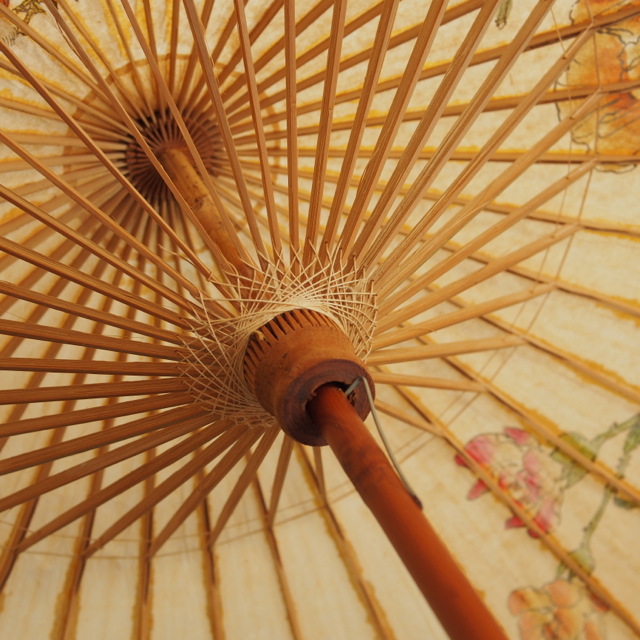
Typhoon Usagi just departed and its raining cats and dogs but this umbrella is probably too delicate to embrace the serve weather – a paper umbrella!

The paper is made from mulberry tissue paper coated with tung oil (oil extracted from the fruit of tung tree, Aluerites fordii Hemsi).  The structure is made delicately with bamboo.  These umbrellas are very durable, I had a plain dark blue one which lasted through my teen years.

OLYMPUS DIGITAL CAMERA OLYMPUS DIGITAL CAMERA

print2

W220xL300mm, China

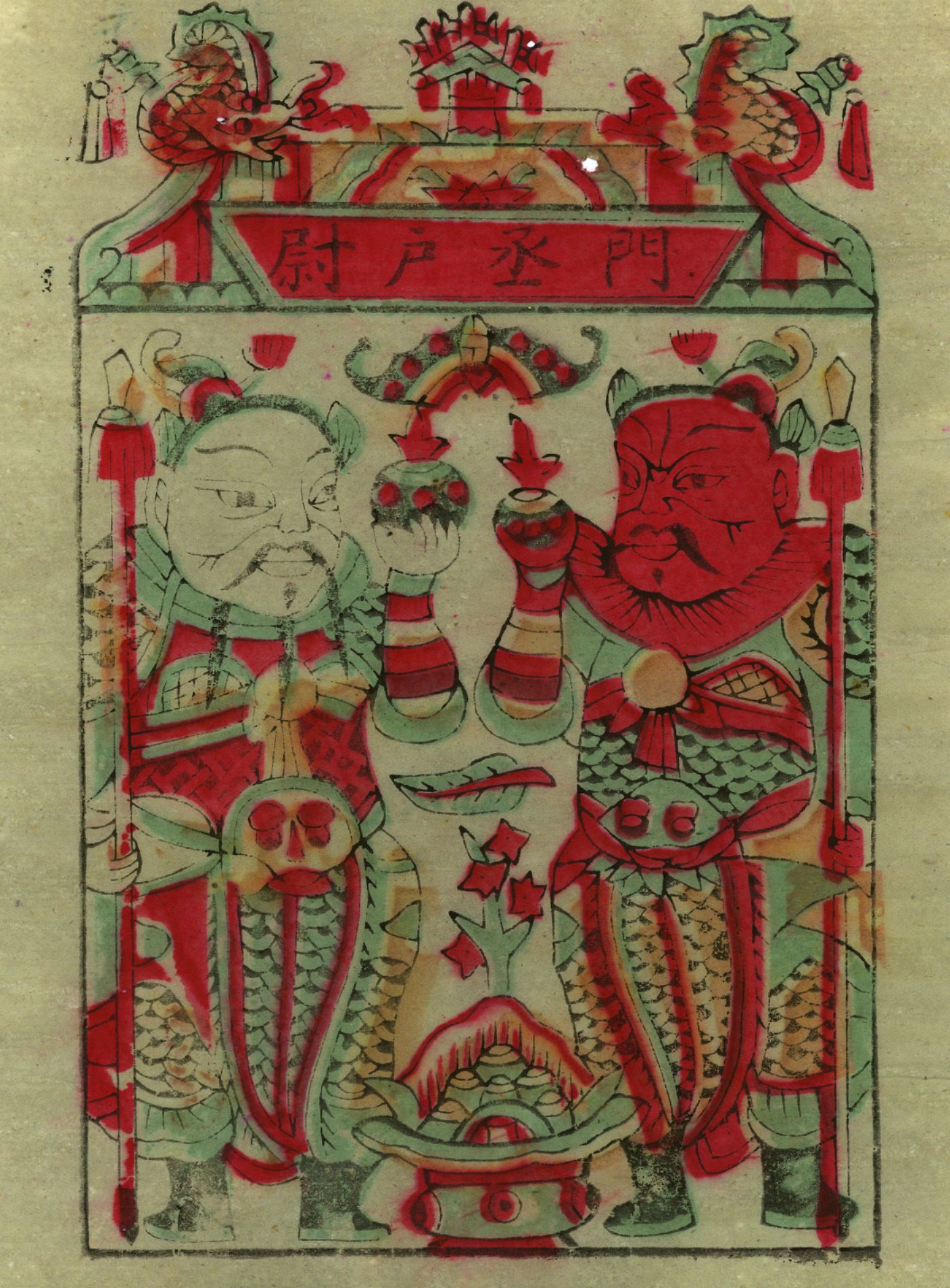
There are many door gods, the most famous and the original ones are Qin Qiong and Wei Chi Gong.  The two generals have been keeping the ghosts away from the imperial court. the Tang Emperor felt sorry for their long shifts and ordered portraits to be put up on the doors to give them a well deserved break.  Click here for the full story.  Traditional Chinese doors comes in pairs and a print of the individual door god would be posted on both doors.  This particular prints has two door gods, the one with the white face on the left is Qin Qiong (門丞) and Wei Chi Gong (戶尉) is on the right, this print is made for single door.

The four words on the print “門丞戶尉” refers to the two door gods, but funny enough with the four words mixed up as “門尉戶丞” it became a Taoist spell for healing the sick.  The procedure apparently goes like this (please don’t try this at home);

take a rooster with lush feathers,
hold a knife with your right hand and the rooster on the left,
go to the house of the sick,
inside of the house take 3 steps and on each step say the spell,
“門尉戶丞,某甲病蠱,當令速出,急急如律令”
(門尉戶丞, so and so’s sickness, expel at once, promptly take the order)
then put the head of the rooster in the mouth of the patient 3 times,
take the knife and draw blood from the rooster’s comb,
mixed the blood with 100ml of white spirit for the patient to drink.

… if the patient was not very sick before … he probably would be now …

printL380xW260mm, China

This is a black and white line print from the Yang Jia Bu school of new year print.  The Yang Jia Bu school is set in a small village in the Shan Dong province, it is most flourished in the Qing dynasty.  The school is famous for the subject matter of the prints, new subjects are added yearly with reflection to the society and as time goes by became a source of documented life of the commons.

The two phrases on the print, “花能解語 晚玉生香” has been quoted in a few of the notable Chinese literature, The Romance of The West Chamber, Water Margin, The Golden Lotus and The Dream of the Red Chamber.  The phrase were praises to a woman; a woman can be as beautiful as a flower but the flower cannot understand words, a woman can be as beautiful as a piece of jade but jade is without fragrance.

washi coster

W150xL150mm, Japan

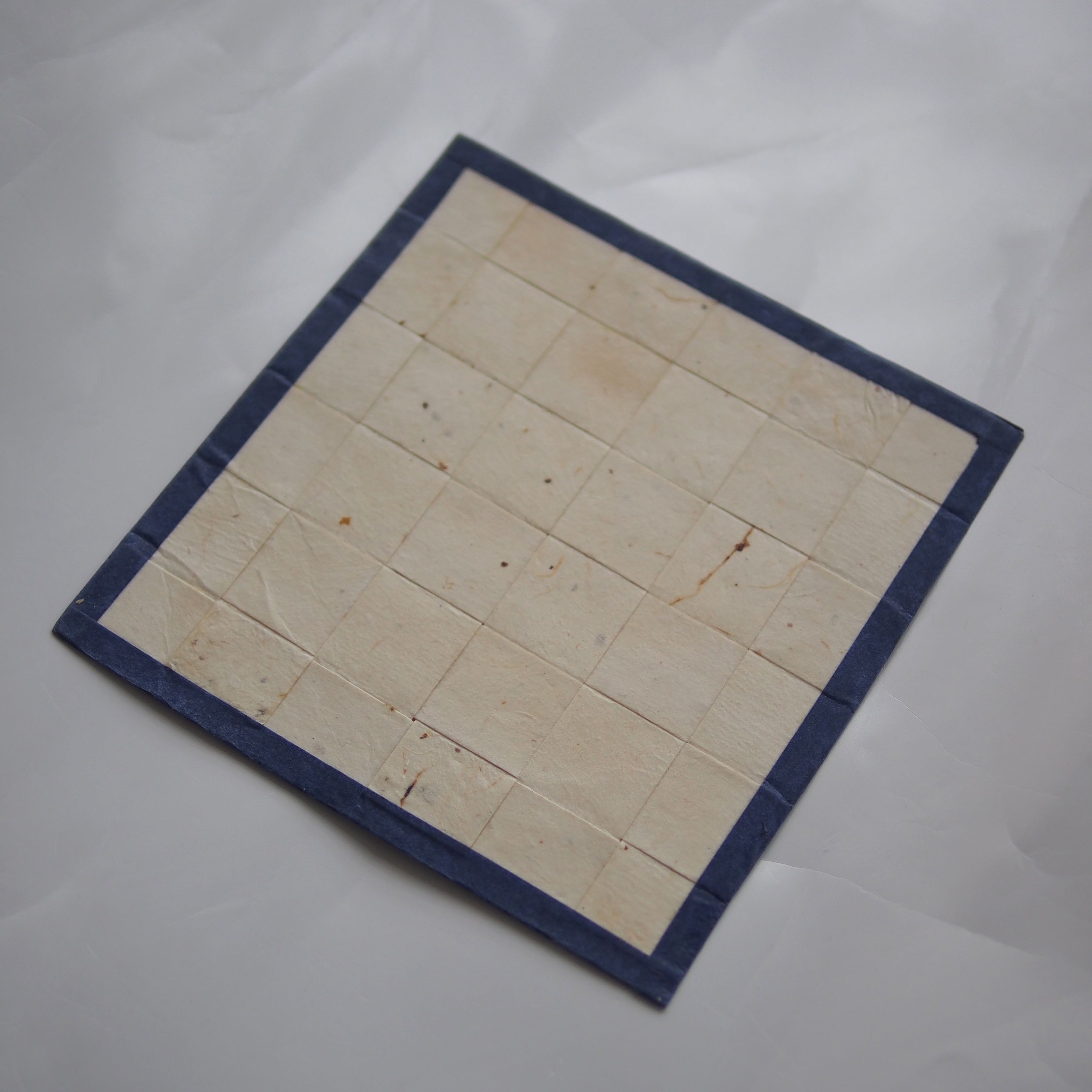
A simple coaster made of handmade Japanese paper, washi.  The paper is treated with water resistant coating to make the coaster more durable.  It is part of the collection from the Otake Japanese Paper Workshop in Hiroshima, the workshop is set up to promote and to continue the art of Japanese handmade paper.

paintingW260xL750mm, China

This painting consists of illustration of the epic Ming dynasty novel “Journey To The West” which is described the journey monk Xuan Zang and his three disciples Sun Wu Kong (monkey), Zu Ba Jie (pig) and  Sha Jing (saint banished to the mortal world) took to the West to find the holy scripts.

I remembered as a child, the novel has been an entire summer’s entertainment.
Here is one of the many adventure described in the book.