Archives for the month of: December, 2011

W100xD40xH110mm, China

This whiskey flask shaped cage is for keeping crickets.  Chinese have been keeping crickets since the Tang dynasty, however, very few of them as been kept as pet but rather as fighters.  Cricket has a life span of around 100 days, cricket match traditionally take place in autumn, it is said that the word “autumn” 秋 represented 2 crickets.  Cricket fight is banned in Hong Kong, so good to say that those raised here are only as pets for admiration.   This cage has 3 compartments, 2 small ones on the upper deck and 1 at the lower deck.  As each male cricket need to be  isolated to avoid conflicts, 3 can be raised in this single cage.  As in all the Chinese bamboo cage design,  if you look closely at a gate, one of the bars is shorter, this acts as a safety lock so that the gate cannot open accidental.

For a more natural cricket cage, see the entry gourd cricket cage.

W60xH120mm, China

These opera dolls have been a popular toy in Beijing since the Qing dynasty. The head and the base of the doll is made of clay, the structure with the stem of millet covered with a beautifully painted paper.  However, the most important construction of the dolls are the 2mm tall bristle at the bottom of the base.  They will be played on a bronze tea tray.  By tapping lightly on the tray, the figurines would move in a rhythmic fashion just as they would in the beijing opera.  Apart from being a toy, they are also used for performance, “bronze tea tray opera”; the required characters for the opera would be put on the tray, matched with real life opera singing.

H110xW90xDIA70mm, China

Drinking game started in China as a form of a disciplined for the banquets, a discipline to enhance the atmosphere for drinking.  The first recorded game is one of archery, the loser drinks (kind of dangerous if you ask me).

Here is a popular game: Rod Tiger
in the order cycle of  Rod > Tiger > Chicken > Worm > Rod
the 2 players say at the same time starting with Rod-Rod then 1 of the 4 words, e.g. Chicken,  so it will be “Rod-Rod Chicken”, the player of the immediate higher ranking wins, the loser drinks.

 W110xL80xH50mm, China

This box is entirely made out of bamboo, even using the natural cross section of the bamboo to create this pattern.

Come check them out!

W80xL250xH140mm, China

We have cowboys in China too and this is a very famous cowboy.  At the end of the Ming dynasty, a time when the capital was under the attack of revolts, the Qing army, the Ming  capital moved south to Nanjing.  The courageous General Zheng  led the Ming navy defended against the Qing at the north, deterred the pilots from the Netherlands and claimed back Taiwan.  Before his return from Taiwan the Qing army took over the ruling of China and Zheng died unsettled in Taiwan.  When Qing took over, the folks were still reminiscent of the previous dynasty, not knowing Zheng’s death was longing for his return to bring back the Ming empire.  At his hometown Fujian, as a discreet statement, the craftman made variation of sculpture with a cowboy on a screaming buffalo; the first Ming emperor Zhu was in fact the famous cowboy.  Now nearly 400 years on, this design has gained his own name.

W220xL300mm, China

This is a wood block print of the Kitchen God (Zao Jun) which traditional would be placed in the kitchen. He has been worshiped by the Chinese since about 1050BC!  The Kitchen God is believed to control the fortune of the household; at the end of the year (form 23 to 30 December of the lunar calender) he will report to the Jade Emperor all the kindness and evil deeds the family has done over that year.  The two assistant gods by his side, one hold a can with the record of the kind deeds and the other the evil record can.  Before the Kitchen God depart for his yearly duty, the families (usually on the 23rd) would make offering to thank him.  The offering are all sweet and gluey food, hoping it would stick to his mouth and sweet things would be said in his report.  Others would add a pair of couplet note to remind him, wine to to make him drunk etc.  hmmm … (also see The Return of the Kitchen God-01/26/2012)

China

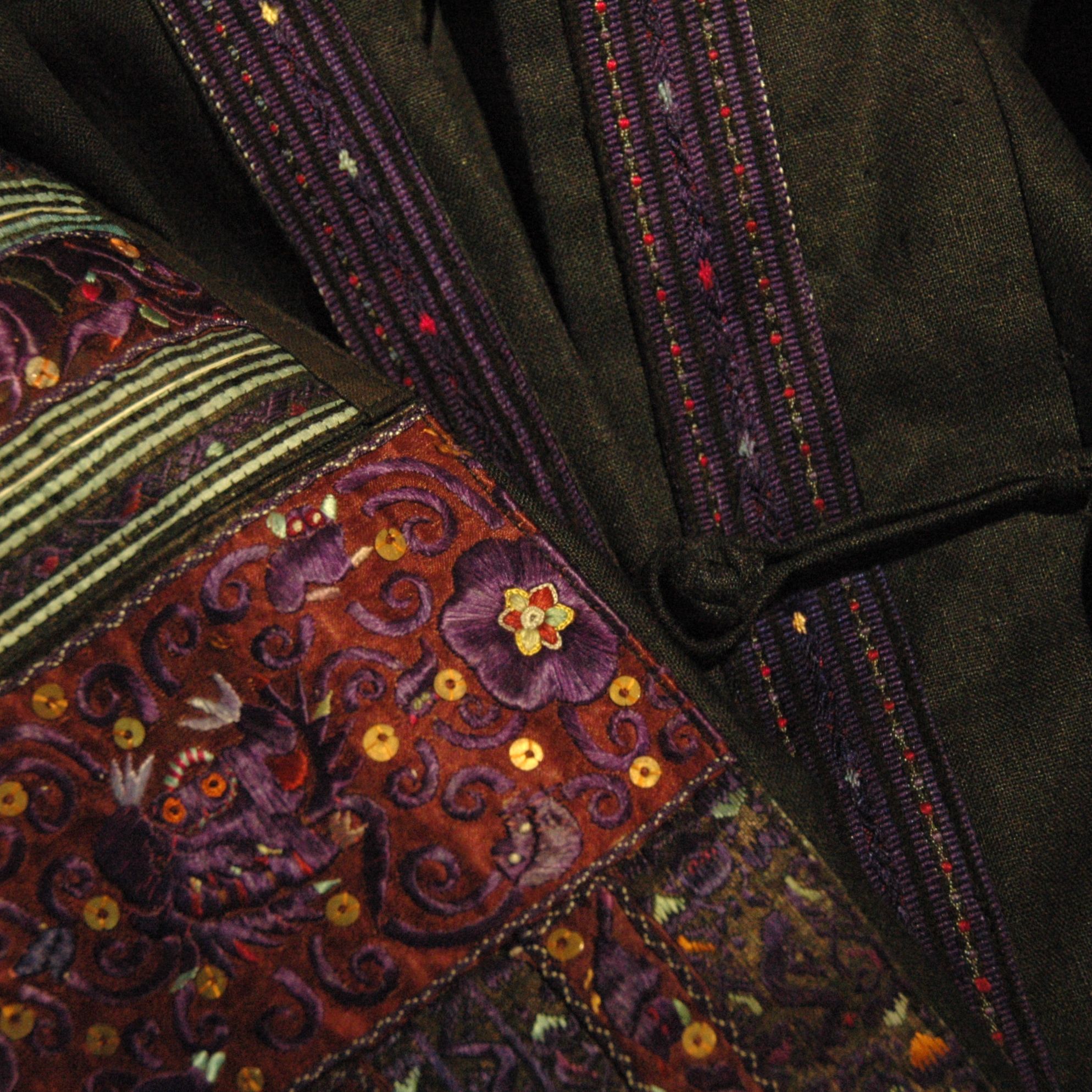
This is a jacket designed and tailored by our shop in the style of the Miao tribe.  The decorative pieces are embroidery from the Miao tribe in Gui Zhou.  The red eye creature in the embroidery (can you spot it?) is a three legged toad.  The toad represented wealth and good harvest.  This representation is shared by an old Chinese folk story; once upon a time there was an evil monster, the young Lui Hai had him defeated and it turned out to be a three legged toad.  The toad turned good and followed Lui everywhere fighting other monsters.  Lui also has a habit of aiding the poor, the legend has it that the toad has the ability of  bring wealth, at where he reside there is treasure.  The toad became a symbol of fortune and blessing.

W200xL200mm, China

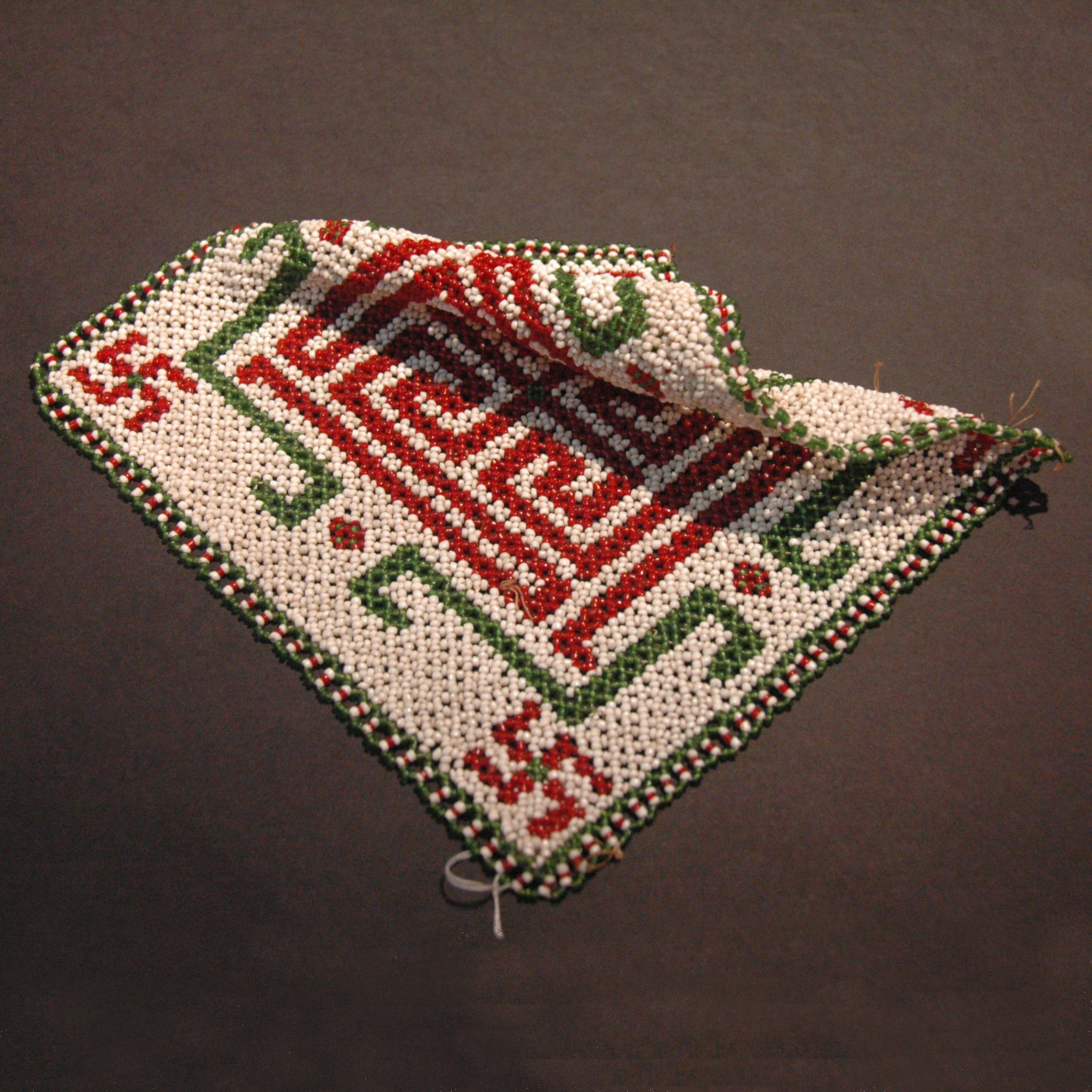
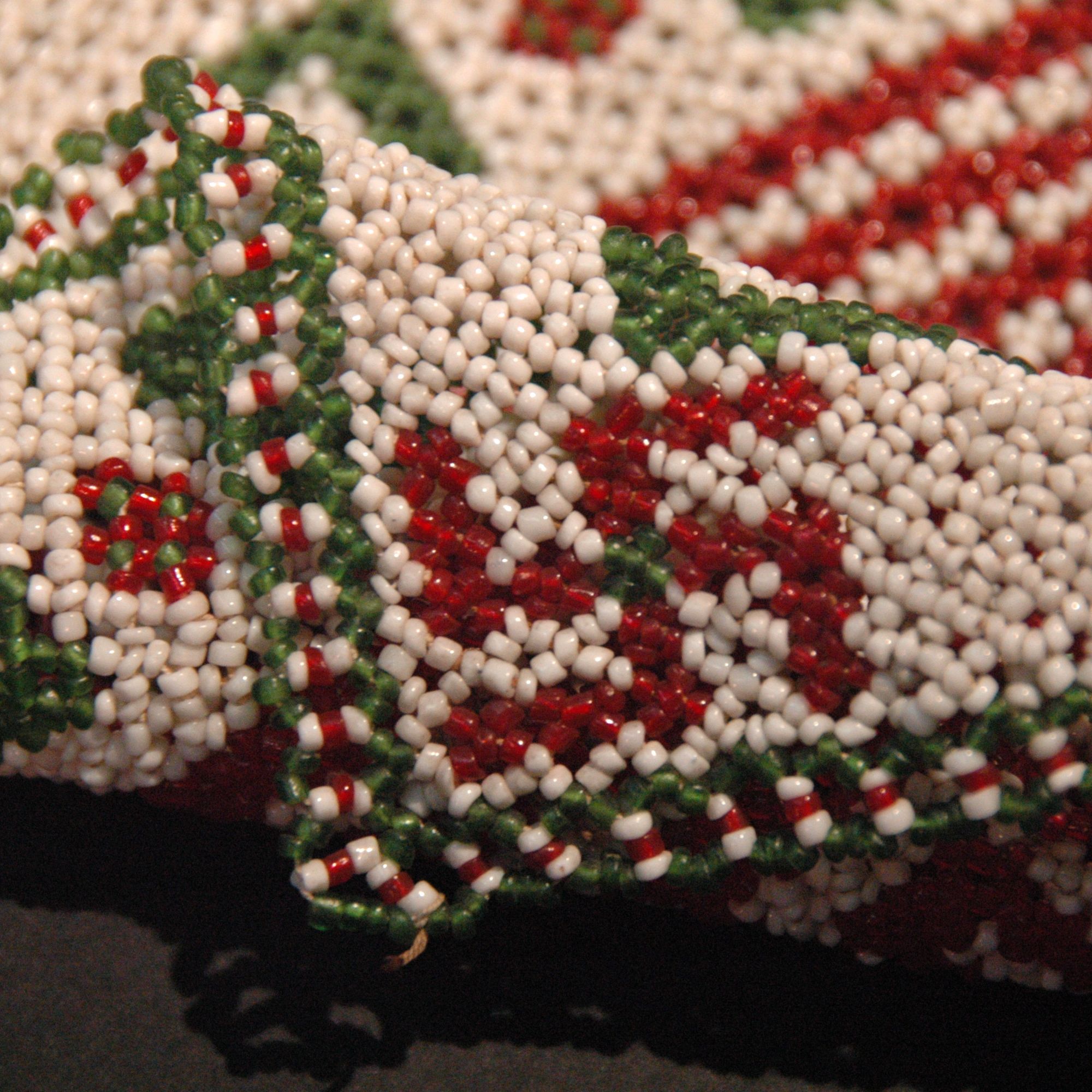
There are 2 lucky symbols on this glass bead mate; the Swastika signs at the corner and the longevity sign in the middle.  The 卐 (Swastika) sign has been passed on to China along with ancient Indian Buddhism religion.  In the 7th century, the Tang Empress Wu Ze Tian, ordered for its inclusion as a Chinese character, selected the right spinning version, to be pronounced as Wan with the meaning “the focal point of blessing from all direction”.  Since then apart from its original Buddhism uses, 卐 was also used as a household blessing symbol from embroidery to pottery and architectural decorations, the symbol also become more graphic and elaborated.  Longevity, has long been a symbol the Chinese adores for decoration.  This symbol on the beaded mate is one generated from the typography of the word Shou (longevity).

W250xH300mm, China

Before the arrival of cinema, television and the internet, shadow puppet was the “it” entertainment in China.  The puppet is placed next to the screen (a 1 sq m treated muslin)  with lighting from behind.  Like the theater, the puppet casts include the hero, heroine, masculine, villain and of course the clown.  Each puppet is controlled with 5 bamboo stick; the puppeteer is responsible for the control 4 puppets, singing, narration, dialogue and drums.  The shadow puppet is usually made of  donkey skin which give a more transparent effect.