Archives for posts with tag: silver

DIA70mm, China

 This silver bracelet has a very simplistic design, a band of silver held at the end by a small opening and a bolt.

This item selected by Furze for the Something Old Something New exhibition and is available at both Mountain Folkcraft and Soil.

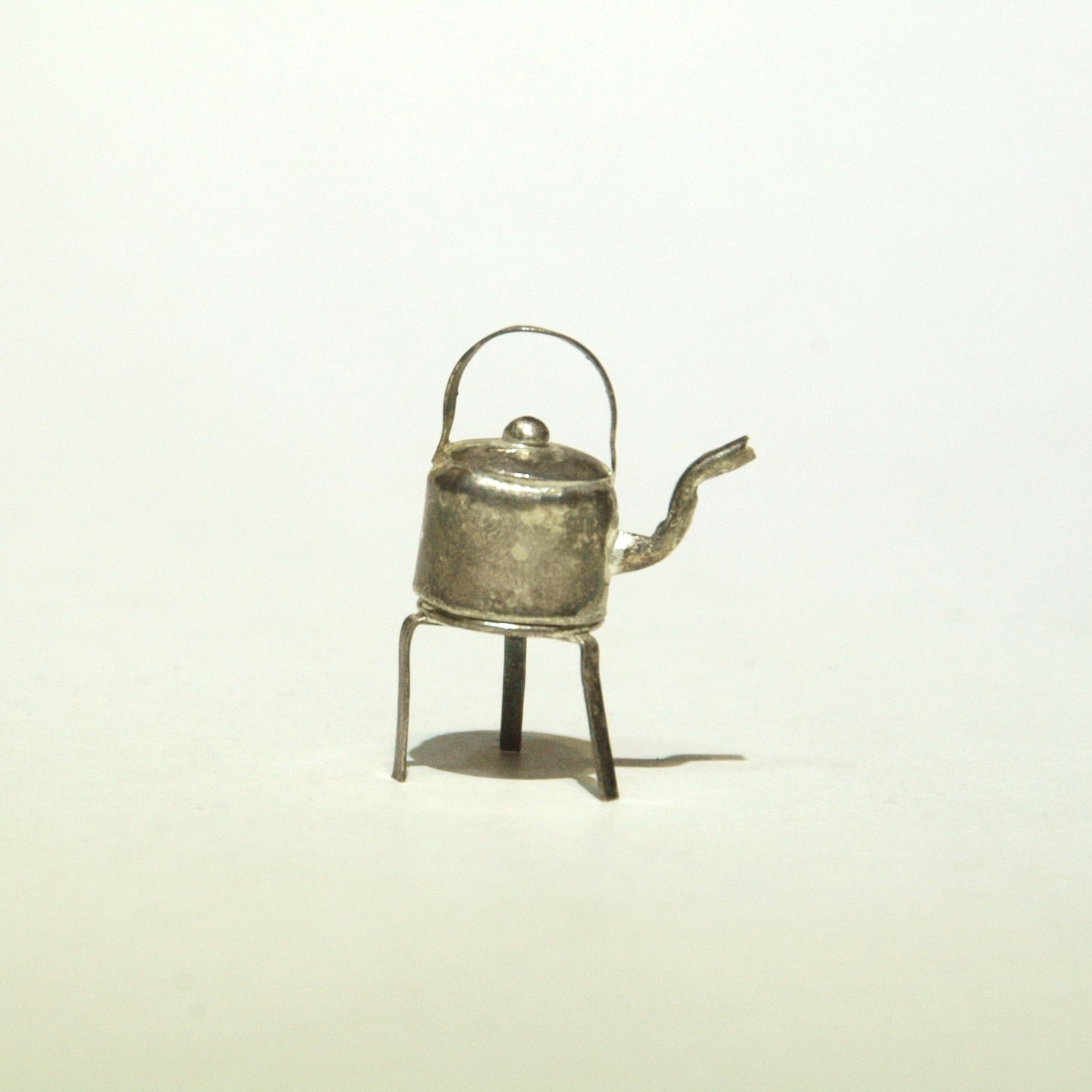
DIA20xH40mm, Thailand

This miniature silver kettle was selected by Furze for the Something Old Something New exhibition and is available at both Mountain Folkcraft and Soil.

Since we have the kettle on, I will share with you a Thai Iced Tea (Cha Yen) recipe.

INGREDIENTS

  • 5 Tbs Thai tea powder
  • 4 Tbs sugar
  • 3 Tbs sweet condense milk
  • 2 cups water
  • milk
  • ice cubes
  1. Bring the water to a simmer, turn off the heat and add the Thai tea powder
  2. Stir and let it brew for 5 – 10 mins
  3. Pour the tea over a fine sieve or a cheeze cloth to get rid of the tea leaves
  4. Add in the sugar and the condense milk, stir well and let it cool down
  5. When it has cool down to room temp, fill a glass with ice and pour in the tea
  6. Add in a dash of milk and enjoy!

DIA 40mm, China

This is one of the gift for the Chinese baby’s shower (normally on the 100th day of its birth), a silver bracelet with the pendent of Budai and a peanut.  You must be wondering why these 2 items would be selected for a child as an ornament.  Budai, the laughing buddha, is an incarnation of Maitreya, however, this image of Maitreya is only found in China but not in India.  It is believed that the image of the laughing monk with a belly and a bag originated from a monk in the Five Dynasties, an incarnation of Maitreya and known for his joyfulness, forgiveness and kindness, for this he is always depicted to be followed with a group of children.  For a child to be wearing Budai would be giving her the blessing and a hope that his character would rub in a little.  As for the peanut, it is known as the fruit of longevity, bringing health and fertility.  In old rural China when medical and hygiene was poor, this blessing to the child is a wish of parents for some extra help for his well being.

This item selected by Furze for the Something Old Something New exhibition and is available at both Mountain Folkcraft and Soil.

CIR 55mm (UK size O), China

I had a similar ring when I was a teenager, it was one of my favorite.  It has a “pure silver” mark in Chinese (but as a human guinea pig I can verify that it is really pure silver as I suffer badly with metal allergy, only pure gold and silver would pass the test, how posh is that!)

Enamel was brought into China from France in the Qing dynasty (17th century) and was immediately adored by Emperor; workshops for the court were set up in Imperial Court in Beijing and in Guangdong.  It then became popular throughout the country during the reign of the next 2 emperors.  The type of enamel produced in China was mainly cloisonne, where a thin wire is applied to form cells to hold the enamel.

DIA100xH40mm, Cambodia

This silver box is part of a betel set.  Betel chewing, a tradition since prehistorical time, was a popular past time all over Asia, enjoyed by men and women alike, in all social levels.  Betel leaf, areca nut, lime paste, camphor, cinnamon, nutmeg, tobacco etc are ingredients for betel chewing; they are stored in separate containers ready for consumption.  These container can be made of ratten, wood, lacquered, copper, silver and even gold.  In Cambodia, for common people silverware are not used as daily utensils, they are prized object used only for entertaining important people or in ceremonies.

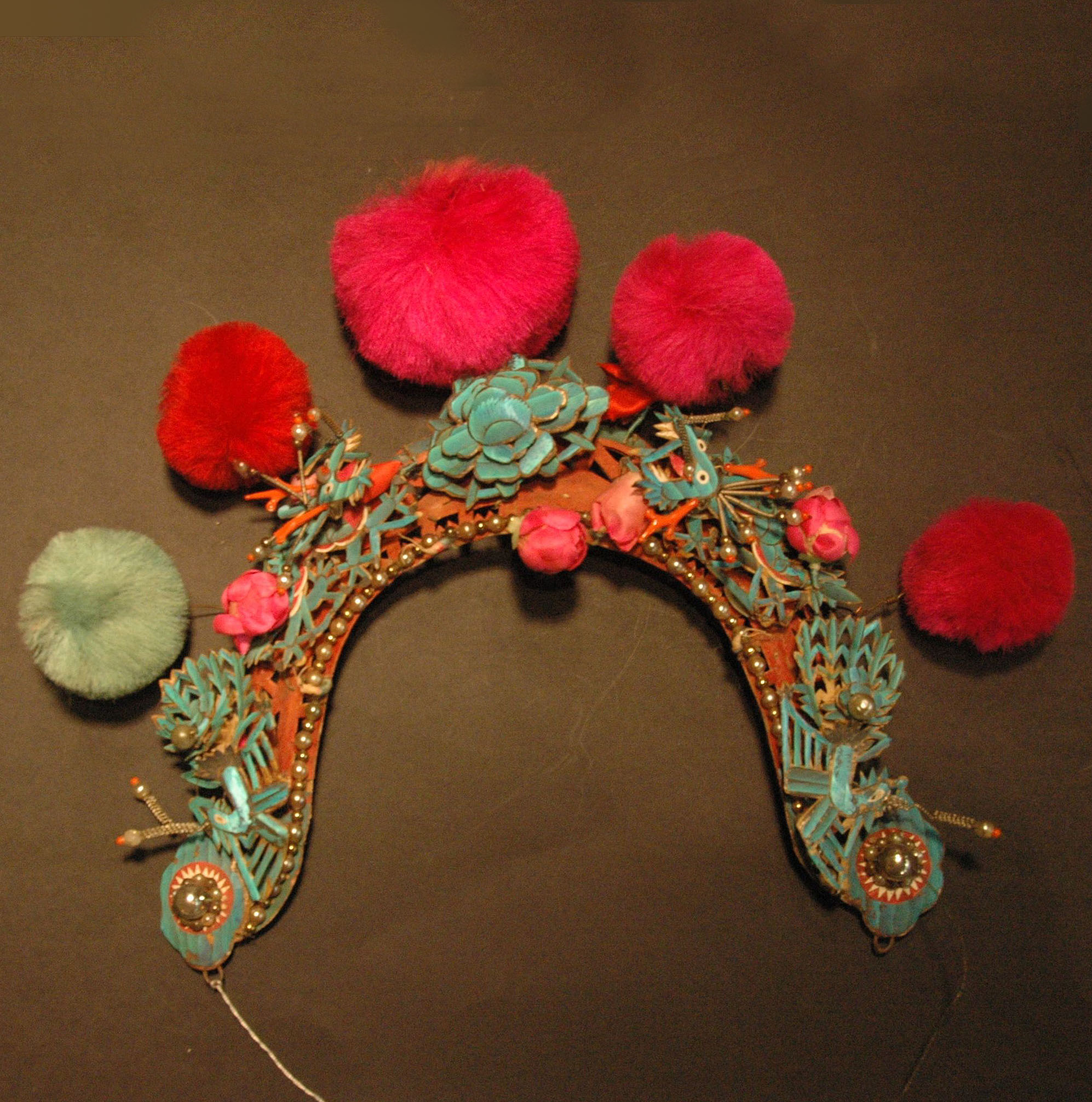
W300xH300mm, China

This is the head piece for Chinese opera, a crown used by the female warrior character, resembling the fighter’s helmet.  It has one layer of pompons and thus known as word one crown (the chinese word for one is 一, a simple horizontal line)

Due to the age of this piece, some of its tassels and a few of the pompons have gone missing.  The blue ornaments on the head piece are made from kingfisher feathers, tian tsui, a precious material.  The kingfisher bird has an amazing blue colour, however the intense colour is not from the pigment of the feather but from the reflection of the light.  Each piece of feather is painstakingly cut and inlay onto a metal gilt.   A relatively thin sheet of precious metal (gold or silver) is formed, gold or silver wires are bent according to the design and placed on the edge of this area, then small pieces of the feather is glued into the recess area.

L140mm, China

There is the English idiom “born with a silver spoon in one’s mouth” describing someone from a wealth privileged family.  In China where silver spoon is not a common utensil, for such a person one would describe him as “born with a golden key in one’s mouth”.

L330xH20mm, Mongolia

In Mongolia Shamanism the Blue Mighty Eternal Heaven (Mongke Tengri) is worshipped, in its legend 6 treasures was given by the Blue Sky to the Mongolian, 3 big treasures and 3 small ones.  The 3 big treasures are, yurts, grassland, cattle and sheep, the 3 small treasures are, Mongolian knife, matouqin and dairy products.  Hence, the Mongolian knife is treated also as a sign of blessing on top of it function.  In the nomadic days, a mongolian man who wear it by the waist together with the snuff bottle and the Mongolian flink.  The sheath has 2 holes for keeping a pair of chopsticks, isnt this the perfect eating kit for nomadic life.

DIA550xH600mm, China

This small umbrella has a silver handle, a structure is made of bamboo and yawn, the shade is non-waterproof, to top it off, it has 2 pom pom on the top of the cap.  This is in fact a Chinese dance umbrella.  Around the Sung dynasty, merchants from the northern province acquired the umbrella from the south and brought them home as a novelty, in order to show it off a dance show is invented.  The moral of the story is – product promotion started early in China.

L220mm, China

Chopstick has been around in China for more than 3000 years; there has been many material used for making them, wood, bamboo, ivory, bone, lacquered, silver, gold, jade and of course the recent plastic and stainless steel version.  It is commonly believed that silver is used as a material for its ability to detect poison.  Perhaps it is the tarnishing of the silver from the sulphur in arsenic that made the name of the silver chopstick.  Please dont be alarmed by the tarnished silver on this pair of chopstick, it is due to natural oxidation from its age and not from any poison.  The legend of the silver chopstick goes like this; the famous politician of the Zhou dynasty Jiang Zi Ya was once only interest in fishing (with a straight hook) and nothing else.  His wife got fed up with his idleness and decided to kill him and to marry someone else.  One day as usual, he came home empty handed after fishing, his wife had prepared a spiked up meat dish for his supper, just as he tried to grab the meat a bird flew in and packed on his hand.  The bird did it again and again as he tried to go for the meat, sensing something is out of the ordinary, he pretend to chase the bird and left the house.  Up a hill, the bird told him only to eat with the two sticks on the ground where it stood.  Jiang return home and pick up the meat with the sticks as he was told, smoke appears and his wife fainted.  His eating sticks got famous and everyone started eating with chopsticks.  The moral of the story …. men, dont go fishing too often + remember to bring at least a fish home (even if you have to buy it from the supermarket).