Archives for posts with tag: pottery

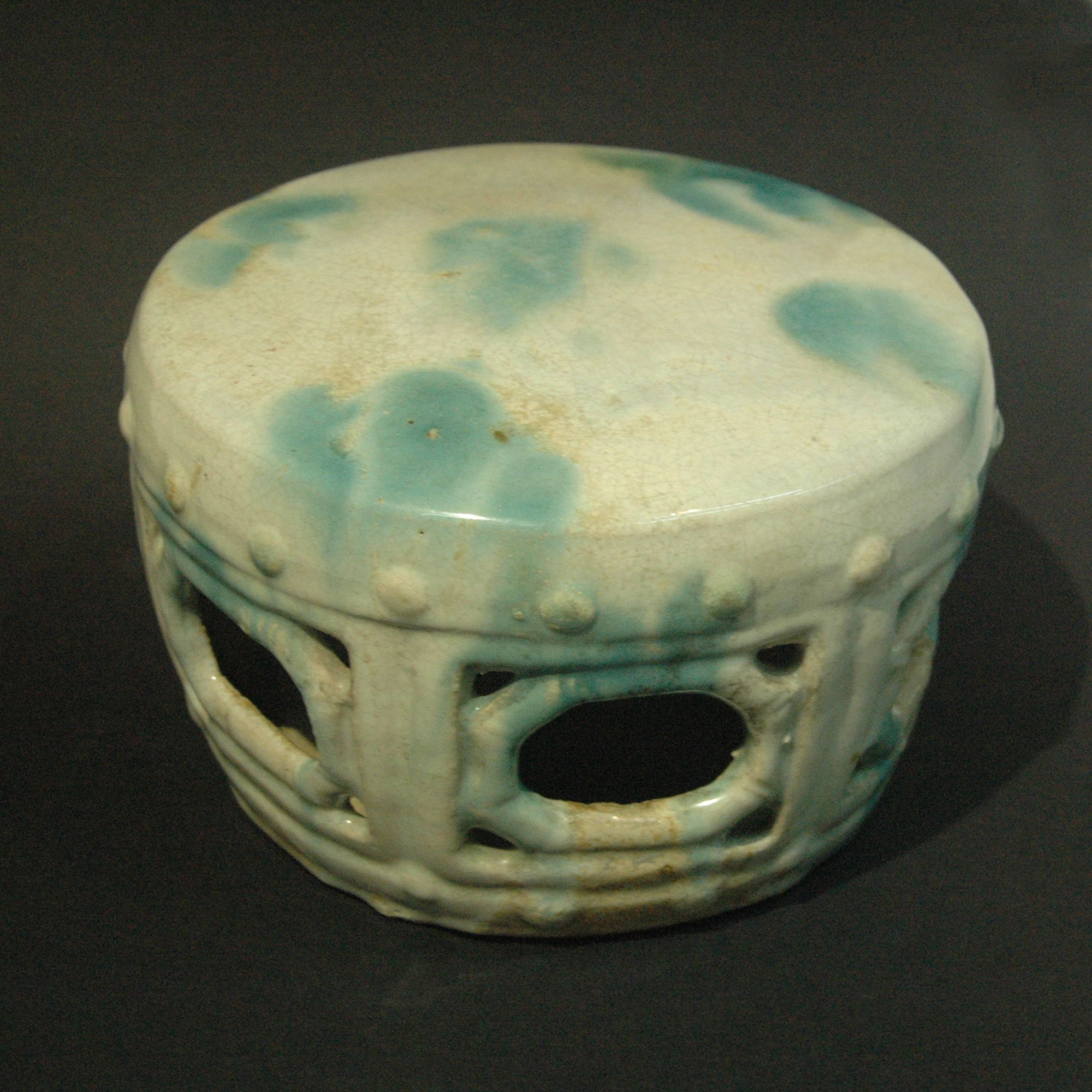
DIA190xH120mm, China

You have probably seen a larger version of this in a Chinese garden before, a stool for sitting on for the ladies.  It is called a Gu Dun, the word “Gu” means drum and as you can see the top of this pottery has decoration resembling a piece of leather held taut like a drum.  The Gu Dun was originally made in wood and later also made with pottery, porcelain, stone and lacquer.   You can see in the Sung painting below that it is already a popular chair at that time and the most recent design is perhaps Philip Starck’s Bonze Stool.

The one featured in the post today is a miniature decoration piece which is made in the form of a Gu Dun.
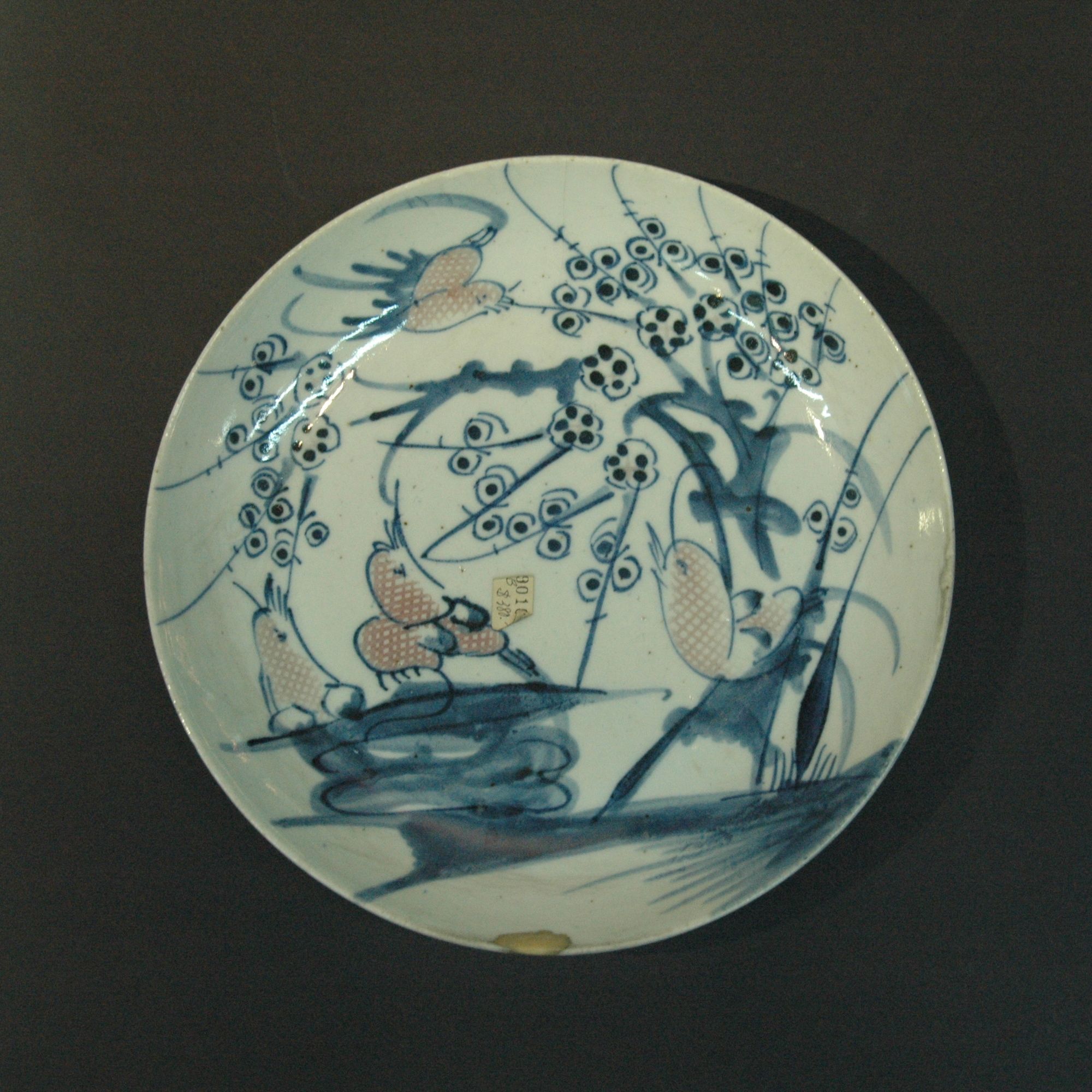
DIA250mm, China

The composition of this plate of the bird and the plum blossom which gave the plate its name – plum & bird plate.  The theme of bird and plum tree can be found on painting, pottery, jewellery, stationary, etc.  The pair sometimes are fighting for the attention of spring and sometimes delivering good news, they are often seen together.  Plum tree blossoms in the spring time, a start of a new year, both a sense of joy and happiness.  The bird, pica pica, is a special bird, according to the Chinese “Book of Birds” (around 500B.C.), the pica pica is capable of telling the weather – “If it sings with its head upwards it will be sunny, if it cries with its head facing down it will rain, people will be happy just listening to it sing”.  Looking at the plate, it seems weather will be good tomorrow, have a nice day everyone!

Though it is not a pica pica (magpie) and it didnt sing, nevertheless its a nice clip.

W40xL60x10mm, China

This pendant is made from a piece of broken ceramic, from the shape of the piece it is likely to be of a medium size jar or a vase.  The figure on the piece is part of the a war story, these figures or themes are known as Knife-Horse-People which is a popular theme in the Qing dynasty.  See here for the clay version of Knife-Horse-People.

Though completely different, this ring seems like part of the portrait jewellery collection.

W200xD100xH250mm, China

Although the god of longevity originated from the stars, his large and elongated brain has nothing to do with the alien and the outer space.  The form of his head is associated with longevity, like that of  the mystical bird, the red crown crane (grus japonensis).  The red crown crane lives to 50-60 years old  which is consider to be very long when the average life span of birds are about 10-15 years.  Another association is queen mother god’s longevity peach which the plant only flower and bear once 3000 years.  Combining both of these longevity forms his head took on the exaggerated shape.

Click  to see our clay and stone version.

DIA180xH270mm, China

The Chinese started making wine some 5000 years ago and the container developed from bronze to lacquer, then to clay and porcelain.  This blue and white porcelain is one that is used by regular folks, this kind of flagon are bold in form and in the pattern different from the usual blue and white porcelain ware.

The traditional Chinese unit for alcohol are measure in sheng, dou, dan.
1 dan = 10 dou
1 dou = 10 sheng
1 dou = app. 6000ml

This flagon holds about 2 dou.

If you can also hold 2 dou of Chinese wine, check our the Wine God wood block print!

DIA80xH60mm, China

No, this is not rudolph.  Yes, the red nose is missing.  For the Chinese, not only does the deer symbolizes longevity, it also represented success as an official.  This cute container is a the base of a mortar, its small size suggest its for grinding medicinal seeds or nuts, e.g. garlic, pepper etc.

L210xD140xH100, China

Narcissus, daffodil, is a very popular plant in China especially for the Chinese New Year.  So popular that there is a special container for its presentation.  A month before Chinese New Year, one would find daffodil bulbs for sale in the market.  The bulb would be placed inside the bowl, secured by pebbles and 2/3 of it cover with water.  Up till the days before flowering, the water would be replaced daily, when it started to flower every 3 days.  When the shoots started to appear, locate the bowl to a sunny but cool place.  As daffodil is part of the New Year decoration, it is almost essential that it is blooming with flowers on New Year’s day, this normally takes 25 days at 20C, if lacks behind a bit of warm water on New Year’s eve would normally do the trick.   And if all fails, one can always pay a bit more for the perfectly planted daffodil at the flower market.

W200xD150xH500mm, China

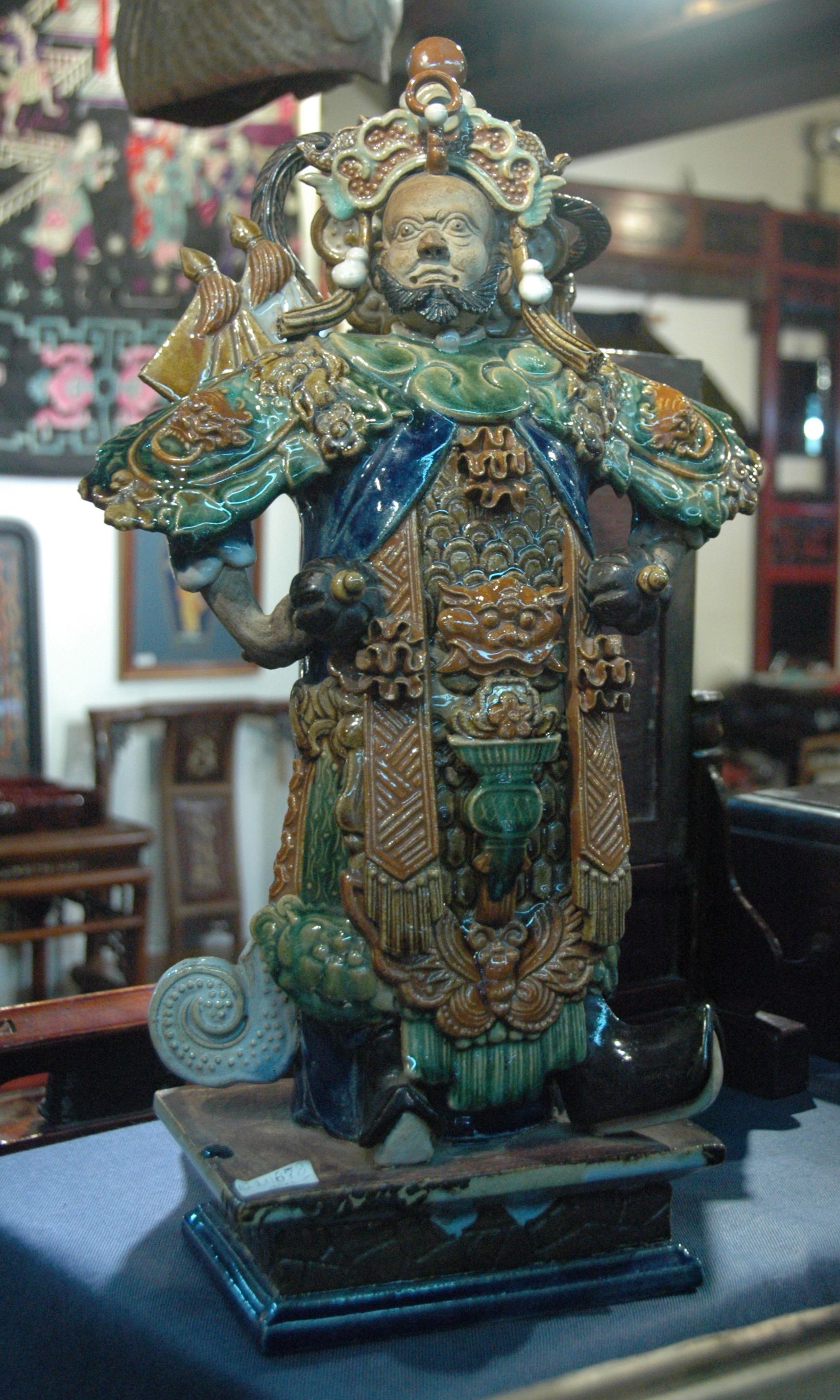
This figurine was made from the famous Shi Wan pottery town in the Guang Dong region.  Their figurines are typical to have a glazeless delicate facial and hand depiction while contrasting with an expressive and bold glazing on the clothing.  Another example can be seen in an earlier post, “Shi Wan Figurines“.

The general depicted here is one of the “3 good blokes” of the Tang dynasty, Pei Yuan Qing, his weapon is a pair of golden melon hammer.

You will be seen in this clip how the weapon  is being used (well at least in the Beijing opera).  This is a graduation show from the students of the Beijing opera school.

My dog spike has started sighing, ok ok, I promise no more Chinese opera reference for a while.

W40xD50xH120mm, China

This is a pair of brown glazed candle stand with a lion figurine.  The lion style candle stand has been popular since the Jin dynasty (at that time the lion is more chubby and the candle holder is attached to the figurine itself).  The Chinese believe that the lion is the king of the animals and thus can offer protection, aside from the other animals also from evils.

W70xL100xH60, China

This blue and white porcelain box, now displayed as a toothpick holder, was used as an “ink pad” for the Chines. It is a container for the red paste used with the Chinese seal. The ink paste has been used since the Qin dynasty and at that time using clay, the clay is made into small balls and soften with water when use, it is used as a seal for a document, similar to the wax seal in the West (only that the document is of bamboo, text written in lacquer, the envelope being as string which is then sealed). By the Tang dynasty, as paper is developed the ink paste is also refined, cinnabar replaced clay as the seal paste which is closer to today’s paste. Also see our previous post “A Seal Case“.