Archives for posts with tag: paper

P1040712b

W300xH250mm, China

 A wood block print about the story of the child fighter Nezha.

Ne Zha was born after 3 and a half year, came out as a lump of flesh, the flesh sudden glows and inside came a little boy.  His father, General Li, was rather worried at the unnatural birth until he was visited by a Taoist Saint, Tai Yi Zhen Ren, who gave the boy a golden ring at that can enlarge and contract by Ne Zha’s will (Qian Kun Quan) and a long ribbon that causes anxiety to the enemy (Hun Tain Ling).

Ne Zha lived in a Chentang Pass in the Shang dynasty, a time when people was sacrificing what they have for the rain.  They made offering to Dragon King for a good supply of water for the crops.  No matter how much food they offer, they receive no rain, the Dragon King instead demand for a boy and a girl as human sacrifice.  One day, at the age of 7, Ne Zha was having a bath in the lake with his 2 friends.  A sea guard was send to capture the children as offering, Ne Zha in order to save his friends defeated the guard.  The Dragon King send his third son, Ao Bing, to match with Ne Zha and this is a scene taken from the fight

To find out who won and what happened to Ne Zha click here.
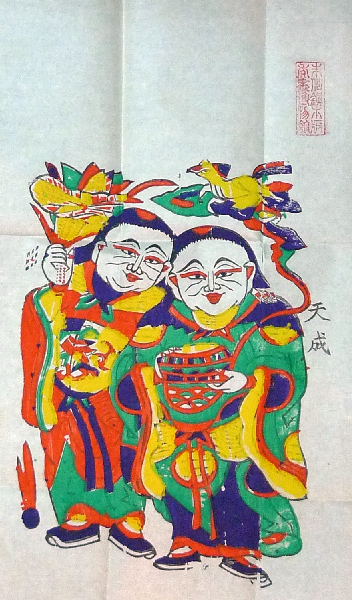
P1040725b

W250xH420mm, China

The two figures in this wood block print is the poet monks Han Shan and Shi Di.  Han Shan and Shi Di are close friends, sharing ideas on poetry, zen teaching as well as literature.  The 2 are known as the He He saints – for love, peace and harmony.

Shi Di (left) carried a stem of lotus “荷 – He” while Han Shan (right) has a rounded box “盒 – He”.  The words 荷盒 “He He” has the same pronunciation as the words 和合 “He He” which has the meaning peaceful harmony.

At the wedding night, offering will be made by the bride and groom to the He He immortals for love, peace and harmony to be extended to the new family.

P1040710b

W300xH250mm, China

The story of this wood block print comes from the Ming dynasty novel 殘唐五代史演義, a fiction set in the late Tang and 5 Dynasty 10 Kingdoms Period (around AD 900).  Though having less literary merits as the Romance of the 3 Kingdoms, the story of the novel has been adapted into opera and craft works.

The scene from the story goes like this; one night the Jin Emperor dreamt that a tiger has entered into his tent, he saw it as an omen of the arrival of a great fighter.  The next day, he met a young fighter who was powerful as well as courageous, able to lift up a tiger with his bare arms.  The emperor made him as one of his 13 adopted sons (Tai Bao) and name him Li Cun Xiao.

card

W110xH150mm, Hong Kong

A paper cutout white cat on a greeting card.

Paper cutout is a traditional Chinese craft, a simple way of decoration which was displayed on windows, lamp shade, anywhere with translucency of light .

… and here is a talented white cat.

P1040727bW300xH490mm, China

The worship of the heaven and earth is perhaps the most primitive of all faith.  Heaven and earth included all the natural and fundamental elements such as the sun, moon and the galaxy, mountain, valley, river, lake and the sea, wind, rain, thunder and lighting are all part of the believes.  The power of nature poses both blessing and treats to the human world.  All, these elements are humanized into a saint known as the God of Heaven and Earth.  Unlike the other saints, he is not housed in a temple as he symbolizes the universe as such; on Chinese New Year day, a wood block print of him will be posted up under the eaves for worship.  Other time you will come across the God of Heaven and Earth are in traditional Chinese weddings, the bride and the groom will begin their wedding ritual by worshiping this god of the universe.

Below the Jade Emperor in the middle of this wood block print is an image of a tablet where it is written, “天地三界 十方萬靈”, there are 3 dimensions, the heaven, the earth and the dead, saints are every where.

cardW110xH150mm, Hong Kong

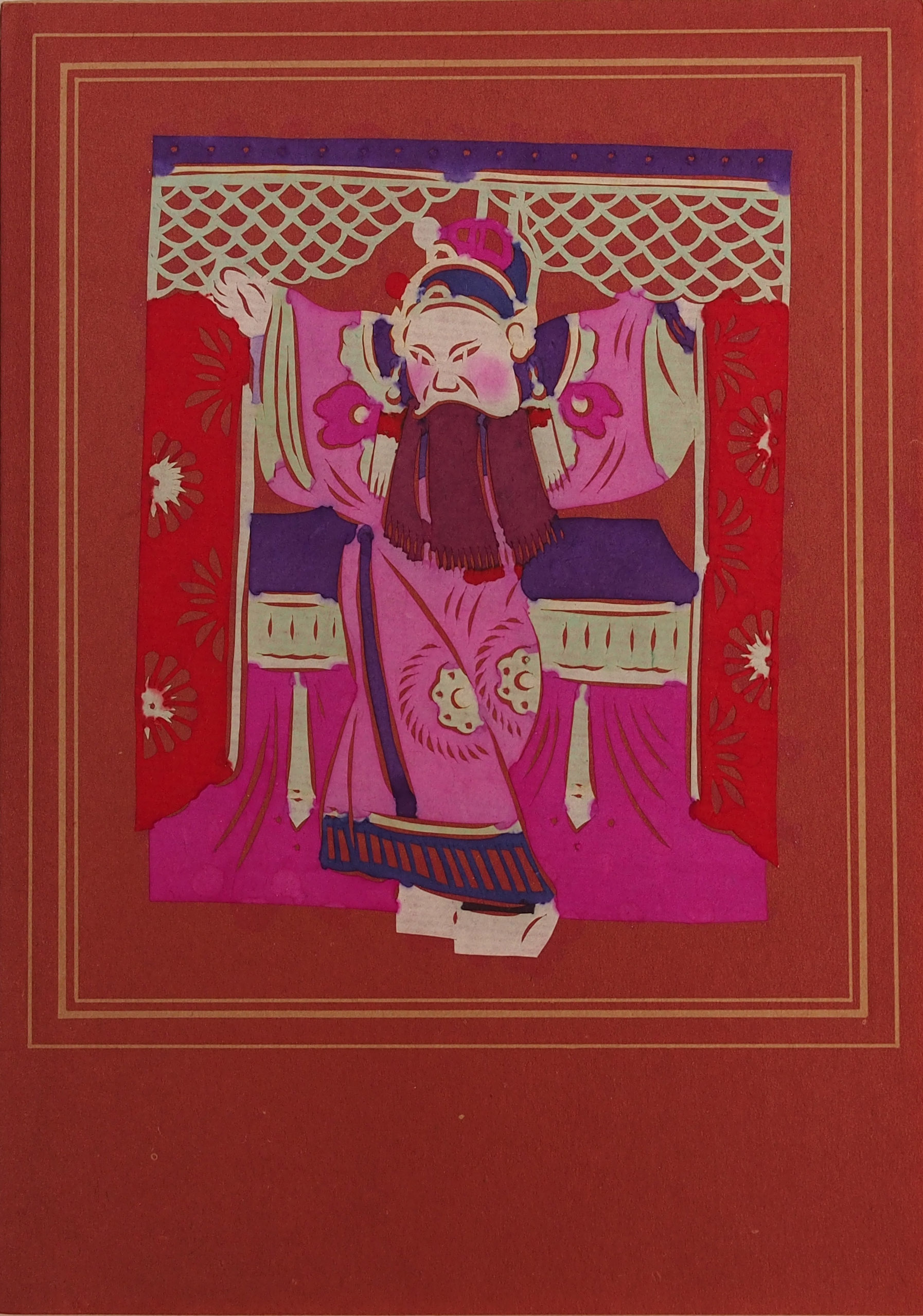
The scene of the paper cutout card is taken from Beijing Opera – Wen Zhao Guan.

The story is set in the end of the Spring and Autumn Period (485BC), due to political slander Chu State offical Wu was under warrant while his father and brother was being executed.  Wu was hoping to escape to the neighbour Wu State but at the check point (Zhao Guan) he saw his arrest warrant on the wall.  Hermit Dong met him in the mountain and recognize that he was the wanted man but felt the unjust upon Wu and hid him in his home.  For 7 days, Dong entertainment him talking about all sorts but not a word about the escape, Wu lost patient as he had planned to rebuild his power and revenge for his family and hanging around is like torture.  Dong calm him down and said it was all planned out and that they were just waiting for a person.  That night Wu was restless, he had the urge to leave and to move on  but he was worry for his arrest at the gate.  After a night of anxious tournament all his hair has turned grey, his was even more trouble but Dong was happy that his planned has worked out.  Dong has a royalty friend Huang, who looked very much like Wu, Huang would pretend to be Wu and when the 3 of them cross the gate, the guard will only concentrate on Huang, now that Wu has a whole head of grey hair he was disregarded.


P1040739a

W600xH170mm, China

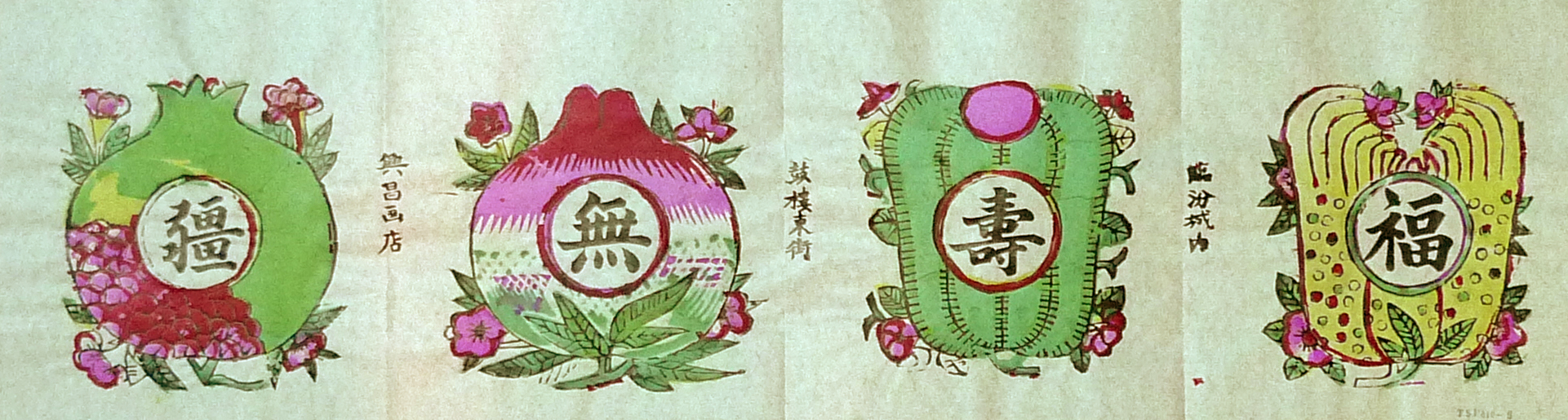
A phrase of blessing, 福壽無疆 “Fu Shou Wu Jiang”, good fortune and longevity without limit.

On the print are 4 fruits (from right to left); the Buddha’s hand fruit, the peach, large fruit and the pomegranate, they are also symbol of blessings.

Buddha’s Hand Fruit 佛手 – the fortune hand 福手 as they share the same pronounciation “Fu Shou”.
Longevity Peach 壽桃- the magical peaches that produce longevity.
Large Fruit 碩果- the rare individual that made large achievements.
Pomegranate 石榴 – the many seeds of the pomegranate symbolizes many sons.

This new year print was from the Ping Yang school which started print making since the Sung dynasty.  This print is by one of the famous print shop 興昌畫店 in Lin Fin Town.

card

W110xH150mm, Hong Kong

One of a pair of cards for with the blessing “peace for the 4 seasons“.

Features boys each holding a potted plant, plum blossom, orchid, chrysanthemum and lotus, the four plants are known as the four season flowers, each representing a season.

Spring – orchid, Summer – lotus, Autumn – chrysanthemum, Winter – plum blossom

The “vase” 瓶 (ping) has the same pronunciation as “peace” 平 (ping); thus symbolizing peace all year round.


OLYMPUS DIGITAL CAMERA portfolio
W140xD160mm, Hong Kong

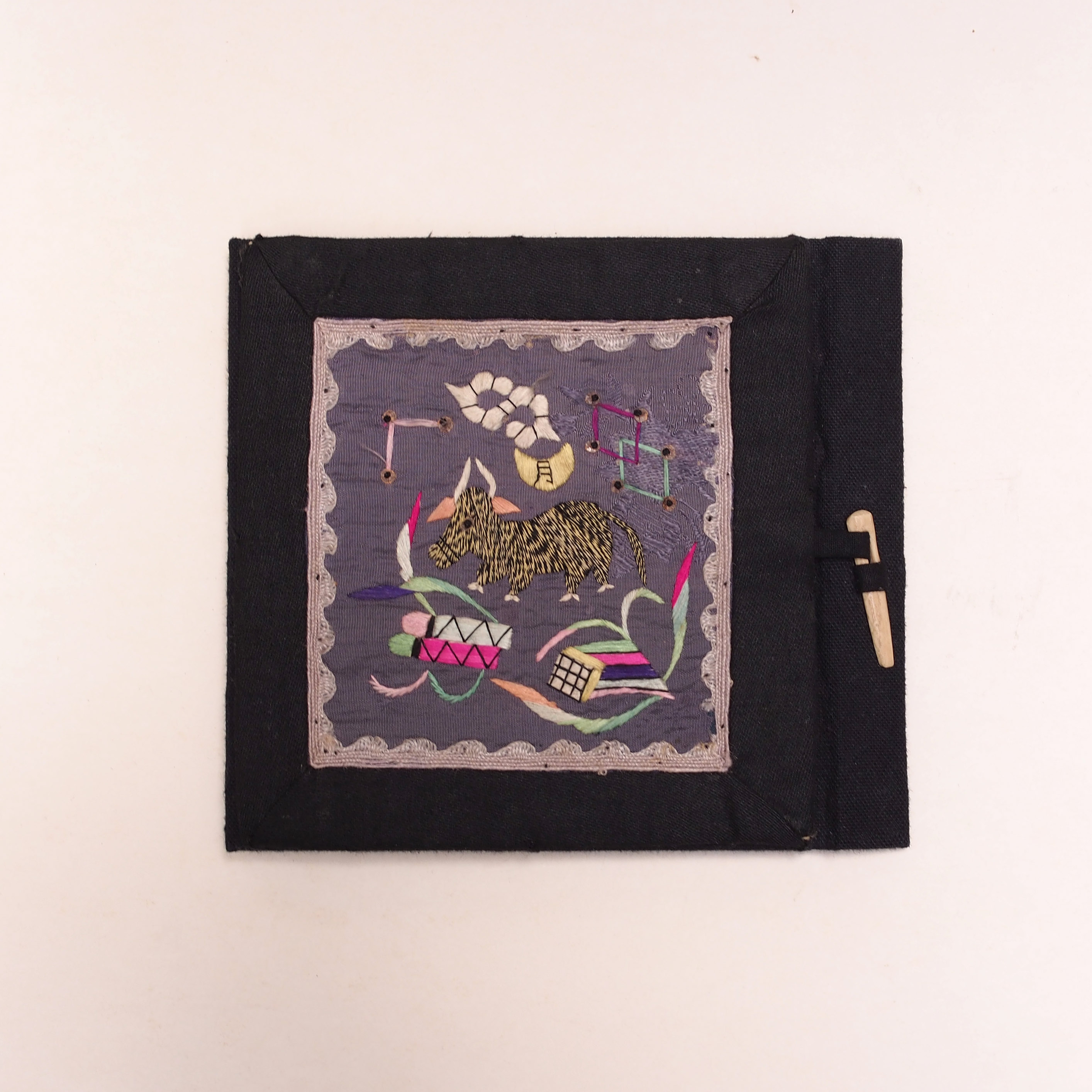
A small portfolio decorated with a piece of embroidery filled with blessing symbols.

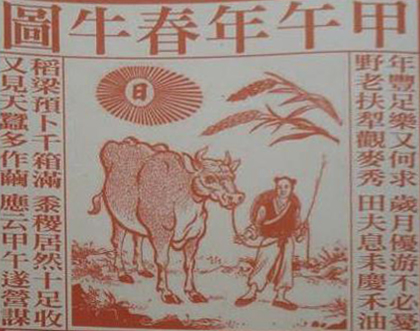
The cow in the middle of the embroidery is known as a Spring Cow, it is part of the Chinese New Year traditional that has been passed down since 800B.C.  The figure of a cow would be made with straws and mud, a day before (Li Chun – the first day of spring in the 24 solar terms) it would be brought to front gate of the town where it would be whipped by all the notable of the town or village.  The ritual is believed to wake up the Spring Cow, the passing of the freezing winter, the start of agriculture and the gone with winter ailmnet.  With us city dwellers who are far away from the farmland and the fields, the only Spring Cow we will see is perhaps the one printed at the back of the Tung Shing which gives us prediction of the year’s weather.  Well, for this year will is suppose to be drought, we seems to be getting a lot of rain so far.
1

Around the Spring Cow are blessing objects;

@12 o’clock –  yellow moon, an object of worship,
@2 o’clock – the double trapezium, Fang Sheng, the hairstyle of the Queen Mother of the West, has the ability to pacify,
@5 o’clock – rhino horn, resembling victory,
@7 o’clock – scroll of  books and painting, wisdom
@10 o’clock – the 3 blessed star Fu Lu Shou,
@11 o’clock –  in form of a white cloud shape is Ru Yi, “as you wished”.

wood block print

W320xH240mm, China

There are different new year print for different blessings, for fertility, longevity, health, prosperity, etc.  This particular one is for the livestock and the working cart; sitting in the middle the guy with 3 eyes is Hua Guang, one of the 4 Taoist Saints, a powerful warrior against evils.  On both sides of him are 2 banners, 牛馬平安 (blessing to the ox and horses), 日進斗金 (daily income of 100g of gold).