Once again, its the time of the year to thank the Kitchen God.
It is believed that at the beginning of every Chinese New Year, on lunar January 4th, the Jade Emperor will sent the Kitchen God to monitor the activities of each household (a bit like the NSA, I guess) and at the end of the year, lunar December 24th, the Kitchen God will depart to make his annual report back to the Jade Emperor. To thank his for a year’s hard work, before his departure a special meal will be prepared for him.
If you still havent prepare the farewell dinner, hurry up before he leaves!
This is a Yang Liu Qing print on the subject of “Searching for Plum Blossoms in the Snow”. The phrase is generally used to described scholars appreciation and effort with poety. The old man on the donkey is Meng Hao Ran, a Tang dynasty poety; he is known to have gotten his inspiration from ploughing through the snow on the Ba Qiao Bridge in Xian.
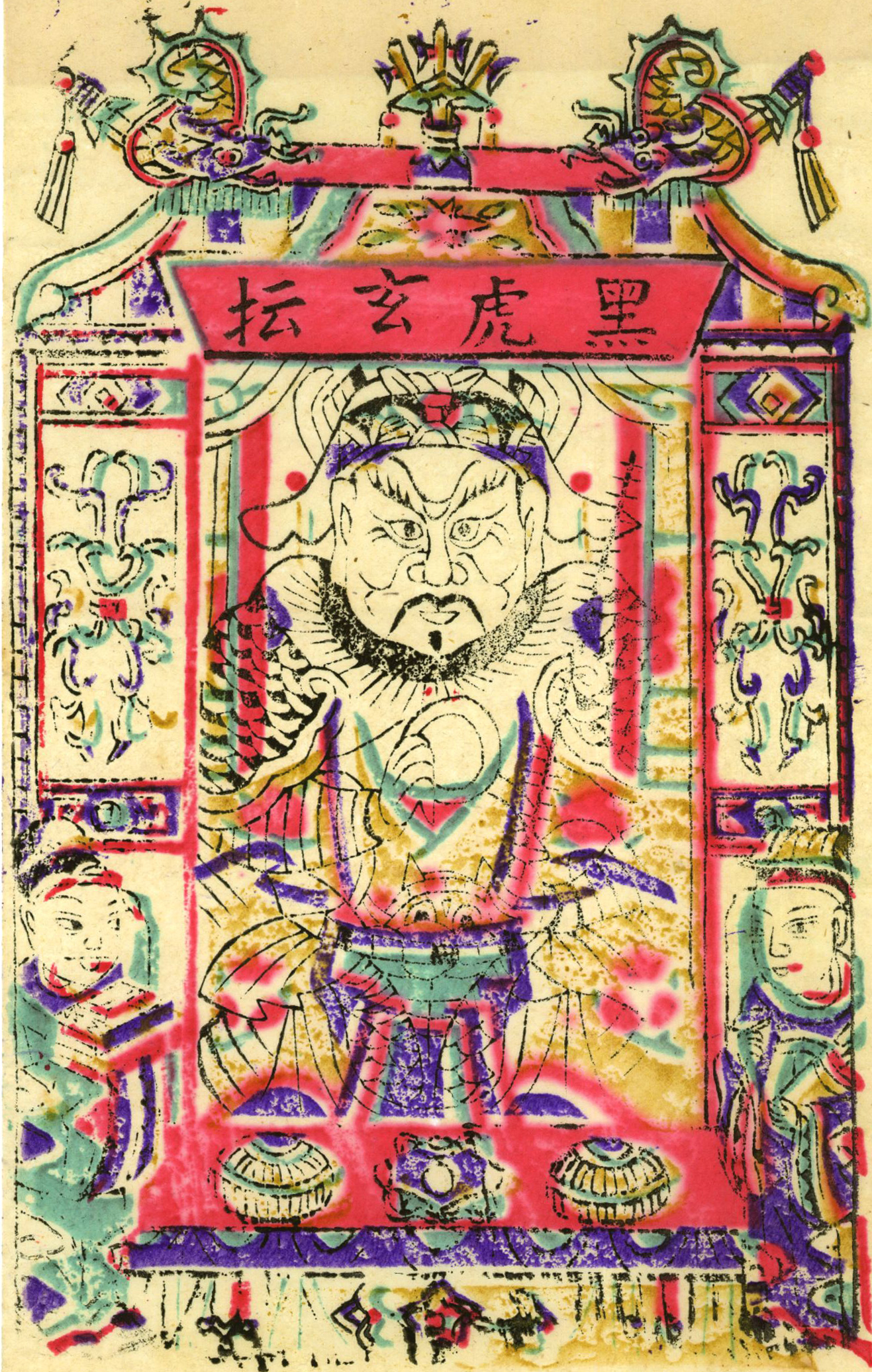
A new year wood block print of the God of Wealth, Zhou Gong Ming. It is believed that Zhou was born in humble family in the Qing dynasty. As a young he worked as a labourer for a wood merchant, being honest, generous and hard working he was popular. Soon he was able to start his own wood business and accumulated a good deal of wealth. Zhou would lend money to those who need them; one merchant borrowed some money and made a lost at a natural disaster, Zhou only asked him to return a pair of chopstick for the money owned. At time of war, Zhou used his own money to fund an army in support of his country and headed the army himself. He bravery was well known and even tamed a troubled tiger as a pet. In most of the God of wealth icon, this black tiger is at his company, here you can see it half hidden inside his coat. Because of his generosity and bravery he was worshipped after his death and named the God of Wealth.
Click here to see our other items of the God of Wealth and the mystical version of his life.
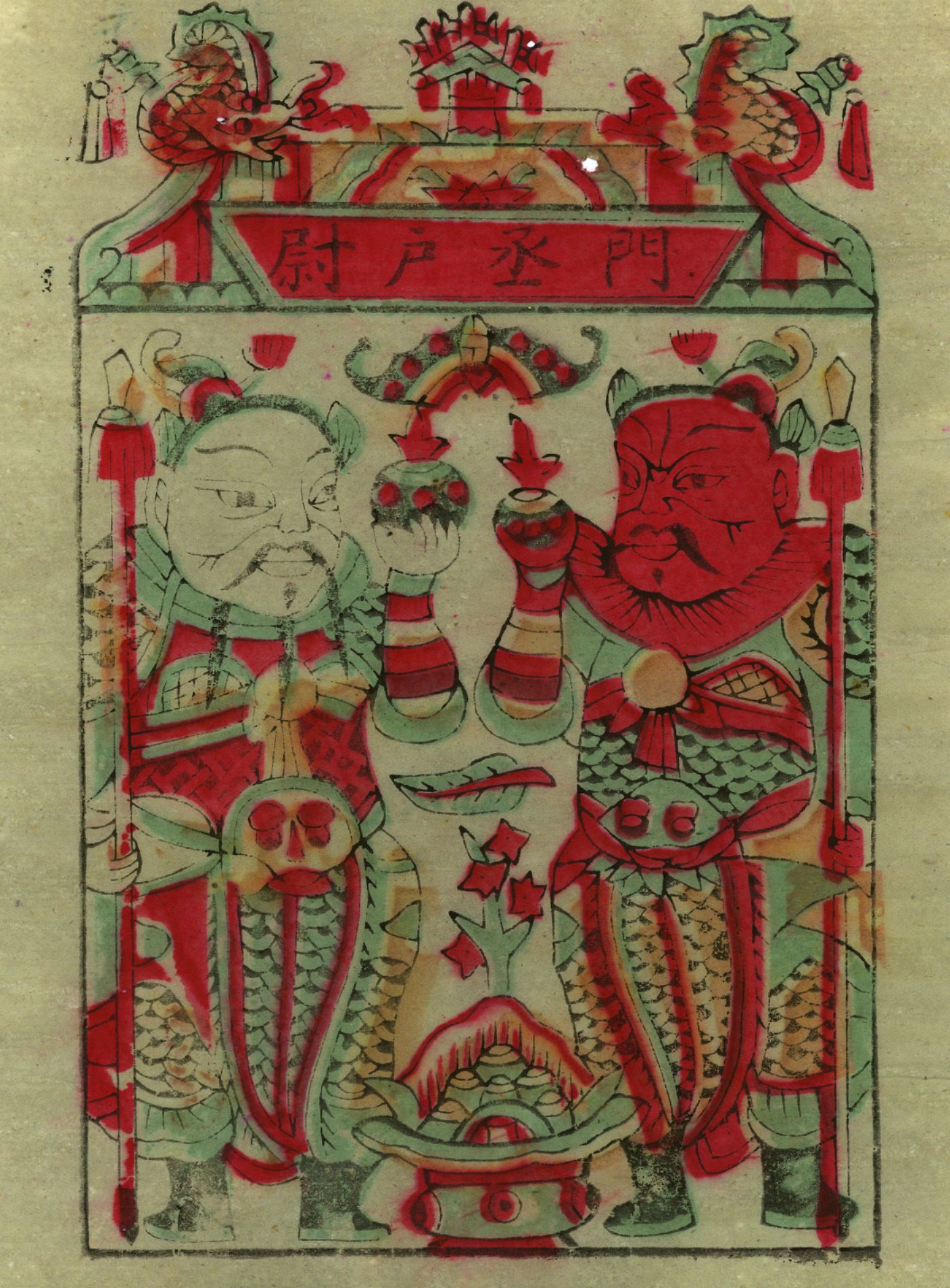
There are many door gods, the most famous and the original ones are Qin Qiong and Wei Chi Gong. The two generals have been keeping the ghosts away from the imperial court. the Tang Emperor felt sorry for their long shifts and ordered portraits to be put up on the doors to give them a well deserved break. Click here for the full story. Traditional Chinese doors comes in pairs and a print of the individual door god would be posted on both doors. This particular prints has two door gods, the one with the white face on the left is Qin Qiong (門丞) and Wei Chi Gong (戶尉) is on the right, this print is made for single door.
The four words on the print “門丞戶尉” refers to the two door gods, but funny enough with the four words mixed up as “門尉戶丞” it became a Taoist spell for healing the sick. The procedure apparently goes like this (please don’t try this at home);
take a rooster with lush feathers,
hold a knife with your right hand and the rooster on the left,
go to the house of the sick,
inside of the house take 3 steps and on each step say the spell,
“門尉戶丞,某甲病蠱,當令速出,急急如律令”
(門尉戶丞, so and so’s sickness, expel at once, promptly take the order)
then put the head of the rooster in the mouth of the patient 3 times,
take the knife and draw blood from the rooster’s comb,
mixed the blood with 100ml of white spirit for the patient to drink.
… if the patient was not very sick before … he probably would be now …
Today, lunar 24th December, is the day for thanking the Kitchen God.
On this day, the Kitchen God is about to depart to do his yearly report to the Jade Emperor; a summary of the good and bad deeds of the family his has been with. This is the day the family should thank him for his presence and to sweeten him up a bit so he will speak well of them.
The offering should include:
A Bowl of Rice + A Bowl of Water
– to show the relationship between the Kitchen God and the family is clean and innocent, if the Kitchen God is lenient, the 2 items would turn black when he return to heaven.
Sugar Canes with Nodes and End Leaves
– with the nodes the Kitchen God can use it as a ladder to climb up to heaven, the end leaves symbolizes a beginning and an ending.
Fried Rice Biscuits, Satsumas, Tangerines, Red Sugar and A Red Packet
– food to sweeten his mouth so good words would be used for his report.
A Paper Horse, Black Robe, Boots
– provision of transport and costume for his meeting with the Jade Emperor.
A Kitchen God Cheat Sheet
– a yellow piece of paper with words chosen by the family.
These offerings should be place in the rice storage container.
With so much bribe, I wonder if the rice and water should be there at all …
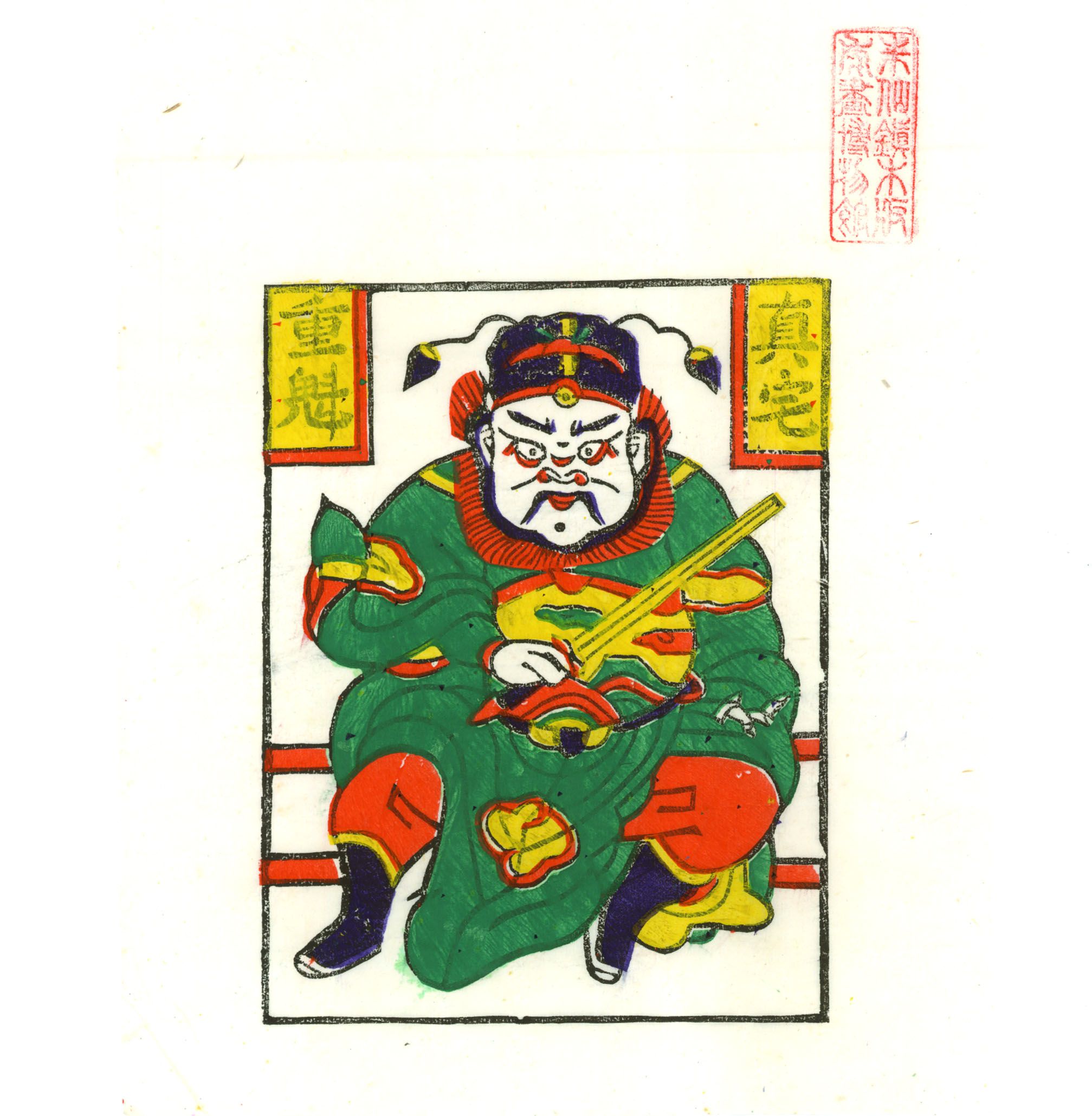
This is a new year print of Zhong Kui, the saint who can defeat all ghosts and evils, keeping the household safe. Zhong Kui has a fierceful stern face covered with a thick beard, despite having such a strange appearance he was a bold character who is a well learnt scholar. Legend has it that in Tang dynasty 730AD, the emperor was gravely ill, one night he dreamt that a ghost came to steal his jade pipe and his favorite concubine’s fragrance sachet. The emperor was upset and was about to send in his warriors to chase off the ghost and saw a larger ghost appear. The larger ghost has messy hair, horns on his head and worn a green robe, he reached out and caught the thief, dug out his eyes and swallowed them. The emperor was horrified by the act and asked who he was, the larger ghost paid his respect and said he is Zhong Kui and that he tried hard in the scholar exam but failed. Ashamed for his failure, he met his death by the steps after reading the results at the courts, feeling sorry for him the earlier Tang emperor award him a green robe for his funeral. Moved by the emperor he oath to remove all the ghost and evils for the Tang dynasty. When the emperor woke up from his dream, his sickness was gone, he ordered the making of Zhong Kui’s print to spread the news. Later on it became a new year tradition for the Tang emperor to award his officials prints of Zhong Kui.
In certain part of China, Zhong Kui is worshiped at every occasion from Chinese new year to opening of a temple to a shop, the start of a work for the year to the start of construction, relocation to birthday and weddings. The ceremony will include the offering to the print of Zhong Kui and for a grander gesture the performance of masked dance or a puppet show of the Zhong Kui theme.
Here is a masked dance performance for a temple ceremony in Taiwan.
For those of you who has followed the recent historical comedy soap on TVB, here is a new year print from the yang liu qing school depicting the same story (minus the satire). This story is set in the San Gou period, it was a time when China was divided into 3 separate kingdoms , a time after the corrupted East Han dynasty, warring period that lasted for almost 100 years.
Briefly the 3 kingdoms are;
WEI – led by East Han chancellor Cao Cao, adviser Sima Yi
WU – led by Sun Quan, adviser Zhou Yu
SHU – led by Liu Bei, general Guan Yu, Zhang Fei and Zhao Yun, adviser Zhu Ge Liang
The Return to Jing Zhou
Sun Quan and Zhou Yu (WU) set up a plan to get Liu Bei (SHU) to hand over his strong hold Jing Zhou. Sun Quan has a beautiful sister, he proposed to Liu Bei for a marriage to his sister, a union of the 2 kingdoms. Liu Bei in return would have to go to WU for the wedding. This is a proposal Liu Bei cannot lightly turn down for the sake of his kingdom. Sun Quan however has no real intention of marrying his sister to his enemy, he would wanted to capture Liu Bei and and force him to hand over his kingdom. Luckily before Liu Bei’s departure, his wizard adviser Zhu Ge Liang see through the trick and handed 3 notes to Zhao Yun and asked him to escort Liu Bei to Wu. When Liu Bei crossed to Wu he opened the first note, it asked Liu Bei to visit the father in law of Sun Quan. Impressed by Liu Bei and thinking that a union of the 2 kingdoms is a good idea from Sun Quan, the in law asked for Sun Quan’s mother for her approval for the marriage. The empress dowager agreed and the marriage went ahead. Sun Quan found out he has lost his sister, set out to detained Liu Bei in Wu. Liu Bei opened the second note, it asked for a faked report that Jing Zhou was being attacked by now their common enemy Cao Cao (WEI). Having a great excuse, Liu Bei together with his newly married wife and his men left Wu for Jing Zhou. Sun Quan found out and had his general went after them. Liu Bei then opened his third note, in the note it asked him to leave the defense to his wife. Now in love with Liu Bei, the princess gave the general a hard time and refused to return to Wu. When Liu Bei returned to Jing Zhou, Sun Quan’s army was confronted by Liu Bei’s general Zhang Fei and badly defeated.
Here goes the idiom, “lost the lady and the army” (making double lost without any gain)
In this yang liu qing school print, we have from the left Liu Bei, Zhao Yun, maid 1, Princess Quan, maid 2, Guan Yu and lastly Zhang Fei
The story was also a very known script for the Beijing opera, here is a part of the opera. The opera singers were the master of masters, the leading dan role was performed by Mr. Mei Lan Fang (in the past all roles are played by male artists).
This is a Chinese new year print of the famous yang liu qing school, different from the new year print from other areas / schools, the yang liu qing prints combined the art of printing and painting in one. Lines for the painting are first carved out from a piece of wood, black water base ink is then applied on the wood block and printed onto the paper by rubbing. Once there is a sharp outline of the image, water base colour is then applied, giving varies tones of colour to the print. Then a thick powder colour is used to give all the details to the painting. The yang liu qing school began at the end of the Ming dynasty; it brought on the tradition of detail painting of the Sung dynasty and combined it with the printing technique popular in the Ming dynasty giving it an unique appearance.
This print is one print of a pair of door gods (traditional doors in China always comes in pairs), Qin Qiong, the other door will be of Wei Chi Gong. The legend of the 2 door gods goes like this; during the Tang dynasty an old dragon made a bet with a fortune teller and violated the law of the heaven. As a punishment the supreme god Jade Emperor ordered Wei Zheng to have it killed at noon the next day. Hearing the news, the old dragon went to see the Tang Emperor and begged him to help him, the Tang Emperor agreed. The next day the Tang Emperor summon Wei Zheng to court and asked him to play a game of Chinese chess with him, hoping that if the game is long enough he will miss the noon execution. During the long game Wei Zheng dosed off and in his dream he went to kill the dragon. Not knowing the whole story, the ghost of the dragon felt bitter that the Tang Emperor did not keep his words and came to haunt the court everyday. Wei Zheng found out and send 2 generals, Qin Qiong and Wei Chi Gong, to guard the gate of the palace and this scared off the dragon. The Tang Emperor felt bad that the 2 generals do not get a break and asked artists to make a painting of them to be put on the doors, and this seems to have the same effects, the rumor spread and now the door gods are all over China.
A wood block print of the lord of medicine Sun Si Miao, he was a doctor and Taoist priest of the Tang Dynasty. He is said to live to 140 years old. However, when he was sickly child, the family used up all their saving to treat his sickness. Being a very gifted child, he studied all forms of medicine, he dedicated his life to save as many people as he can and refused to become a doctor for the court. He has made a huge contribution to the Chinese medicine; not only did he wrote the “Thousand Golden Prescriptions”, a complete medical ethics, started gynaecology and pediatrics in Chinese medicine and more. This is a new year print that would be seen in Chinese medicine clinic.
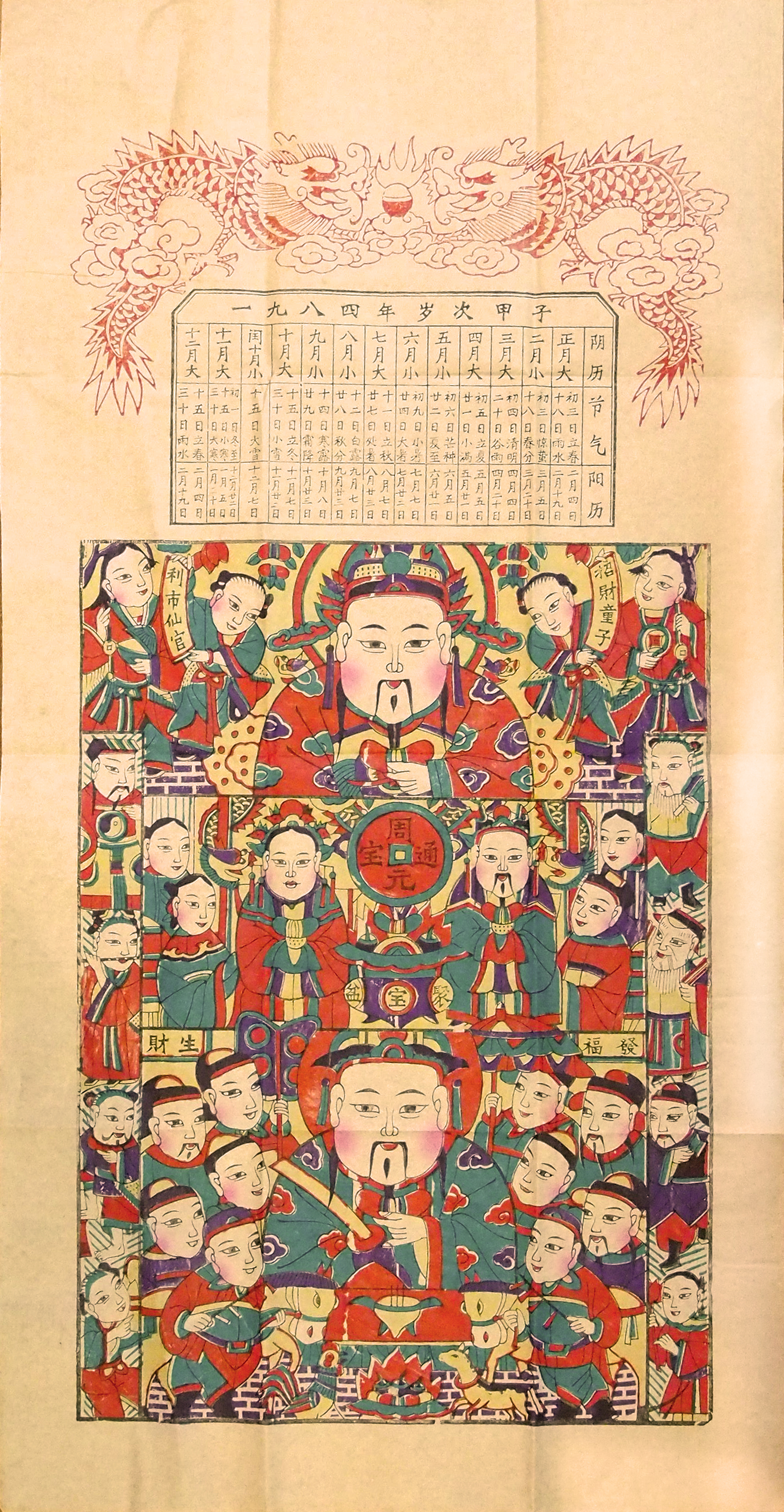 W400xH760mm, China



 Mountain Folkcraft