This is fine piece of embroidery on silk.
A corner is trimmed back on this perfect square, a minimal cutting for the costume.
A Du Dou, a traditional undergarment.
The curve is placed on the collar with a string tied around the neck, strings from the two diagonal corners tied around the body.
Chrysanthemum and peony flowers are the theme of the embroidery, symbolizing happiness and wealth.
A wall hanger embroidery, use for festivities such as birthday for the elders or for new born babies.
The embroidery is full of well wishes;
Blossom of the Four Season Flowers – (Narcissus, Lotus, Chrysanthemum, Plum) representing good fortune all year round. Dragon & Phoenix – (Dragon a concept of mammals, fish and reptiles while the phoenix of the birds) the combination of the dragon and the phoenix is the totality, the perfect match. Kirin Delivery of a Baby Boy – (legend of how Confucius was born) and of course every parents would like to have a son as smart as Confucius.
Ru Yi and the Birthday Peach – (man on a horse was holding a scepter and a birthday peach). The birthday peach representing longevity while the decorative scepter has the name of “as you wish”.
This embroidery is taken from a traditional Chinese under garment, the du dou, a garment that is made by the mother for the child as an extension of love and blessing. The design of this embroidery showed the well wishes of the mother, the hope that her child would become a zhuang yuan, the scholar who came first in the official examination. Since the Siu dynasty, the imperial court has set up a system of examination to find the best scholar to take up an imperial post. This is perhaps the only way to promote one’s status in a hereditary society.
In the embroidery, there is the zhuang yuan holding a bamboo while stepping on head of the Ao fish. 獨占鰲頭, occupying the head of the so fish alone, is a symbol of being the zhuang yuan for during the ceremony with the emperor the zhuang yuan will be standing on the head of a stone carving of the ao fish.
This embroidery was taken from a du dou, a traditional Chinese under garment. Du dou for men and children are mostly decorated with embroidery, normally by the mother or the lover. This embroidery is one from the mother to the child, the pattern of the embroidery is filled with object of blessing.
In the middle is a TIGER, representing bravery.
Surrounding the tiger are 6 treasures (from 12 o’clock);
GOURD – charm against evils,
BOOKS – wisdom
FAN – inject life into the dead (one of the treasures of the 8 Immortals) XIU QIU – love
SCISSOR – charm against evils
RHINOCEROS HORN – victory
PAINTINGS – scholarly
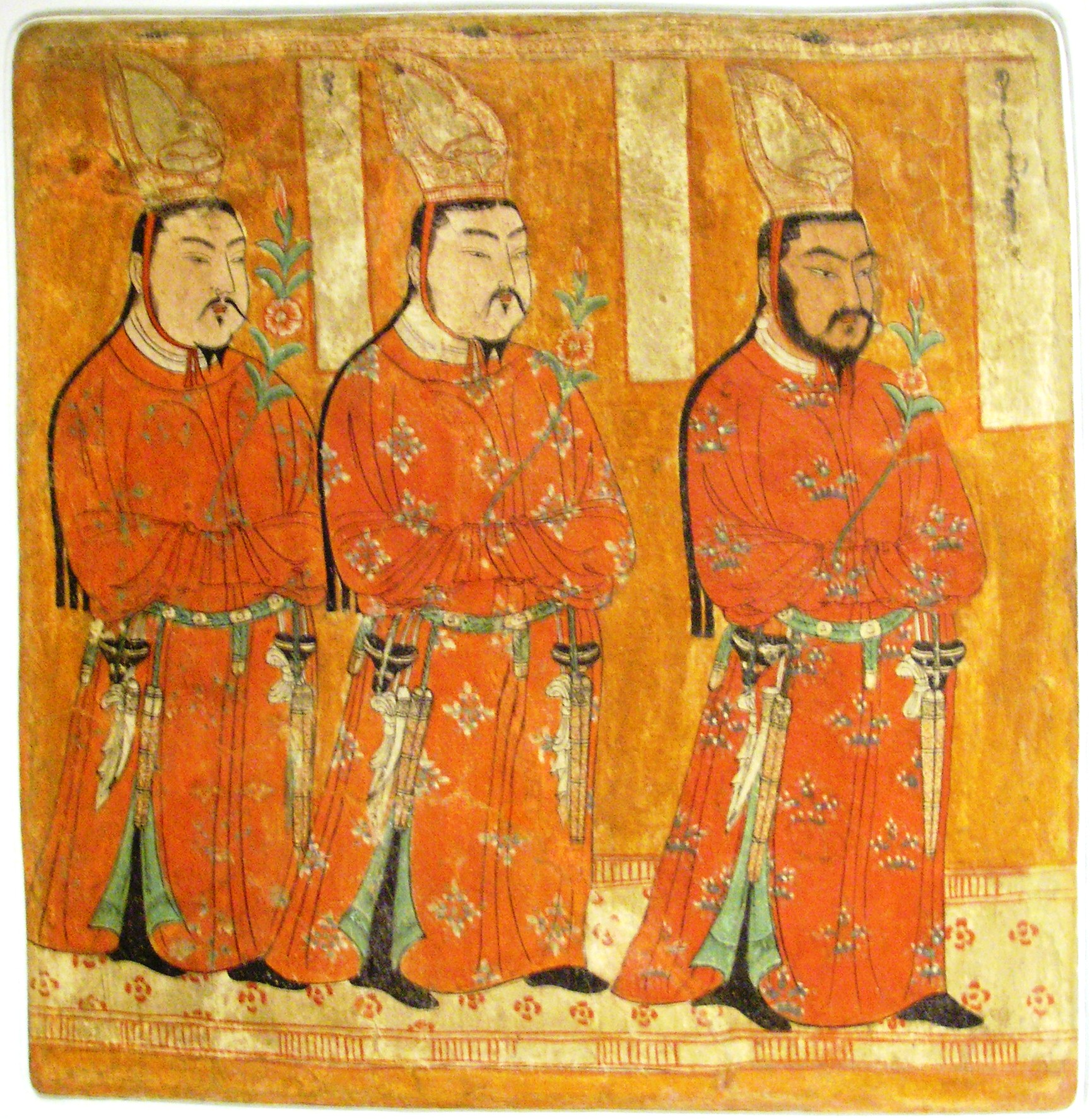
Similar to the western wallet which began its life as a knapsack for carrying articles not restricting to money, the Chinese wallet too start as a bag for keeping items like handkerchief, seals and of course money. The use of the wallet dated back to the Han dynasty, on the Bezeklik cave painting, 12th century CE, one can see Uyghur princes dressed in Chinese style robes and hanging wallets on their waists. As time goes by the shape and decoration of the wallet became more and more elaborated.
This embroidery captured a scene from the legend Madame White Snake, the novel Jing Shi Tong Yan from the late Ming dynasty. The story was set in the West Lake of Hang Zhou in the period of the Sung dynasty. The serpent spirit of the white snake and her friend green fish subordinate transformed themselves into 2 pretty girls; Bai (white) Su Zhen and Qing Qing (green). Bai fell in love with the Xu Xian and used her magical power got married to him. As time goes by, many strange incident happened because of Bai and Qing. Xu Xian was approached by monk Fa Hai who told him the truth about his wife being a serpent spirit and gave him a monk’s bowl. As Xu Xian place the bowl over his wife’s head, Bai and Qing returned to their original selves. Monk Fa Hai took the bowl with the two spirits and build a Lei Feng pagoda on top of them.
A more romantic story has been adapted for opera, movies where the true love of the white snake is celebrated and the monk became a busybody.
To see the same scene as the embroidery, go 10 minutes into the movie.
As for the Lei Feng pagoda, it was believed that the brick used for building the pagoda has the power of healing, people began to steal the brick, grind it into powder and use it for medicine. 950 year later in 1924, the pagoda fell under its own weight … wonder if the white snake and the green fish manage to escape. A new pagoda was rebuild in 2002.
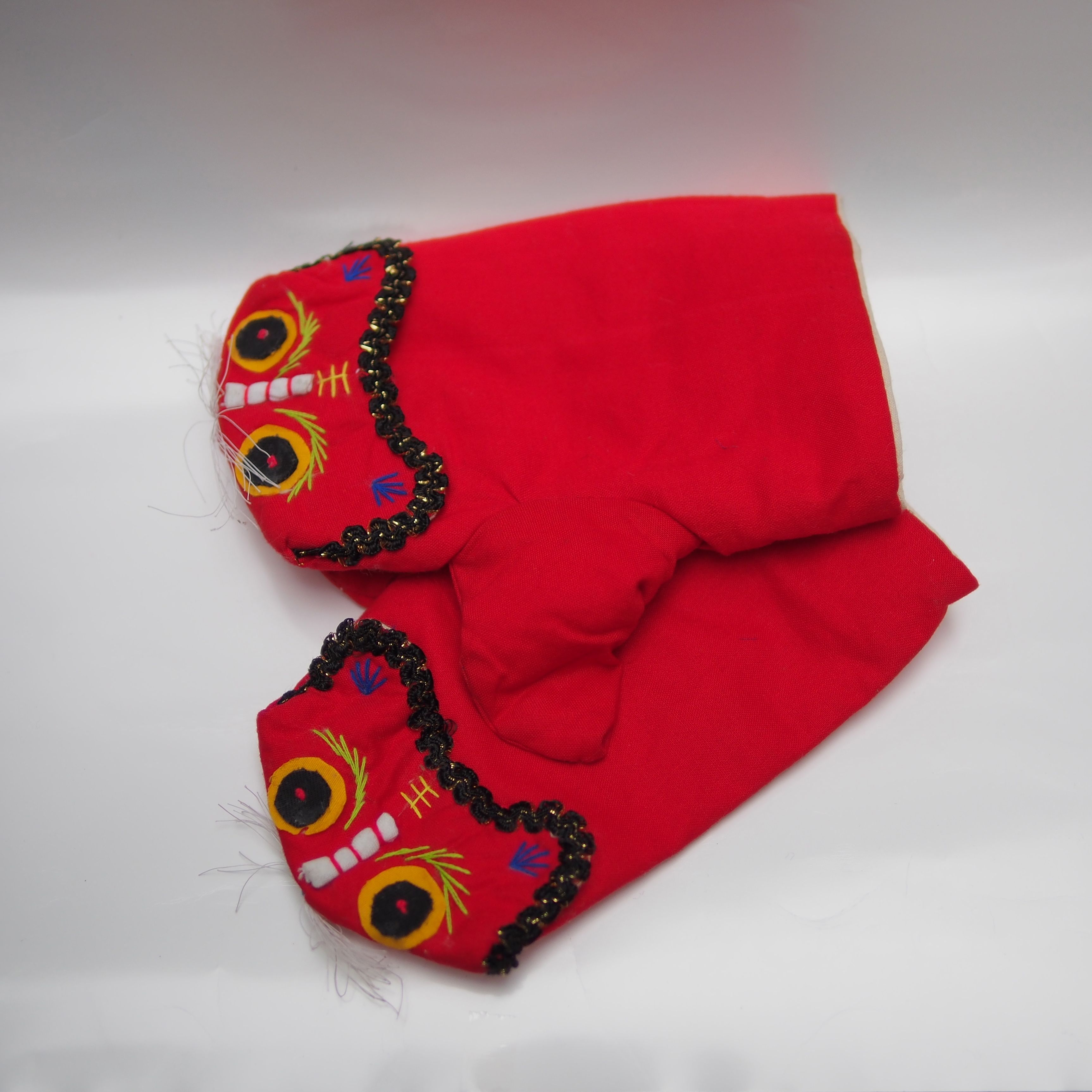
In China, the idea of tiger is not seen as a threat but a sign of protection. The strength and bravery of a tiger is aspired to; for the Chinese New Year, parents would dress the baby up in tiger gear, both as a protection blessing as well as a wish for their son to have the tiger’s attributes.
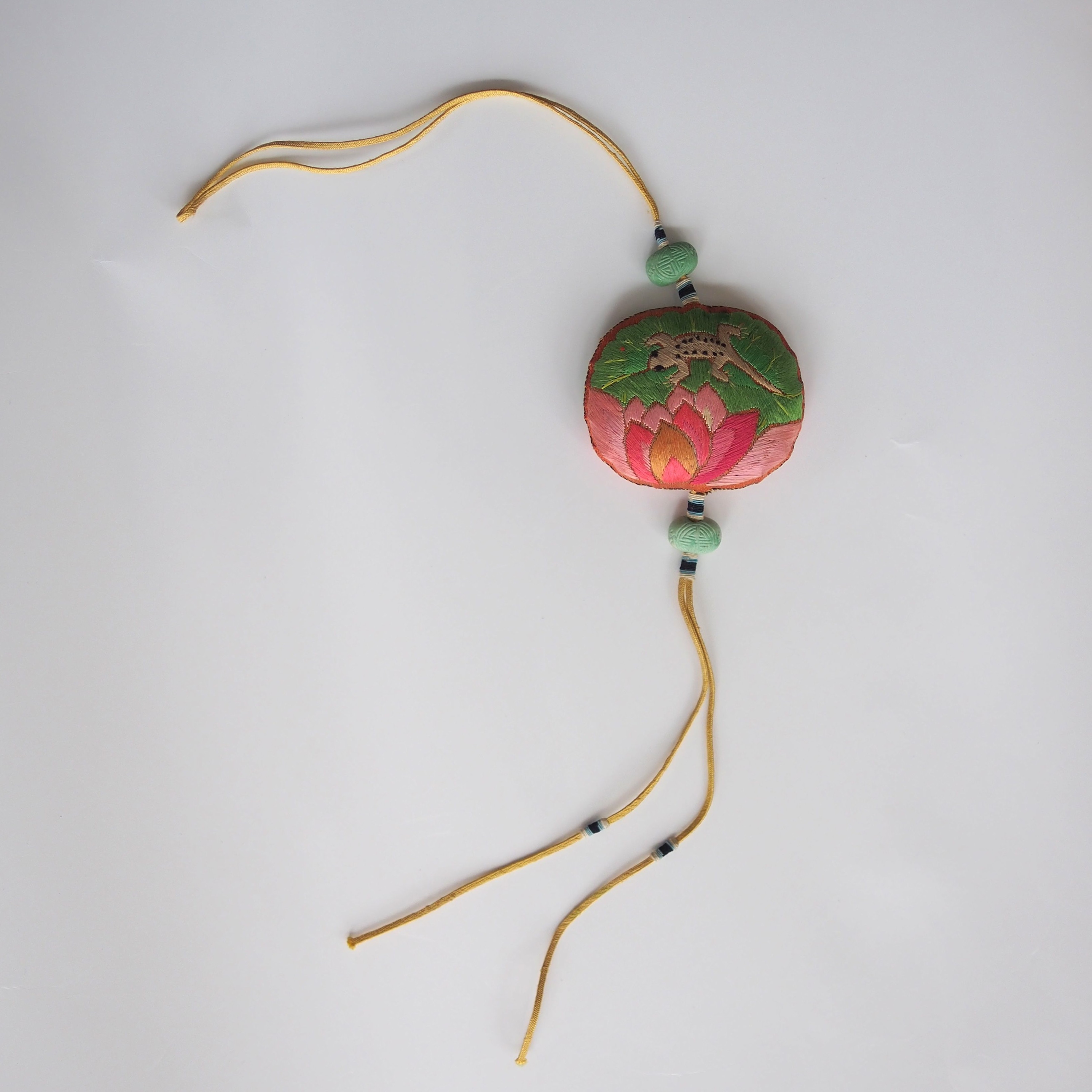
Tomorrow is the Duan Wu festival, the 5th day of lunar May, before Qu Yuan and the dragon boats came along it was a day for casting away the deadly famine. In ancient times when science and hygiene was poor, it is believed that lunar May is the month of toxin and the 5th is the day of evil and on this combination the day of death. To avoid ailment one is to be purified by bathing and resisted on meat, alcohol and sexual activities. A fragrant sachet would be worn by people all ages, the contents of the bag changes through time as hygiene improves and the taboo of the day of death becomes more remote, from the evil busting copper coins to the pesticide realgar powder, to the antiperspirant clam powder to medicinal fragrant herbs. From patchwork, the sachet was later decorated with embroidery; this particular on has on it a lotus and a lizard, lotus symbolizes togetherness with the lizard (one of the 5 poisonous creatures) offering it protection.
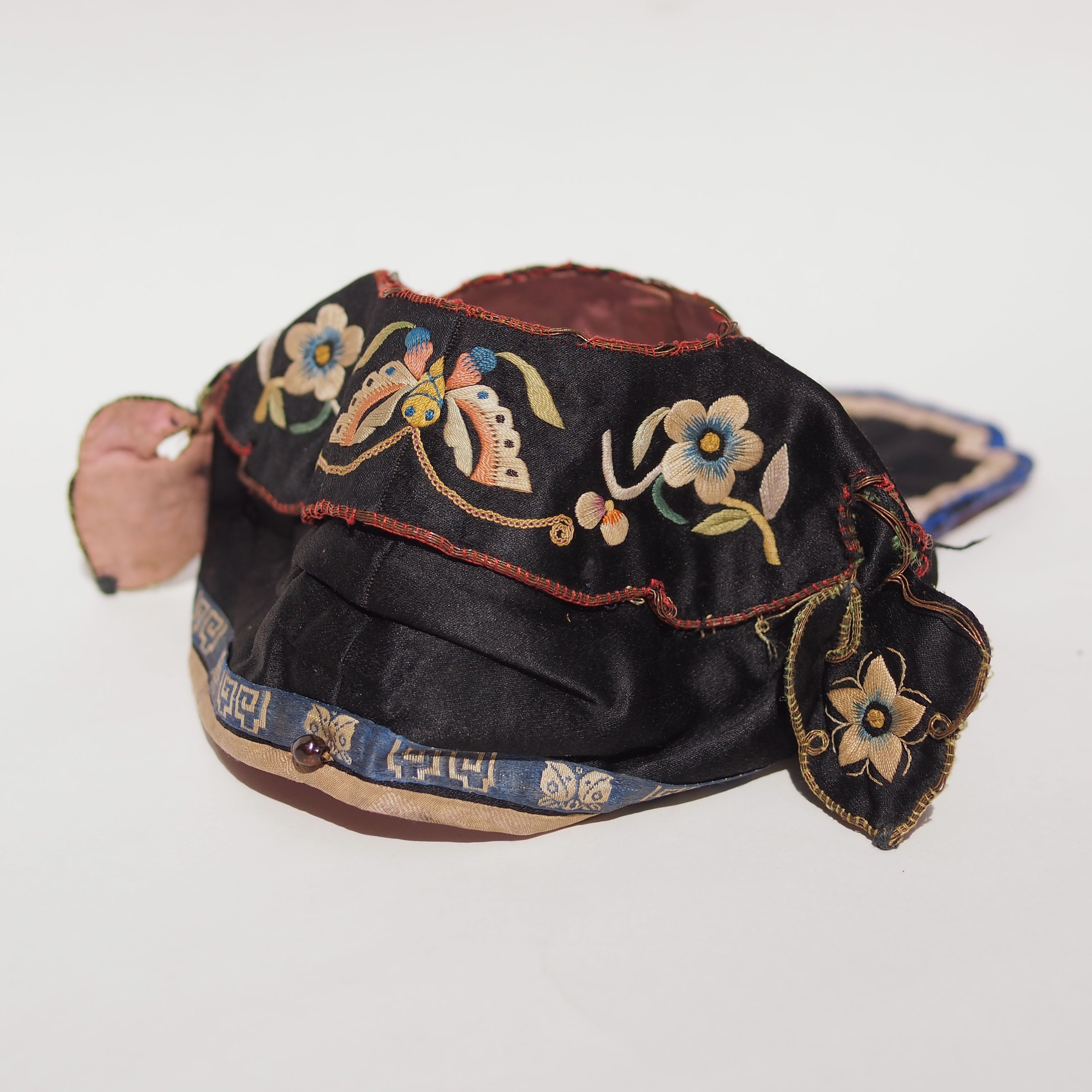
This is a butterfly embroidery hat for a new born baby, before a child is born the grannies will prepare a hat for the new comer. A tiger hat for the boy and a butterfly hat for the girl (there was no ultrasound then, so I suppose they will have to make one of each, just in case). Butterfly symbolizes beauty, a wish for the family for the young baby girl.
In the old days, needles are precious items that a girl would keep as part of her possession. In the days before the $10 budget store when one will just get a new set instead of looking for the one you already have. As needlework is part of any girls’ qualification, they would make their own pin holder, decorated with embroidery, patchwork, etc.







 Mountain Folkcraft