Archives for posts with tag: chinese

W60xL160xH100mm, China

Every child seem to have a horsy toy at some stage, whether they are big or small, rocking  or ride able.  This is the Chinese version made with clay and like most of the clay toy it is also a whistle making a horse like sound.  I like this particularly over the other clay toys as it looks half sleepy and totally silly.

H500xW150mm, China

This puppet is called a Chaozhou wire puppet, the body of the puppet is supported by a main wire attached to the back of waistline of the puppet while the 2 arms are controlled by 2 wires attached to the waists, hence wire puppet, all the 3 wires are controlled by the puppeteer at the back stage.

There are over 2000 repertoires for the chaozhou wire puppet, these are roughly divided into 3 main themes; adaptation from the southern Chinese opera, local legends and historical stories.  This puppet has the warrior helmet featured in the blog a couple of days ago, a female warrior figure.

W50mmxD30mmxH70mm, China

In the old days, every morning the ink will be grind on the inkstone.  Water will be added so the ink stick will be dissolved, water is also added during the day to dilute the ink on the stone.  For the ease of controlling the flow water, the water drip was invented.

This water drip of child and carp figurine which would have been made for children; the composition is a traditional one of blessing, carp being resilient and full of vitality which is what every parents would wish for their child.    Also see our earlier entry for a different form of  water drip .

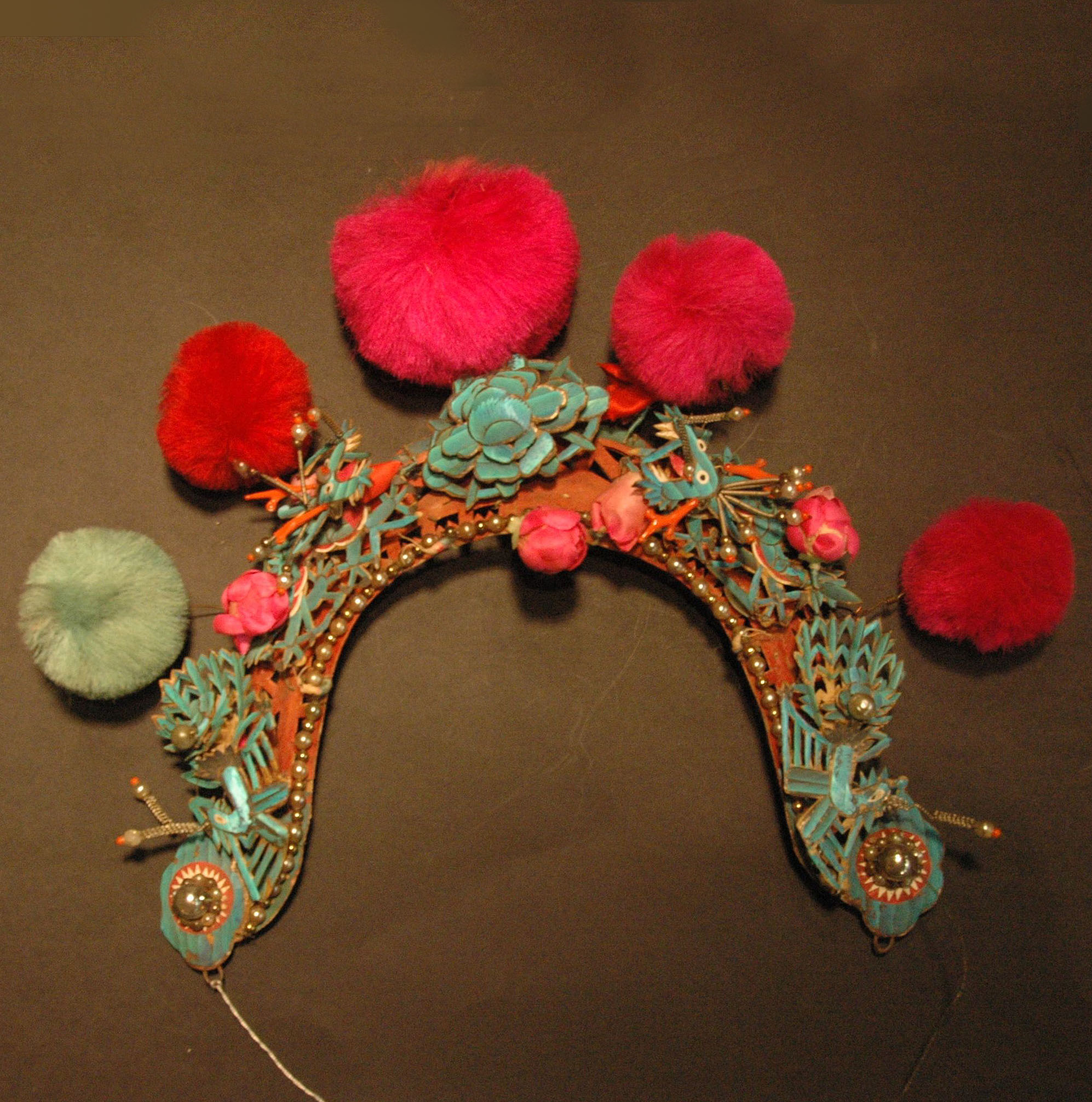
W300xH300mm, China

This is the head piece for Chinese opera, a crown used by the female warrior character, resembling the fighter’s helmet.  It has one layer of pompons and thus known as word one crown (the chinese word for one is 一, a simple horizontal line)

Due to the age of this piece, some of its tassels and a few of the pompons have gone missing.  The blue ornaments on the head piece are made from kingfisher feathers, tian tsui, a precious material.  The kingfisher bird has an amazing blue colour, however the intense colour is not from the pigment of the feather but from the reflection of the light.  Each piece of feather is painstakingly cut and inlay onto a metal gilt.   A relatively thin sheet of precious metal (gold or silver) is formed, gold or silver wires are bent according to the design and placed on the edge of this area, then small pieces of the feather is glued into the recess area.

Textile width 380mm, China

This checker fabric is from the Bu Yi tribe in China, they are famous for their hand woven checker pattern fabric and their wax dyed fabric, they are one of the remain tribes whom the tradition of cloth weaving remains a strong tradition.  The checker pattern cloth is used for head wrap, bed sheet and clothing; though they are all checkers, the use are very specific.  Each pattern has its own story, this particular cloth is for making clothes.  Instead of going online or glue to the telly, girls of the Bu Yi tribe would weaving as their past time during the evening; the motivation comes from the preparation of the dowry which has to include the minimum of bed sheets, duvet cover, 10 costumes.

W300xH450mm, China

This glove puppet character is called Di Lei, within the show (opera) he belongs to Jing (painted face) category.  Di Lei, is courageous fighter but lacking in tactics, he is one of the 4 hammer warriors of the famous Sung general Yue Fei.  With extraordinary strength, he is known as the iron hammer warrior.

The head of the puppet (as well as its eyes and mouth) is controlled with the index finger, while the thumb would control one arm and the rest of the 3 fingers control the other arm.  The thumb will also control the turn of the head while palm of the hand will control the waist and leg gestures.  As the puppet is manipulated with one hand, one puppet master can have 2 puppets on the show at the same time.

W220xL300mm, China

This is a wood block print of the Skanda, Wei Tuo, a guardian of Buddhism (leader of the 32 celestial guardians).  He has been worshiped in Chinese temples since the Sung dynasty, his statue is often placed behind the Maitreya statue.  It is believed that when the Buddha passed away and cremated, the demons came and robbed away his relics.  Wei Tuo chased and caught up with them and got back the relics, he was honored to be the guardian.  Though Indian in origin, Skanda was adapted into the Chinese culture as a courageous warrior and guardian and even has a Chinese name as Wei Tuo, but his task has never altered.

W90xL1900mm, China

This hand woven band is the belt for the costume of the Miao tribe.  Just after lunar New Year is the Cai Hua Shan festival of the Miao tribe.  Different clans will come together to the common area between the different villages, a large pine or cypress tree will be selected as the “flower stem”.  Before dawn the person in charge, “head of the flower stem”, will take on the task of erecting the tree post and tying ribbons and flower on the top.  This job is done by commonly agreed most kind hearted person (with such a task, I am not surprised).  The day begins with the “head” tossing wine to everyone and giving them blessing; fire crackers, drums are played to signify the start of the festival, followed by days of dance, music and laughter.  It is also the chance for dating, the men will give a woven band to the lady he desire and in return the lady will give him a embroided handkerchief or headwrap.

W40xL80xH80mm, China

This little clay peacock toy has come to join in the birdy collection.

H300x W190mm, China

To continue with our series of bird entries, here is a paper cutout of a phoenix (the mystified peacock).  For the Chinese, the phoenix is believed to be  the symbol of beauty and talent, an icon of blessing.  Its often paired together with the dragon, the dragon representing the male and phoenix the female (funny enough the more glamorous looking peacock is in fact a male).