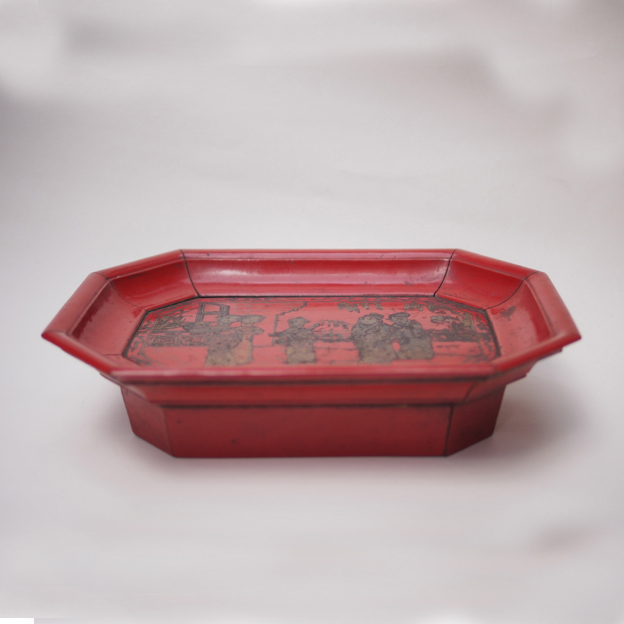
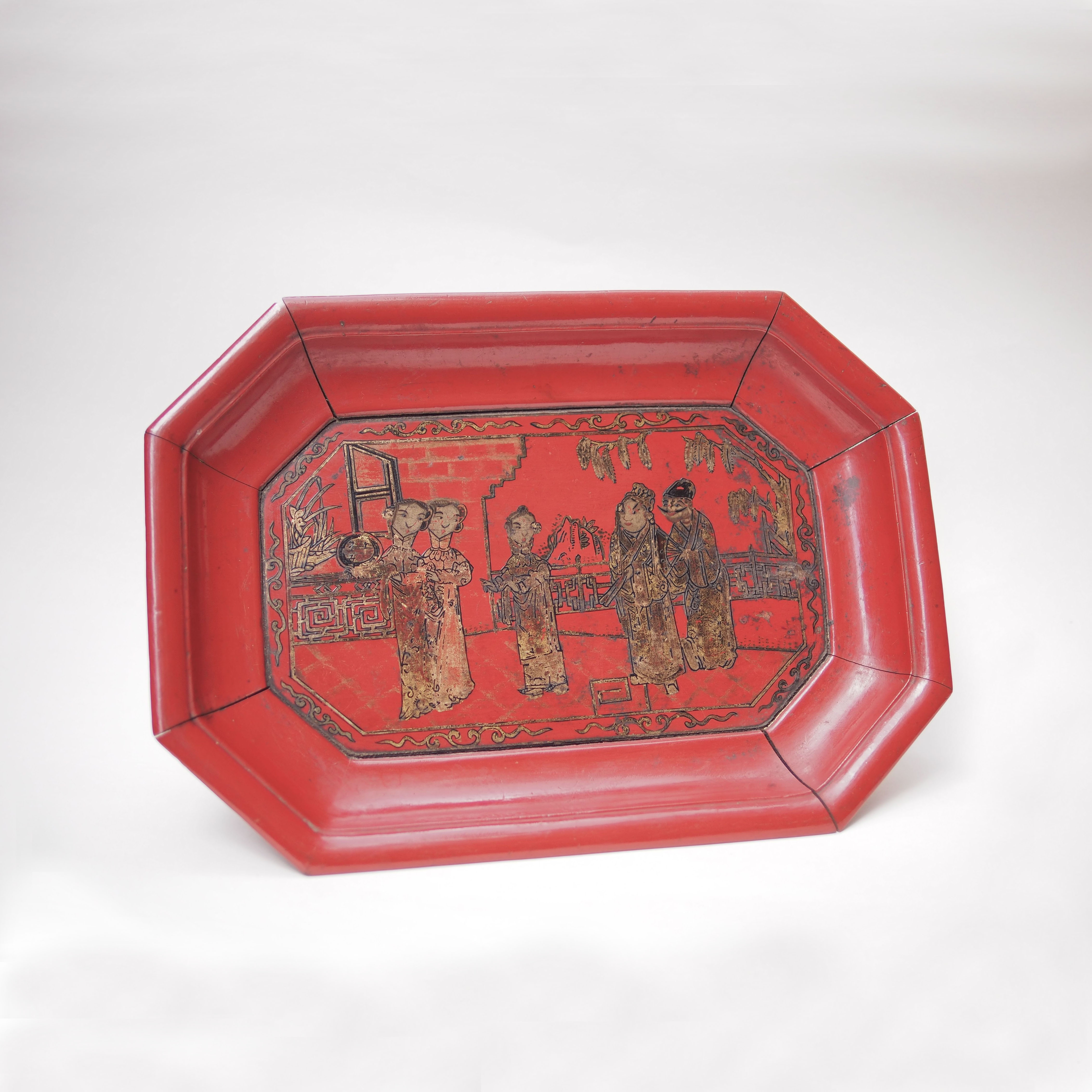
lacquer tray

lacquer tray

L320xW230xH75mm, China

The story depicted on this lacquer tray is from the same book, Jing Shi Tong Yan, as the Madame White Snake legend featured a couple of days earlier. The story about the flamboyant artist scholar Tong Yin; one day on a boating trip he sensed that a maid on another boat was smiling to him.  Electrified he ordered the boatman to followed the other boat and found out it belonged to the family of a court scholar.  Tong Yin disguised himself and applied for a job as a scholar assistant for the family and named himself Hau An.  Being over qualified for the job, he soon got promoted and trusted by the family and meanwhile he managed to find out the maid was called Qiu Xiang who directly serves the lady of the house.  The family wanted to promote Hau An as the person in charge but was weary of his single statue and suggested to arrange a marriage for him.  When Hau An found out about this, he proposed to pick one of maid as his wife.  The family agreed and on the same night, all the maids were there to be chosen but Hau An did not make a decision.  It turned out that Qiu Xiang was not there, the lady of the house then sermon her personal maid also to be present.  Hau An picked Qiu Xiang, married and lived happily ever after.

This story however, has nothing to do with the history of Tong Yin who got married three times; his first wife passed away at the age of 24, second wife left him and the third wife was a famous prostitute called Chen Jiu Niang.

go to 1 hour 23 minutes to see the same screen
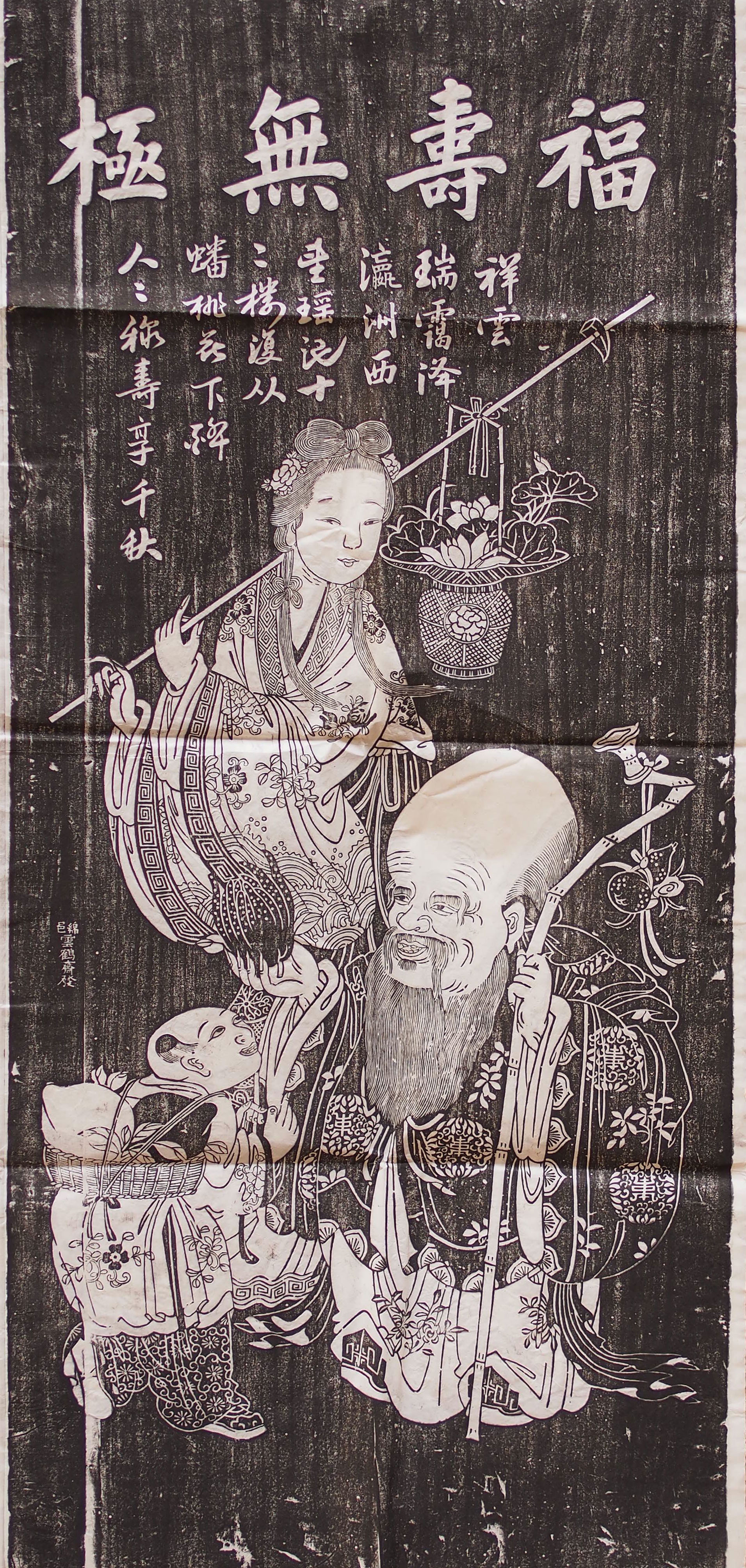
wood block printW600xL1750mm, China

This birthday print is filled with blessing symbols –

God of Longevity who is holding a cane on one hand and the Buddha’s hand fruit on the other hand.
The lady of behind is Ma Gu, the female God of Longevity with a basket full of magical plants.  Unlike the God of Longevity who has an appearance of an old man with a protruding forehead, Ma Gu is portrayed as a beautiful girl in her late teens.  In the legend, every year on the 3rd of lunar March, on the birthday of the Queen Mother of the West, Ma Gu will give her best wishes.
Lastly, the child saint carrying a basket full of longevity peaches, also a well known theme for birthday blessings.

Unlike the birthday scroll being a respectable birthday present for the elderly lady that would be held around birthday time, this is a Mian Zhu new year print that is pasted on the wall on Chinese New Year and to be replaced yearly.

embroidery

W170xW220mm, China

This embroidery captured a scene from the legend Madame White Snake, the  novel Jing Shi Tong Yan from the late Ming dynasty.  The story was set in the West Lake of Hang Zhou in the period of the Sung dynasty.  The serpent spirit of the white snake and her friend green fish subordinate transformed themselves into 2 pretty girls; Bai (white) Su Zhen and Qing Qing (green).  Bai fell in love with the  Xu Xian and used her magical power got married to him.  As time goes by, many strange incident happened because of Bai and Qing.  Xu Xian was approached by monk Fa Hai who told him the truth about his wife being a serpent spirit and gave him a monk’s bowl.  As Xu Xian place the bowl over his wife’s head, Bai and Qing returned to their original selves.  Monk Fa Hai took the bowl with the two spirits and build a Lei Feng pagoda on top of them.

A more romantic story has been adapted for opera, movies where the true love of the white snake is celebrated and the monk became a busybody.

To see the same scene as the embroidery, go 10 minutes into the movie.

As for the Lei Feng pagoda, it was believed that the brick used for building the pagoda has the power of healing, people began to steal the brick, grind it into powder and use it for medicine.  950 year later in 1924, the pagoda fell under its own weight … wonder if the white snake and the green fish manage to escape.  A new pagoda was rebuild in 2002.

kirin

W100xD50xH100mm, China

Chinese figurine of the lion are more often friendly and friendly rather then fierce, this might be because there are no lions originated from China.  The image of lion was brought to China by word of mouth from traders of the Western Region, as a tribute from Persia to the Emperor and as the symbolic “suan ni” from the Buddhist culture.  The worship of lion is thus mainly as a mystic protection of evil rather than the fierce forceful animal.

Black glaze pottery was first developed in China as early as the Jin dynasty (400 A.D.), it was a popular glazing in the Tong and Sung dynasty and further refined in the Qing dynasty.

Textile Width 380mm, China

 This fabric is woven by the Pu Ji tribe, a minority tribe in Gui Zhou.  Weaving is a technique passed down the generation of women, all fabric for the household would have been weaved by the family.  Traditionally, the young girls will be helping their mother and elder sisters and pick up the know how along the way, by the time they are a teenager they will be capable of making the cloth from scratch.

By from scratch, its from the cotton and indigo plant.  Cotton are collected and made into yarns and rolled onto the simple spindle while the strings for the warp are set out according to the design and often with the use of the exterior of the building.  Clothes are placed on the loom and the work begins.

Incense BurnerDIA100xH110mm, China

This old incense burner has a very contemporary design, even the exterior has a glossy finished to it.  It would have been used at home for the worship of gods or the ancestors.  The interior of the burner would be filled with ashes of the rice bran, these would be used to secure the incense stick.  As times goes by the container will be naturally filled with the ashes of the incense.

mask

W200xH300xD80mm, China

This is a warrior mask of the Chinese Ground Theatre (Di Xi).  A form of theater which based on the warring theme.

The character of the masks can be broadly divided into 4 catagories; generals, saints, clowns and animals.  The generals would wear helmets, like this one; and consists of warriors, intellectuals, female, old and young generals.  This particular mask belongs to the warrior general which the blue face symbolizes bravery and a strong character.  The saint types are masks with a weird features, e.g. a beak; they are powerful figures which comes to assist the generals on wars.  As in all theatres, di xi cannot be without the clowns, often character of distorted faces.  Lastly, the animals; the fierceful lion and tiger, the tamed horse, the stipid pig, hard working ox, endearing dog and the cheeky monkey.

snuff bottlesnuff bottle

W40xD25xH70mm, China

The blue rabbit on the transparent glass gives this bottle a dream like quality, it reminds me of legendary jade rabbit on the moon.

For the rabbits, this is perhaps their dream place to be, Okunshima, the rabbit paradise where rabbits runs free with no predators.  However, back in 1925 this island was a hell hole for the rabbits, they were used to test the poisonous gas that was produced on the island by the Japanese Imperial army.  The poisonous gas is now commissioned and a museum has been set up to alter the people of the effect of poisonous gas and war.

See click here to see our other snuff bottles.

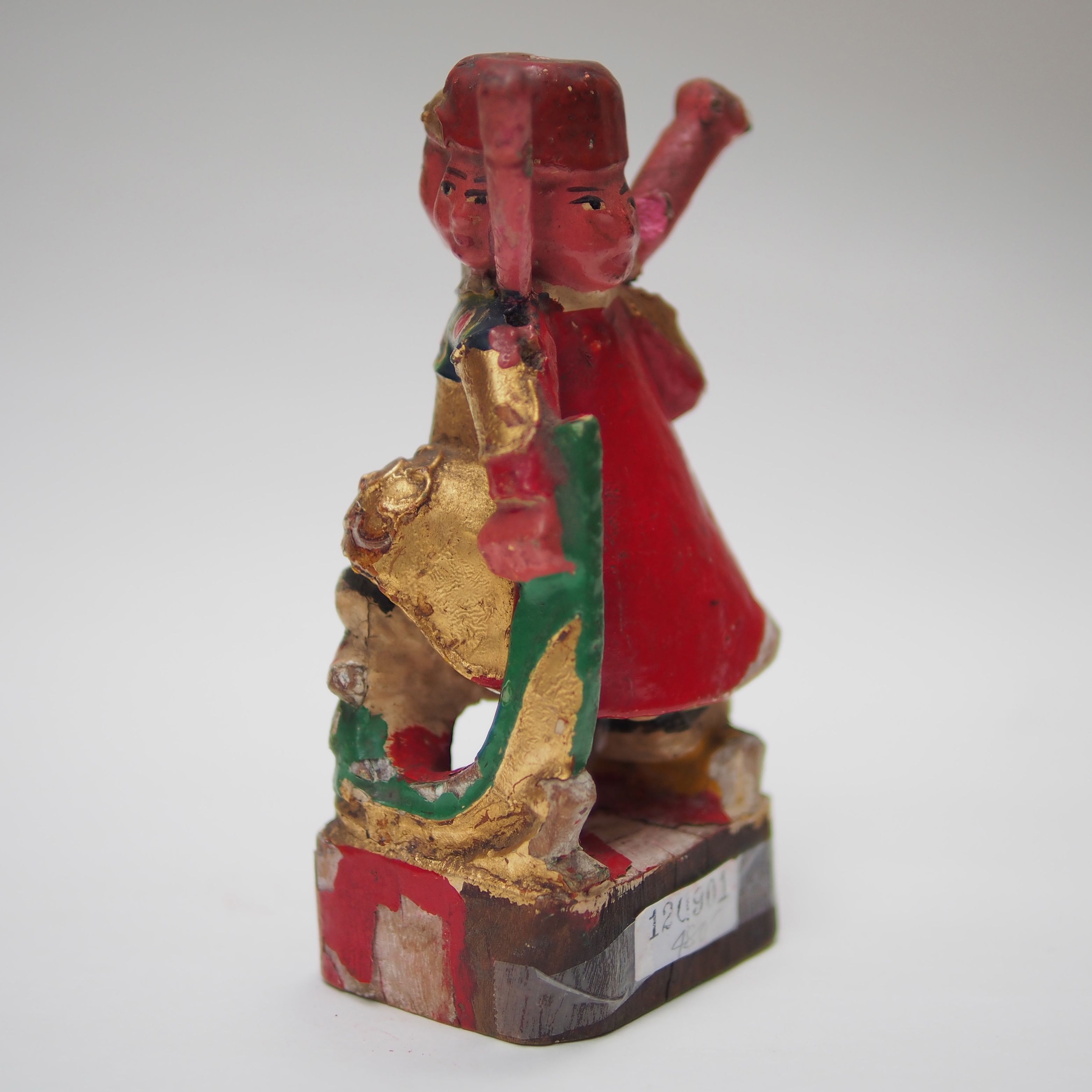
junk boat god

junk boat godjunk boat god

W70xD50xH150mm, Macau

This dragon and tiger rider was an ancestral saint that was kept at the alter of the junk boat for keeping the fisherman’s journey safe.  The multiple faces offer a supernatural power for this ancestral saint which is an usual expression for these figurines.  Or would the fisherman had been to Bangkok on one of their fishing spree and got their inspiration from the famous Erawan Shrine?

Click here to see our other junk boat gods.