Archives for category: wood

W390xD320xH800mm, China

This chair is called a Lamp Hanger Chair, it got its name because it takes on the form of a bamboo oil lamp hanger used in southern China.  This style of chair went back a long way, it was even depicted in a painting in the 5 Dynasty period of around 950AD, it then became the most typical chair type in the Ming Dynasty.   The chair has a simplistic form and uses mainly rounded rod as key members.  This particular chair is a smaller version of a typical chair.

W70xD70xH100mm, China

I am sure not by the craftsman’s intent but this item just put a smile on my face, a grinning pomegranate! It can even pass as an anime figure.

Pomegranate was imported into China in the Han dynasty from Persia, because of its beautiful flowers, it was immediately loved by the country.  It blossoms in lunar May, being such an event May is also known as the pomegranate month.  Apart from its flowers, pomegranate is seen as a symbol of blessing in China; a symbol of fertility, a single fruit it bears over 1000 seeds!

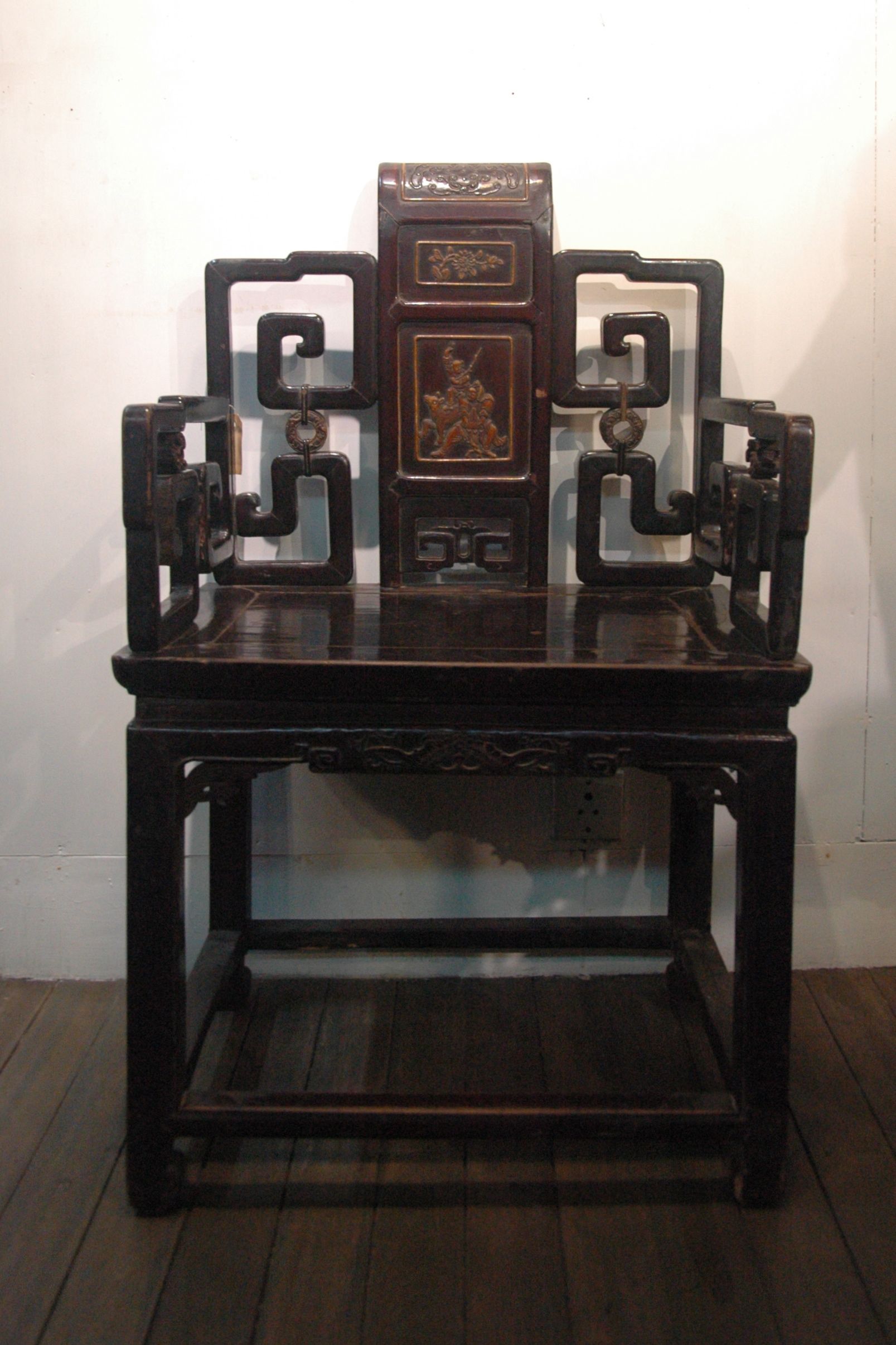
W470xD370xH950mm, China

This is one chair from a pair.  This type of chair is known as “chair with armrest, scroll style headrest with guai zi dragon pattern”, my translate is not perfect but believe me the Chinese name is equally as long.  The armrest need no explanation, the scroll style headrest refers to the top of the head board that turns in at the back similar to that of the old Chinese scroll.  The head board is decorated with relief carving panels of blessing symbols.  The guai zi dragon is the pattern that forms the back and the armrest of the chair, it is also echoed as a decoration on front of the seat and at bottom of the legs.  Guai zi dragon is a pattern that is commonly used in furniture and architectural decoration; it is broadly divided into 2 styles, a more realistic type where from pattern one can tell the head and claws of the dragon where the dragon is usually quite animated and a more conceptual style (as on this chair).

This type of chair was popular from the middle Qing dynasty, particularly in the Southern region of China.  It is normally placed in the study, on the 2 sides of the table or facing the table.

DIA350xH200mm, China

Before the invention of the disposable paper gift boxes and wraps, there were these lacquer boxes for transporting and presenting gifts.  This particular one is for cakes and confectionery gift.  After the gift is received, the boxes will be returned to the sender.  A red packet will be placed inside the boxes as a thank you gesture to the giver, they should never be returned empty.  For bigger celebrations like wedding, the bride’s family will send out boxes of the bridal cake for friends and family as an announcement of the wedding.  The boxes will be rented out from the cake shop, though the wealthy family would have custom made the lacquer boxes for these occasion.  Nowadays the custom is replaced by a cake gift voucher … I must say I would be much happier to receive the gift from a beautiful box like one then a paper voucher, I think it will make the cake taste better and share more of the joy of the happy couple.

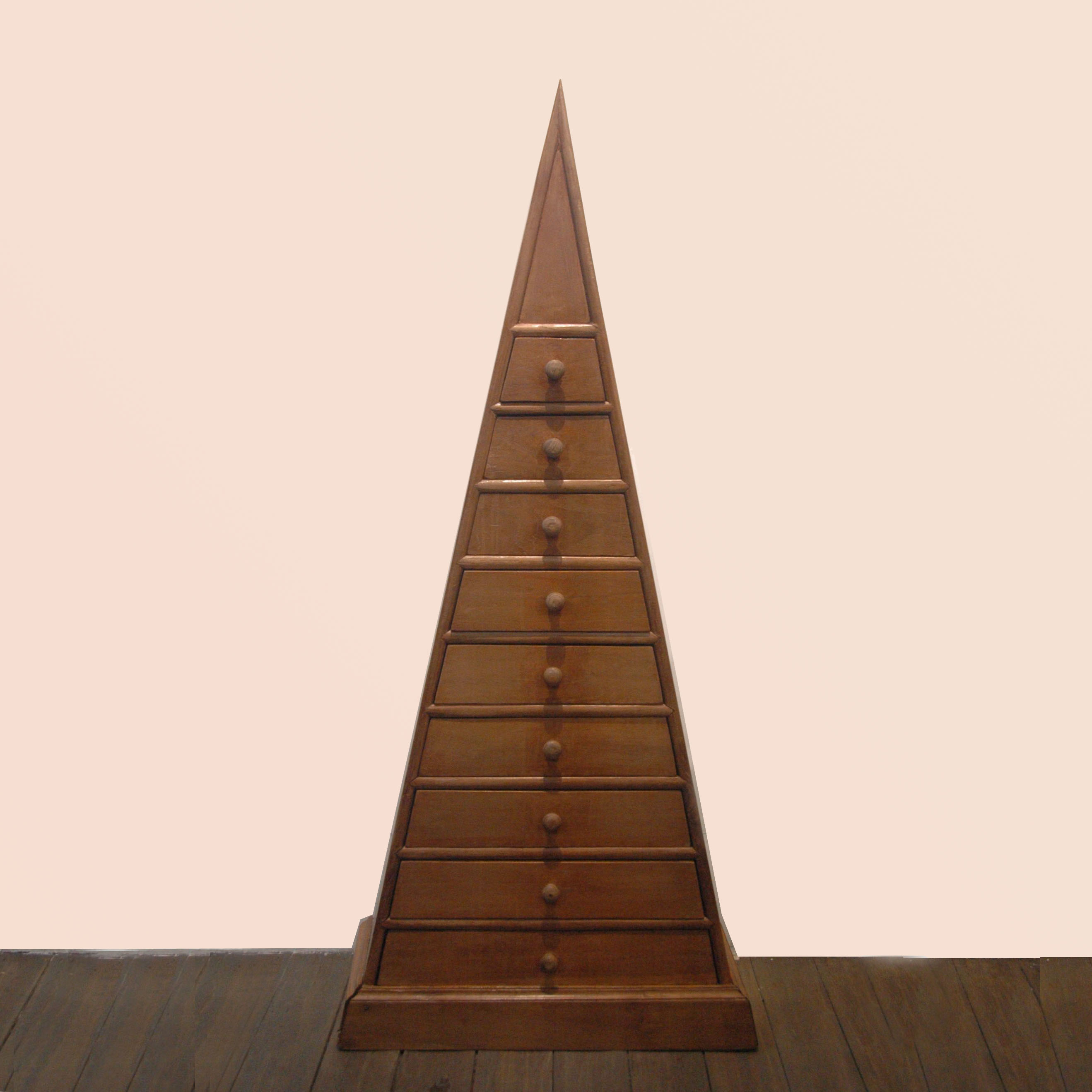
D170xW450xH1100mm

This item has been in the shop for as long as I can remember, being an architect I can see it as a concept for a skyscraper, a vertical city, etc.  But there is something more to it, it seems it really should belong to a fairy tale where these drawers open up to endless possibilities and magics.

W50xD40xH120mm, Macau

We have posted this form of wooden figurine (Junk Boat God, Junk Boat God, god?) twice already in the blog, but this time with a new understanding.  Last week I was at the Hong Kong Heritage Museum visiting the Picasso Exhibition (Masterpieces from Musée National Picasso, Paris), if you are visiting Hong Kong try to prebook a ticket to see, its well worth the trip.  Now I have got you all excited, well, the effigy has nothing to do with Picasso, I found similar  figurines in the local history section of the museum and here is the describsion;

“Wooden Effigies – People who lived on land worshipped wooden tablets with the names of their ancestors written on them.  Fishermen worshiped wooden effigies instead.  the appearances of the effigies vary according to the status and sex of the deceased.  The usual practice was for a family to hire a spirit medium to conduct a ceremony, and sculpt a wooden effigy of the deceased according to her instuction.  As time passed and fishing families became better educated, wooden effigies were replaced by wooden tablets.”

If this is correct, I wonder if the person this effigy is made for had an ambition to become a concert conductor.  The explanation from the museum is quite different from the one told me by the old Tanka gentlemen in the Tai O fishing village (see Junk Boat God, god?).  Would a Tanka person help me to clarify this?

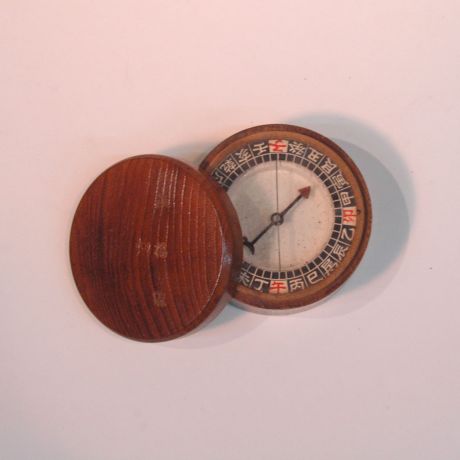
DIA100xH60mm, Hong Kong

This is a compass used by Tanka clan, a clan who lived on junk boats along the coast of Southern China and worked as fisherman.  As it is a day to day object, their compass is more simple then the traditional geomancers’ compass.  The compass for the Chinese is not only for telling the direction but related to space (direction extending to the universe) and time (past and future) as a whole

The Chinese Compass Points

Chinese navigators reduced the compass they inherited from the geomancers to its simplest form, using only 24 points, or even reducing them to 12 or 8.  The dial itself is divided into segments of 15 degrees each, represented by 24 Chinese characters.  These are the compass points, which scholars say were the basis for calculations by diviners and geomancers in ancient times.  These compass points were stabilized in their present system by at least the early 8th century.  These characters used on the compass dial are not the characters commonly used in China to represent directions.  Their origin or etymology is, for the most part, lost in the mists of antiquity.  But scholars have traced many of them back to over 4000 years ago when they appeared on “oracle bones” used to look into the future.  12 of the characters ;  子 zi, 丑 chou,  寅 yin,  卯 mou, 辰 chen, 巳  si, 午 wu, 未 wei,  申 shen, 酉 you,  戌 xu, 亥 hai, have been traditionally grouped together and referred to as the 12 branches.  8 of these character 甲 jia, 乙 yi, 丙  bing, 丁 ding, 庚 geng,  辛 xin, 壬 ren,  癸 gui,  are part of the traditional grouping knon as the 10 stems.  The remaining 4 乾 qian, 坤  kun , 艮 gen,  巽 xun derive from one of the earliest Chinese works on divination, the I Ching.  In very ancient times, the 12 branches were applied to the months of the tropical year and the 10 stems were used to name the ten day week.  Diviners used the stem/ branch combinations of the day, month and year of birth as basis for their calculations and conclusions.  The 12 brances are also associated with the Chinese zodiac; the rat, ox, tiger, hares, dragon, serpent, horse, gost, monkey, cock, dog and bear.  Each of htese creatures is supposed to exercise an astrological influence over a particular 2 hour period of the day, and one year out of every 12.

子 zi – North, rat, 23:00-01:00
癸 gui – N15°E
丑 chou – N15°E , ox, 01:00-03:00
艮 gen – NE
寅 yin – N60°E, tiger, 03:00-05:00
甲 jia –  N75°E
卯 mou – East, hare, 05:00-07:00
乙 yi –  S75°E
辰 chen –  S60°E, dragon, 07:00-09:00
巽 xun – SE
巳  si – S30°E, snake, 09:00-11:00
丙  bing –   S15°E
午 wu – South, horse, 11:00-13:00
丁 ding – S15°W
未 wei – S30°W, sheep, 13:00-15:00
坤  kun – SW
申 shen – S60°W, monkey, 15:00-17:00
庚 geng – S75°W
酉 you – West, cock, 17:00-19:00
辛 xin – N75°W
戌 xu – N60°W, dog, 19:00-21:00
乾 qian – NW
亥 hai – N30°W, pig, 21:00-23:00

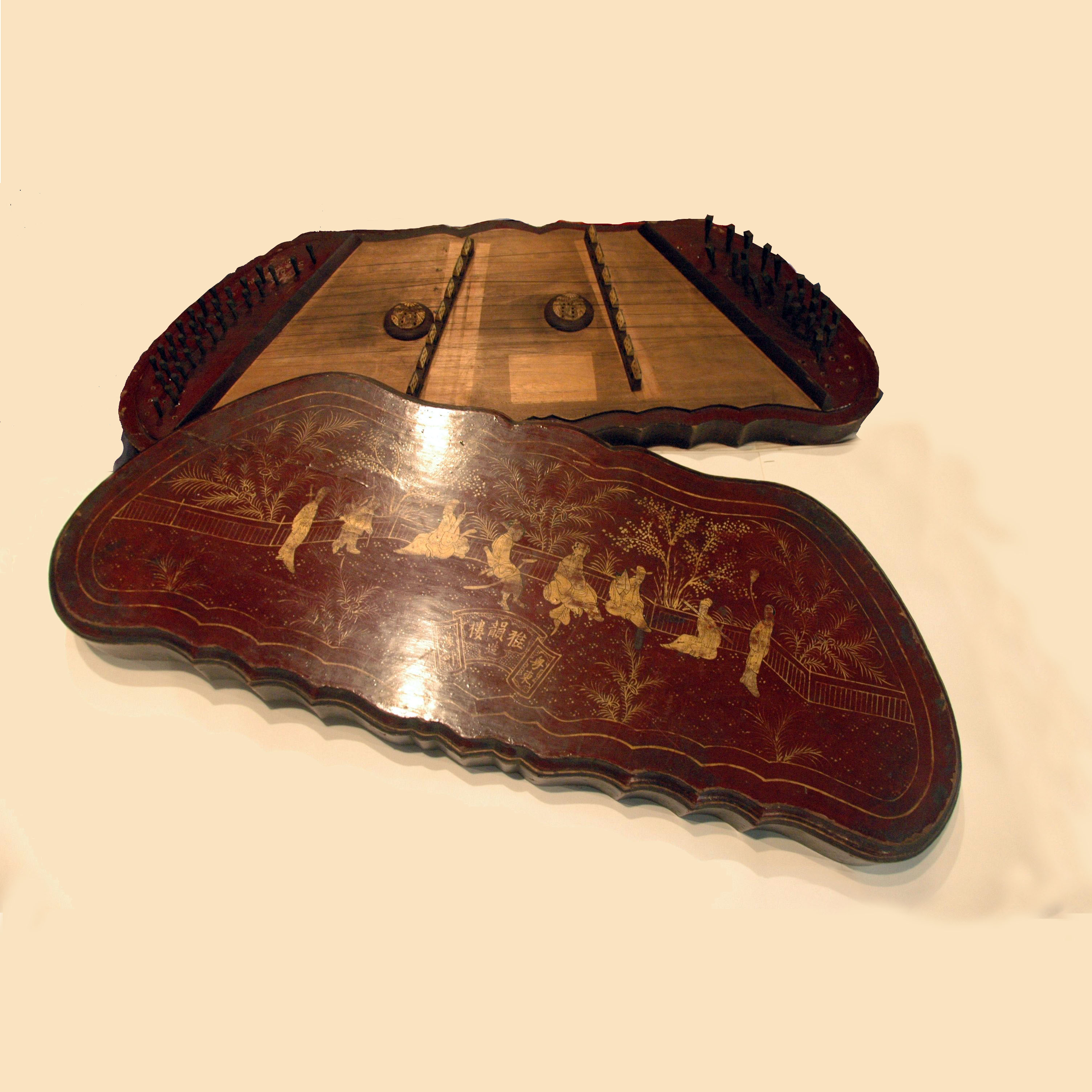
L770xW300xH120mm, China

The Yangqin is Chinese hammered dulcimer, however, the original  instrument was imported from Persia in the Ming dynasty (around 1580).  A similar instrument was very popular in Europe during the 14th century which later inspired the invention of the harpsichord, clavichord, piano forte, and eventually the piano.  There are many different types of Yangquin, the one we have here is a Butterfly Yangqin which is similar to the origin version, it is smaller and only has 2 bridges.  Its sound range is limited to the natural note (the sound from the white keys of the piano).  This yangqin has a lacquered box with beautifully gold painting of the 8 Saints, the instrument  is a bit worn out and would require some fixing and tuning before it can be played.  The instrument was made the the Guangdong Ya Yun Leu.

Performance of the Ode to Yellow River with the Yangqin

Same piece performed on the piano by Lang Lang

H500xW150mm, China

This puppet is called a Chaozhou wire puppet, the body of the puppet is supported by a main wire attached to the back of waistline of the puppet while the 2 arms are controlled by 2 wires attached to the waists, hence wire puppet, all the 3 wires are controlled by the puppeteer at the back stage.

There are over 2000 repertoires for the chaozhou wire puppet, these are roughly divided into 3 main themes; adaptation from the southern Chinese opera, local legends and historical stories.  This puppet has the warrior helmet featured in the blog a couple of days ago, a female warrior figure.

W70xD60xH270mm, Borneo, Indonesia

This is a hampatong from Borneo, the Dayak tribes create these wooden figurines portraying humans, animals and supernatural creatures.  The hampatongs can be broadly divided into two types; the tajahan (ancestral figures) and pataho (guardian figures for protecting the tribe).  This particular figurine is a tajahan.  Each figures are have their own function and meaning, for the tajahan figures the craftman would capture the details of the particular ancestor.  The animal on which the ancestor is sitting on is most likely to be a goat is believed to be sacred.  This is a protective amulet of a male ancestor sitting on a chair. the bread are made from coconut husk.