Archives for category: jewellery

DIA70mm, China

 This silver bracelet has a very simplistic design, a band of silver held at the end by a small opening and a bolt.

This item selected by Furze for the Something Old Something New exhibition and is available at both Mountain Folkcraft and Soil.

DIA 40mm, China

This is one of the gift for the Chinese baby’s shower (normally on the 100th day of its birth), a silver bracelet with the pendent of Budai and a peanut.  You must be wondering why these 2 items would be selected for a child as an ornament.  Budai, the laughing buddha, is an incarnation of Maitreya, however, this image of Maitreya is only found in China but not in India.  It is believed that the image of the laughing monk with a belly and a bag originated from a monk in the Five Dynasties, an incarnation of Maitreya and known for his joyfulness, forgiveness and kindness, for this he is always depicted to be followed with a group of children.  For a child to be wearing Budai would be giving her the blessing and a hope that his character would rub in a little.  As for the peanut, it is known as the fruit of longevity, bringing health and fertility.  In old rural China when medical and hygiene was poor, this blessing to the child is a wish of parents for some extra help for his well being.

This item selected by Furze for the Something Old Something New exhibition and is available at both Mountain Folkcraft and Soil.

W40xL60x10mm, China

This pendant is made from a piece of broken ceramic, from the shape of the piece it is likely to be of a medium size jar or a vase.  The figure on the piece is part of the a war story, these figures or themes are known as Knife-Horse-People which is a popular theme in the Qing dynasty.  See here for the clay version of Knife-Horse-People.

Though completely different, this ring seems like part of the portrait jewellery collection.

CIR 55mm (UK size O), China

I had a similar ring when I was a teenager, it was one of my favorite.  It has a “pure silver” mark in Chinese (but as a human guinea pig I can verify that it is really pure silver as I suffer badly with metal allergy, only pure gold and silver would pass the test, how posh is that!)

Enamel was brought into China from France in the Qing dynasty (17th century) and was immediately adored by Emperor; workshops for the court were set up in Imperial Court in Beijing and in Guangdong.  It then became popular throughout the country during the reign of the next 2 emperors.  The type of enamel produced in China was mainly cloisonne, where a thin wire is applied to form cells to hold the enamel.

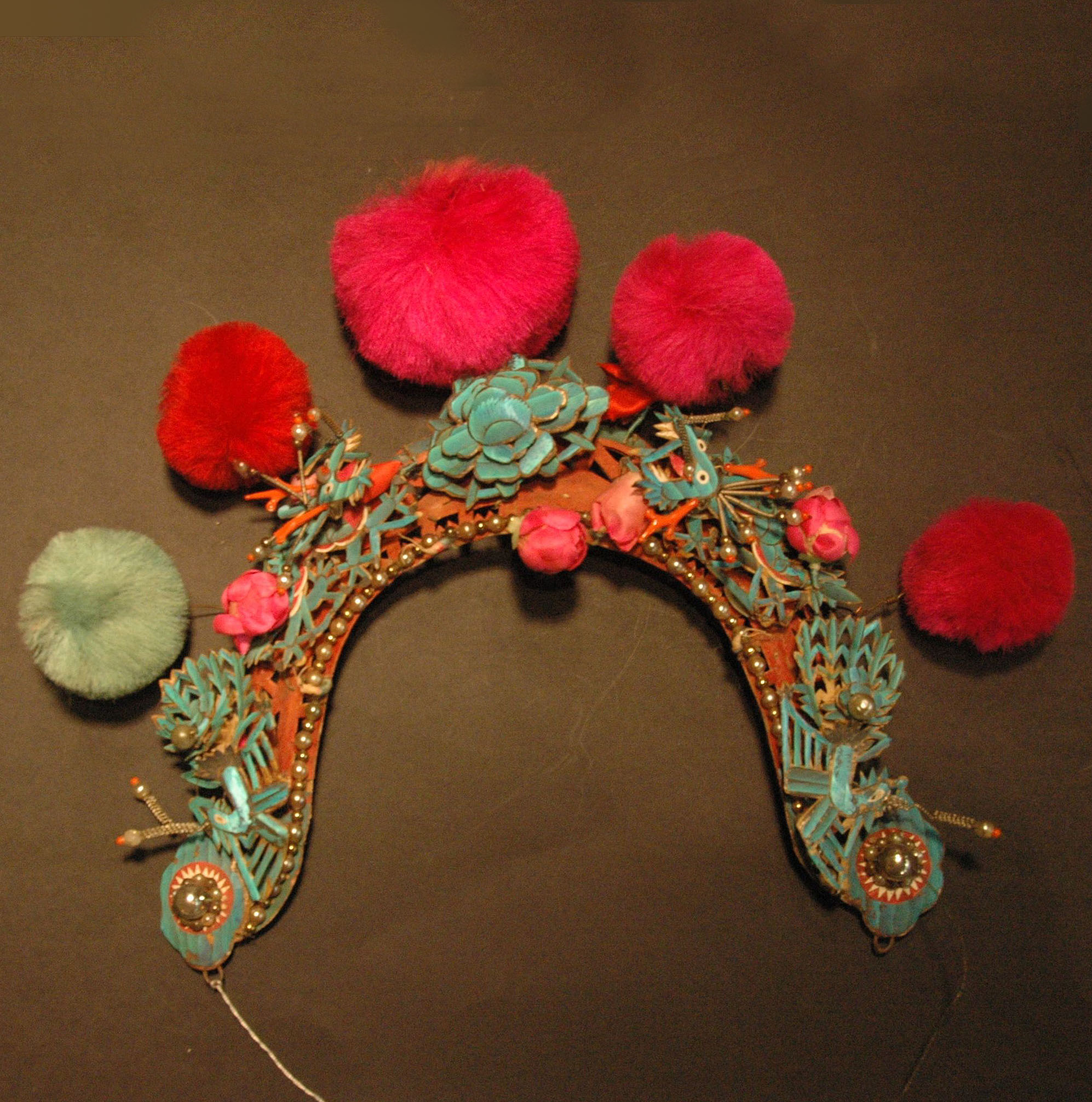
W300xH300mm, China

This is the head piece for Chinese opera, a crown used by the female warrior character, resembling the fighter’s helmet.  It has one layer of pompons and thus known as word one crown (the chinese word for one is 一, a simple horizontal line)

Due to the age of this piece, some of its tassels and a few of the pompons have gone missing.  The blue ornaments on the head piece are made from kingfisher feathers, tian tsui, a precious material.  The kingfisher bird has an amazing blue colour, however the intense colour is not from the pigment of the feather but from the reflection of the light.  Each piece of feather is painstakingly cut and inlay onto a metal gilt.   A relatively thin sheet of precious metal (gold or silver) is formed, gold or silver wires are bent according to the design and placed on the edge of this area, then small pieces of the feather is glued into the recess area.

DIA180mm, Thailand

This is a buffalo bone necklace from Thailand, the beads are not finely polished giving a more natural wooden look.  The hook and closure are made with buffalo horn.  Buffalo has been a part of the traditional Thai agricultural for a long time, they helped to do the laboriousness task of ploughing the paddy field, a treasure livestock for the farmers.  The horns, bones and hide are used for many traditional crafts.

W150xH150mm, Thailand

This is a gold hairpin to be worn by the bride in a Thai wedding.  During Thong Mun, the engagement ceremony (which sometimes is on the same day as the wedding), the groom will present gold sindod (dowry) to the bride.  The ceremony will be attended also by friends and relatives.

DIA20mm, China

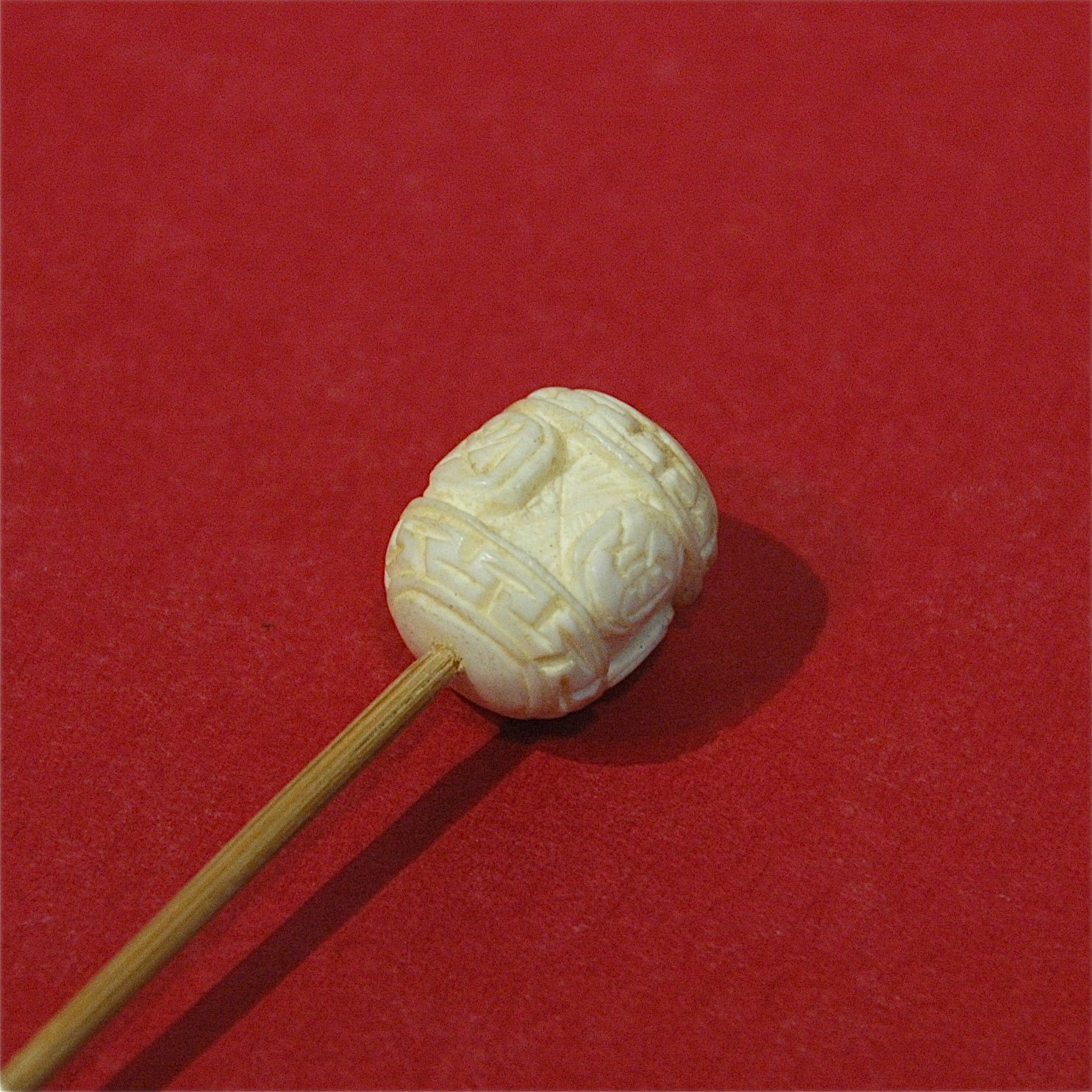
This is an buffalo bone bead for the buddhist rosary, Mala.  The Mala is used for counting the number of times a mantra has been recited.  Bone beads (because of its material departing from the idea of Chinese Buddhism) is not commonly used for the Chinese buddhist rosary.  In Tibetan Buddhism, however, the use the nature bones and horns are a reminder of the impermanence of our bodies and that we are, like everything else just a passing phenomenon.

L60xD20xH50mm, China

The longevity lock, a tradition for the Chinese babies hundred day celebration, the child will keep it on till his 12th birthday.  The Chinese believes that life will be locked just as a door or a trunk.  In a way its a kind of blessing given to the child by the elders of the family.  Its history started from the Han dynasty, on the 5th of lunar May, every household would hang a 5 colour rope on the door as a blessing against the plague.  By the Jin dynasty, the 5 colour rope would be tied on to the arms of women and the children as a blessing.  The tradition extending into the empirical court in the Han dynasty, the Emperor would  give out the rope to all his ministers on the 5th of lunar May.  The rope became more elaborated by Ming dynasty and became the silver locket we have here.

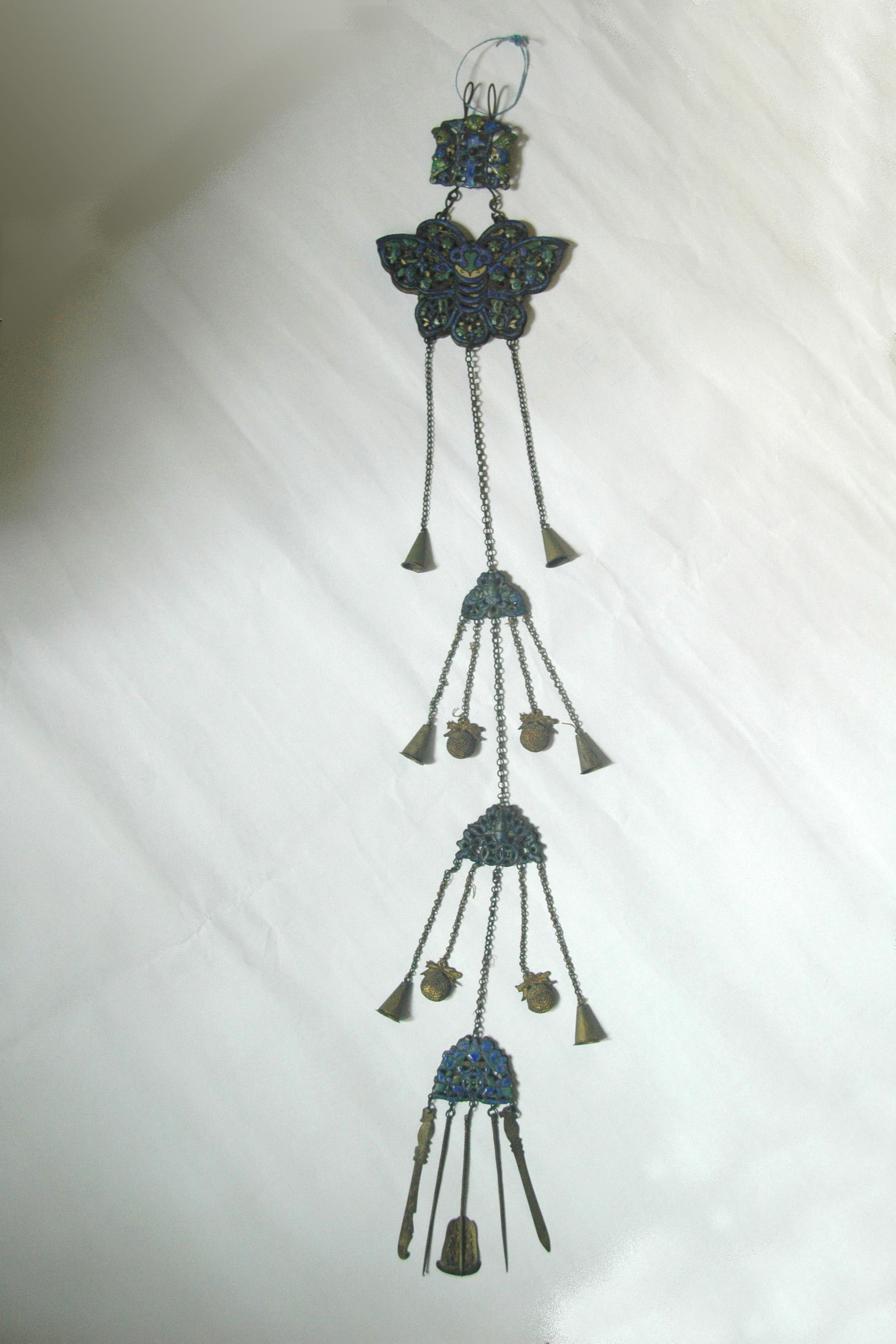
L650xW100mm, China

This is a ladies’ silver waist hanging ornament, highlighted with enamel pendant pieces.  On the top three layers, small bells are hang making a delightful charm as one move around.  At the bottom hung 5 accessories; 2 type of knive, a shove, toothpick and earpick (a traditional Chinese style Swiss army knife).