Archives for category: figurine

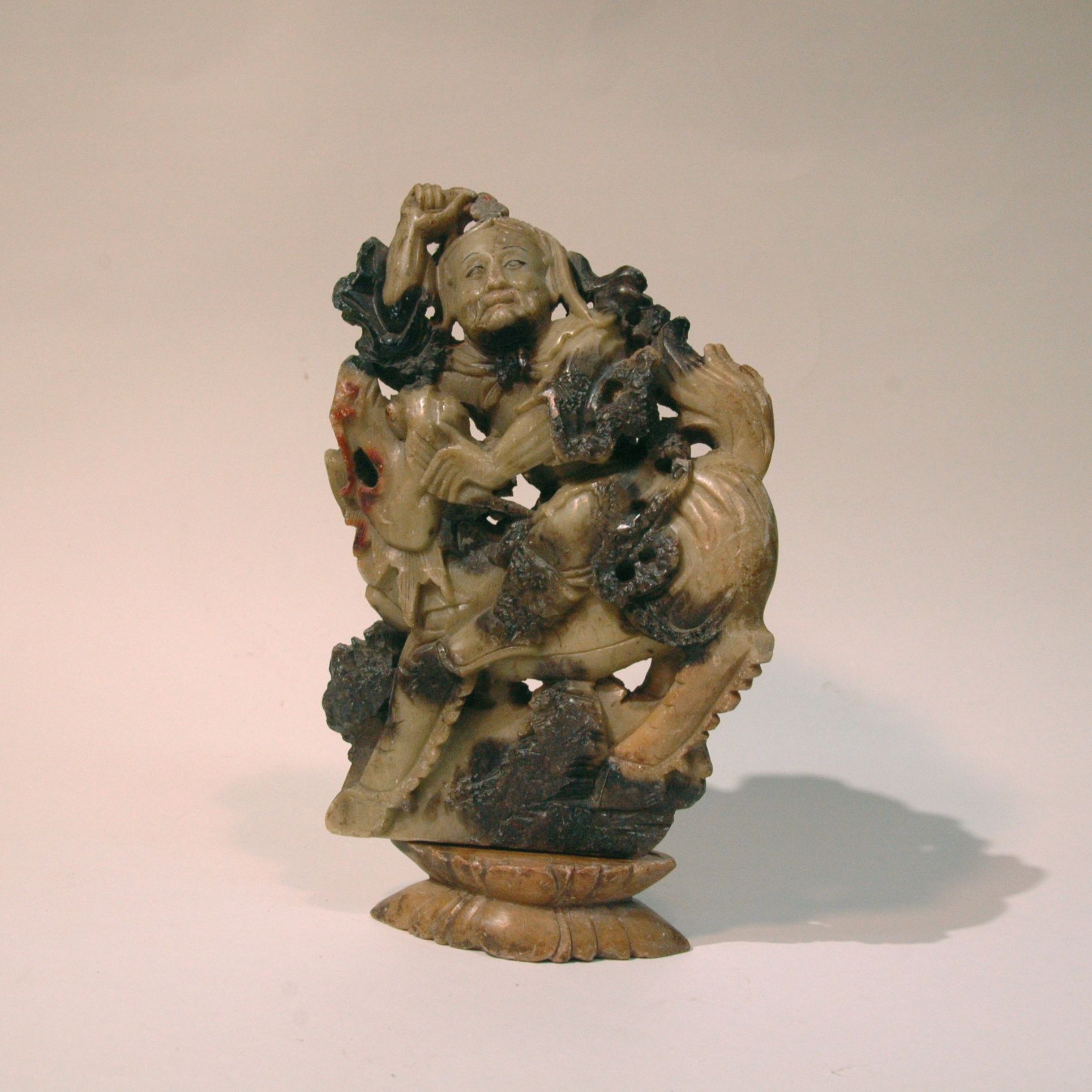
W130xD50xH230mm, China

This figurine is a Shou Shan stone carving, the Shou Shan stone is famous for its wealth of colours, the artist would made use of the colour to form the composition of the carving work, all the carvings are one off piece of artwork.

The warrior of this carving is riding on a Kirin (yes, its the same mythical creature as on the beer can) with bats accompanying them.  The Kirin (together with the Phenoix, the turtle and the dragon) is believed by the Chinese to be one of the four old saintly creatures.  Its a creature of heaven and not of the earth, those that were captured by the gods became their carriage (as on this figurine).  The Kirin has the head of a dragon, horns of a deer, eyes of a lion, the body of a tiger, the scale of fish, but despite this fierce appearance it is a kind creature and believe to an animal of blessing.  As for the bats, they are also a symbol of blessing for the Chinese but as we all know what they look like I wont go into details in this post.

Here is a story about the bat and the kirin from the Ming dynasty which i find quite amusing; one day the Phoenix held a birthday party, as she was the queen of the birds all the birds from everywhere came to wish her happy birthday.  The bat, however, did not show up.  The Phoenix, being the queen, was not please at all, so she summoned for the bat and asked, “you live under my rule, where are you so arrogant and did not come when invited?”  The bat answered, “I have craws, I am a beast, why should I pay my respect to a bird?”  Then the Kirin held his birthday party and the bat did not show up, the Kirin was angry and condemned the bat, the bat answered, “I have wings, a bird, why should I come to a beast party?”  Then the Phoenix and the Kirin met up and of course the bat incident came up in their conservation, “what a world this is coming to that there is such non bird non beast creature, how frustration is that.”  As time moves on from the Ming Dynasty, I feel that the bats now would claim to be a bird in front of the Phoenix and a beast in front of the Kirin, a fence sitter in all sense.

W20xL150xH100mm, China

Today, lunar 5th May, is the Duan Wu Festival, better know as the Dragon Boat festival.  It is a day to commemorate the death of the Chinese hero Qu Yuan.  Qu Yuan was poet from the Warrings State Period,(278 BC), he was a close aid to the emperor helping the Chu Guo state becoming a strong state.  Being loyal to his country he refused to collaborate with the corrupted higher ranking officers and empress, for this they kept him away from the emperor.  Despite his advice and objection for a treaty with the Qin Guo state, the emperor was lured to visit the Qin, was held captive and died there .  When the son of the emperor took over Qu Yuan was sent into exile.  Qin attacked and conquered the Chu; Qu Yuan, heart broken that his country was lost committed suicide in the river Mi Luo Jiang.  Hearing the news the folks steer boats to rescue him but neither him nor his body could be found, fearing that the fish would eat away his body, they beat drums to scare the fish away and throw in dumplings to keep the hungry fish away.

L160xW50xH160mm, China

This clay toy is of the god of  longevity who began his legend as Canopus, the brightest star  in the southern constellation of Carina and Argo Navis.  In the Qin dynasty, temples were erected for the worship of  the Canopus star, it is believed that when the star shines brightly the world would be peaceful and vice versa.  Canopus is also known as the “elderly star”, apart from peace, it also upheld the ethic of the respect for the elders.  In the East Han dynasty, the ceremony for Canopus worship consist of a stately banquet that included all the over 70, nobleman and commoners.

Besides the astronomy aspect, the god of longevity also has a human figure, Peng Zu.  Legend has it that Peng Zu has mastered the art of longevity and lived to an age of  767 years old!

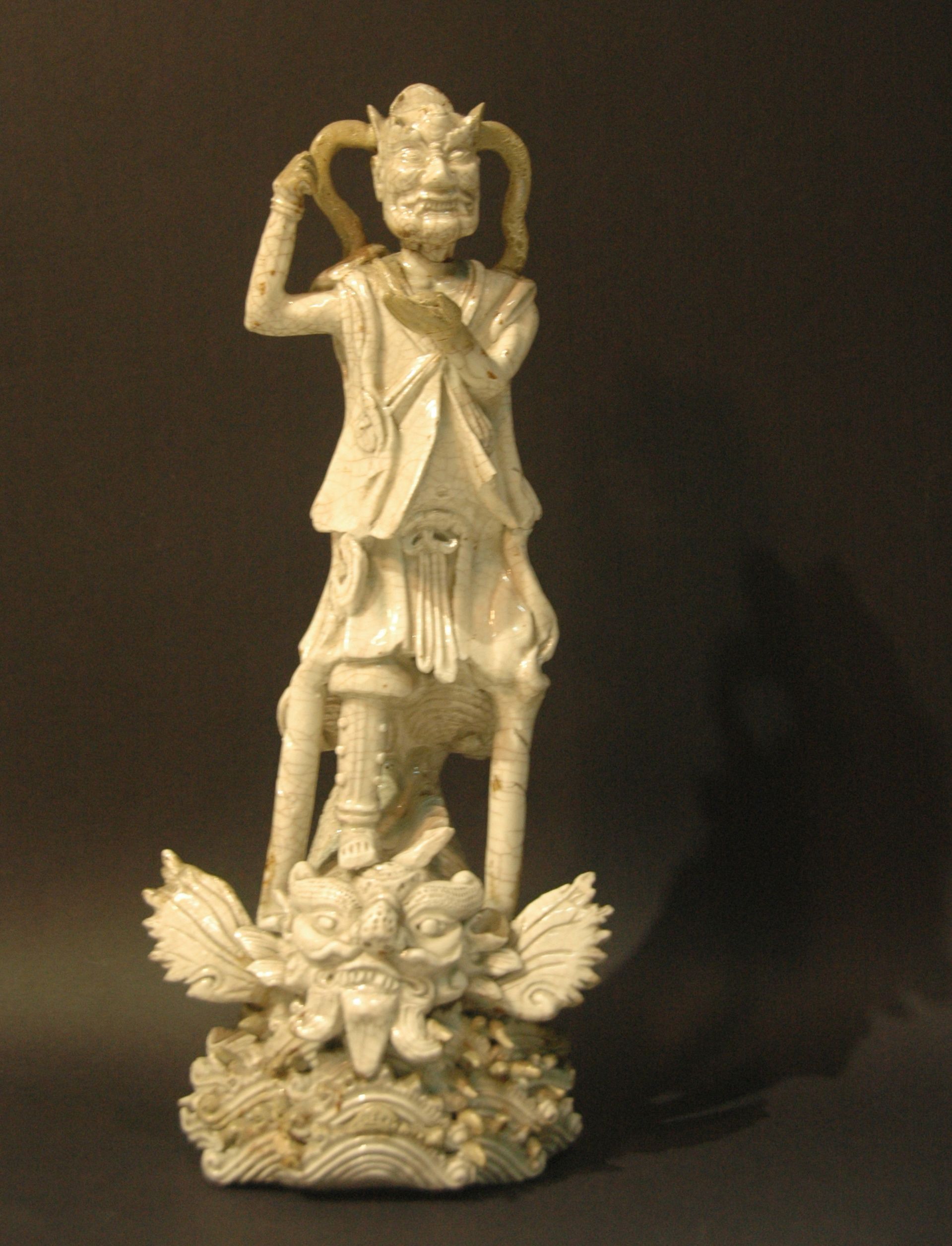
W100xD100xH300mm, China

This is a figurine of Kui Xing, a well respected figure amonst the Confucius intellectuals, he is believed to have the power to control the fate of all literature.  The legend has it that before being a god, Kui Xing was a scholar who took the Zhuang Yuan examination 3 times but failed, it was not because of his intellect but his ugly appearance.   Furious and frustrated, he kicked the box that held his books, jumped into the river and committed suicide … those were the days before we have plastic surgery …  Despite not being recognized officially by the court for his literary skills, his intellect was well acknowledged by the commoners, figurines of him were made for getting his blessing in examinations.  On the figurine he held a brush and ink, he is believed to write down the names of those who will success in the examination.  Under his feet is an Ao fish, a creature with a fish head a dragon body, a step carving outside of the palace where the Zhuang Yuan (the person who came top of the exam) will stand to wait for the emperor’s blessing.

W50xD40xH120mm, Macau

We have posted this form of wooden figurine (Junk Boat God, Junk Boat God, god?) twice already in the blog, but this time with a new understanding.  Last week I was at the Hong Kong Heritage Museum visiting the Picasso Exhibition (Masterpieces from Musée National Picasso, Paris), if you are visiting Hong Kong try to prebook a ticket to see, its well worth the trip.  Now I have got you all excited, well, the effigy has nothing to do with Picasso, I found similar  figurines in the local history section of the museum and here is the describsion;

“Wooden Effigies – People who lived on land worshipped wooden tablets with the names of their ancestors written on them.  Fishermen worshiped wooden effigies instead.  the appearances of the effigies vary according to the status and sex of the deceased.  The usual practice was for a family to hire a spirit medium to conduct a ceremony, and sculpt a wooden effigy of the deceased according to her instuction.  As time passed and fishing families became better educated, wooden effigies were replaced by wooden tablets.”

If this is correct, I wonder if the person this effigy is made for had an ambition to become a concert conductor.  The explanation from the museum is quite different from the one told me by the old Tanka gentlemen in the Tai O fishing village (see Junk Boat God, god?).  Would a Tanka person help me to clarify this?

W60xL160xH100mm, China

Every child seem to have a horsy toy at some stage, whether they are big or small, rocking  or ride able.  This is the Chinese version made with clay and like most of the clay toy it is also a whistle making a horse like sound.  I like this particularly over the other clay toys as it looks half sleepy and totally silly.

H500xW150mm, China

This puppet is called a Chaozhou wire puppet, the body of the puppet is supported by a main wire attached to the back of waistline of the puppet while the 2 arms are controlled by 2 wires attached to the waists, hence wire puppet, all the 3 wires are controlled by the puppeteer at the back stage.

There are over 2000 repertoires for the chaozhou wire puppet, these are roughly divided into 3 main themes; adaptation from the southern Chinese opera, local legends and historical stories.  This puppet has the warrior helmet featured in the blog a couple of days ago, a female warrior figure.

W70xD60xH270mm, Borneo, Indonesia

This is a hampatong from Borneo, the Dayak tribes create these wooden figurines portraying humans, animals and supernatural creatures.  The hampatongs can be broadly divided into two types; the tajahan (ancestral figures) and pataho (guardian figures for protecting the tribe).  This particular figurine is a tajahan.  Each figures are have their own function and meaning, for the tajahan figures the craftman would capture the details of the particular ancestor.  The animal on which the ancestor is sitting on is most likely to be a goat is believed to be sacred.  This is a protective amulet of a male ancestor sitting on a chair. the bread are made from coconut husk.

W50mmxD30mmxH70mm, China

In the old days, every morning the ink will be grind on the inkstone.  Water will be added so the ink stick will be dissolved, water is also added during the day to dilute the ink on the stone.  For the ease of controlling the flow water, the water drip was invented.

This water drip of child and carp figurine which would have been made for children; the composition is a traditional one of blessing, carp being resilient and full of vitality which is what every parents would wish for their child.    Also see our earlier entry for a different form of  water drip .

W300xH450mm, China

This glove puppet character is called Di Lei, within the show (opera) he belongs to Jing (painted face) category.  Di Lei, is courageous fighter but lacking in tactics, he is one of the 4 hammer warriors of the famous Sung general Yue Fei.  With extraordinary strength, he is known as the iron hammer warrior.

The head of the puppet (as well as its eyes and mouth) is controlled with the index finger, while the thumb would control one arm and the rest of the 3 fingers control the other arm.  The thumb will also control the turn of the head while palm of the hand will control the waist and leg gestures.  As the puppet is manipulated with one hand, one puppet master can have 2 puppets on the show at the same time.