Fresh meat and vegetable bleached with boiling soup then dipped into a variety of different sauces is super tasty. Hotpot used to be a winter dish; eating around the stove with meat just off the pot, rice wine and friends is the perfect meal for a freezing evening. Since the invention of air conditioner, we just find any excuses for such gathering, even on a 30+c summer night.
Before the induction stove, the canister gas stove, charcoal is used to heat up the soup for hotpot. Despite its appearance, this is stove for the hotpot where a traditionally a chimney donut shaped copper pot would be placed over the porcelain stove. Charcoal will be placed in the slot at bottom which opened up to the center of the stove and into the copper chimney, the copper conducts the heat to the rest of the pot.
A snuff bottle decorated with 8 treasures used by the Taoisit 8 Immortals, “An Ba Xian”.
Gourd – Iron Crutch Li
Fan – Han Zhong Li
Fish Drum – Elder Zheng Guo
Sword – Lu Dong Bin
Lotus – He Xian Gu
Basket of Flower – Lan Cai He
Flute – Philosopher Han Xiang Zi
Castanet – Royal Uncle Cao
These 8 treasures have special powers;
Gourd – saving the world
Fan – resurrection
Fish Drum – prediction
Sword – keep evil at bay
Lotus – purification of the soul
Basket of Flower – direct line to the Saints
Flute – revitalizing all creatures
Castanet – purifying the world
When I was writing this, I thought the Gourd being able to save the world would be all that we need, but writing on all the other 7 treasures are even more powerful. For the world we live in now, we need the Castanet more than ever.
A lacquer tray decorated with picture of a scene from the Beijing opera “Tai Jun Ci Cao”. The story is about the famous Yang family of warriors.
First some background to the story; Commander Lord Yang, his wife She Sai Hua and their 7 sons was defending the North Han country against the Sung. Though the Sung army is the stronger one, the Yang’s family out smarted them, the Sung General Pan was shot by Lady’s She’s arrow and had to retreat. Failing with the attack, the Sung emperor spread rumors about Lord Yang which had the suspicious North Han emperor distrust Yang’s advice and was defeated utterly. After the victory, the Sung emperor took Lord Yang under his wing and made him a trusted official, General Pan was very jealous of this promotion.
The Liao country start attacking Sung, Lord Yang and his sons was defending Sung at the border. Yang’s army was out numbered, 3 of his sons were killed in action, he send his 7th son to get reinforcement but was secretly killed by Pan. Lord Yang was captured and one of his son was captured, Lord Yong committed suicide to avoid being used as a hostage while his son was selected by the Liao Princess to be her husband. The 5th son was tired of all the fighting and the politics became a monk. The 6th son managed to escape and returned to the Sung capital and became the commander in place of his father but was later killed in action.
The opera story on the lacquer dish appear at this point, the Sung emperor asked the Yang family to led the fight with the Liao. With all the males gone, here is only Lady She (now in her 70s), 2 daughters, the daughter in laws and young grandson left in the family. Lady She, the commander with the female warriors led the army to victory. When they return safety home, Lady She after losing all her sons fearing that her only grandson too would eventually die in battle ask the Emperor to allow the family to leave their duty as the commanders.
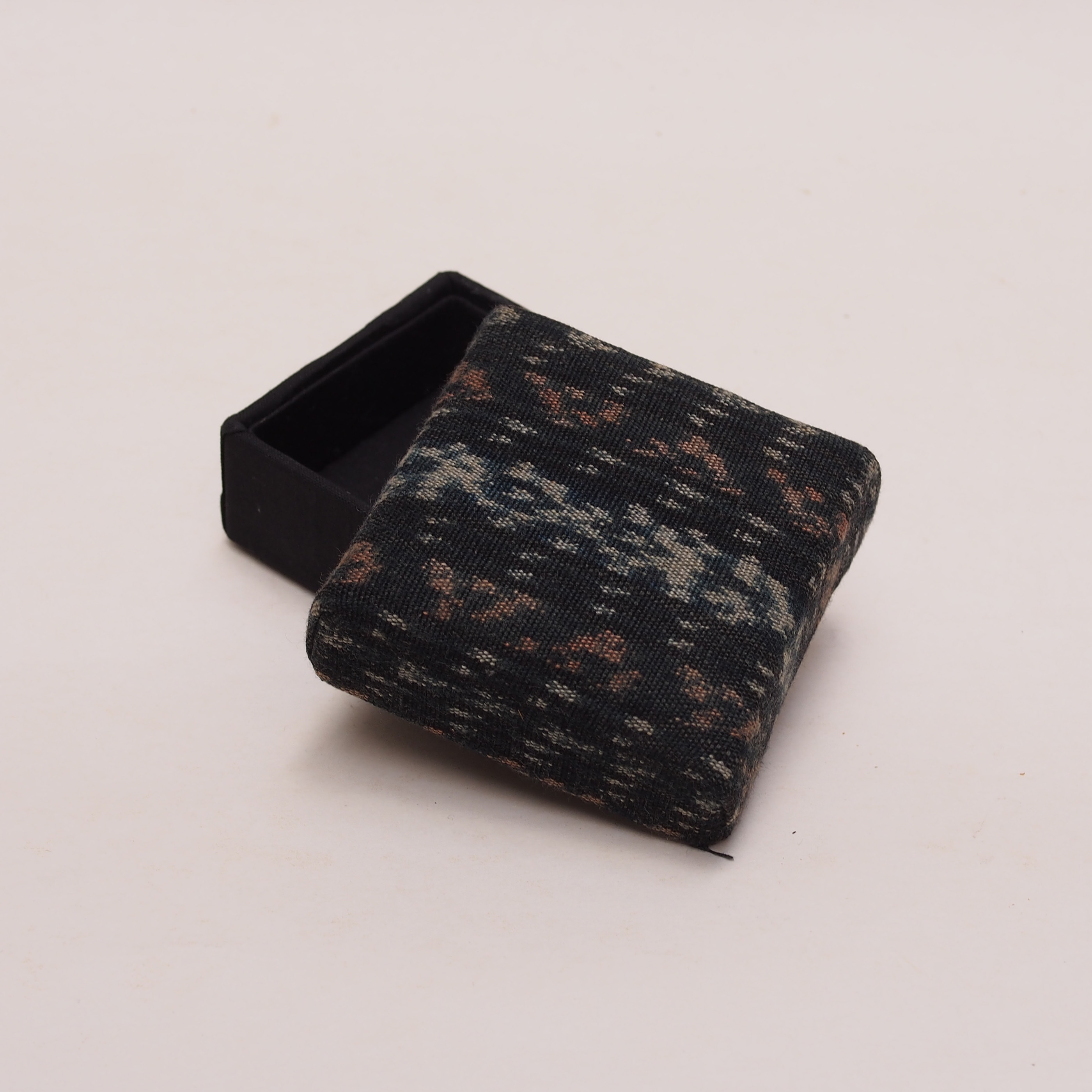
A small box with the covered made from ikat fabric.
The technique of ikat dyeing starts before the actual weaving begins. Certain yarn on the warp is wrapped up with thread or string. When the dye applied to the warp, the wrapped up part form a resist to the dye. Threads are then removed, leaving an area of undyed yarn. It is then ready to be woven into cloth. Because of the unevenness of the warp wrapping, the woven result has a characteristic ikat effect.
Ikat weaving is particularly laborious as the pattern is often pictorial, the warp has to be loaded on the weaving loom before carefully tying up the pattern. After dying the warp has to be loaded but on the loom at the same location before weaving.
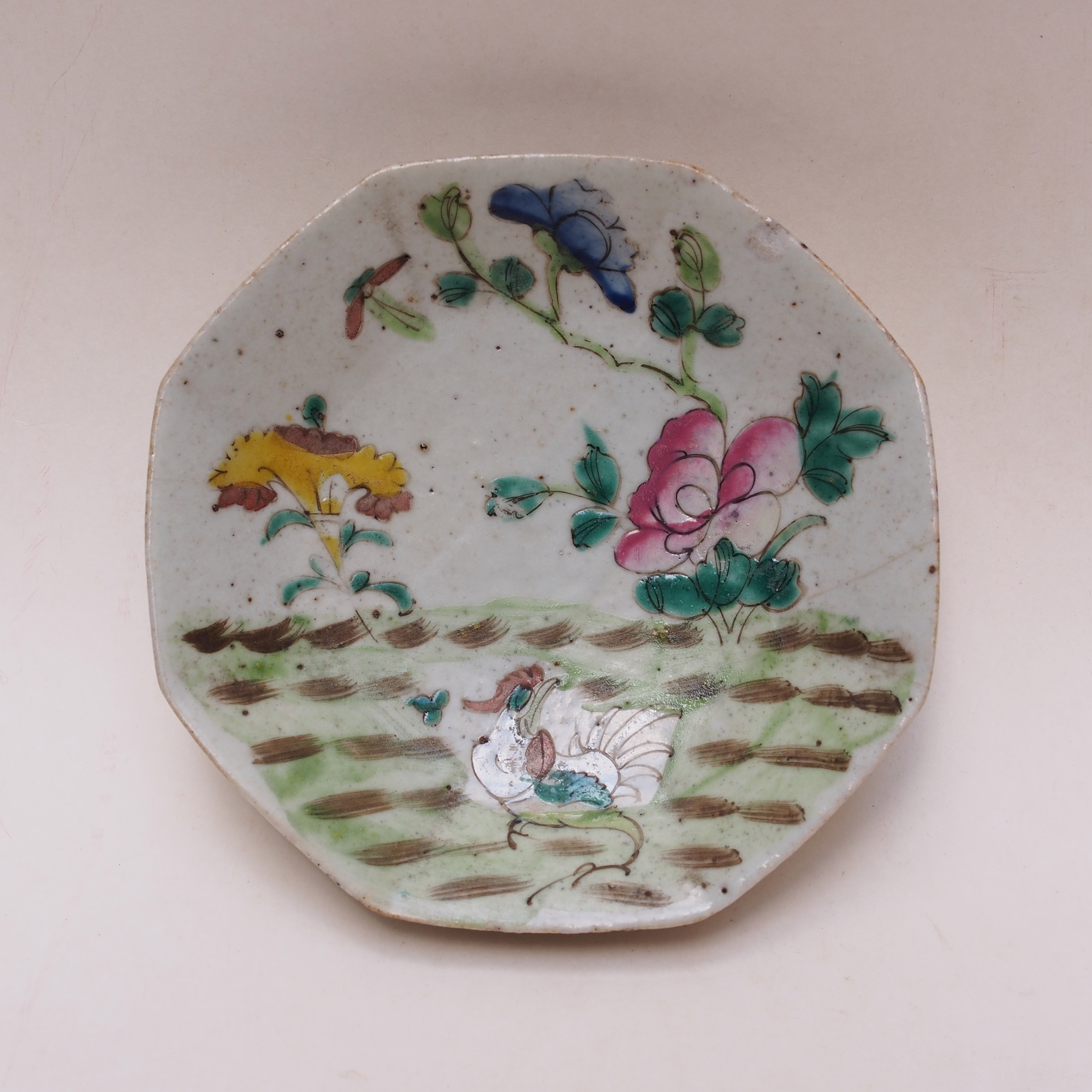
An octagonal plate with a rooster in a field of peony.
In Chinese, rooster with peony 公雞牡丹 symbolizes 吉祥富貴 wealth and blessed, with the word rooster 雞 “Ji” has the same pronunciation as the word 吉 “Ji” blessed and the peony being the flower of wealth.
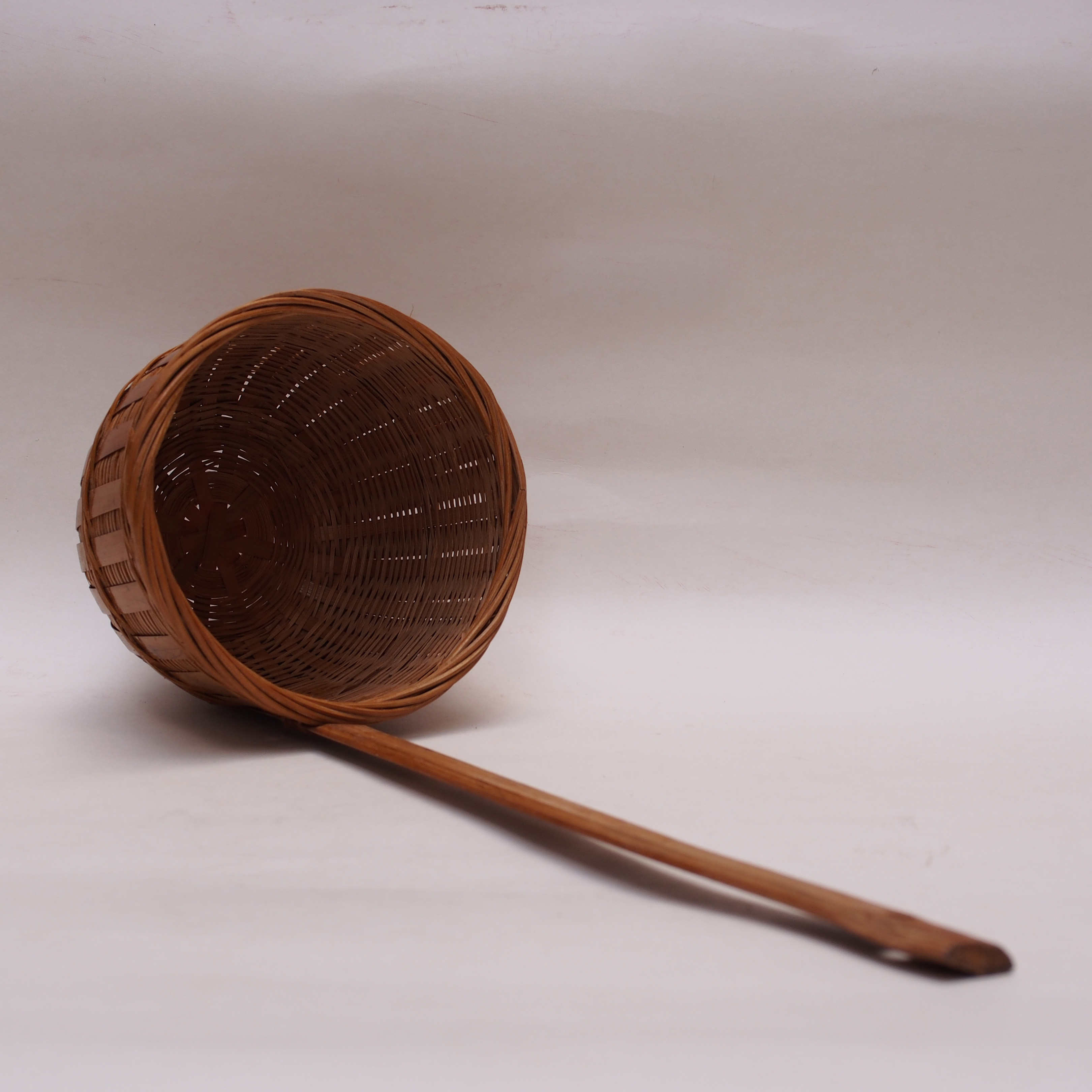
Before there are plastic or stainless steel drainers, the one made with bamboo is a household item. Bamboo is a faster growing plant, a material that was employed in most household objects; chairs, sieves, baskets etc. The technique of bamboo weaving became a special craft in China and Japan alike, but with the arrival of newer material such as plastic, the craft of bamboo weaving is becoming a dying art.
The bamboo strainer is perfect for making noodles.
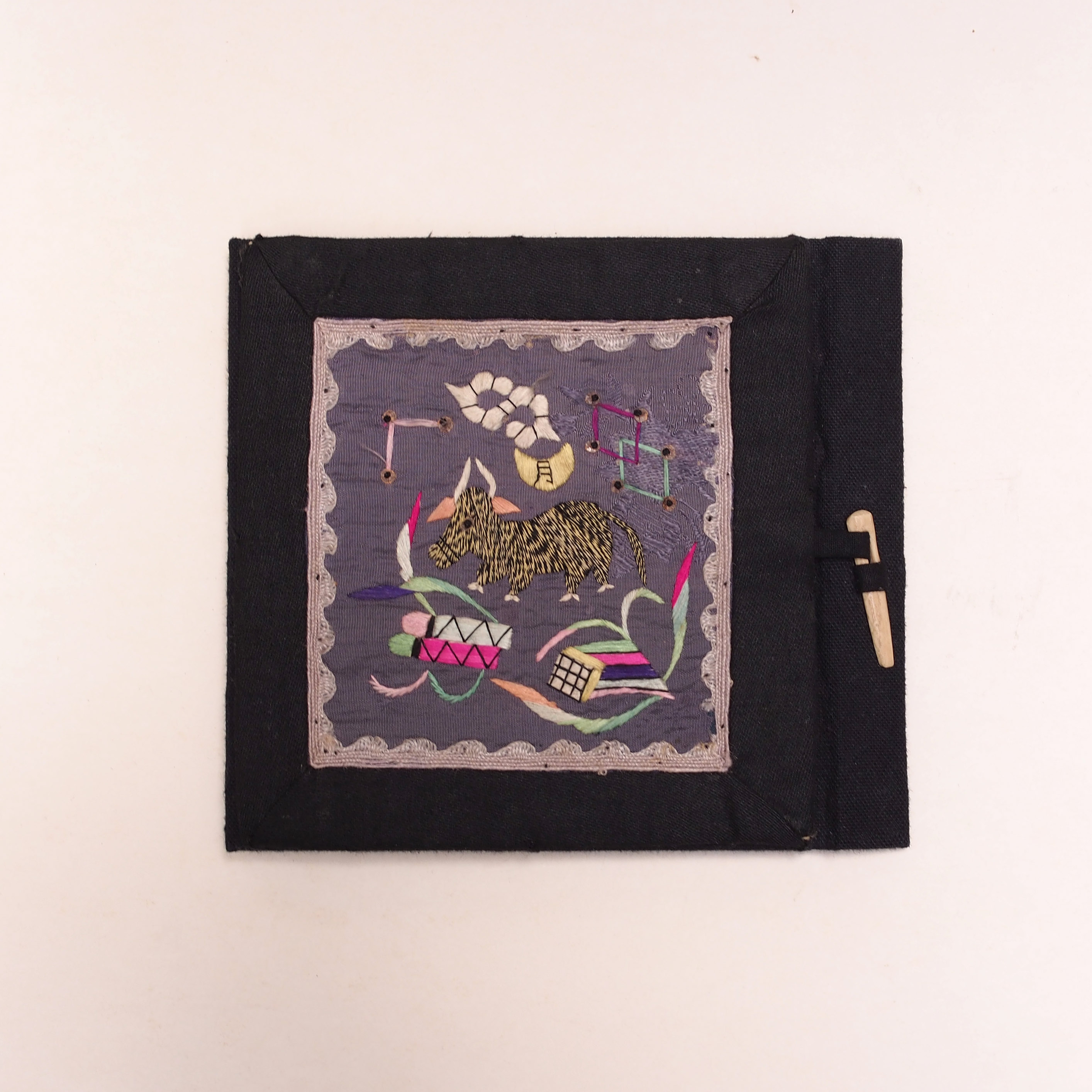
A small portfolio decorated with a piece of embroidery filled with blessing symbols.
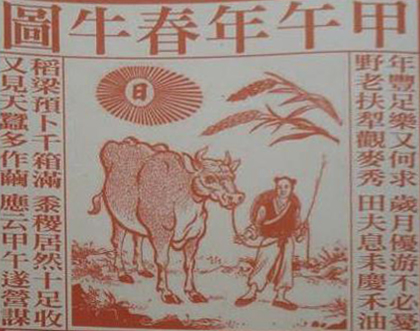
The cow in the middle of the embroidery is known as a Spring Cow, it is part of the Chinese New Year traditional that has been passed down since 800B.C. The figure of a cow would be made with straws and mud, a day before (Li Chun – the first day of spring in the 24 solar terms) it would be brought to front gate of the town where it would be whipped by all the notable of the town or village. The ritual is believed to wake up the Spring Cow, the passing of the freezing winter, the start of agriculture and the gone with winter ailmnet. With us city dwellers who are far away from the farmland and the fields, the only Spring Cow we will see is perhaps the one printed at the back of the Tung Shing which gives us prediction of the year’s weather. Well, for this year will is suppose to be drought, we seems to be getting a lot of rain so far.
Around the Spring Cow are blessing objects;
@12 o’clock – yellow moon, an object of worship,
@2 o’clock – the double trapezium, Fang Sheng, the hairstyle of the Queen Mother of the West, has the ability to pacify,
@5 o’clock – rhino horn, resembling victory,
@7 o’clock – scroll of books and painting, wisdom
@10 o’clock – the 3 blessed star Fu Lu Shou,
@11 o’clock – in form of a white cloud shape is Ru Yi, “as you wished”.
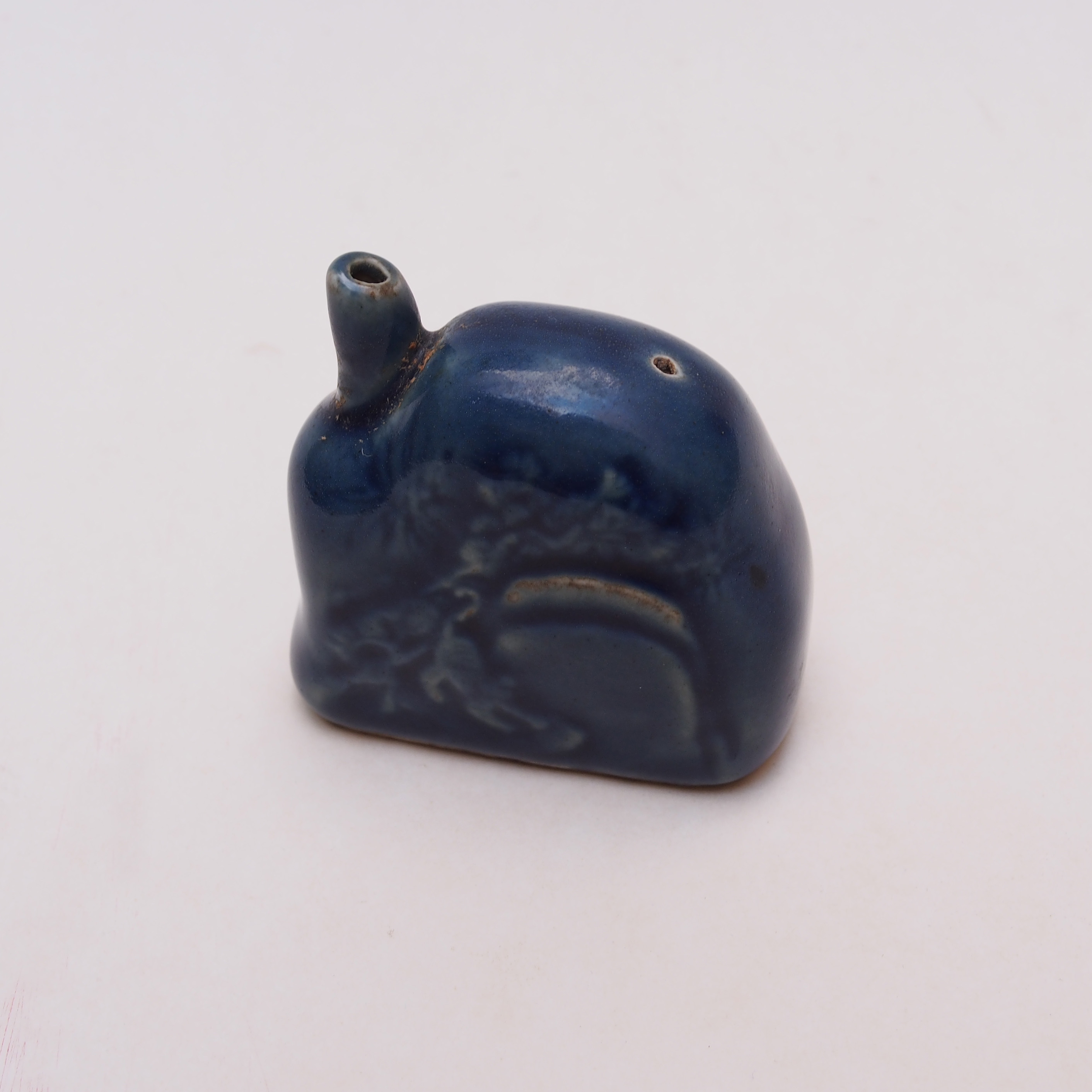
This little gadget is a part of the traditional Chinese stationary. A vessel to contain water for diluting the ink on the inkstone, known as a water drip. The water is drip out from the spout, the velocity of the flow is control by easing the finger placed over the small hole. These water drips though functional is also a item of delight for the scholars, one would have several of these, if I would have to draw a parallel in today’s world … iphone cases I suppose?
This is a item which used to be in every household, a pottery chopstick drainer, a bit like the cutlery drainer which is now replaced by the plastic draining tray. I must admit I am part of the plaster tray generation and have never seen the chopstick drainer in action.
On the drainer is written 百子千孫, hundred of sons and thousands of grandsons, a blessing of fertility. At a time when mortality rate is high, a large family to continuation the bloodline is the most important aim in life, though it does such a priority in life as much (particularly with China’s one child policy) its still seen as a welcome blessing for the family.
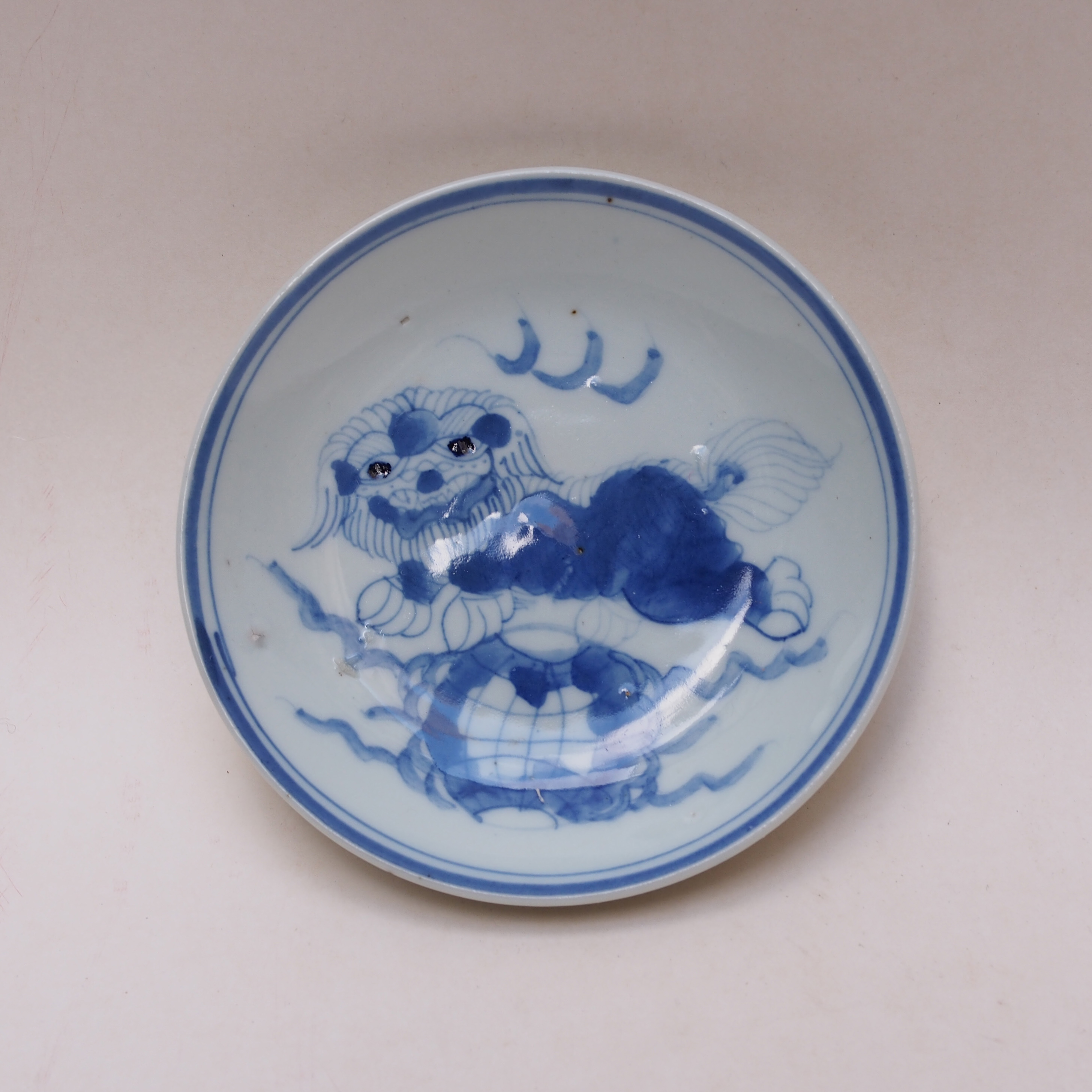
To celebrate the victory of Germany winning the World Cup, here a plate with the lion playing with a xiu qiu.
The composition of the lion playing with the ball is a traditional blessing pattern. The lion being nonnative in China was a mystical creature, not only is it the symbol of power and strength, it is also the carrier of the Manjusri Bodhisattva. Lions sculptures are often found outside buildings as the guard against evils. Here is the legend of how this supreme creature start getting addicted playing with balls; during the Southern and Northern dynasty, there is a general named Zong Que who was in a losing battle. Zong thought of a way to breaking out of the surrounding enemy, he had the soldier build a figure of the lion, put on a mask and dressed in yellow fur, from a distance the enemy thought the lion has arrived and flee, enabling Zong’s army to escape from the situation. The army celebrated with the local villages and the tradition went on, to humanize the lion more movements were added as well as the xiu qiu ball. The pattern of the lion and the xiu qiu is a blessing of strength and energy.
Click here to see our other items of the lion and the xiu qiu.
 DIA220xH160mm, China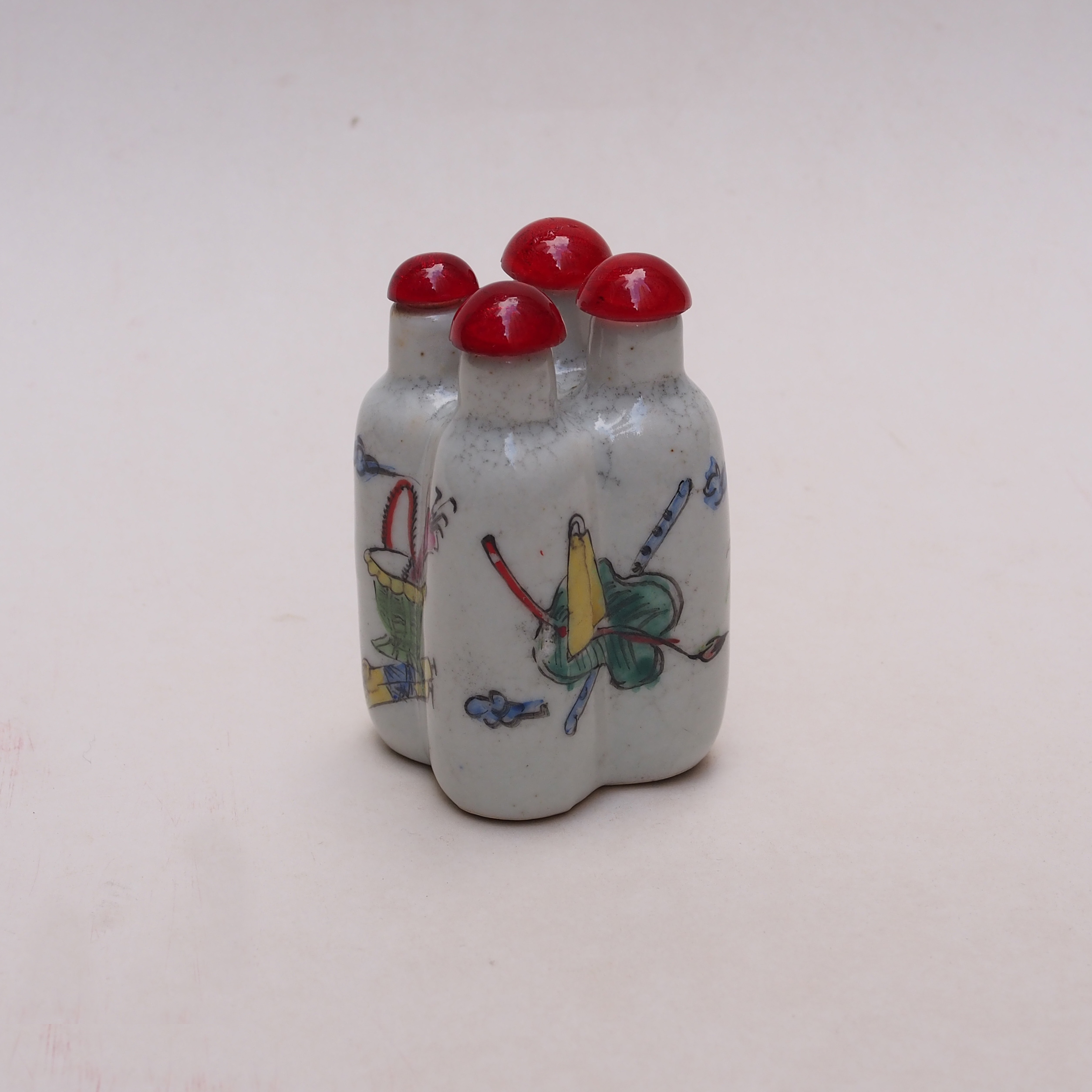



 Mountain Folkcraft