Archives for posts with tag: wooden

W50xD40xH120mm, Macau

We have posted this form of wooden figurine (Junk Boat God, Junk Boat God, god?) twice already in the blog, but this time with a new understanding.  Last week I was at the Hong Kong Heritage Museum visiting the Picasso Exhibition (Masterpieces from Musée National Picasso, Paris), if you are visiting Hong Kong try to prebook a ticket to see, its well worth the trip.  Now I have got you all excited, well, the effigy has nothing to do with Picasso, I found similar  figurines in the local history section of the museum and here is the describsion;

“Wooden Effigies – People who lived on land worshipped wooden tablets with the names of their ancestors written on them.  Fishermen worshiped wooden effigies instead.  the appearances of the effigies vary according to the status and sex of the deceased.  The usual practice was for a family to hire a spirit medium to conduct a ceremony, and sculpt a wooden effigy of the deceased according to her instuction.  As time passed and fishing families became better educated, wooden effigies were replaced by wooden tablets.”

If this is correct, I wonder if the person this effigy is made for had an ambition to become a concert conductor.  The explanation from the museum is quite different from the one told me by the old Tanka gentlemen in the Tai O fishing village (see Junk Boat God, god?).  Would a Tanka person help me to clarify this?

W70xD60xH270mm, Borneo, Indonesia

This is a hampatong from Borneo, the Dayak tribes create these wooden figurines portraying humans, animals and supernatural creatures.  The hampatongs can be broadly divided into two types; the tajahan (ancestral figures) and pataho (guardian figures for protecting the tribe).  This particular figurine is a tajahan.  Each figures are have their own function and meaning, for the tajahan figures the craftman would capture the details of the particular ancestor.  The animal on which the ancestor is sitting on is most likely to be a goat is believed to be sacred.  This is a protective amulet of a male ancestor sitting on a chair. the bread are made from coconut husk.

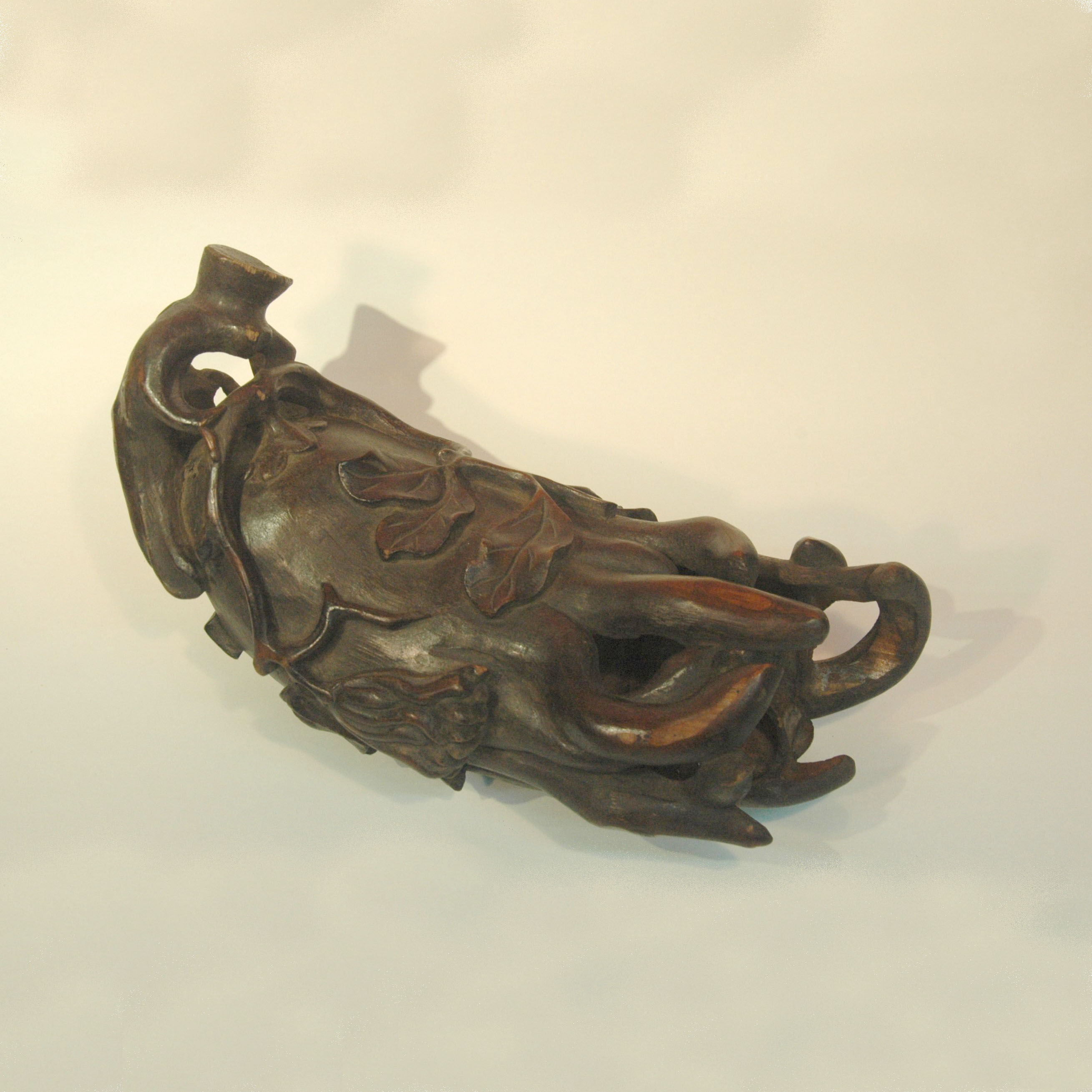
L350xW200xH200mm, China

This is a wood carving of a plant known as the Buddha’s hand fruit (Citrus medica var. sarcodactylis).  It is a citrus fruit that is segmented into finger like section, the section resembles the fingers of the Buddha is tradition Chinese painting, hence the name.  In China the fruit is mainly used for perfuming the room and as an object for appreciation, it is also used in herbal remedy.  Because of the beautiful form of the fruit, it has become an subject for craving (wood, root, stone, jade, etc).

W150xH150xL250mm, Thailand

A Korean legend about the tiger lily; once upon a time … there was a hermit who save a tiger by removing a arrow from his wound.  The tiger requested the hermit to use his magic to extend their friendship after his death.  After the death of the tiger, where his body lay sprouted a tiger lily.  The hermit got drown by the river and his body was washed away, tiger lily spreaded along the river bank as though the tiger was looking for his missing friend.

These are the first fake flower that I can appreciate, each petal are carved out from wood.

China

This is part of the armrest detail for the Chinese wooden furniture.

Come check them out!

W100xD80xH200mm, China

This is a gold plated figure of the God of Wealth General Zhao Gong Ming worshiped by the Taoist.  The figure is well known to be in armour, one hand holding a piece of gold, the other a silver whip and riding on a black tiger.  Legend had it that originally there were 1o suns, they blasted the earth, Hou Yi was asked to shoot down all of them but one.  The 9 suns became demons, 8 of them revenged and brought about sickness but one of them Zhao became human.  He was trained and attained the power to fight plague, as a reward for his hard work he was made god and in charge of the wealth of the world. You might also known him as one of the door god icon.