Archives for posts with tag: wood

lacquer trayDIA330xH80mm, China

A lacquer tray decorated with picture of a scene from the Beijing opera “Tai Jun Ci Cao”.  The story is about the famous Yang family of warriors.

First some background to the story; Commander Lord Yang,  his wife She Sai Hua and their 7 sons was defending the North Han country against the Sung.  Though the Sung army is the stronger one, the Yang’s family out smarted them, the Sung General Pan was shot by Lady’s She’s arrow and had to retreat.  Failing with the attack, the Sung emperor spread rumors about Lord Yang which had the suspicious North Han emperor distrust Yang’s advice and was defeated utterly.  After the victory, the Sung emperor took Lord Yang under his wing and made him a trusted official, General Pan was very jealous of this promotion.

The Liao country start attacking Sung, Lord Yang and his sons was defending Sung at the border.  Yang’s army was out numbered, 3 of his sons were killed in action, he send his 7th son to get reinforcement but was secretly killed by Pan.  Lord Yang was captured and one of his son was captured, Lord Yong committed suicide to avoid being used as a hostage while his son was selected by the Liao Princess to be her husband.  The 5th son was tired of all the fighting and the politics became a monk.  The 6th son managed to escape and returned to the Sung capital and became the commander in place of his father but was later killed in action.

The opera story on the lacquer dish appear at this point, the Sung emperor asked the Yang family to led the fight with the Liao.  With all the males gone, here is only Lady She (now in her 70s), 2 daughters, the daughter in laws and young grandson left in the family.  Lady She, the commander with the female warriors led the army to victory.  When they return safety home, Lady She after losing all her sons fearing that her only grandson too would eventually die in battle ask the Emperor to allow the family to leave their duty as the commanders.
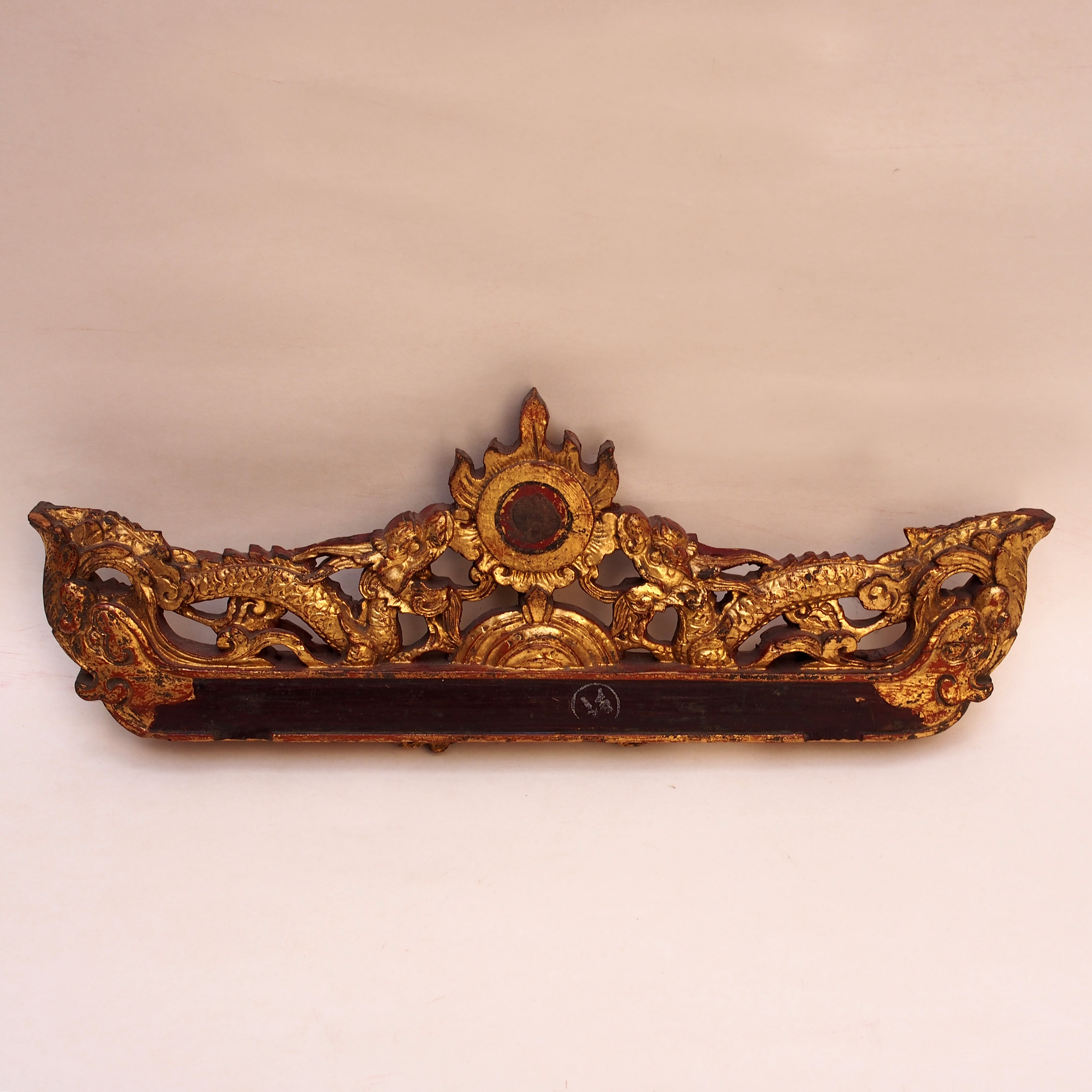
 

golden wood carvingL350xD25xH130, China

This golden wood carving used to be center pediment of an ornamental object, perhaps on small shrine in a temple.

On the carving, there are 2 dragons chasing after a pearl.  Dragons are believed to be mythical creatures from the sky, they need to attain a certain quality to become a saint.  After a few hundred years, the essence of what they have learnt from nature would become a pearl like pellet.  The dragon would spit out the pearl for it absorb the spirit of nature and the bigger the pearl would grow.  One day while a dragon was practicing with his pearl, another dragon decided to take this pearl to speedup his own attainment. The bad dragon spit out his pearl hoping it would absorb the other, the two pearls melted and became one giant pearl, both dragons wanted to take it in and started using all their tricks.  Their fight upset the nature of the universe and the Jade Emperor took them in and set the pearl on the temple which would be protected by the dragons for good

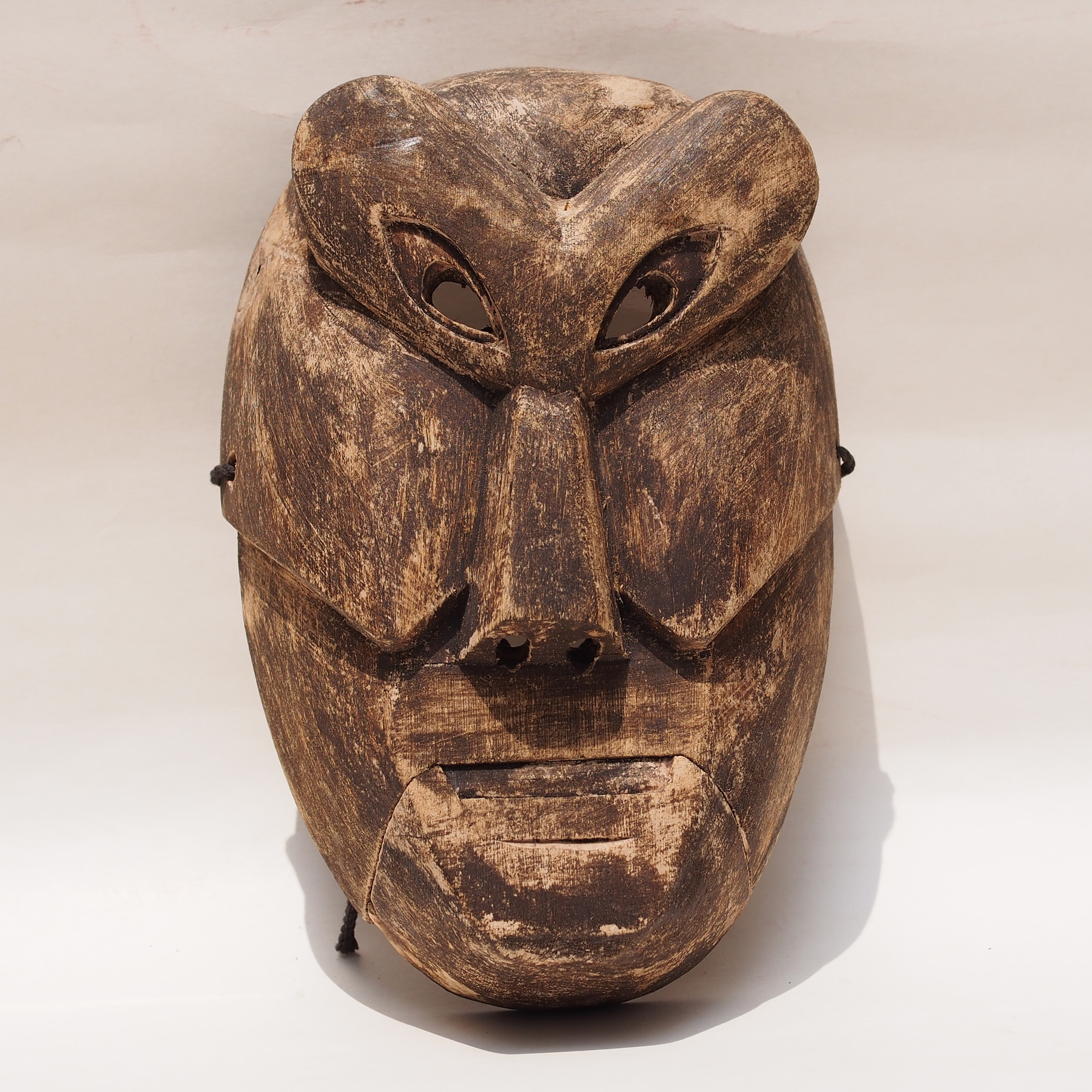
OLYMPUS DIGITAL CAMERAW140xD80xH210mm, China

The white coloured face most often denote a villain in the Chinese opera.

This is a mask of the Qin dynasty prime minister Zhau Gao.  In the opera story, “Yu Zhou Feng” (Sword of the Universe) happened in a time during the regime of Emperor Qin Er Shi.  Zhau Gao and Kuang  Hong was in laws, with Zhau’s daughter married into Kuang’s family.  Kuang showed his displeased about how Zhau was manipulating the Emperor caused revenge from Zhau.  He has someone stole the well known Sword of the Universe from Kuang and had faked an attempt assassination of the Emperor.  Thinking that it was Kuang, the Emperor ordered the execution of the Kuang family.  Kuang’s son escaped while his wife Yan Rong (Zhau’s daughter) returned to his father’s home.  The Emperor seeing the beautiful Yan Rong and wanted to have her as a concubine but she hated his notorious style of ruling and his father’s treatment to teh Kuang family, she pretended to have gone made in order to escape the Emperor.

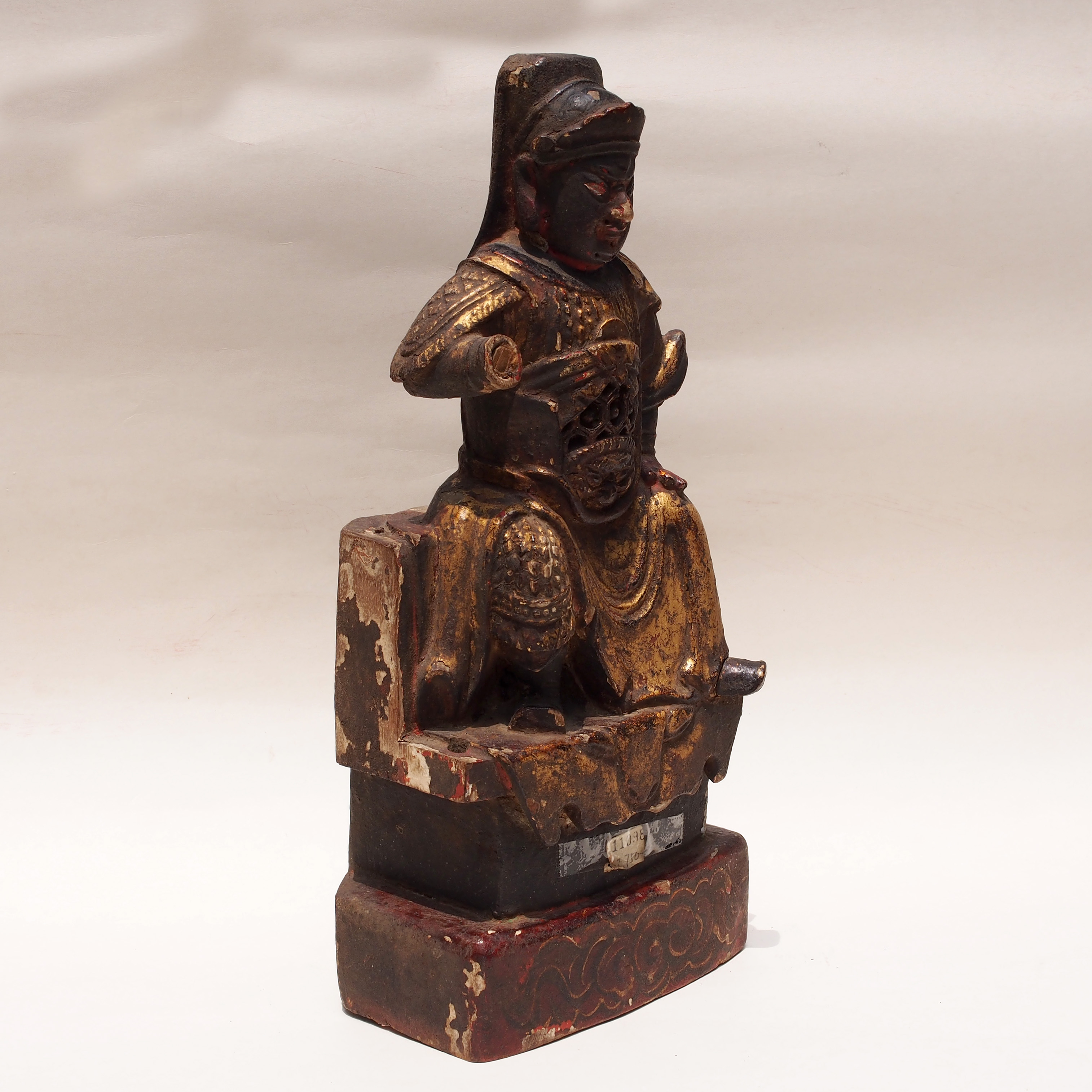
figurineW140xD100xH320mm, China

This is a figurine of Bei Di, who is the Prince of  Shang dynasty.  In a dream, the Queen swallowed the sun and felt pregnant after 14 months Bei Di was born.  Though being the heir of the kingdom, he was more interested in meditation than in the power he was born into.  Finally, he left his parents and went to Wu Dung to study Taoism.  After 42 years, he was sainted by the Jade Emperor.  It is also believed that he is the 82 reincarnation of the Tai Shang Lao Jun.

There are several Bei Di temples in Hong Kong which is well worth visiting.
There is one in Wanchai, Sham Shui Po and Cheung Chau.

figurine

figurine
W85xD70xH200mm, Hong Kong

This is an effigy of a elder female ancestor of the Tanka tribe.  These ancestor figurines were kept at the boats of the Tanka fisherman offering them safety at sea.

Click here to see our other junk boat gods.

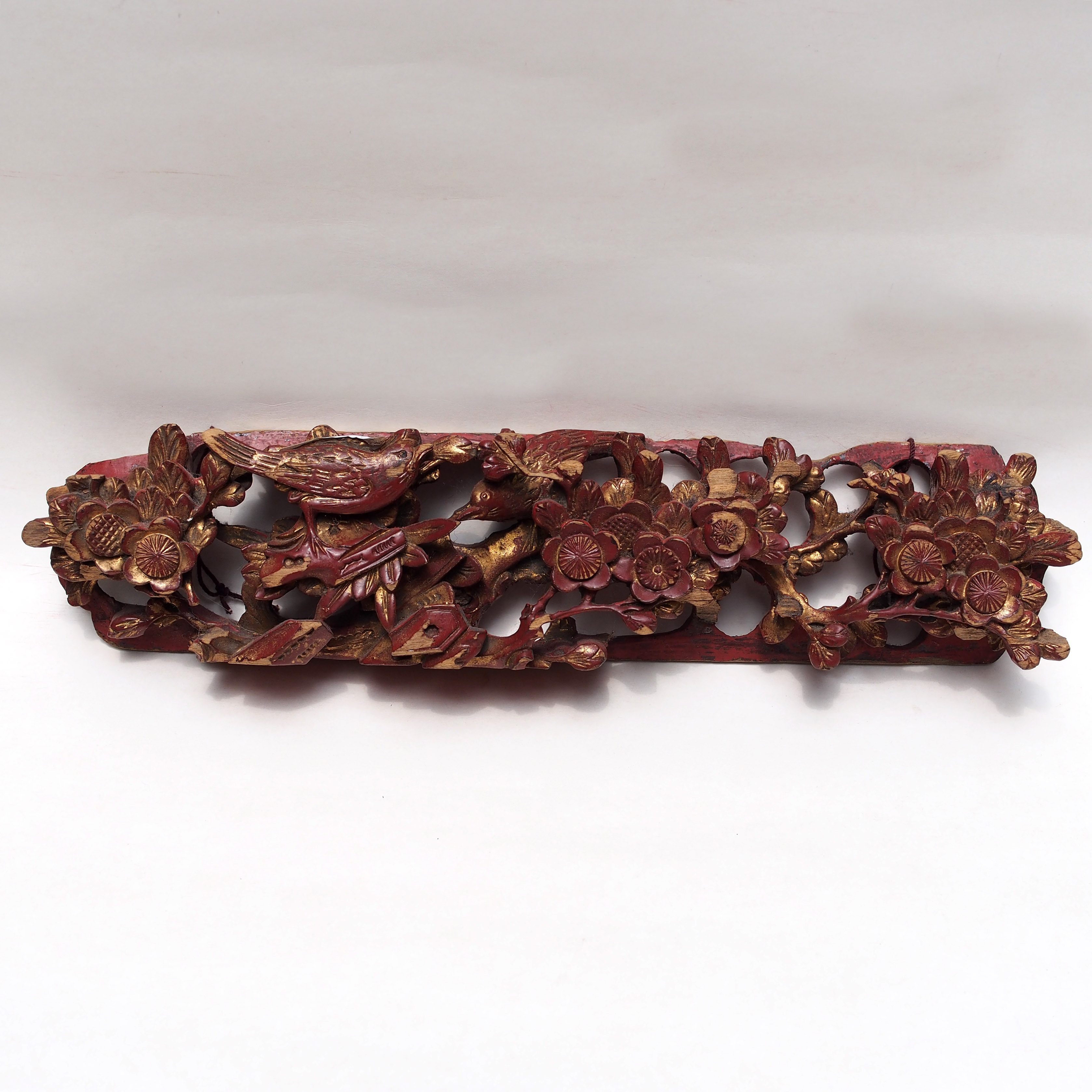
golden wood carvingL300xD45xH65mm, China

The composition of plum blossom and bird is a popular theme for Chinese crafts.

Not only it this a yearly event when the birds come to party and feast when the plum blossom, it also has a symbolic meaning.  A play on the phase 喜上眉梢 (xi shang mei shao), one is so happy that joy is expressed when in the eye brow.  You might wonder what a facial express has to do with plum blossom and bird.  The bird is 喜鵲 pica pica (magpie), its climbing on the plum branch 喜上梅梢 (xi shang mei que) has the same pronunciation has this uncontrollable joy.

cookie mouldL310xW70xH20mm, China

Cookie moulds for 3 different cookies.

Happiness (喜), blessings (福), the lotus fruit.

You might wonder with the style of the cookies are so different, maybe the 2 on the left with the words are for the parents and the more graphical one for the child.  All the 3 cookies are a symbol of  blessing, the lotus fruit (蓮子) “lian zi” is wish for having many children, the word 蓮 “lian” sounds like 連 “consecutive” and the word 子 means sons.

Blessing cookies for the wedding with happy future and many children.

golden wood carving

L230xD30xH90mm, China

This golden wood carving makes a perfect birthday present.

The four figurines are full of blessing, Fu Lu Shou and Ma Gu.  They are all Taoist saints, representing blessings and happiness.

Fu (far right) – the planet Jupiter which was also attributed to Yang Cheng of the West Han period.  Yang, after being nominated to be the Daozhou official, abolished the practice of present contribution to the Emperor, relieving the stain for the people and therefore seen as a blessing.

Lu (left of Fu) – god of prosperity.  The stars Ursa Majoris humanized as Zhang Xian of the Shu dynasty, a brave general who was respected by the Emperor and worshiped by the people.

Shou (left of Lu) – god of longevity.  The stars of Canopus, translated as Peng Zu who is believed to have livd to an age of 767!!

Lady (at the far left) is Ma Gu, goddess of longevity – with the appearance still being in her teens, she has witnessed 3 times the sea turned into fields (judging its not from any dramatic climatic changes, she has been around for a long long time).  Her immortality and her yearly birthday tribute to the Queen Mother of the West is seen as a blessing and so Ma Gu is a popular subject for pritns, figurines, embroidery and alike.

maskW150xD60xH240mm, Malaysia

This mask belongs to the Mah Meri tribe.  Mah Meri means “People Forest”, they believes that all mythological characters are supreme and that ancestral spirits use plants and animals to make food for humans.

The Jo-Oh masks are said to give spiritual power to the wearer during dance rituals, representing the soul of the ancestors.

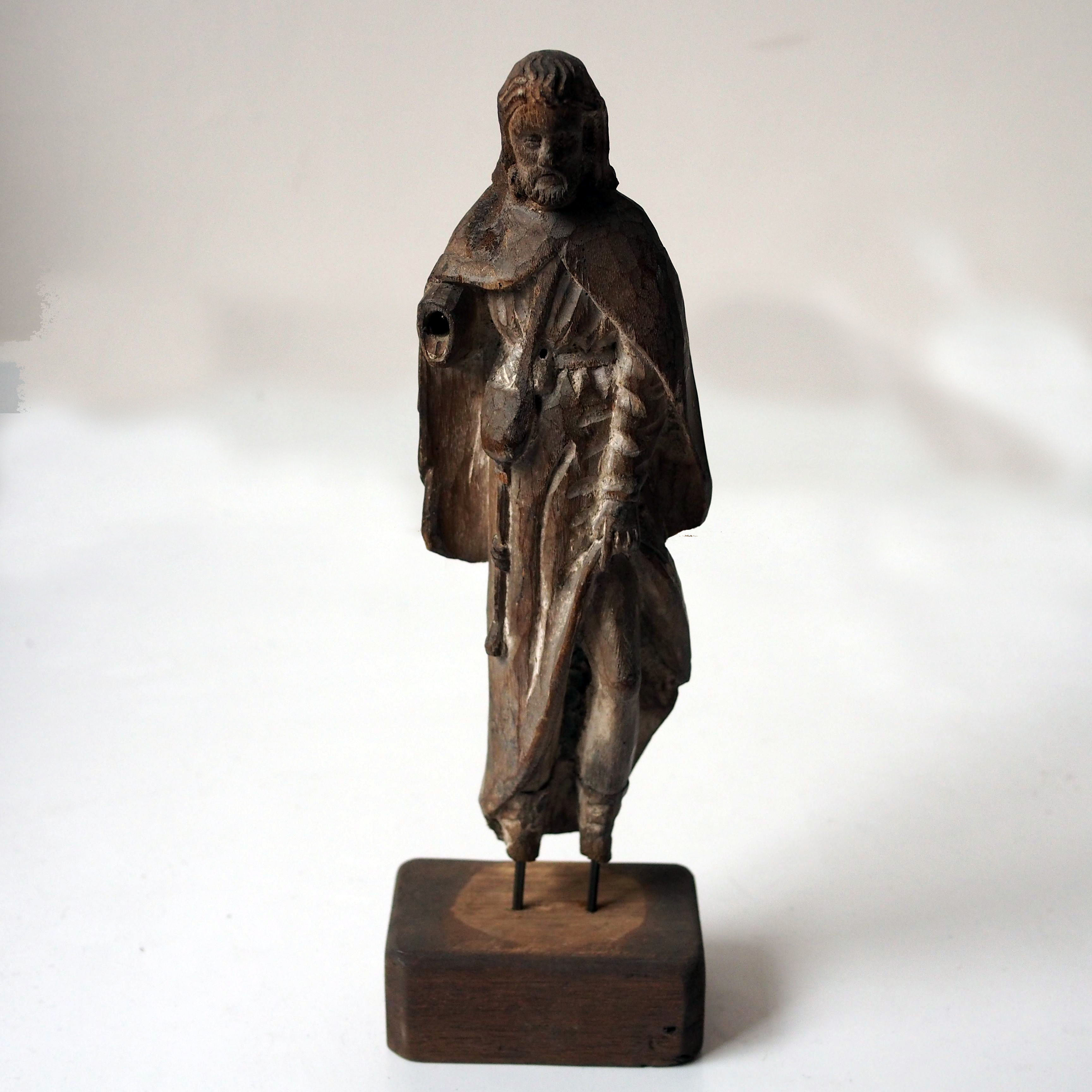
christW100xD65xH320mm, Philippines

During the Holy Week in the Philippines, starting from Palm Sunday to Easter Sunday, a number of religious observations were held.

On Good Friday (Biyernes Santo), the day starts with the Way of the Cross procession where Jesus’ Seven Last Words are portrayed.  In some area, this was acted out literally, those who had their wishes granted even went as far as having themselves nailed on a cross.  This is followed by the procession of the Sano Eniterro, where a wooden sculpture of the dead Christ is parade.  Scenes from the life Jesus were also depicted in figurines and shown in carriages around town.

In this figurine, Jesus is lifting up his garment and revealing his left leg, would anyone know which part of the scripture does this fit into?