Archives for posts with tag: chinese

Fish L200xW100mm, China

These ceramic moulds are for making Guo.  The guo is a Chaozhou dumplings made with a thin rice flour dough with fillings of different types vegetable, nuts or beans that can be savory or sweet.   Guo is made for Chinese New Year, all other festivals, harvests and all events in life (birth, adulthood, marriage, death).  Different guo are made for different events;  the red peach guo for new year, vegetable guo for spring and autumn festivals, rice plant guo for harvest.  The moulds are made of different patterns  for this purpose;  the turtle and the peach for birthday – represents longevity, the fish is synonymous with excess (to have more than enough), bat synonymous with blessing, etc.  These moulds can be of wood or ceramics.

W250xL250mm, China

Porcelain tiles are often used as a decoration piece in traditional wooden Chinese furniture.  These decorative tiles can be found as the panel for the seat or the back of the chair, panels for the door of a cabinet, panels for the back of the bed and as the panel of a screen.  The Chinese have viewed ceramic as utensils, it was not until late Ming dynasty when more colourful glazing was developed that ceramic as painting took a fashion.

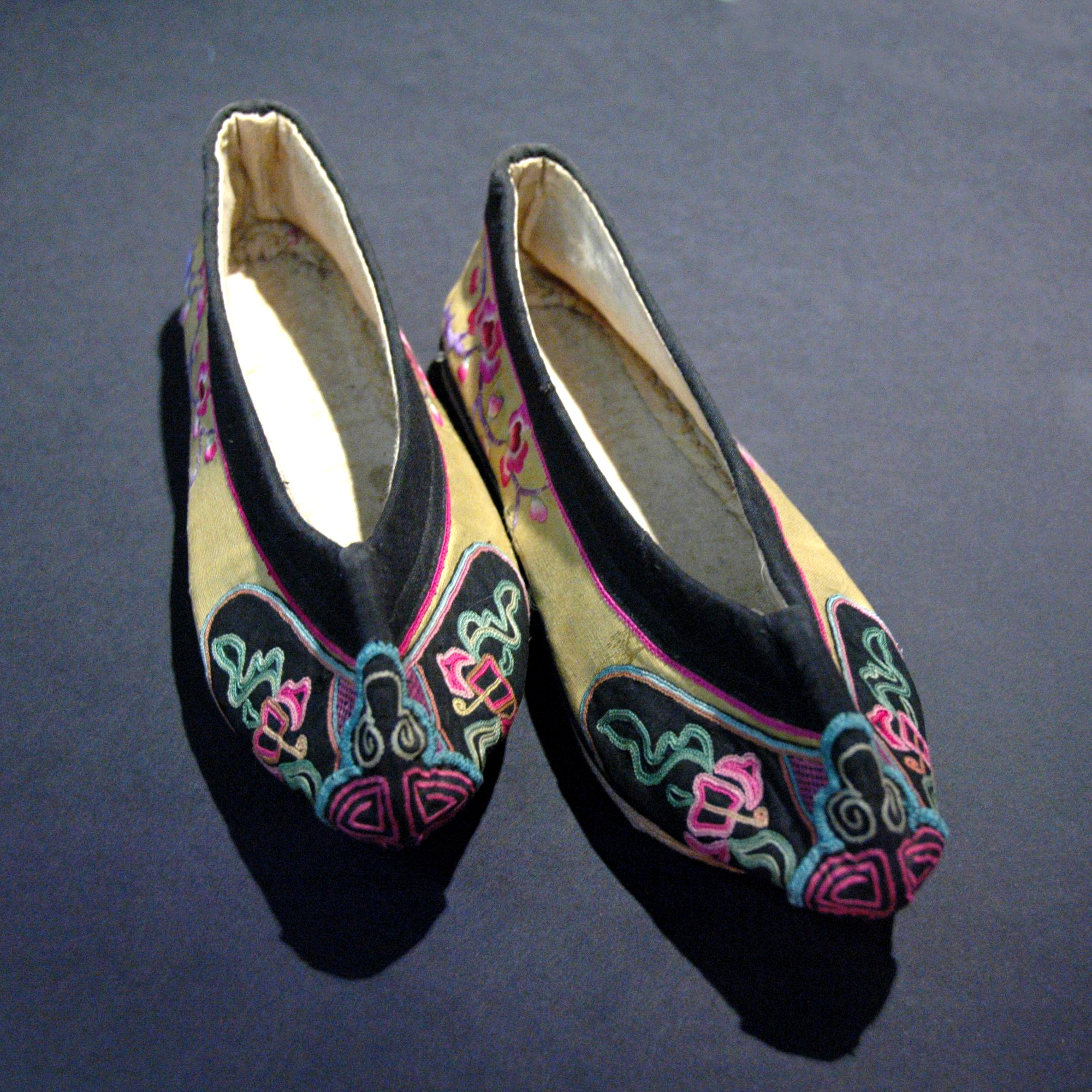
L250mm, China

This is a pair of Miao Zu minority tribe embroidery shoes.  The Miao has their own individual language but not an individual text; their history is passed down the generations by word of mouth in form of songs or as a design on their costumes (by embroidery, accessories, folding, stitching, etc).  For example, Butterfly = ancestors, mother.  As fashion is their form of literature, it goes hand in hand that they have superb embroidery skills.  The skill would be passed down from mother to daughters.  Traditionally, embroiled shoes are worn by single young ladies who would select different shoes for different suitors and occasions.

 Textile Width 750mm, China

Discharge dyeing works with the removal of the dye originally applied to the fabric.  In this case, it was originally a red piece of fabric using a dye remover was applied through a stencil resulting in a pattern of the red colour.  This technique was introduced into China in the 50s which became very popular in the rural area.  Traditional fabric dyeing technique in China are based on vegetable dye where the intensity of the colour will run through time and wash.  Discharge dyeing was most welcomed as the colour stays and the patterns are fine.  This fabric has a butterfly and flower print.

H150xW100xD80mm, China

This is a clay toy named Da A Fu; legend has it that once upon a time, the area of Hui Shan was inhabited by wild monsters.  The villagers were very afraid of them.  One day the the Sand Child god, named Da A Fu, was send from heaven to tame the  monsters. With magical powers, just a grin from Da A Fu, the monsters would become very gentle.  The villagers made clay figures of Da A Fu to commemorate him.  The figures are also used as a protector of devils.

W700xH550mm, China

This is a reverse glass painting; paint is applied onto a piece of glass which the image is to be viewed from the opposite side of the glass.  This art form was introduced from west to China in the Qing dynasty and likely by missionary Giuseppe Castiglione.  Being a Chinese court painter, he was a major influence in the oil painting history in China.

Dia250xH450, China

This is a birdcage both for raising a bird at home and for “walking” the bird.  The Chinese believed that even for home kept birds, they should be meeting with their birdy friends to share their songs.  In the south, this gathering would happen daily at the teahouse, usually in the morning over dim sum where the owners should chat with their friends and the birds theirs.

There are also the attachment to go with it; bird feed bowl,  bird feeding cage.

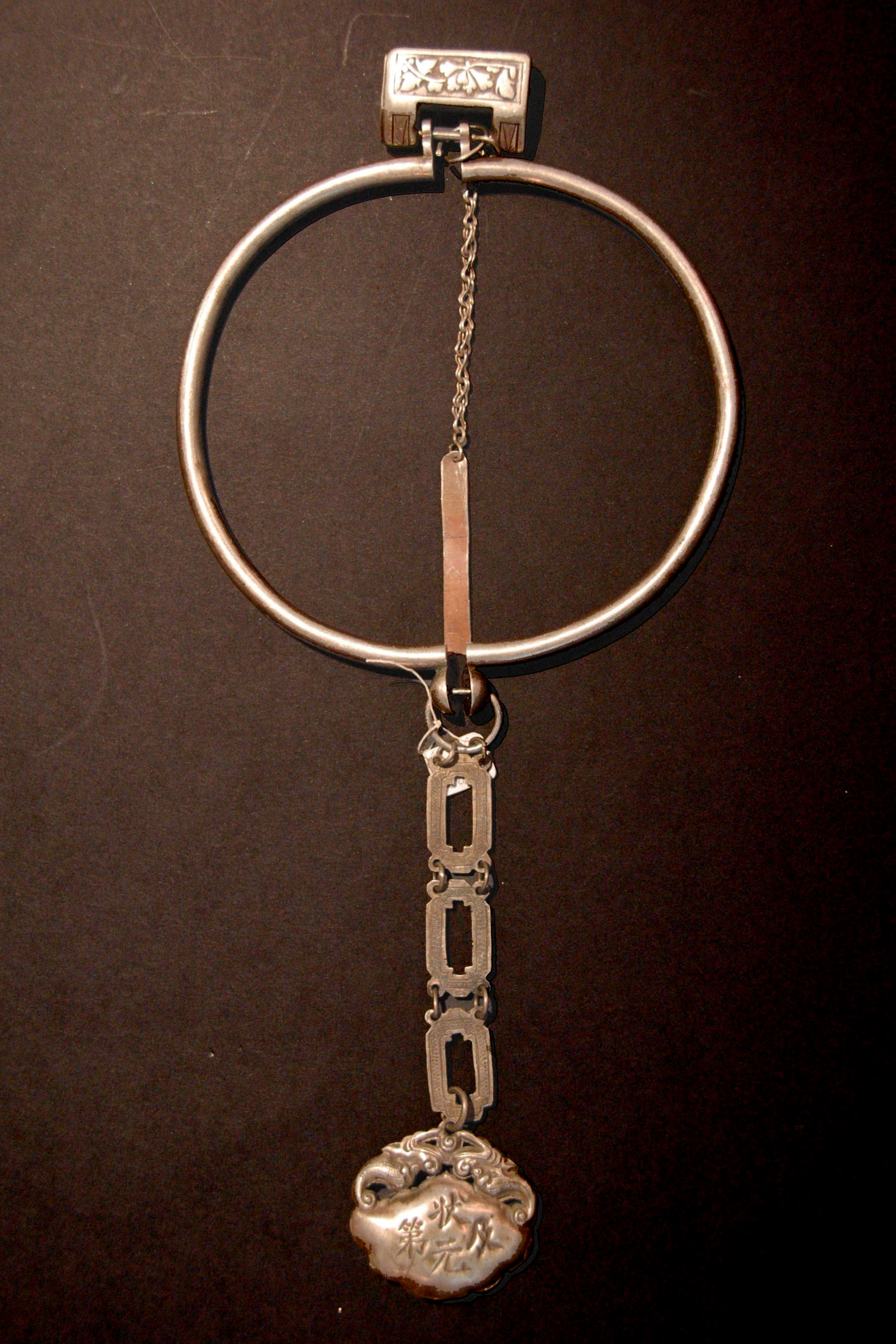
DIA150mm, China

This is silverware gift for the baby’s 100 days birthday, a bit like the silver spoon for the baby shower in the West.  The child mortality rate in old China is very high, it is be believed that the locket would lock the life of the child to the living world.   The pendent is an add on blessing for the child’s success in the future.  The child will keep the necklace on till adulthood.

H120xW90mm, China

Snuff bottle is very popular in Qing Dynasty China, tobacco was introduced to China in the 16th century  smoking however is banned.  The use of snuff (powdered tobacco) is believed to have medicinal effect and therefore allowed, it quickly spread amongst the upper class and became a social ritual.  The container became more refined in terms of craftsmanship and the use material showing off the status of its owner.  This bottle is a red  overlay on transparent glass ground carved to illustrate bats (blessing).

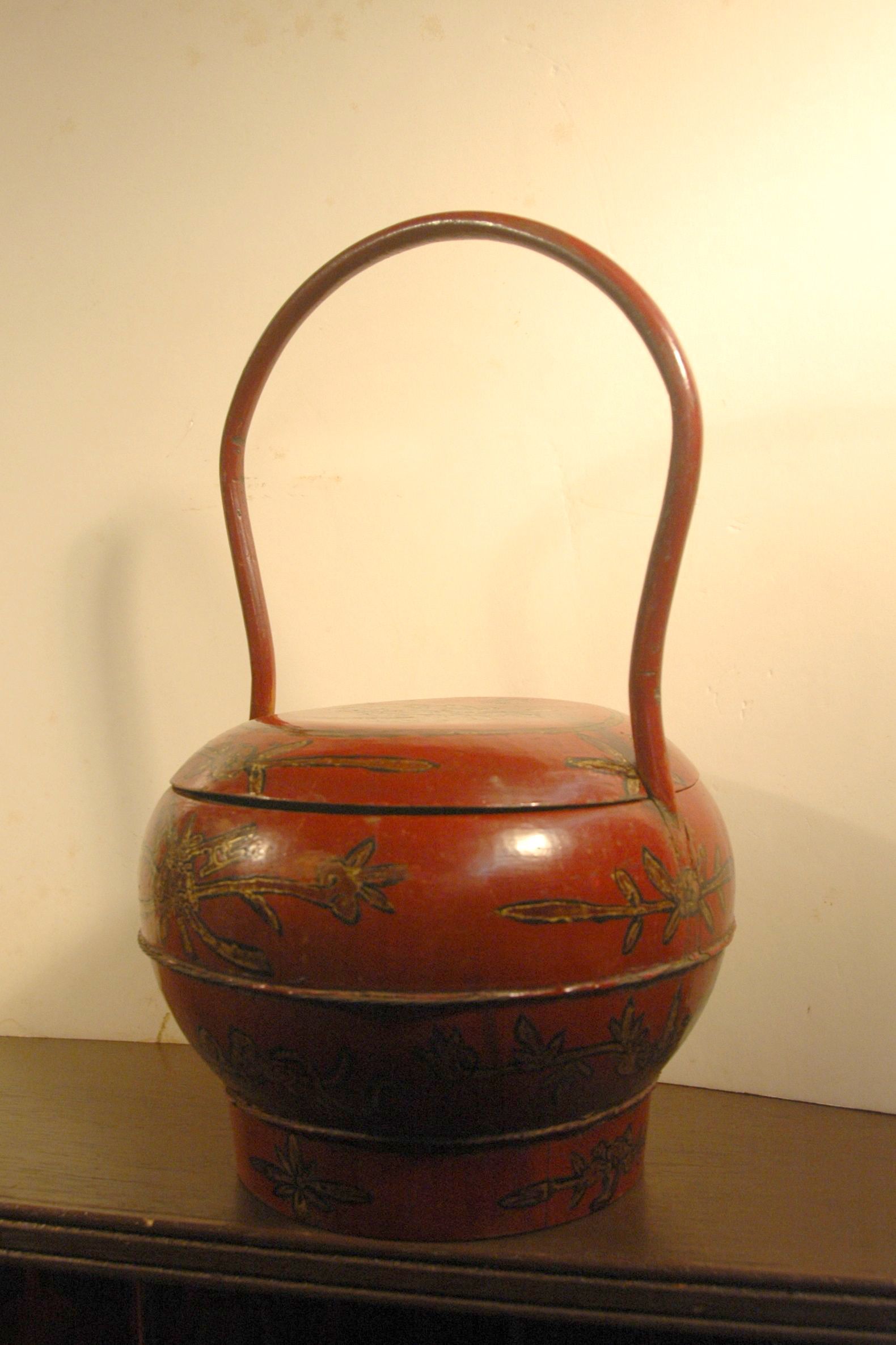
W220xH360mm, China

This is a rice container for the southern part of China. In a traditional Chinese family very often the clan would be living within one house / estate, all meals would be eaten together, rice would be cooked in a wok  in a kitchen far away, the cooked rice would be transported and served in a lacquered pail.  This pail is has a gold painted decoration over the lacquered.

Side tracking; the Chinese would insult a stupid person as a “rice barrel”,  someone who is “a gold painted lacquered rice barrel” would transfer to someone who is well package but in fact an idiot (the precise word has escape me, please help to suggest the word).  This is very nice item, I hope the story wont stop you from taking it home.  :)