Archives for posts with tag: chinese

DIA100xH140mm, China

The oil lamp has been a form of lighting since the Warring State period (400BC), with its long history the design explored into many different forms and materials, by the Ming and Qing dynasty they are as common as today’s light bulb.  Lamps for the court and the wealthy tend to be decorative, the one used by the folks are more functional based (see our previous entries; oil lamp, pewter oil lamp, oil lamp shades).  They remained as a form of lighting till the arrival of the gas lamp from the west and of course electricity, my parents still remember the days when they are reading  under the light of an oil lamp when they were a child.

This item selected by Furze for the Something Old Something New exhibition and is available at both Mountain Folkcraft and Soil.

DIA75 x H50mm, China

This item selected by Furze for the Something Old Something New exhibition and is available at both Mountain Folkcraft and Soil.

These pair of cups has a brown glazing (known as the soy sauce glaze) and internally a hand painted blue and white porcelain goldfish pattern.  The goldfish pattern is a traditional Chinese pottery decoration; the word goldfish (金魚) and the word gold & jade (金玉) are heterographs (same pronunciation, but different meaning and spelling), a bowl full of golden fish is hence a house of wealth.

And here is the ultimate goldfish in a bowl by Riusuke Fukahori

DIA50xH70mm, China

This is small vase is a stationary, a water drip for diluting the ink.  The 2 other water drips featured in our previous posts ,which both has a mouth piece, those are known as “shui zhu”, one like this is known as a “shui cheng”.  Water drip is one of the essential stationary besides the fundamental 4; paper, brush, ink and inkstone.  Its small size and its basic utilitarian function enable the craftsman to be more expressive on the material, form and decorations.   The water drip is an articulated item for the scholar, an item kept at the desk which would reflect the owner’s passion.  I tried hard to think of an equivalent object for today’s scholar and failed, at best an old fountain pen and at worst a desktop pattern.  Is it because nowadays we owned too many objects?  Or has the digital life leave us little individuality?

This item selected by Furze for the Something Old Something New exhibition and is available at both Mountain Folkcraft and Soil.

DIA330mm, China

For those of us who grew up going to Japanese restaurants in Hong Kong, eating out of the black / red shiny bento boxes is a norm, so much that it becomes a symbol in our mind.  But anyone ever wonder why there are so many black plastic containers?  They are actually a replica of the lacquer ware that would have been traditionally used.  Those are probably the closest some of us get to know of lacquer ware.

The making of lacquer ware is a laborious task of collecting urushiol from the lacquer tree (Toxicodendron vernicifluum) and applying thin layers of lacquer over a form (in this case, wood), let dry, polish and apply again and again.  Here is a clip of Japanese lacquer tray making;

You will be surprised that the price of this handmade lacquer tray is not any more expensive than a good quality plastic one, and if you handle it with care (avoid soaking in water and the use of abrasive cleaner) it will last just as long.  Make this your first lacquer ware!

This item selected by Furze for the Something Old Something New exhibition and is available at both Mountain Folkcraft and Soil.

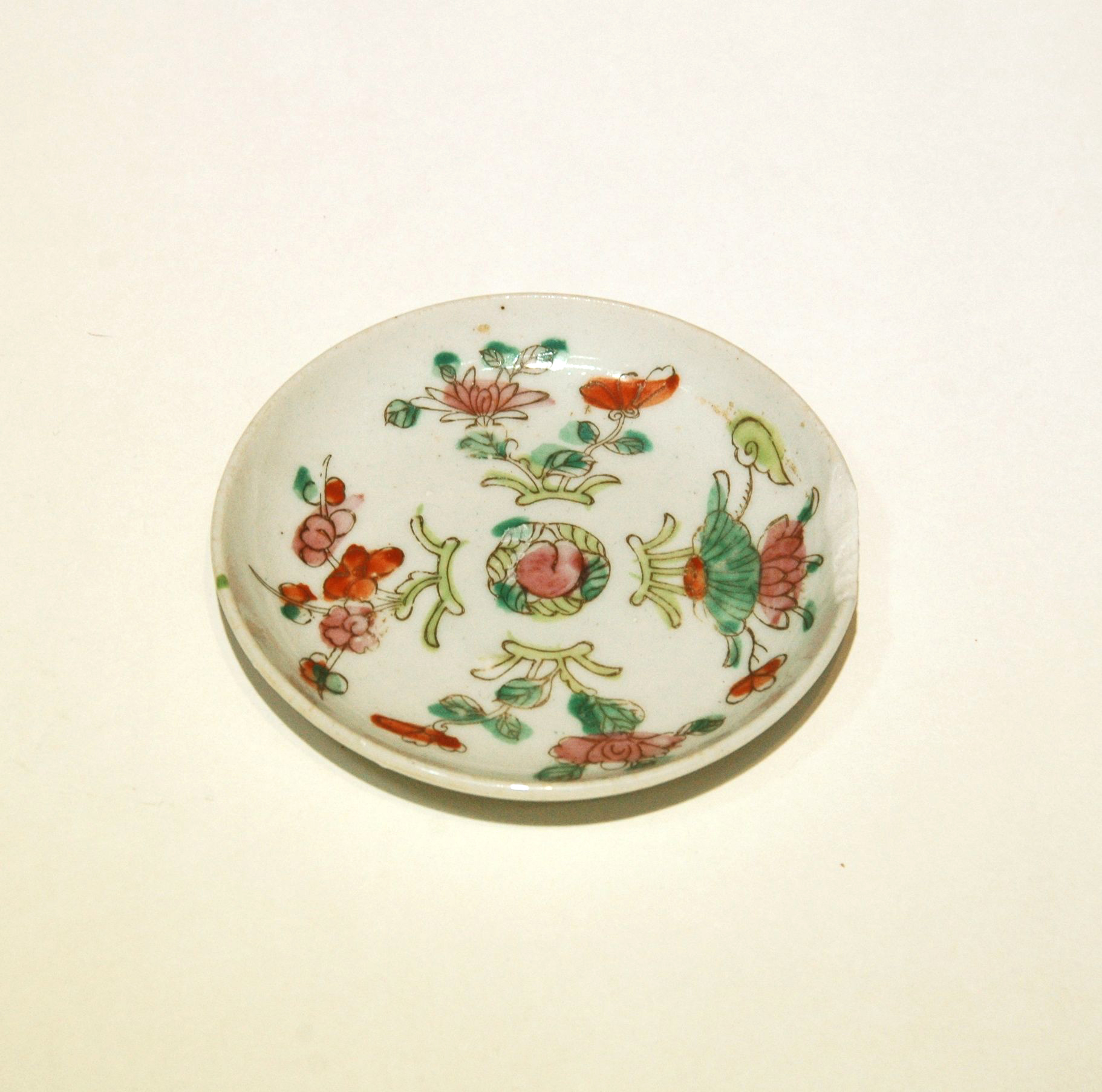
DIA100mm, China

This is four seasons floral plate is a folk’s version of the famille rose decoration.  The normal examples of famille rose you see in museum and exhibitions are very delicate and refine works of art, they can be seen as an extension of Chinese painting, the decoration of this plate uses the same technique of glazing but with a bolder pattern, it is an everyday plate for the commoners.  Famille rose was invented and became popular in the Qing dynasty, basing on the technique acquired from famille verte and the colour material of the color enamel from the West, a decoration of a softer and different shades is achieved.  The work is made from white clay, on the biscuit a colour outline is painted, then glass whiteness (a white colour use for enamel work) is applied within the outline.  Colours are then painted over the glass whiteness glazing, giving a softer colour than the famille verte decoration.

This item selected by Furze for the Something Old Something New exhibition and is available at both Mountain Folkcraft and Soil.

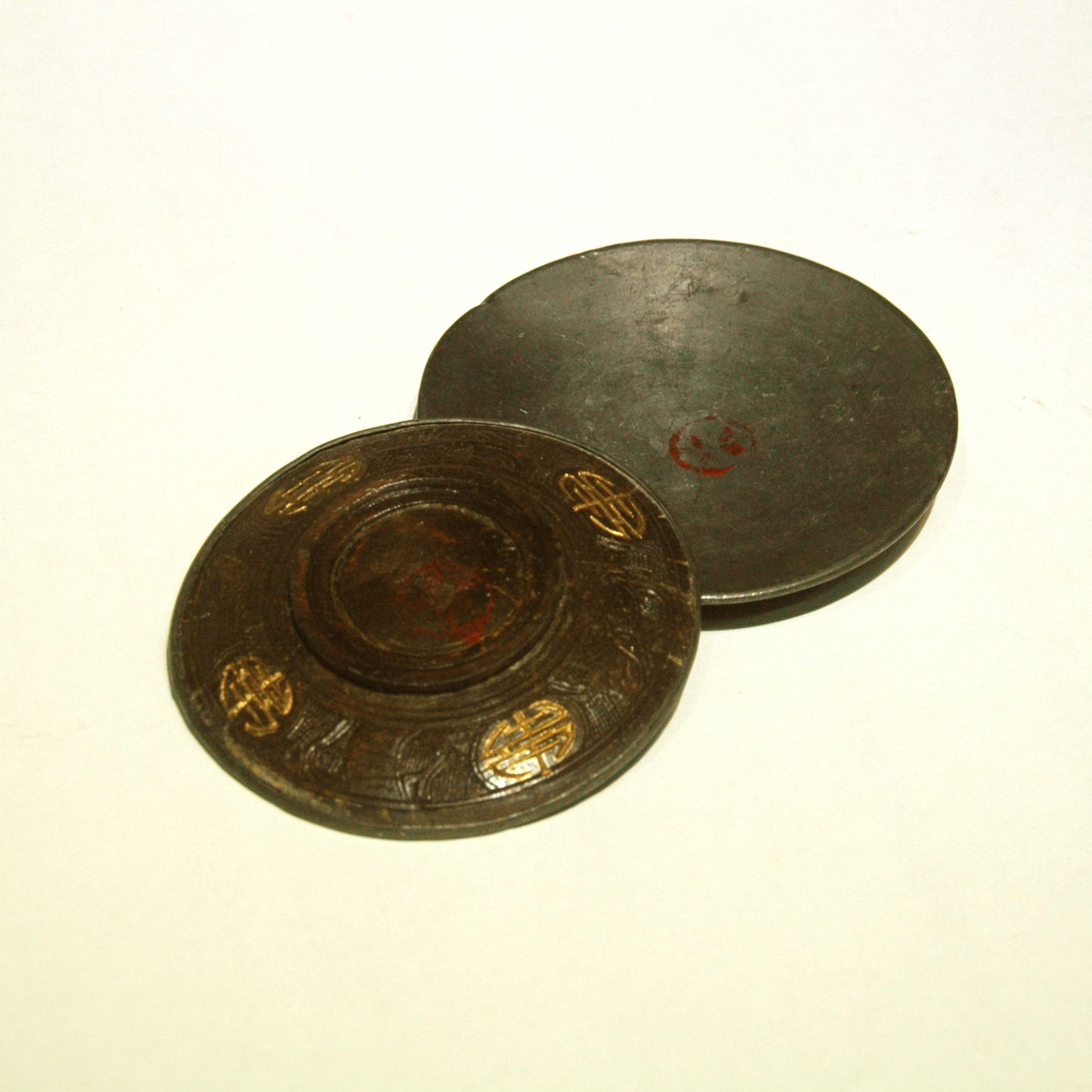
DIA100mm, China

This is a pair of lids made with coconut shell and inlay with pewter, they would have been matched with a coconut shell cups but unfortunately the cups are not absent.  Coconut as a material for tea ware has been used since the Ming dynasty, mainly as an exotic gift to the imperial court from the Hai Nam area.  See also our previous post of the Coconut Teapot.

This item selected by Furze for the Something Old Something New exhibition and is available at both Mountain Folkcraft and Soil.

DIA50xH100mm, China

This item selected by Furze for the Something Old Something New exhibition and is available at both Mountain Folkcraft and Soil.

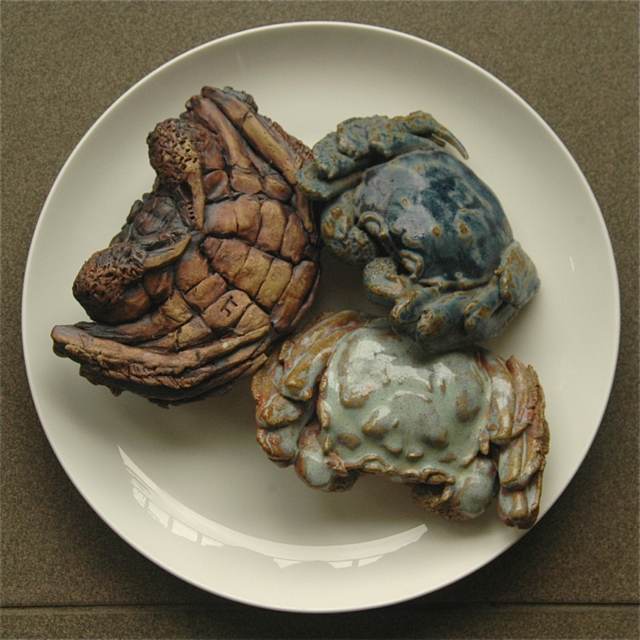
In the old days this flask would have been used in the kitchen for keeping oil or soy sauce for cooking.  Now with the hairy crab (Chinese mitten crabs) season coming up, it would be ideal for serving Hua Diao wine.  Being pottery, you can submerge the flask into hot water to heat up the wine.  Now talk about pottery and hairy crab, I cant help to show a piece of my work.

W120xD80xH40mm, Hong Kong (not for sale)

W280xL320mm, China

To celebrate Halloween we have a new year print of the god of Feng Du, Feng Du is a physical province in China where it is believed to be occupied by ghosts and spirits, a city where the dead goes to live.  (unfortunately since the Three Gorges Dam project, the ghost town is now submerged in water with only a small island remaining, so there is little chance of visiting it before death.  well, it will be rather cramp as well … o dear)  For Taoist, the god of Feng Du is the controller of all spirits and is in charge of the Hell god, Yan Luo Wanɡ (Yamaraja), he also has 72 helpers who monitor on people during their life time.  At death everyone would be led by officials with the head of a cow and a horse to Diyu where one’s deed will be judged, life long sins will be punished.  At the end of the punishment (the length of time will depend on the sins) one’s spirit will be renewed and reincarnated into the next life.

Diyu is divided into 10 courts each headed by a Yama king (their portraits are shown on the 2 sides of the print) who reports back to Yan Luo Wang.

Court 1: Jiang, King Qinguang – in charge of life and death
Court 2: Li, King Chujiang – in charge of the Frozen Hell
Court 3: Yu, King Songdi – in charge of Black Rope Hell under the sea
Court 4: Lü, King Wuguan – in charge of the Blood Pond Hell
Court 5: Bao, King Yanluo – in charge of the Screaming Hell under the sea
Court 6: Bi, King Biancheng – in charge of those who died before their time
Court 7: Dong, King Taishan – in charge of the Minced Meat Hell
Court 8: Huang, King Dushi – in charge of the Stewing Hell
Court 9: Lu, King Pingdeng – in charge of Avici, the darkest hell of all
Court 10: Xue, King Zhuanlun – in charge of reincarnation

DIA50 x H45mm, China

This item selected by Furze for the Something Old Something New exhibition and is available at both Mountain Folkcraft and Soil.

This Chinese porcelain tea ware is decorated with plum blossom, however, the white on the brown glaze just reminded me of Bambi.  Its not surprising that Chinese name for the Sika deer is plum blossom deer.

DIA 40mm, China

This is one of the gift for the Chinese baby’s shower (normally on the 100th day of its birth), a silver bracelet with the pendent of Budai and a peanut.  You must be wondering why these 2 items would be selected for a child as an ornament.  Budai, the laughing buddha, is an incarnation of Maitreya, however, this image of Maitreya is only found in China but not in India.  It is believed that the image of the laughing monk with a belly and a bag originated from a monk in the Five Dynasties, an incarnation of Maitreya and known for his joyfulness, forgiveness and kindness, for this he is always depicted to be followed with a group of children.  For a child to be wearing Budai would be giving her the blessing and a hope that his character would rub in a little.  As for the peanut, it is known as the fruit of longevity, bringing health and fertility.  In old rural China when medical and hygiene was poor, this blessing to the child is a wish of parents for some extra help for his well being.

This item selected by Furze for the Something Old Something New exhibition and is available at both Mountain Folkcraft and Soil.