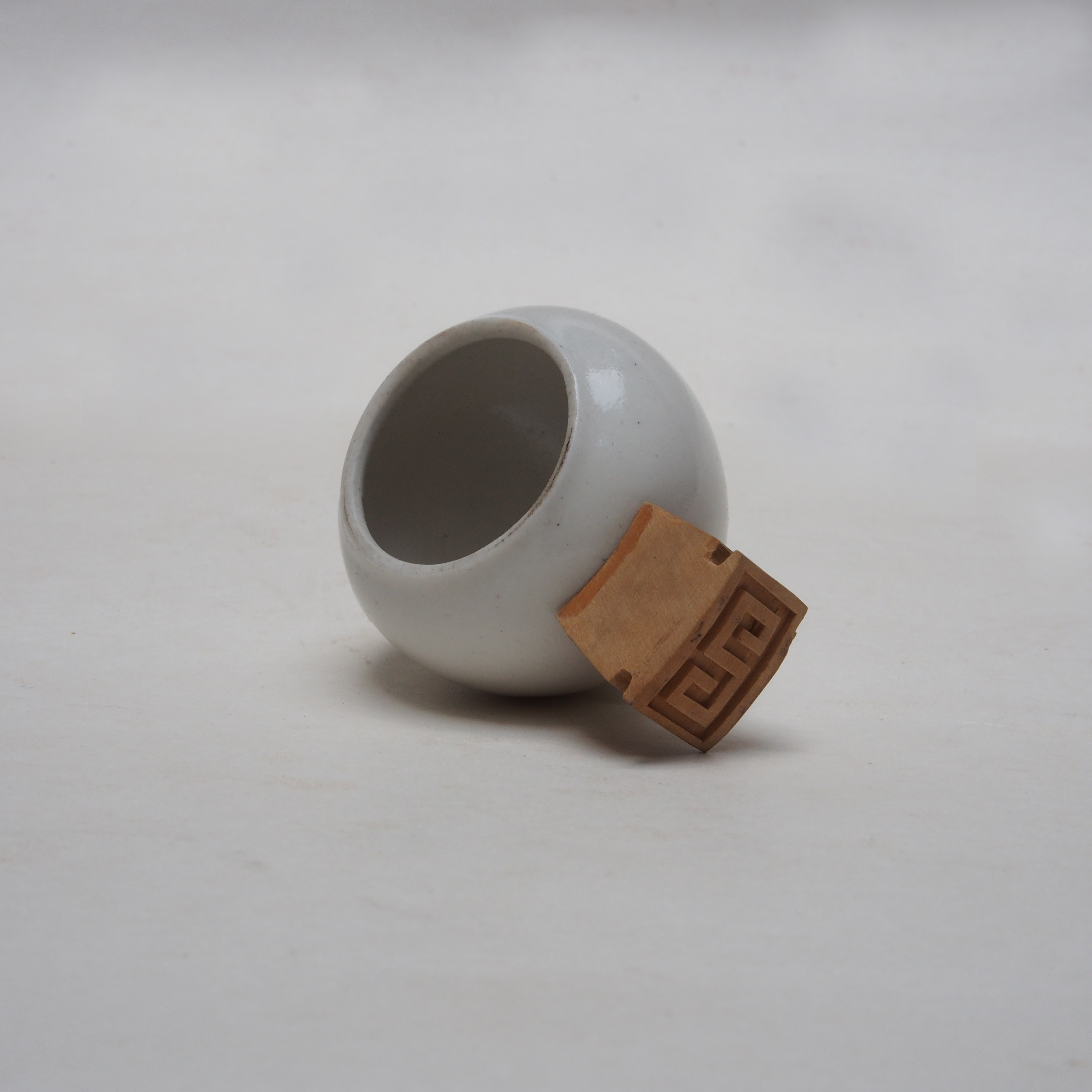
A small bowl for feeding the bird inside the cage. One for water and another for to contain food such as millet, corn, fruits, etc, but for special treats, this would be used.
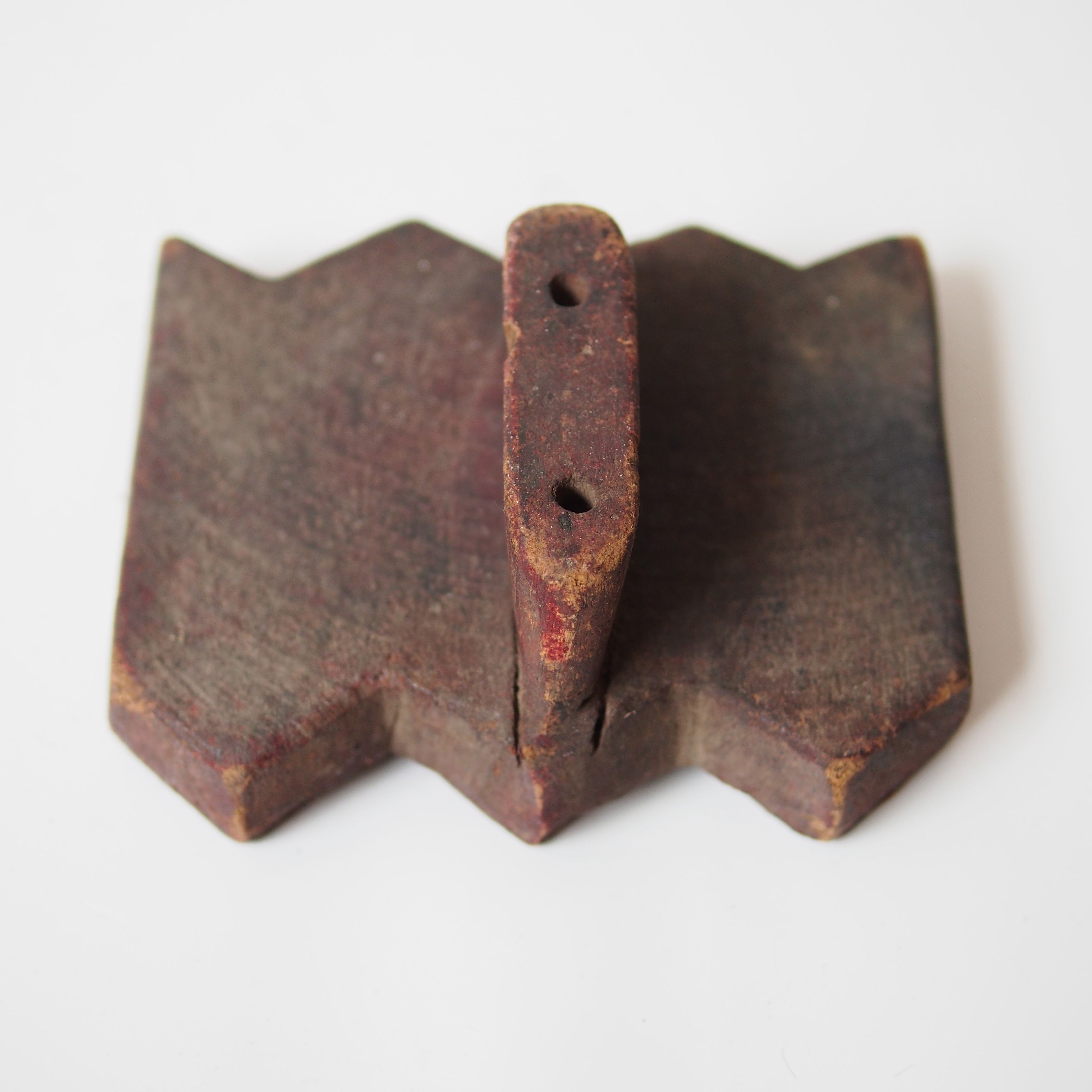
The wood attachment that bears the guai zi dragon pattern, a pattern that is used in furniture and architecture a like, is for fixing the container to the rods of the cage.
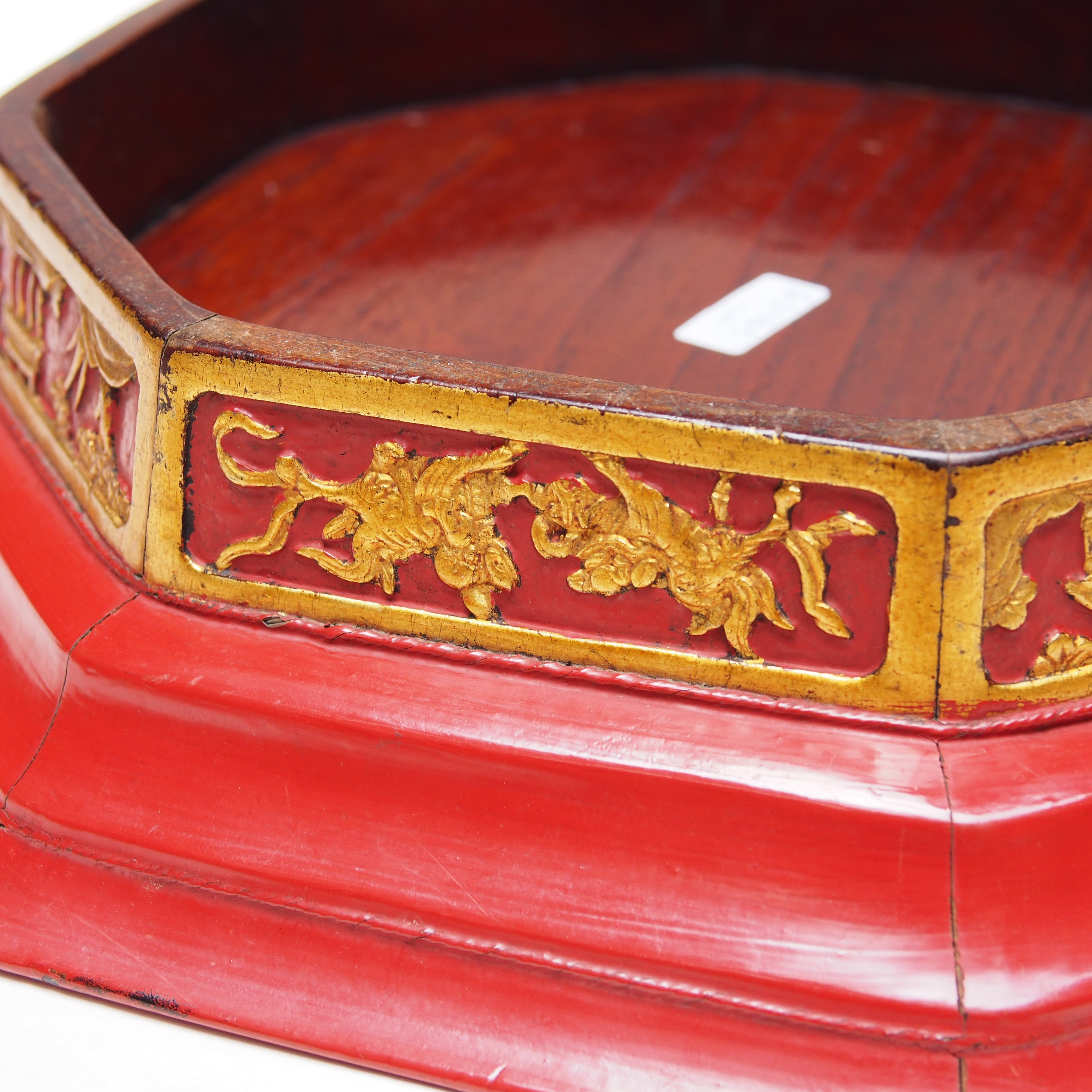
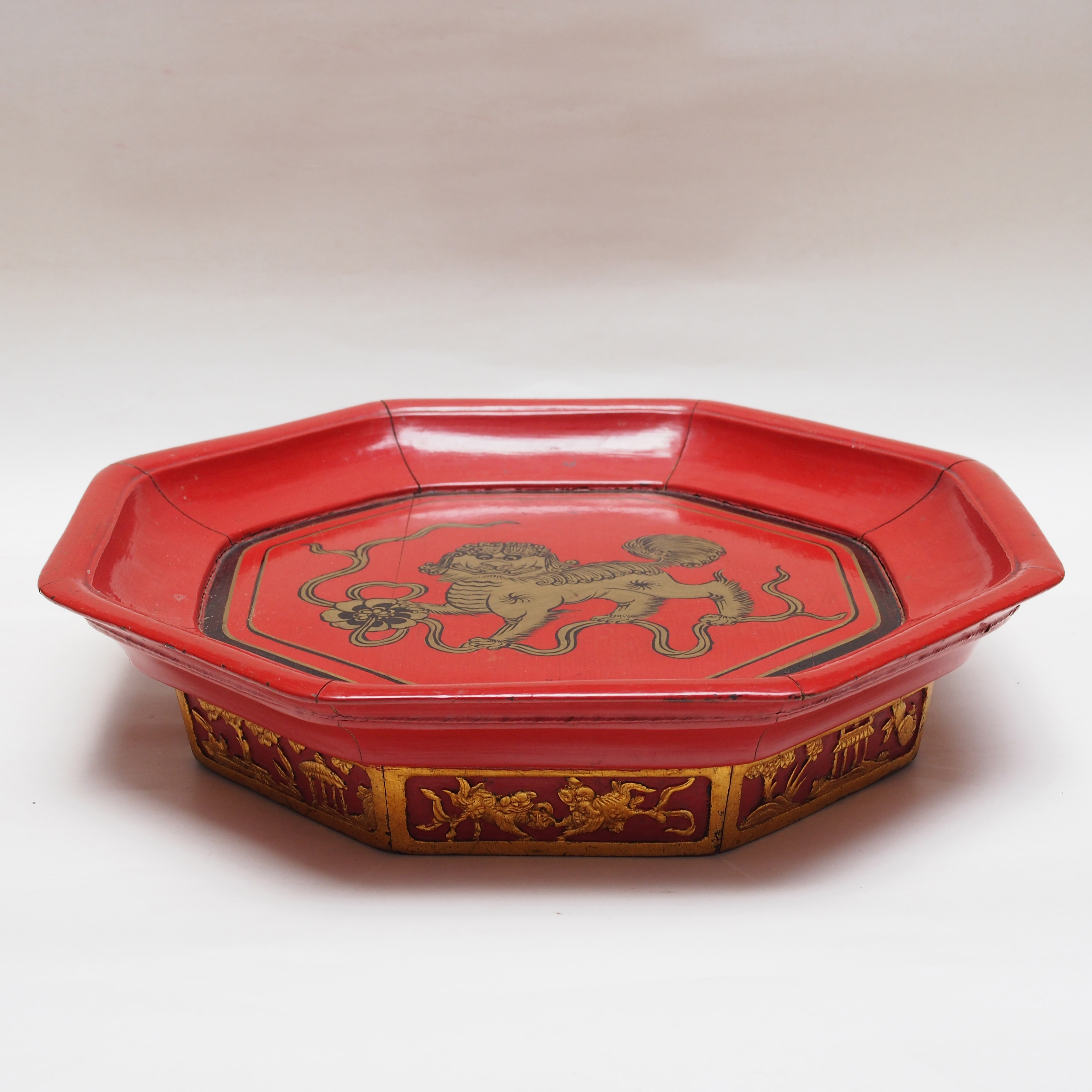
A lacquer tray of a lion playing with a xiu qiu (a fabric ball), a symbol of blessing from this mythical powerful creature.
The tray is constructed by 8 sections and a flat octagonal size board in the center, held with a wire. The base of the 8 sections have fine carving painted in gold.
This puppet head is the General Deng Ai of the 3 Kingdom period (197-264 AD). The story “Tan Shan Gu” has been made into opera and puppet theater. At the time, China was divided into 3 kingdoms, General Deng was defending the Wei kingdom against the attack of the General Jiang Wei of the Shu kingdom.
This figurine belonged to the Tanka tribe, a group who lived on junks by the bay and fish for a living. In the Guangdong area, it said that their junks used to be tied together which stretches a mile long. As time goes by, with development along the coastline, better living offer on land, most and almost all of the junks have disappeared.
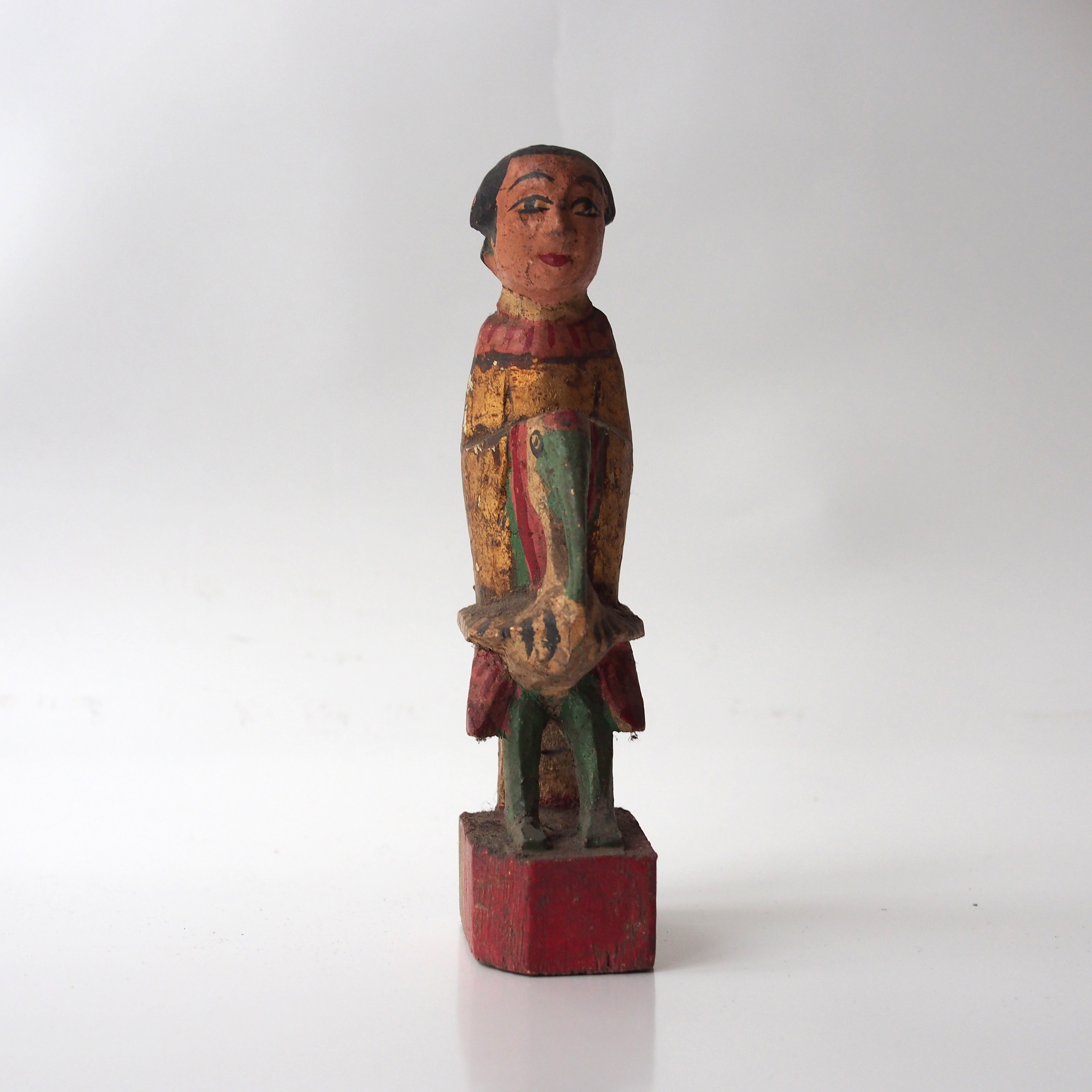
This is an ancestor figurine of a middle ranking female, the crane symbolizes a departure from this world like the saints.
The character in this golden wood carving is known as Lin Bu, a poet in the North Sung dynasty, he is surrounded by plum blossoms and there is a crane by his side. Lin led a hermetic life on a small hill at the West Lake in Huangzhou, never setting foot in the city, he found company with the monks whom he would visit with his small boat. Lin also admire plum blossoms which he planted around his hut, this also inspired him to write poems about them. Lin also kept a couple of cranes for company. It is said that if he got unexpected guests visiting while he is out on his boat, the cranes would flew to him, hoover above his boat and gave him his message. Lin was never married, the plum blossom being his wife and the crane his sons, this phrase 梅妻鶴子 (Mei Qi He Zi) became a description for a hermetic life.
A lacquer tray decorated with picture of a scene from the Beijing opera “Tai Jun Ci Cao”. The story is about the famous Yang family of warriors.
First some background to the story; Commander Lord Yang, his wife She Sai Hua and their 7 sons was defending the North Han country against the Sung. Though the Sung army is the stronger one, the Yang’s family out smarted them, the Sung General Pan was shot by Lady’s She’s arrow and had to retreat. Failing with the attack, the Sung emperor spread rumors about Lord Yang which had the suspicious North Han emperor distrust Yang’s advice and was defeated utterly. After the victory, the Sung emperor took Lord Yang under his wing and made him a trusted official, General Pan was very jealous of this promotion.
The Liao country start attacking Sung, Lord Yang and his sons was defending Sung at the border. Yang’s army was out numbered, 3 of his sons were killed in action, he send his 7th son to get reinforcement but was secretly killed by Pan. Lord Yang was captured and one of his son was captured, Lord Yong committed suicide to avoid being used as a hostage while his son was selected by the Liao Princess to be her husband. The 5th son was tired of all the fighting and the politics became a monk. The 6th son managed to escape and returned to the Sung capital and became the commander in place of his father but was later killed in action.
The opera story on the lacquer dish appear at this point, the Sung emperor asked the Yang family to led the fight with the Liao. With all the males gone, here is only Lady She (now in her 70s), 2 daughters, the daughter in laws and young grandson left in the family. Lady She, the commander with the female warriors led the army to victory. When they return safety home, Lady She after losing all her sons fearing that her only grandson too would eventually die in battle ask the Emperor to allow the family to leave their duty as the commanders.
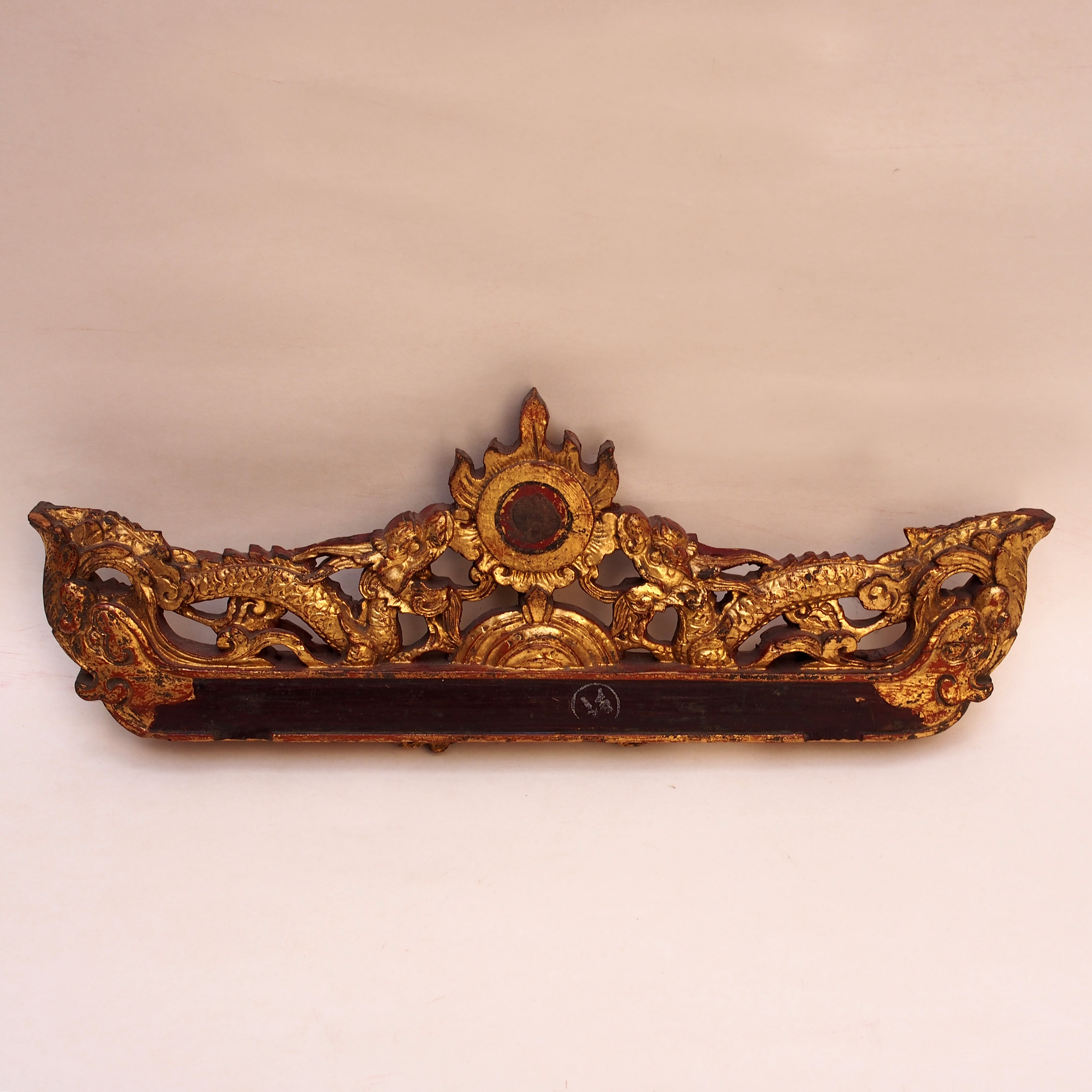
This golden wood carving used to be center pediment of an ornamental object, perhaps on small shrine in a temple.
On the carving, there are 2 dragons chasing after a pearl. Dragons are believed to be mythical creatures from the sky, they need to attain a certain quality to become a saint. After a few hundred years, the essence of what they have learnt from nature would become a pearl like pellet. The dragon would spit out the pearl for it absorb the spirit of nature and the bigger the pearl would grow. One day while a dragon was practicing with his pearl, another dragon decided to take this pearl to speedup his own attainment. The bad dragon spit out his pearl hoping it would absorb the other, the two pearls melted and became one giant pearl, both dragons wanted to take it in and started using all their tricks. Their fight upset the nature of the universe and the Jade Emperor took them in and set the pearl on the temple which would be protected by the dragons for good
The white coloured face most often denote a villain in the Chinese opera.
This is a mask of the Qin dynasty prime minister Zhau Gao. In the opera story, “Yu Zhou Feng” (Sword of the Universe) happened in a time during the regime of Emperor Qin Er Shi. Zhau Gao and Kuang Hong was in laws, with Zhau’s daughter married into Kuang’s family. Kuang showed his displeased about how Zhau was manipulating the Emperor caused revenge from Zhau. He has someone stole the well known Sword of the Universe from Kuang and had faked an attempt assassination of the Emperor. Thinking that it was Kuang, the Emperor ordered the execution of the Kuang family. Kuang’s son escaped while his wife Yan Rong (Zhau’s daughter) returned to his father’s home. The Emperor seeing the beautiful Yan Rong and wanted to have her as a concubine but she hated his notorious style of ruling and his father’s treatment to teh Kuang family, she pretended to have gone made in order to escape the Emperor.
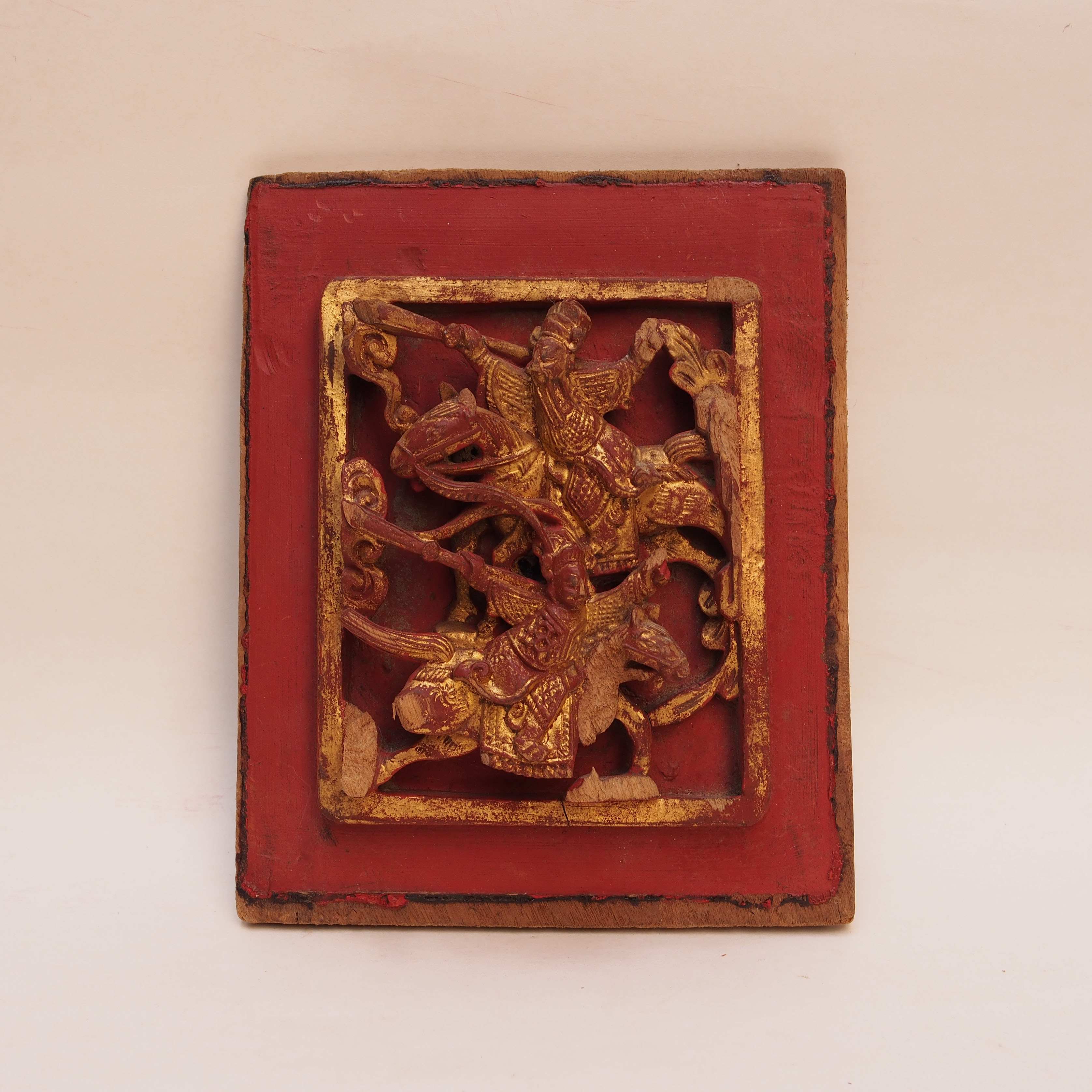
The two character on this wood block carving is Fan Li Hua and Xue Ding Shan. The story of the two are in opera, movies and on telly with Fan Li Hua being the famous female warrior of the Tang dynasty. Fan was the daughter of the general of the country name Onog, both beautiful and with superb martial skills. General Xue was in charged of expanding on the western territories; Fan was assigned to aid his father at the battle by her mother who also told her that she was destined to marry Xue. Without effort Fan defeated her enemy and requested for a battle with General Xue and quickly defeated Xue as well. Her terms for ending the war was for him to marry her, three times she captured him and released him and . General Xue was moved and the two was married, Fan then pretended to loss the battle and was captured by Xue. Fan then help Xue to conquer the western frontier.




 Mountain Folkcraft