Archives for category: wood

DIA260xH480mm, China

This lacquered water bucket is part of the bridal dowry of a Chinese wedding.  The basic dowry list for bucket section would include a foot a water bucket, a foot washing basin and a chamber pot.  The list for a well off family would go up to more than 20 items.  All these items have in common is that they are all lacquered in red and structurally formed like a barrel, segments of circular planks tightened together by a piece of metal.  The bucket artisan used to be a very popular trade, making every day use items, repairs and of course the dowry items, but as China became industrialized now there is only a handful of old artisan left.

W400xH250mm, China

The folding fan was introduced to China from Japan in the Song dynasty; they were a gift from monk Chonen to the Emperor.  Emperor Zhu Di lead on the fan fashion, he ordered the court to produce a large number of hand fans, decorated with poems or verses and award the to the high officials.  This became to the trend of the intellectuals, exchanging poems and calligraphy through the fans as a gesture of friendship.  Even the Qing dynasty, the fashion of hand fan was well in its height.  This is a fan from the 50s, a Bai Ju Yi poem about parenthood was added by my father recently.

W100xD40mm, China

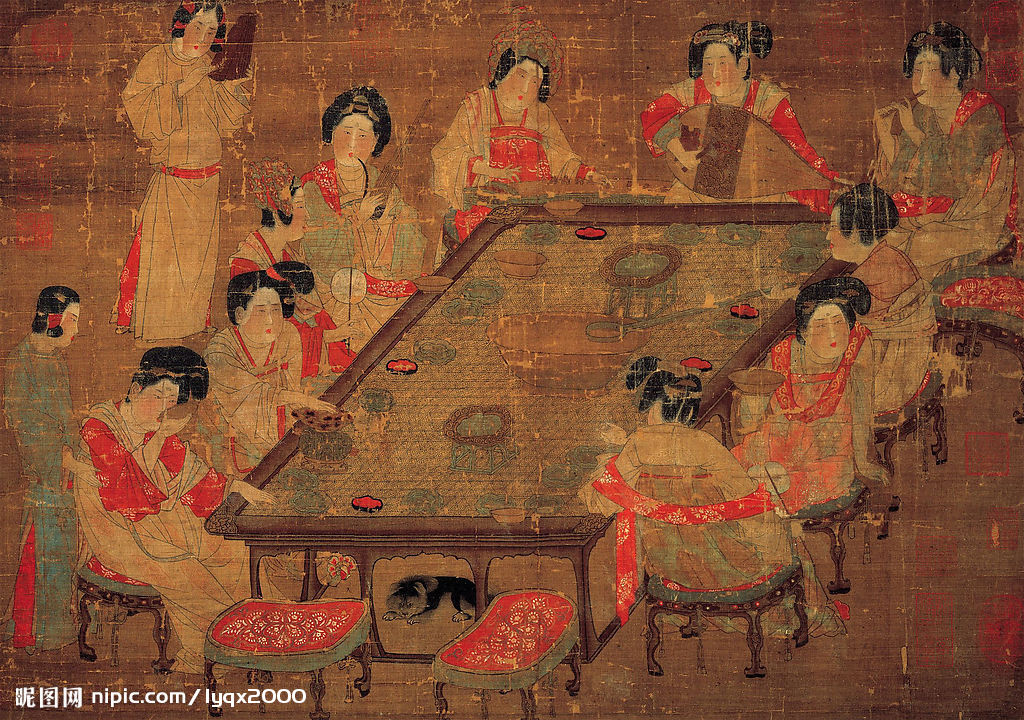
Comb in China became a special artisan trade around 700BC, the design, shape and material changes through out the different dynasty.  Apart from being a function object, it also became an accessory for hair styling in the Tong dynasty.  This can be seen in the Tang dynasty scroll “A Palace Concert” where ladies from the Emperor’s inner court were shown to be enjoying their drinks, the comb accessory can be seen as decoration in their hairdo.  This is still practiced by the minority tribes; the Shui, the Miao, the Dong tribe etc.  There is a folk tale explaining why the Shui tribe ladies have a comb in their hair, the story goes: a group of women were working hard in the fields, they have left their baby in a basket at the edge of the rice paddle.  Suddenly they heard the baby crying, they went running to see what is wrong only to found a large centipede making its way to the baby.  By the baby’s side is few wooden combs, the centipede had a look at the combs and compared the number of teeth with his own number of legs.  “Damn, i have been out numbered” thought the centipede and quickly made retreated.  Since then, the Shui tribe ladies have combs in their hair.

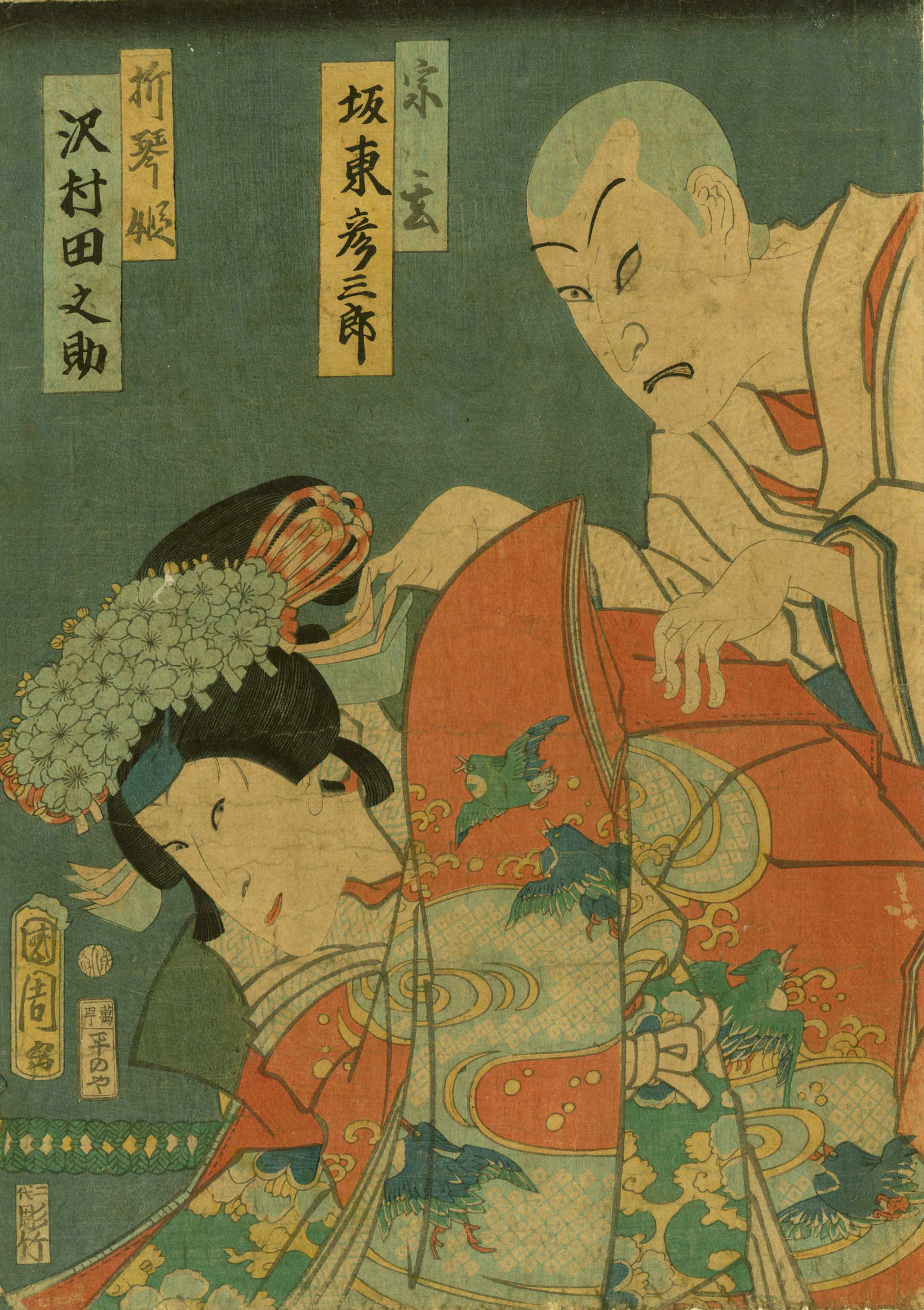
W240xL360mm, Japan

This is a Japanese wood block print by the artist Kunichita, published in 1862 by Hiranoya.  Kunichita was the founder of the Toyohara School and was one of the most famous ukiyo-e artist of his time.  His love with the Kabuki theater led him to work on ukiyo-e actor prints (prints of the kabuki actors and scenes from the popular plays).  In 1867, he was commissioned by the Japanese government to produce 10 pictures for the World Exhibition in Paris.  This exhibition strengthen the Japonism influence in the European art world.

This print is about the Kabuki play where monk Sogen (played by Bando Hikosaburo) became infaturated with the beautiful courtesan Orikotohime (played by Sawamura Tanosuke).  For this Sogen was expelled from the temple, tragically  Orikotohime died and he was left alone.

L180xD70xH70mm, China

There are many themes for the gold plated lacquered wood carving (so many verbs, but there there are so many layers layers to the work); floral and symbolic carving is one of them.  The two symmetrical flowers are peony, representing wealth and glamour.  The center piece is xiu qiu (embroidery ball) which is a blessing symbol for love.  Many year ago when public dating are forbidden, the girl would select the groom by throwing the xiu qiu.  On the 15th of lunar January / August, the suitors would gather under the ladies’ quarter, the girl would throw the xiu qiu and whoever catches it will be the groom.  This carving is likely to be part of the decoration from the bridal sedan.  (see more about xiu qiu)

China

This is part of the armrest detail for the Chinese wooden furniture.

Come check them out!

W150xH200mm, Indonesia

This is the Java mask for the Ramayana epic character Sugriwa , the king of the monkeys.  The monkey kingdomm Kishkindha was ruled by Bali, Sugriwa’s brother, one day a demon came to challenge a fight with Bali.  Seeing blood from the demon’s mouth and that Bali not returning, Sugriwa thought his brother has died and took over the kingdom.  Bali however returned unharmed and suspected Sugriwa has betrayed him, took Sugriwa’s wife Tara and banished him from the kingdom.  During his exile, Sugriwa made friends with Rama whose wife Sita was captured by the demon Rakshasas.  Sugriwa and Rama made a deal to help each other, Sugriwa to take revenge of Bali and Rama to save his wife.  Sugriwa challenged Bali and a fight started, midway Sugriwa’s counsellor Hanuman to place Garland of flower around Sugriwa’s neck.  Rama took the chance and shoot Bali at the heart.  After Bali’s death, Sugriwa took over the kingdom and forgot about the promise with Rama.  Rama’s brother Lakshmana was upset and was planned to destroy the monkey kingdom and to kill Sugriwa.  Luckily Tara reconciled Rama and Sugriwa.  Hanuman found out the location of Sita and with joint forces Sita was free.


L450xW100xH150mm, China

Chuan Jiang  is upper course of Chang Jiang River running between Si Cuan and Hu Bei.  Chuan Jiang was the main route for goods transportation serving the areas around the region.  In Qing dynasty with  Chong Qing opened up as a port, it also became a major routing for the import and export goods, boats on Chuan Jiang were in their thousands.  There are many different kind of boats; boat tracker range from a few to a hundred, each boat tracker’s ranking and task is well defined.  The Chun Jiang has a drop in level of  more than 120m, hundreds of  torrents, invisible reefs and shoals, at each of them the boat trackers would have to disembark the boat and to manually steer or pull the boat to course.  To reduce the fiction of the pressure from the rope and their clothing, the boat trackers prefer to work naked.  In winter time they will rub their body with a layer of lard to prevent froze bite by the freezing water.  Since the introduction of other means of transport and Three Gorges project the necessity of the boat trackers are longer.

W100xD80xH200mm, China

This is a gold plated figure of the God of Wealth General Zhao Gong Ming worshiped by the Taoist.  The figure is well known to be in armour, one hand holding a piece of gold, the other a silver whip and riding on a black tiger.  Legend had it that originally there were 1o suns, they blasted the earth, Hou Yi was asked to shoot down all of them but one.  The 9 suns became demons, 8 of them revenged and brought about sickness but one of them Zhao became human.  He was trained and attained the power to fight plague, as a reward for his hard work he was made god and in charge of the wealth of the world. You might also known him as one of the door god icon.

W100xL290mm, China

This is an old wood block printed script in 2 volumes of a popular Buddhist sutras in Chinese.  The sutra was translated into Chinese in Tang Dynasty; it was presented as a dialogue between the Buddha and Ksitigarbha.  The teaching is about the the ultimate sense of a universal code of duty for all living beings.