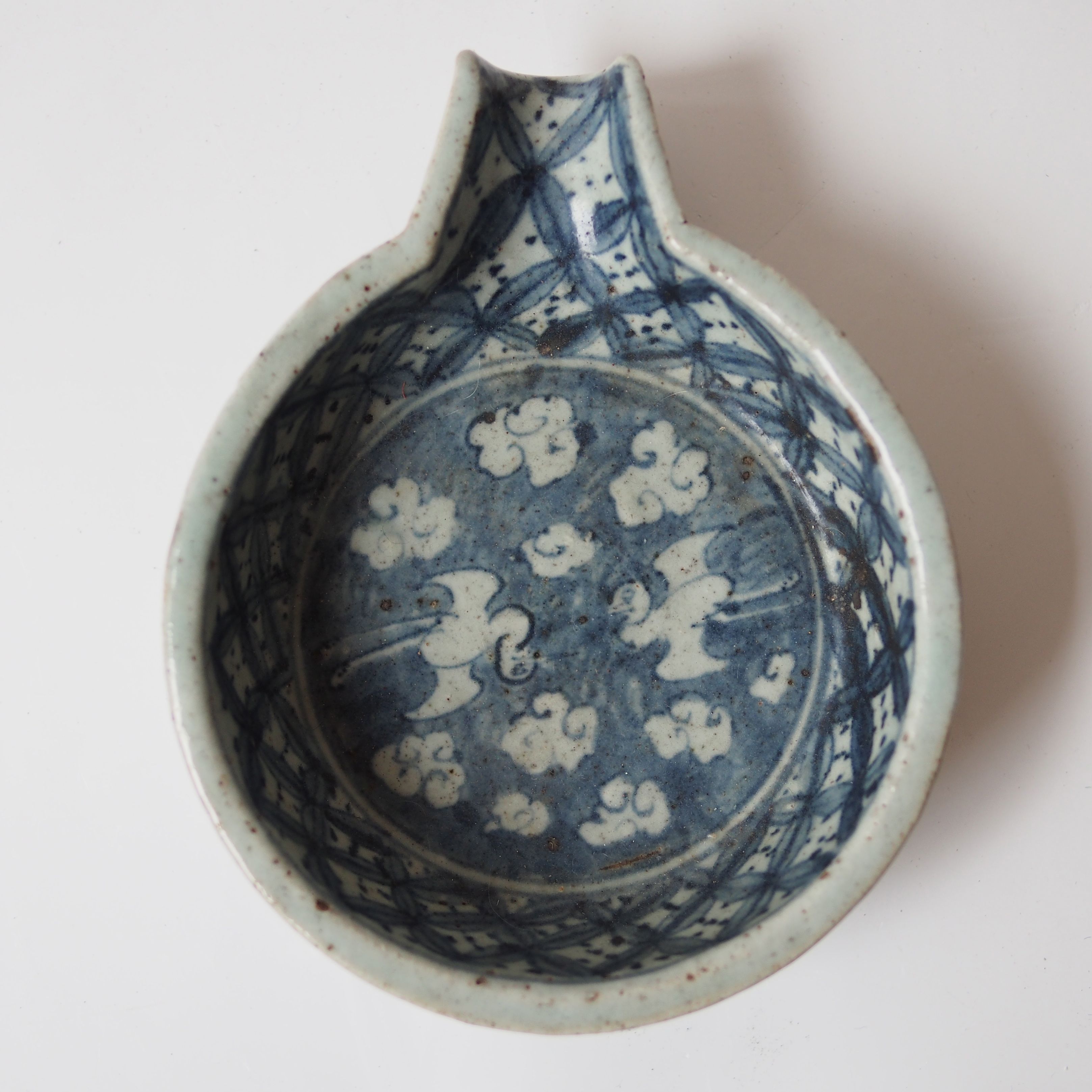
This is one of the items in the shop that I have problem finding out its use.
Spout – suggest the use for pouring out liquid, powder or beads?
Blue and white under glaze – suggest a clear liquid (verse ink) so pattern can be appreciated?
Heavy & flat – suggest not intended to be handle often (unlike a teapot)?
If anyone has any idea how this item was intended to be used, please let me know!
This plate depicted a scene from the river, boats scattered around in the water with the landscape at the background.
Rivers are the veins of China, they provide water for irrigation, food source and transport. River scenes are the homeland for us and dreamland for others. In the Li River in Gui Lin, cormorant fishing is practiced, these birds are trained to capture the fish that had been attracted to the light from the boat and to bring them back to the fisherman, a bit like the hunting dogs.
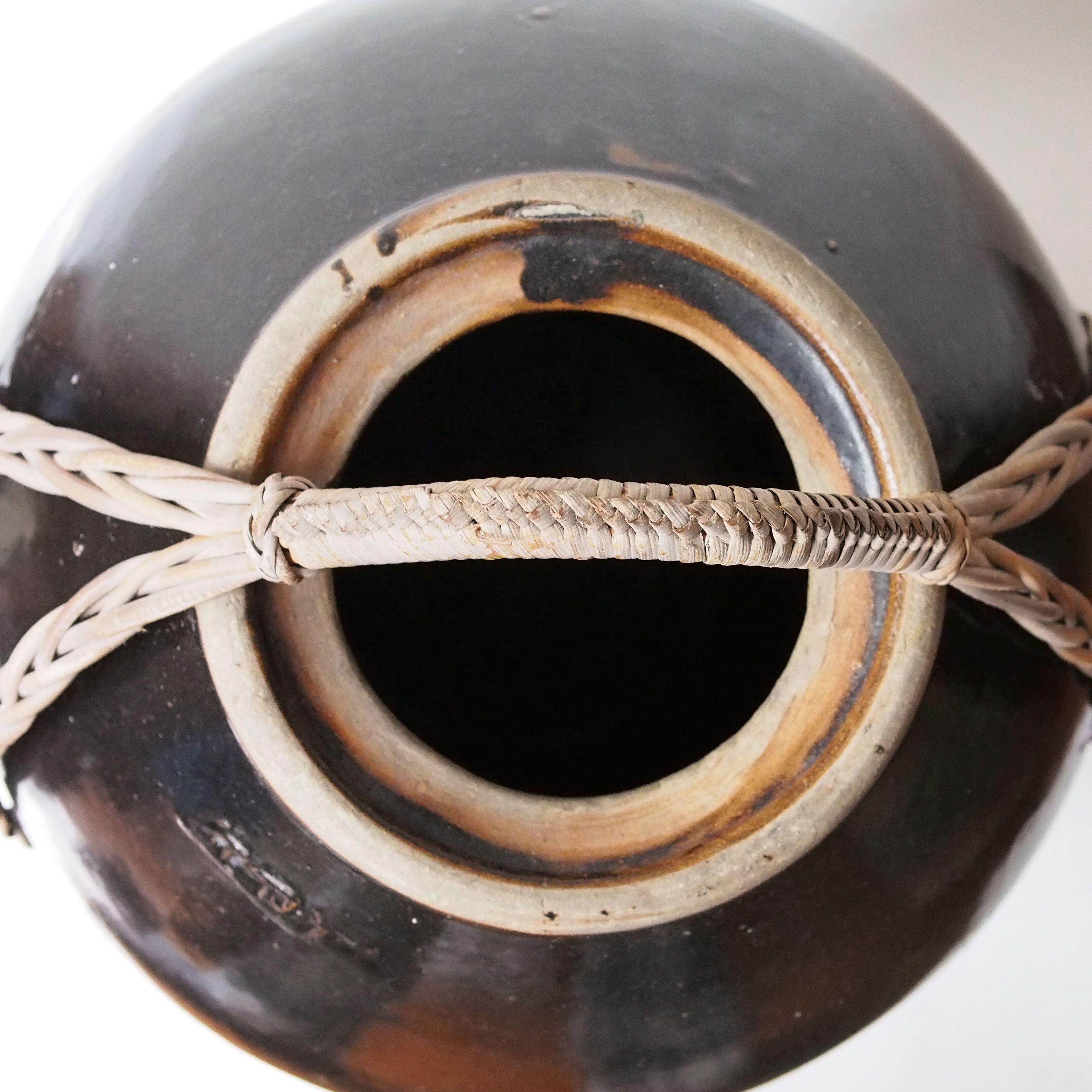
Jars were used to contain sauces, paste and oil for sale in the grocery stores. In the old days, it was these jars would be reused and everyone would bring their own bottles and containers to buy the stuff which are either wrapped in newspaper or tied together by a string of plant fiber (Cyperus Tegetiformis). There was no concept of being environmentally friendly but the general atmosphere of not being wasteful, objects would take on different function as they fit again and again until it disintegrates.
Sadly, the jars and the recycled bottles have been replaced by plastic ones, local grocery stores by supermarkets and our countryside replaced by landfills.
Peony is a flower that has been much appreciated, beyond displaying in gardens.
Its beauty reciprocated in painting, opera and poetry.
Emperor Xuan Gong was with his beloved Lady Yang admiring the peony blossom in the palace garden. Li Bai was summoned to court to write a poem about the peony.
清平调
雲想衣裳花想容,春風拂檻露華濃。
若非群玉山頭見,會向瑤臺月下逢。
一枝紅豔露凝香,雲雨巫山枉斷腸。
借問漢宮誰得似?可憐飛燕倚新妝。
名花傾國兩相歡,長得君王帶笑看。
解釋春風無限恨,沉香亭北倚闌干。
The poem “Lady Yang” by Li Bai, translation by S. Obata
The glory of trailing clouds is in her garments,
and the radiance of a flower on her face.
O heavenly apparition, found only far above
On the top of the Mountain of Many Jewels,
Or in the fairy Palace of Crystal when the moon is up!
Yet I see her here in the earth’s garden
The spring wind softly sweeps the balustrade,
And the dew-drops glisten thickly …
She is the flowering branch of the peony,
richly-laden with honey dew.
hers is the charm of the vanished fairy,
That broke the heart of the dreamer king
In the old legend of the Cloud and Rain.
Pray, who in the palace of Han
Could be likened unto her,
Save the lady, Flaying Swallow, newly dressed
In all her loveliness?
She stands, leaning against the balustrade
Of Chen Hsiang Ting, the Pavilion of Aloes.
Vanquished are the endless longings of Love
Borne into the heart on the wind of spring
The radiant flower and the flowery queen rejoice together,
For the emperor deigns to watch them ever with a smile.
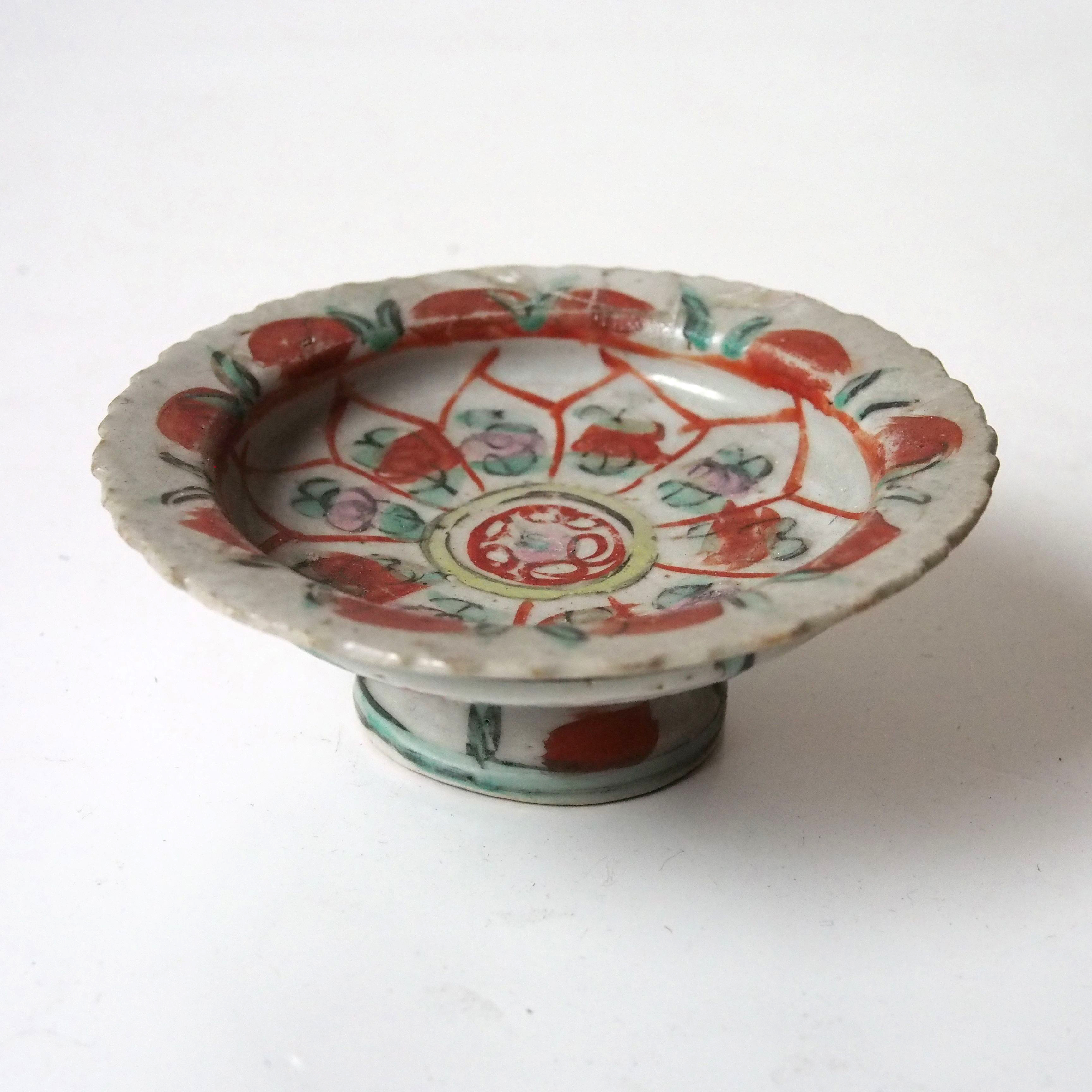
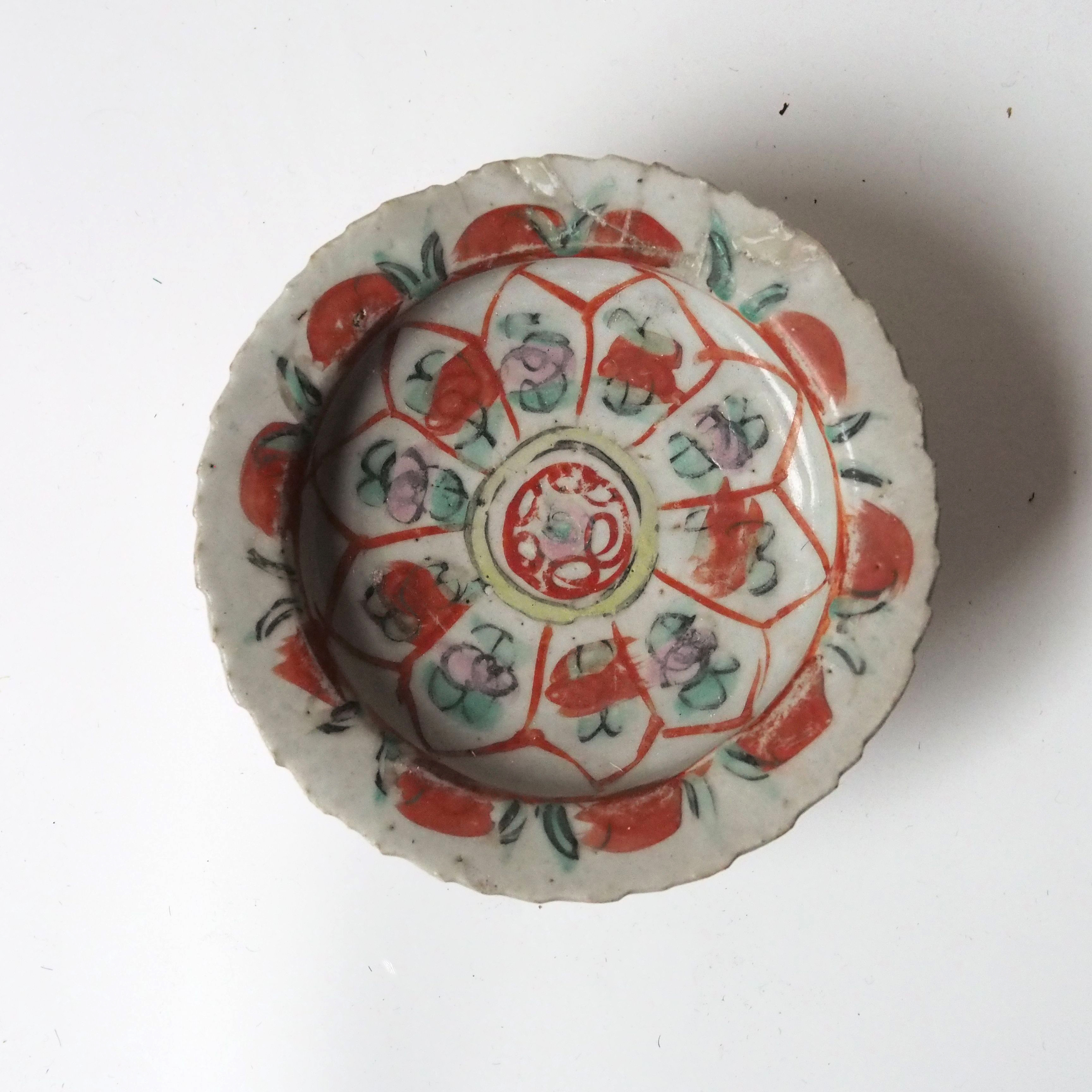
This is an offering plate for the gods at the temple or even at the shrine at home.
The offerings are broadly divided into 5 groups; tea and wine, incense, fruits and cakes, the 5 grains, animals. These offering has to be aesthetically beautiful, making a melodic sound and of course tasty.
However, it seems Master Chin Kung’s teaching makes more sense.
Instead of tea and wine, water should be offered, our mind should be as pure and peaceful as water.
We should understand the meaning of what it is we are offering.
This figurine is by the famous pottery area Shi Wan; their figurines are typical to have a glazeless delicate facial and hand depiction while contrasting with an expressive and bold glazing on the clothing.
The drunken poet, Li Bai, is a popular subject for figurine, paintings, etc., apart from his literary stature, his love for drinking also give a character for the artisan to express.
The poem “Drinking Alone under the Moon” by Li Bai, translation by W. Bynner
From a pot of wine among the flowers
I drank alone. There was no one with me—
Till, raising my cup, I asked the bright moon
To bring me my shadow and make us three.
Alas, the moon was unable to drink
And my shadow tagged me vacantly;
But still for a while I had these friends.
To cheer me through the end of spring . . .
I sang. The moon encouraged me.
I danced. My shadow tumbled after.
As long as I knew, we were boon companions.
And then I was drunk, and we lost one another.
. . . Shall goodwill ever be secure?
I watch the long road of the River of Stars.
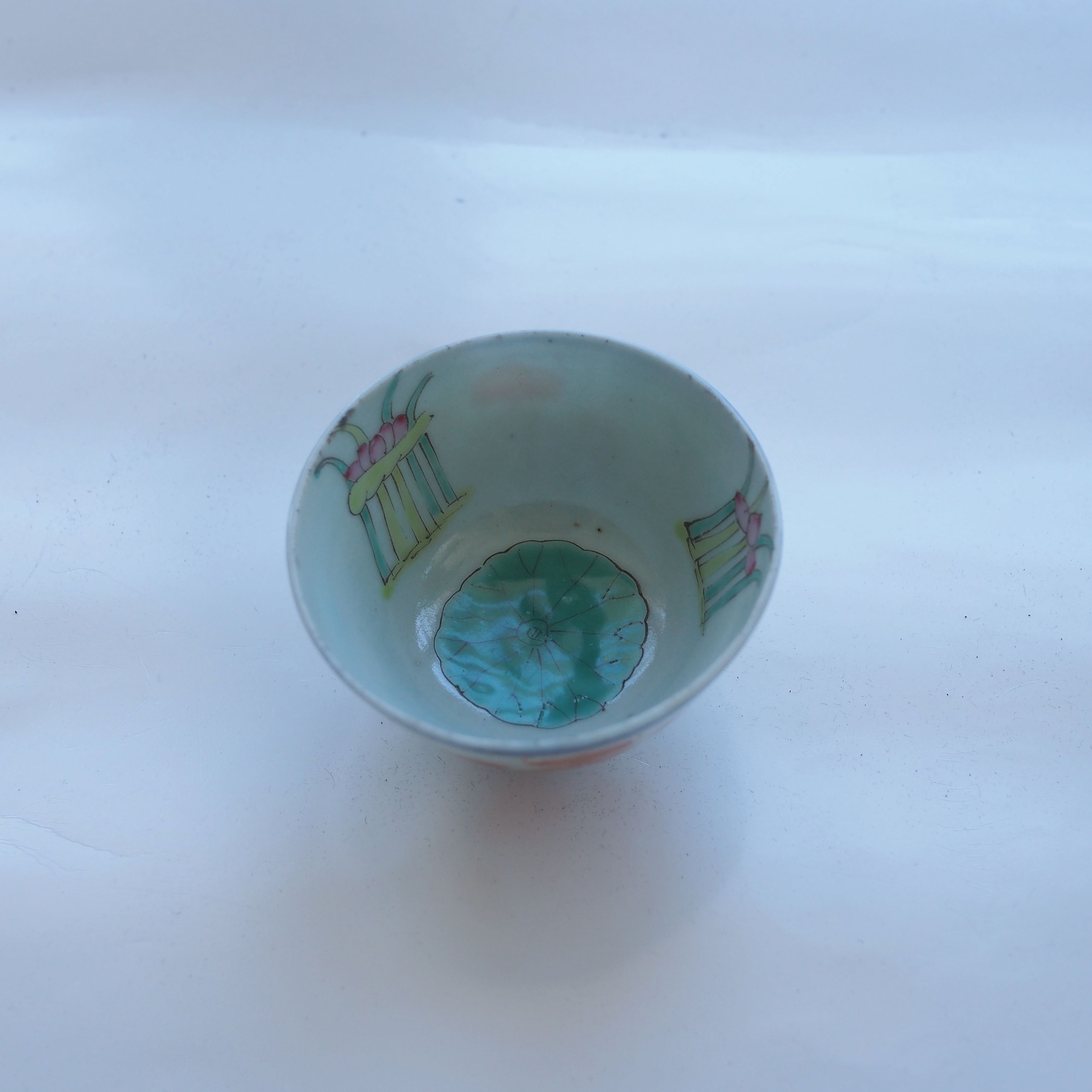
This small wine cup is decorated with all the lucky symbols.
One the outside of the cup, are 5 red BATS circling the word LONGEVITY, next to it is a large green BAT hanging from it are a couple of GOLD COINS. On the inside of the cup, there is a LOTUS leave at the bottom with LOTUS BLOSSOMS on the side.
BAT – the word BAT (蝠 fu) have the same pronunciation as the word (福fu), symbolizing being blessed.
LONGEVITY – needs no further explanation
GOLD COINS – wealth
LOTUS BLOSSOM – the lotus plant grows on muddy ponds, the idea that such beautiful flowers can appear untained by the mud resembles purity
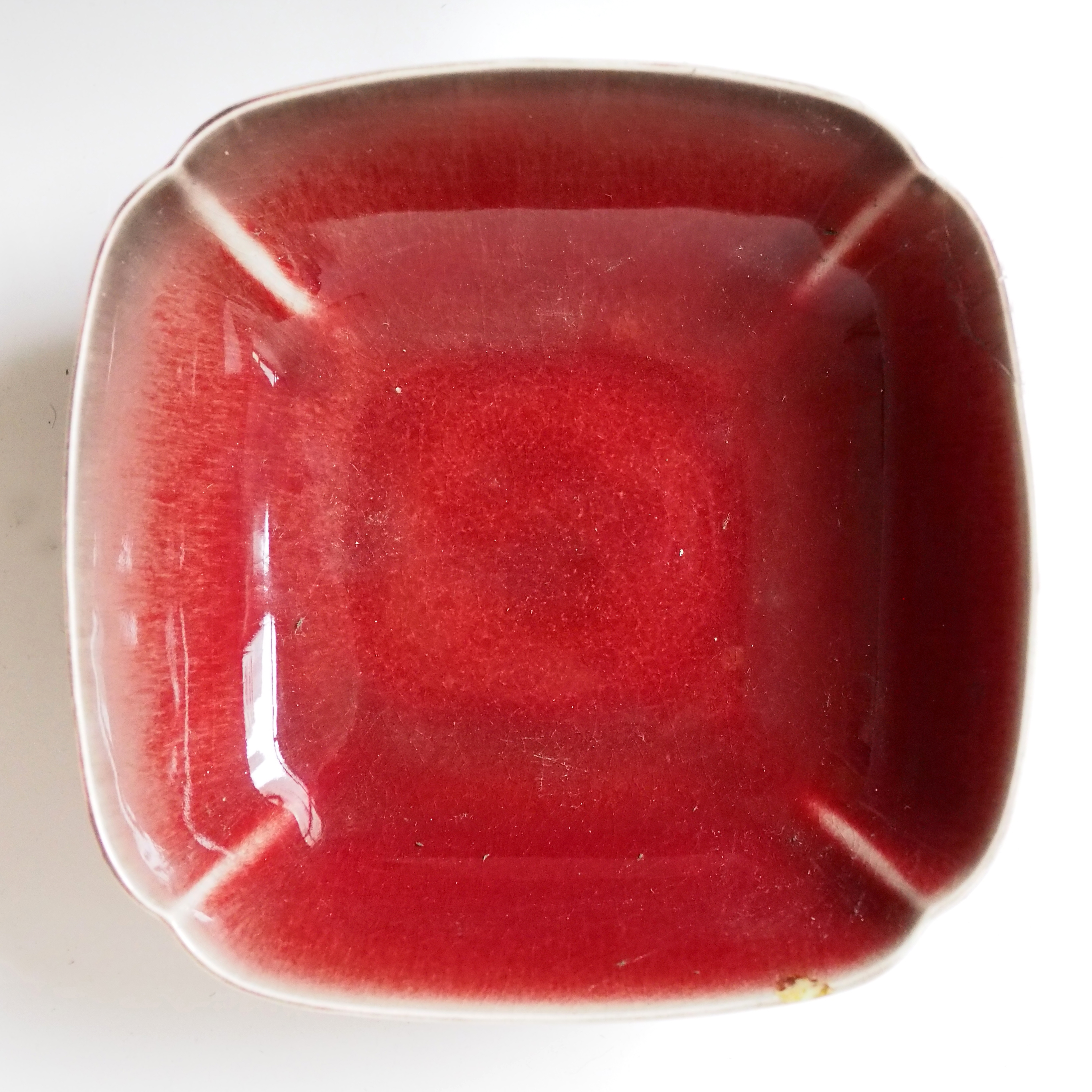
Begonia shape? I see no flower but only a squarish bowl, what is this all about?
The begonia shape comes from the outline of the flower, the niches formed by overlapping of the petals are conceptualized. Gone are the details of the flower, the anther, the stigma and even the petals, what remains in the negative of the flower. The begonia shape is a popular decorative element and is not restricted to pottery, it expand also to the realm of architecture; doorways, windows, gillworks, pavings, etc.
 DIA150xH40, China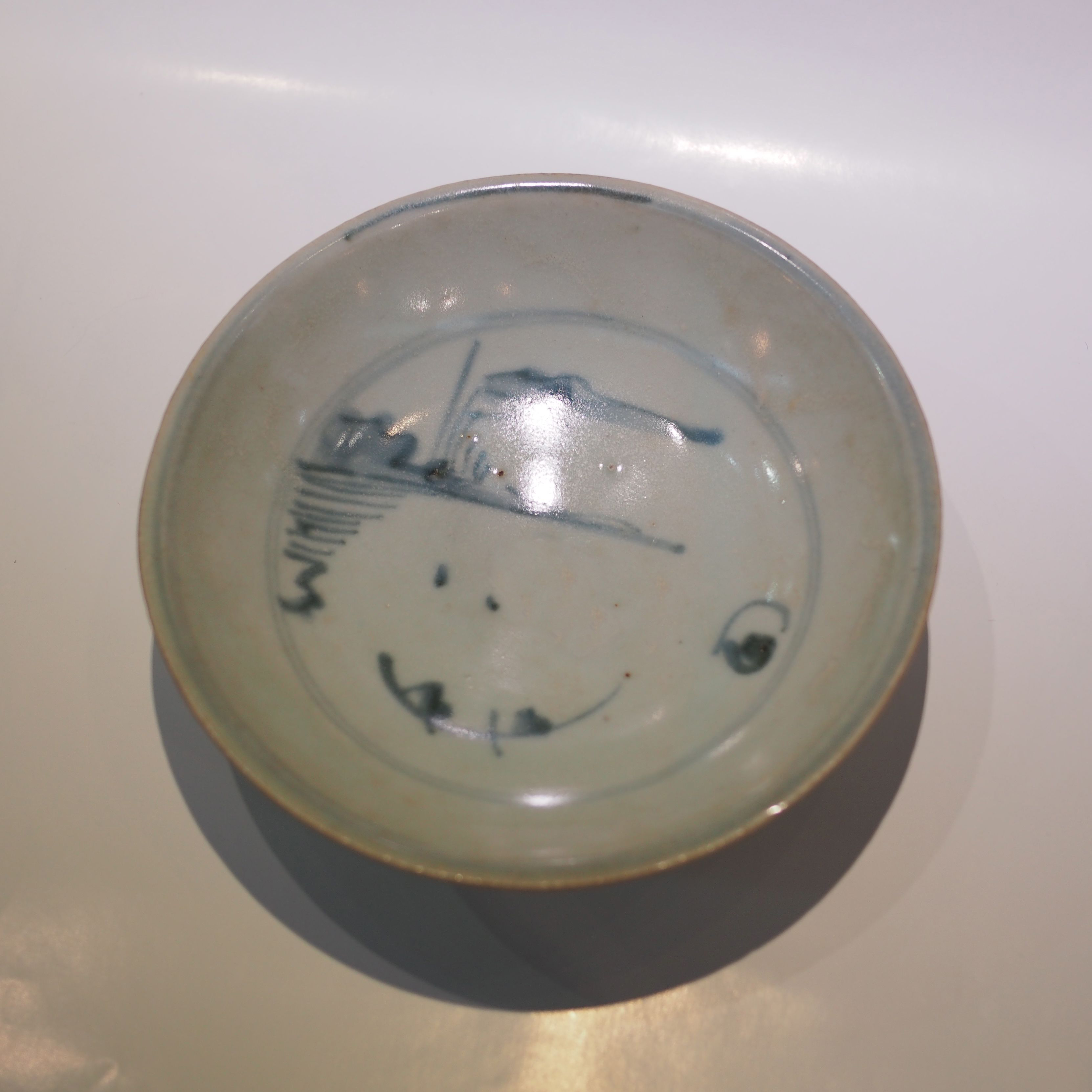









 Mountain Folkcraft