Archives for category: paper

W240xH260mm, Japan

This is a Ukiyo-e print of the Nihonbashi, likely to be of late Edo period or early Meiji Period.  The print depicted a scene of the busy junction of the Nihobashi with Nakasendo and the Tokaido which connect Edo with Kyoto.  There is much action going on in the scene.  Since the Edo period, the Nihobashi area has been the commercial center and developed into the financial district of today’s Tokyo.  The bridge in the print is the first bridge, a wooden bridge – Edobashi, it was replaced by a stone bridge, in 1964 an expressway was built over the bridge for the Olympic games.  The  print does not bear the name of the artist, it seems to have a similar style and theme of Utagawa Hiroshige III (perhaps someone more knowledgeable can let me know if my rough guess is correct).

W700xH1100mm, China

This is a Chinese new year print of the famous yang liu qing school, different from the new year print from other areas / schools, the yang liu qing prints combined the art of printing and painting in one.  Lines for the painting are first carved out from a piece of wood, black water base ink is then applied on the wood block and printed onto the paper by rubbing.  Once there is a sharp outline of the image, water base colour is then applied, giving varies tones of colour to the print.  Then a thick powder colour is used to give all the details to the painting.  The yang liu qing school began at the end of the Ming dynasty; it brought on the tradition of detail painting of the Sung dynasty and combined it with the printing technique popular in the Ming dynasty giving it an unique appearance.

This print is one print of a pair of door gods (traditional doors in China always comes in pairs), Qin Qiong, the other door will be of  Wei Chi Gong.  The legend of the 2 door gods goes like this; during the Tang dynasty an old dragon made a bet with a fortune teller and violated the law of the heaven.  As a punishment the supreme god Jade Emperor ordered Wei Zheng to have it killed at noon the next day.   Hearing the news, the old dragon went to see the Tang Emperor and begged him to help him, the Tang Emperor agreed.  The next day the Tang Emperor summon Wei Zheng to court and asked him to play a game of Chinese chess with him, hoping that if the game is long enough he will miss the noon execution.  During the long game Wei Zheng dosed off and in his dream he went to kill the dragon.  Not knowing the whole story,  the ghost of the dragon felt bitter that the Tang Emperor did not keep his words and came to haunt the court everyday.  Wei Zheng found out and send 2 generals, Qin Qiong and Wei Chi Gong, to guard the gate of the palace and this scared off the dragon.  The Tang Emperor felt bad that the 2 generals do not get a break and asked artists to make a painting of them to be put on the doors, and this seems to have the same effects, the rumor spread and now the door gods are all over China.

W110xH170mm, Japanese

The print belongs to the Tale of Genji, a classic Japanese literature which many consider to be the first and finest pose work novel.  The author Murasaki Shikibu (11th century) was a noblewoman and lady-in-waiting, offer a glimpse into the live of the high courtiers of the Heian period.  There are 54 chapters in the Tale of Genji, each represented by a individual crest (genji-mon/genji-ko).  In this ukiyo-e print, the crest is the repetitive background symbols in dark and light blue, it is the 12th chapter (Suma).  The print depicted Genji exiled in Suma for the scandal of his love affair with Oborozukiyo.

This is an ukiyo-e print of the Utgawa school.  The Utgawa school was founded by Toyoharu and expanded by his student Toyokuni I who made it the most famous and powerful woodblock print school of the late 19th century.

W380xH470mm, Tibet

This is a Tibetan Mandala (dkyilvkhor), originally it was a Hindu stage for meditation, it was later made also in the form of a painted work.  This tradition was also practiced by Buddhism.  The Mandala is the concept of the universe held the different religion; for meditation it is used for focusing attention of aspirants and adepts and creating a sacred space for the mind.

W220xL300mm, China

This is a wood block print of the Skanda, Wei Tuo, a guardian of Buddhism (leader of the 32 celestial guardians).  He has been worshiped in Chinese temples since the Sung dynasty, his statue is often placed behind the Maitreya statue.  It is believed that when the Buddha passed away and cremated, the demons came and robbed away his relics.  Wei Tuo chased and caught up with them and got back the relics, he was honored to be the guardian.  Though Indian in origin, Skanda was adapted into the Chinese culture as a courageous warrior and guardian and even has a Chinese name as Wei Tuo, but his task has never altered.

H300x W190mm, China

To continue with our series of bird entries, here is a paper cutout of a phoenix (the mystified peacock).  For the Chinese, the phoenix is believed to be  the symbol of beauty and talent, an icon of blessing.  Its often paired together with the dragon, the dragon representing the male and phoenix the female (funny enough the more glamorous looking peacock is in fact a male).

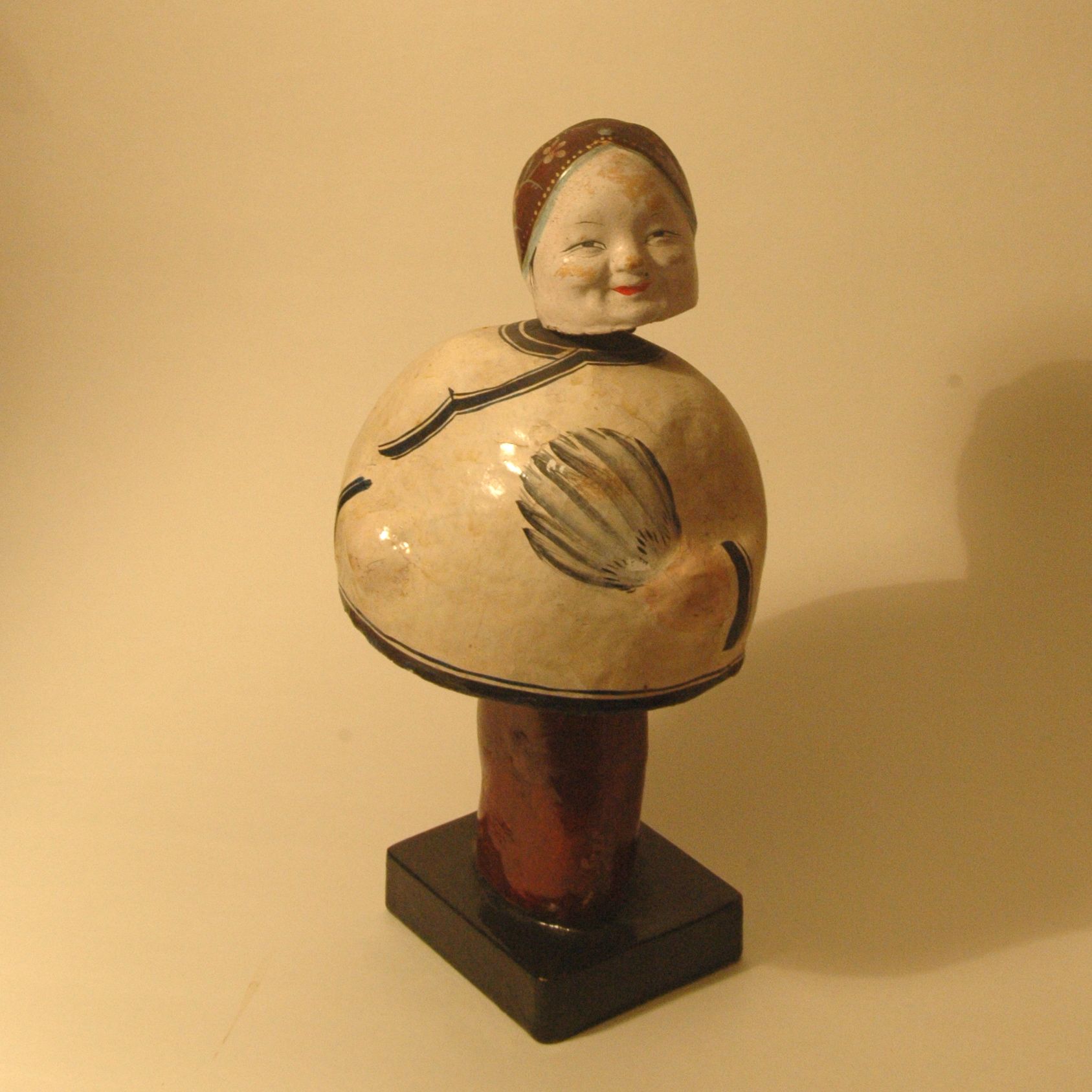
W120xD100xH200mm, China

In the old days when free love was forbidden in China, all marriage proposals has to go through a matchmaker.  Even when the couples are already in love with each other, one would still have to go through a matchmaker in order to make the marriage a proper one.  The job of the matchmaker seems to be only opened to woman, apart from the proposing, they are also responsible for presenting the information of both families.  In order to make the deal, the positive points are often emphasised and the weakness carefully put.  Acting as the communicator for both families, she is also the   co-ordinator, MC, organiser for the wedding.

The head of the figurine nods and the body wobbles resembling the matchmaker lady saying all the goodness about the marriage.  The fan, of course, is the essential tool for the matchmaker, making sure everyone would stay cool during the big day.

H230xW200mm, China

To start the black friday weekend here is a wood block print of the wine god.  Du Kang is believed to be the person who have discovered brewing wine in China and is known as the wine god.  Another person Liu Ling is said to be the wine saint, he is one of the 7 bamboo forest intellectuals who is so obsessed with drinking that he will always has a wine cup with him.  There is story of the wine god and the wine saint, it goes something like this … Once upon a time, Du Kang has opened a wine bar in the small town of Bai Shiu Kang Jia,  one day Liu Ling happened to walk pass, outside of the bar was the words “one cup will make a fierce tiger drunk for a year in the mountain, two jars will make a dragon sleep in the deep sea, if you are not drunk you can drink for three years for free”.  The mighty drinker Liu Ling laughed at the sign and decided to give it a try, what kind of wine has he not tasted before he thought.  Du Kang served the wine and drank with Liu Ling, after 3 cups Liu Ling could only felt the world spin around him.  He stumbled back home and stayed drunk for 3 years.  After 3 years, Du Kang went to collect the money for the wine and was told that Liu Ling has passed away 3 years ago!  The wife of Liu Ling was upset with Du Kang and wanted to take him to court, Du Kang explained that her husband is only drunk and the wine did not kill him.  They open up his grave to find him sobering up, the first thing he said was “what good wine it was!”.  The story is beautiful but in fact made up, as Du Kang was from the Shan dynasty (1000 BC) and Liu Ling was from Jin dynasty (300AD) … probably a story formulated after a glass or two …

H300x W190mm, China

Isnt this paper cutout perfect birthday decoration for the pet shih tzu?

W250xH250mm, China

It is believed that when the god Nu Wa created the world, it was the chicken he made on the first day (of Chinese New Year), dog on the second, pig on the third, goat on the fourth, buffalo on the fifth and horse on the sixth.  On the seventh day, human was created (hence it is the birthday for all man on the 7th day of Chinese New Year).  These 6 livestock were very important for the Chinese who are agriculture based for a long time, they are seen as a symbol of blessing (they made up half the 12 zodiac animals).

Legend has it that a long time ago on a mount in Chong Shan lived a golden rooster who like a alarm would crow at the same time every morning.  Hearing the crowing, people who lived a the mount opposite would ring the bell to wake all the villages around.  The golden rooster has a habit of snacking off the vegetable field, one day a farmer was angry at the rooster for damaging his crops and curse on it.  With the curse, the golden rooster fell from the mount and landed on by the river and turned into a large piece of rock, since then no crowing can be heard again.

This is a wood block print of the golden rooster crowing, a blessing.