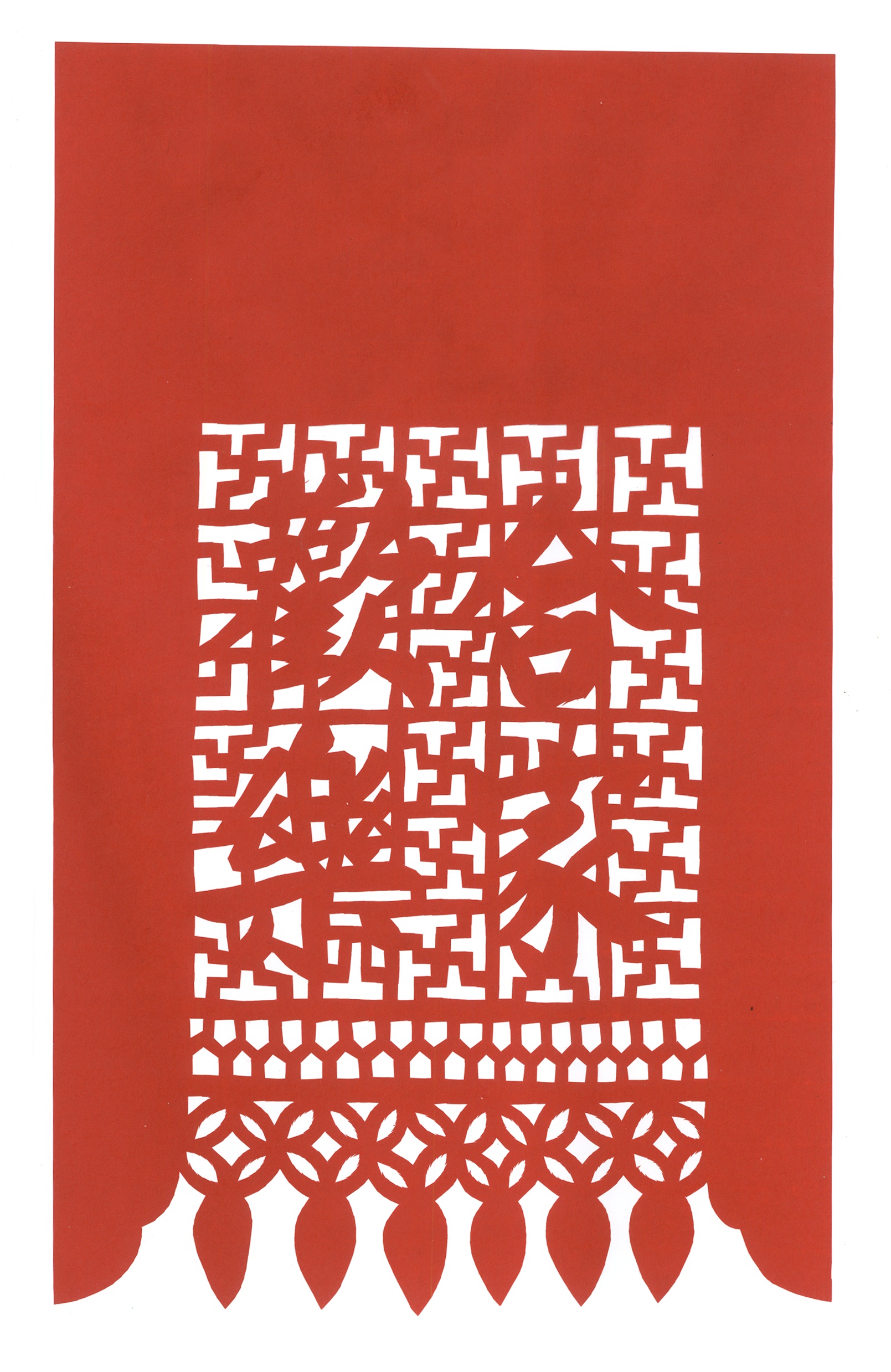
This door hanger paper cutout is called Diao Qian Er, a blessing for household for the new year. They would be place on the lintel on “Spring Arrival” day ( last Monday, the 4th of Feb) and be taken down on, 24th Feb, the night of Yuan Xiao. It is believed that if if is not taken down on Yuan Xiao, the sleepy worm would stay with the household for the year. In rural China, the farmers who have no Sunday or Public Holiday, Chinese New Year is the only time they would allow themselves to take a break from work and rest. Taking off the Dio Qian Er would signify the end of the New Year celebration.
On this paper cutout; there is the word “合家歡樂”, happiness for the whole family, on a backdrop of 卍 Man Ji Wan which is a symbol for essence of goodness. Below are symbols of coins, symbolizing wealth.
Today, lunar 24th December, is the day for thanking the Kitchen God.
On this day, the Kitchen God is about to depart to do his yearly report to the Jade Emperor; a summary of the good and bad deeds of the family his has been with. This is the day the family should thank him for his presence and to sweeten him up a bit so he will speak well of them.
The offering should include:
A Bowl of Rice + A Bowl of Water
– to show the relationship between the Kitchen God and the family is clean and innocent, if the Kitchen God is lenient, the 2 items would turn black when he return to heaven.
Sugar Canes with Nodes and End Leaves
– with the nodes the Kitchen God can use it as a ladder to climb up to heaven, the end leaves symbolizes a beginning and an ending.
Fried Rice Biscuits, Satsumas, Tangerines, Red Sugar and A Red Packet
– food to sweeten his mouth so good words would be used for his report.
A Paper Horse, Black Robe, Boots
– provision of transport and costume for his meeting with the Jade Emperor.
A Kitchen God Cheat Sheet
– a yellow piece of paper with words chosen by the family.
These offerings should be place in the rice storage container.
With so much bribe, I wonder if the rice and water should be there at all …
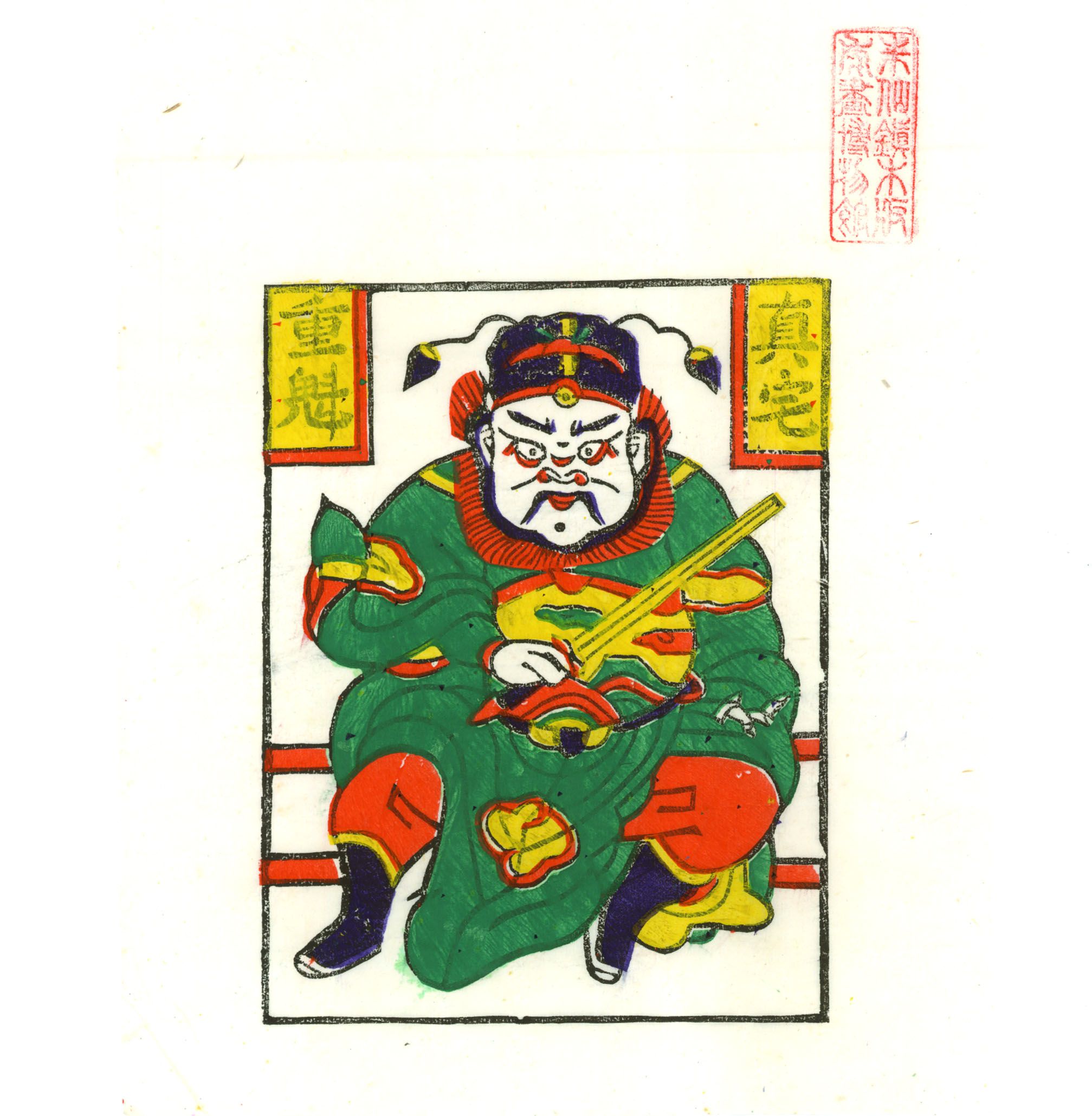
This is a new year print of Zhong Kui, the saint who can defeat all ghosts and evils, keeping the household safe. Zhong Kui has a fierceful stern face covered with a thick beard, despite having such a strange appearance he was a bold character who is a well learnt scholar. Legend has it that in Tang dynasty 730AD, the emperor was gravely ill, one night he dreamt that a ghost came to steal his jade pipe and his favorite concubine’s fragrance sachet. The emperor was upset and was about to send in his warriors to chase off the ghost and saw a larger ghost appear. The larger ghost has messy hair, horns on his head and worn a green robe, he reached out and caught the thief, dug out his eyes and swallowed them. The emperor was horrified by the act and asked who he was, the larger ghost paid his respect and said he is Zhong Kui and that he tried hard in the scholar exam but failed. Ashamed for his failure, he met his death by the steps after reading the results at the courts, feeling sorry for him the earlier Tang emperor award him a green robe for his funeral. Moved by the emperor he oath to remove all the ghost and evils for the Tang dynasty. When the emperor woke up from his dream, his sickness was gone, he ordered the making of Zhong Kui’s print to spread the news. Later on it became a new year tradition for the Tang emperor to award his officials prints of Zhong Kui.
In certain part of China, Zhong Kui is worshiped at every occasion from Chinese new year to opening of a temple to a shop, the start of a work for the year to the start of construction, relocation to birthday and weddings. The ceremony will include the offering to the print of Zhong Kui and for a grander gesture the performance of masked dance or a puppet show of the Zhong Kui theme.
Here is a masked dance performance for a temple ceremony in Taiwan.
To celebrate Halloween we have a new year print of the god of Feng Du, Feng Du is a physical province in China where it is believed to be occupied by ghosts and spirits, a city where the dead goes to live. (unfortunately since the Three Gorges Dam project, the ghost town is now submerged in water with only a small island remaining, so there is little chance of visiting it before death. well, it will be rather cramp as well … o dear) For Taoist, the god of Feng Du is the controller of all spirits and is in charge of the Hell god, Yan Luo Wanɡ (Yamaraja), he also has 72 helpers who monitor on people during their life time. At death everyone would be led by officials with the head of a cow and a horse to Diyu where one’s deed will be judged, life long sins will be punished. At the end of the punishment (the length of time will depend on the sins) one’s spirit will be renewed and reincarnated into the next life.
Diyu is divided into 10 courts each headed by a Yama king (their portraits are shown on the 2 sides of the print) who reports back to Yan Luo Wang.
Court 1: Jiang, King Qinguang – in charge of life and death
Court 2: Li, King Chujiang – in charge of the Frozen Hell
Court 3: Yu, King Songdi – in charge of Black Rope Hell under the sea
Court 4: Lü, King Wuguan – in charge of the Blood Pond Hell
Court 5: Bao, King Yanluo – in charge of the Screaming Hell under the sea
Court 6: Bi, King Biancheng – in charge of those who died before their time
Court 7: Dong, King Taishan – in charge of the Minced Meat Hell
Court 8: Huang, King Dushi – in charge of the Stewing Hell
Court 9: Lu, King Pingdeng – in charge of Avici, the darkest hell of all
Court 10: Xue, King Zhuanlun – in charge of reincarnation
Here is a folding fan with the fan leave decorated with a poem and painting by my father. The poem from the poet Bai Ju Yi, “The Jackdaw’s Nightly Cry”,
The Jackdaw cries for the lost of its mother.
That year it stayed at their forest home; by day and by night.
Every midnight it cried, tears would run down those who heard.
As if it was saying it has not taken care of its mother.
Hundred of birds are without mother but only you are grieving so.
Your mother’s kindness deepens your sorrow.
There was general Wu Qi too busy chasing fortune to attend his mother’s funeral.
These kind of humans are worse than birds.
The Jackdaw is the dutiful son of birds.
Here is a clip of a jackdaw to make up for my bad translation of poem.
The character on this wood block print is not a Chinese version of Avatar but the hero Guang Hui Wang who was attributed the title of the country’s protector. The name Guang Hui Wai is itself a title given to him by general Chen when his effigy was worshiped during Chen’s battle to pacified Ziang Ziu some 300 odd years later. Guang Hui Wang became an idol god in Ziang Ziu and the legacy spread to Taiwan and South East Asia through the immigration of the Ziang Ziu people. Now back to Guang Hui Wang, his real name is Xie An, he lived in East Jin dynasty (320-385 AD). Xie An was a great scholar as well as a politician and a military leader. Apart from winning numerous battles, reclaiming lost territories and resolving disputes between nobles within his country; he is much admired for speaking and acting with morality and justices, not taking sides in the court and lastly being able to step away from power after battles were won. Xie An was borned in a established family, he was well known for his intellect, charm and good looks (this being reconfirmed by his poem with the famous Wang Xi Zhi and his portraits) … who someone please explain why he has turned into Avatar in all the new year prints?
Here is a clip from the procession in Southern Taiwan for Guang Hui Wang and the Xie family.
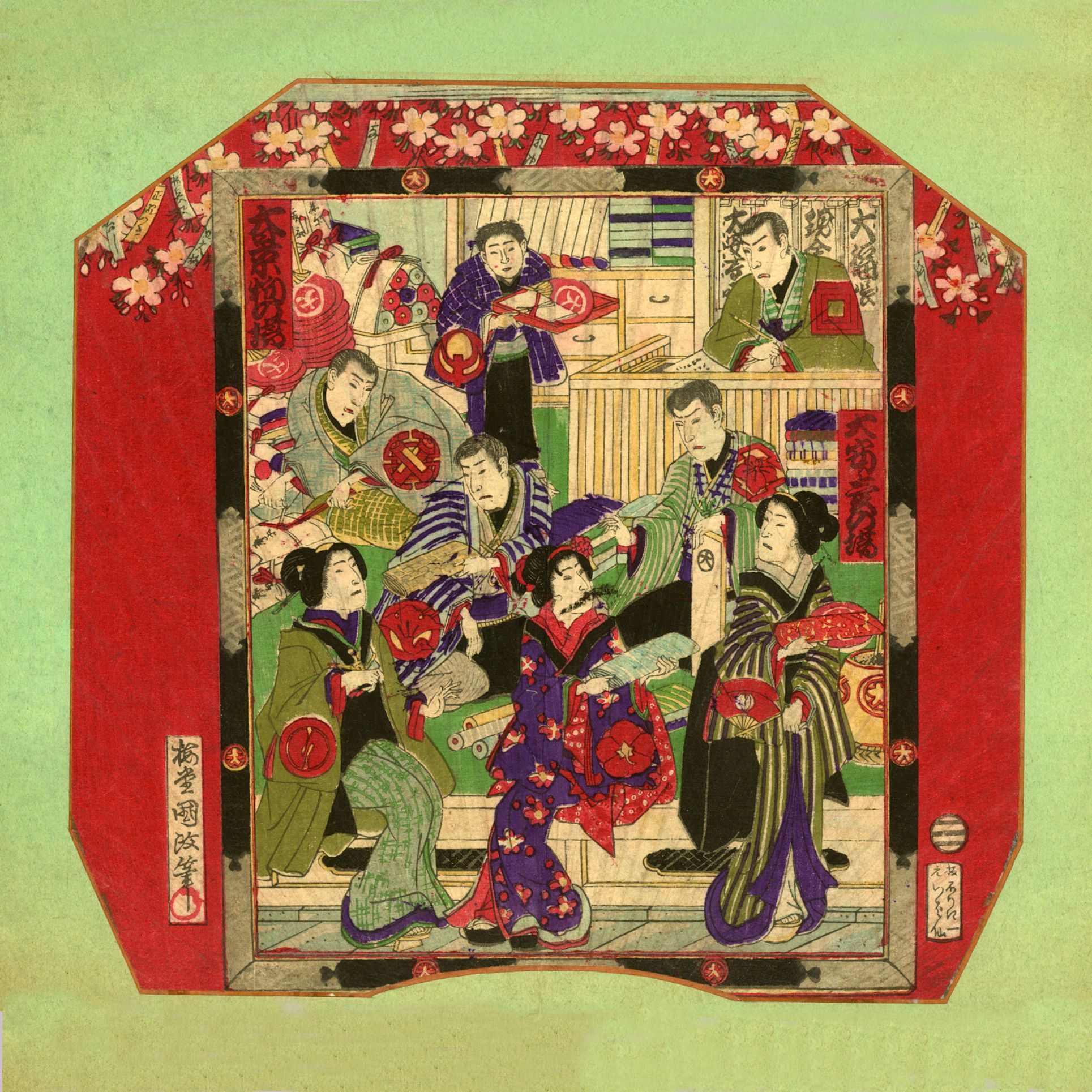
This ukiyo-e print is a work by Baido Kunimasa (1848-1920); born Takenouchi Hidehisa during his career he used different names (go) for his works, Baido Hosai, Baido Kunimasa, Kochoro, Kunimasa IV, Kunisada III, Toyokuni V and Toyokuni V.
This print depicts the on going in a kimono shop. Wonder if it was something like a xmas shopping day, everyone looks really stressed out in the picture.
For those of you who has followed the recent historical comedy soap on TVB, here is a new year print from the yang liu qing school depicting the same story (minus the satire). This story is set in the San Gou period, it was a time when China was divided into 3 separate kingdoms , a time after the corrupted East Han dynasty, warring period that lasted for almost 100 years.
Briefly the 3 kingdoms are;
WEI – led by East Han chancellor Cao Cao, adviser Sima Yi
WU – led by Sun Quan, adviser Zhou Yu
SHU – led by Liu Bei, general Guan Yu, Zhang Fei and Zhao Yun, adviser Zhu Ge Liang
The Return to Jing Zhou
Sun Quan and Zhou Yu (WU) set up a plan to get Liu Bei (SHU) to hand over his strong hold Jing Zhou. Sun Quan has a beautiful sister, he proposed to Liu Bei for a marriage to his sister, a union of the 2 kingdoms. Liu Bei in return would have to go to WU for the wedding. This is a proposal Liu Bei cannot lightly turn down for the sake of his kingdom. Sun Quan however has no real intention of marrying his sister to his enemy, he would wanted to capture Liu Bei and and force him to hand over his kingdom. Luckily before Liu Bei’s departure, his wizard adviser Zhu Ge Liang see through the trick and handed 3 notes to Zhao Yun and asked him to escort Liu Bei to Wu. When Liu Bei crossed to Wu he opened the first note, it asked Liu Bei to visit the father in law of Sun Quan. Impressed by Liu Bei and thinking that a union of the 2 kingdoms is a good idea from Sun Quan, the in law asked for Sun Quan’s mother for her approval for the marriage. The empress dowager agreed and the marriage went ahead. Sun Quan found out he has lost his sister, set out to detained Liu Bei in Wu. Liu Bei opened the second note, it asked for a faked report that Jing Zhou was being attacked by now their common enemy Cao Cao (WEI). Having a great excuse, Liu Bei together with his newly married wife and his men left Wu for Jing Zhou. Sun Quan found out and had his general went after them. Liu Bei then opened his third note, in the note it asked him to leave the defense to his wife. Now in love with Liu Bei, the princess gave the general a hard time and refused to return to Wu. When Liu Bei returned to Jing Zhou, Sun Quan’s army was confronted by Liu Bei’s general Zhang Fei and badly defeated.
Here goes the idiom, “lost the lady and the army” (making double lost without any gain)
In this yang liu qing school print, we have from the left Liu Bei, Zhao Yun, maid 1, Princess Quan, maid 2, Guan Yu and lastly Zhang Fei
The story was also a very known script for the Beijing opera, here is a part of the opera. The opera singers were the master of masters, the leading dan role was performed by Mr. Mei Lan Fang (in the past all roles are played by male artists).
The fisherman is one of the fundamental role in old agricultural based China. Fisherman, wood cutter, farmer and intellectual are the four main roles; they have been the theme for many artworks, in fact, the 4 are a collective noun “yu qiao geng dou”. Yu refers to the fisherman, yan zi ling, Yan was a classmate of the first emperor of the East Han dynasty. Despite numerous invitation to become an government official, he declined and remained a fisherman until old age. Qiao, was the wood cutter Zhu Mai Chen, a high official of the Han dynasty. Zhu love reading, from a poor family he was in such poverty that even his wife left him but for his determination he was recognized. Geng, farming, is Emperor Shun (the legendary second emperor, 1700BC) teaching his people how to farm. Dou, the intellectual, is Su Qin, the hardworking scholar who would use an awl to pitch himself if he has fallen asleep at his study. The phase “yu qiao geng dou” not only recognized the 4 roles being fundamental, it also projected a desire of the rural commoners to become the part of the officials.






 Mountain Folkcraft