This is a black and white line print from the Yang Jia Bu school of new year print. The Yang Jia Bu school is set in a small village in the Shan Dong province, it is most flourished in the Qing dynasty. The school is famous for the subject matter of the prints, new subjects are added yearly with reflection to the society and as time goes by became a source of documented life of the commons.
The two phrases on the print, “花能解語 晚玉生香” has been quoted in a few of the notable Chinese literature, The Romance of The West Chamber, Water Margin, The Golden Lotus and The Dream of the Red Chamber. The phrase were praises to a woman; a woman can be as beautiful as a flower but the flower cannot understand words, a woman can be as beautiful as a piece of jade but jade is without fragrance.
This painting consists of illustration of the epic Ming dynasty novel “Journey To The West” which is described the journey monk Xuan Zang and his three disciples Sun Wu Kong (monkey), Zu Ba Jie (pig) and Sha Jing (saint banished to the mortal world) took to the West to find the holy scripts.
I remembered as a child, the novel has been an entire summer’s entertainment.
Here is one of the many adventure described in the book.
The title of this wood block print is called “Buddha of the West Sky”, referring to Siddhattha Gotama of India. The idea of the West Sky is complex, in the early days the sun is believed to be a godly object; raising from the east, watching us on the day and going away and setting on the west. It is believed that while we sleeping the sun will be watching over in the west sky. With Buddhism introduced to China from India, a country to the south west, India, the West Sky, is the place where the truth, the important scripts are. Monks, notably Xuanzang (depicted in the novel the Monkey King), went to India to find enlightenment. The West Sky symbolizes a cleansed soul and mind, a nirvana world.
After a restless night thinking of my home town, I woke up with the hurrying bells of the inn.
The rooster crow at the frailing moon, on the frost cover bridge left the footprints of the travelers.
The down hill road is covered by wilting plants, orange flower shines out on the inn wall.
Seeing the sunrise, I thought of my dreams of ansers returning to the pond, maybe too I can see my family soon.
The people on the print, however, described another story;
人家骑马我骑驴,回头再看推车汉,比上不足 比下有余!
I ride a donkey and look up to those who ride a horse, but looking at the cart pusher I feel content.
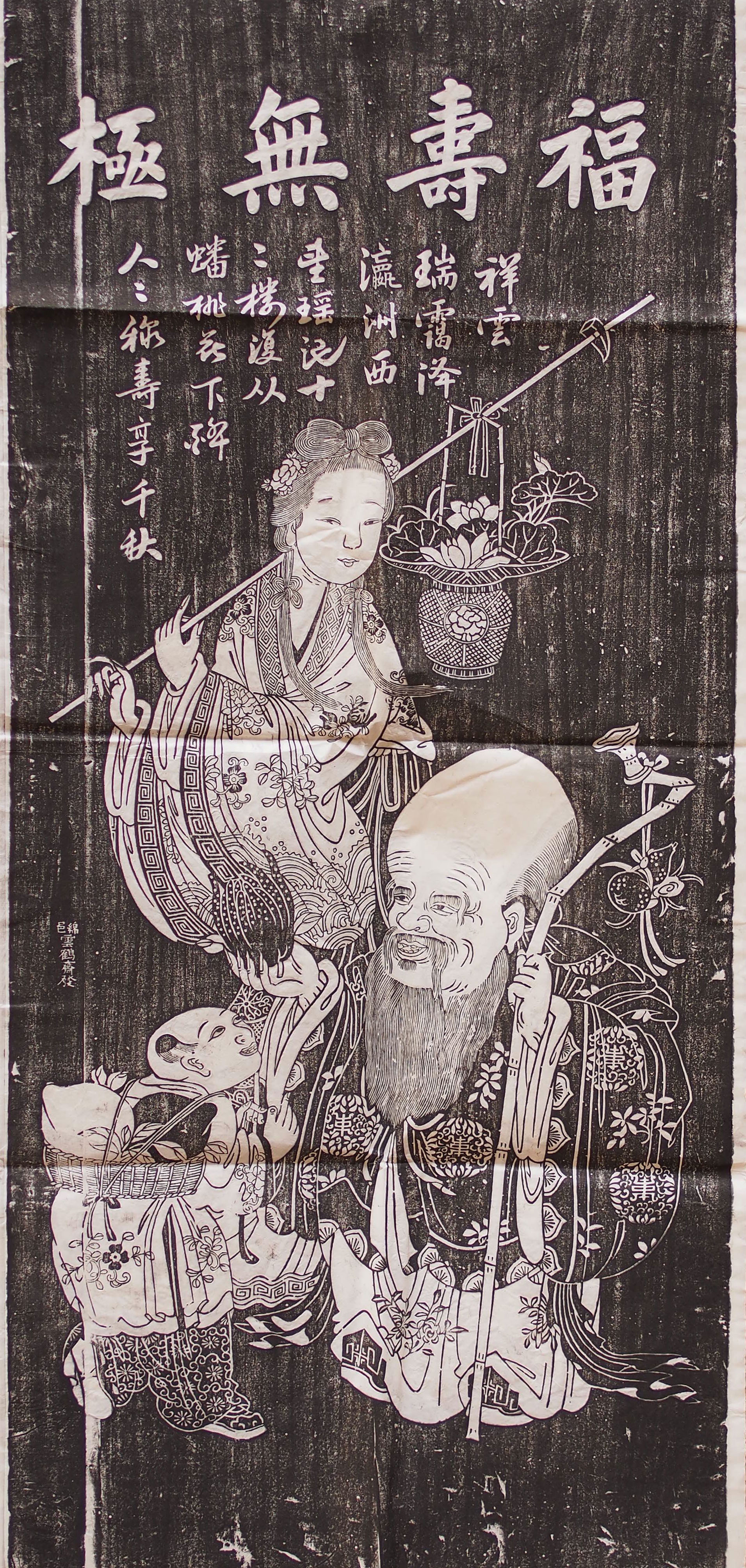
This birthday print is filled with blessing symbols –
God of Longevity who is holding a cane on one hand and the Buddha’s hand fruit on the other hand.
The lady of behind is Ma Gu, the female God of Longevity with a basket full of magical plants. Unlike the God of Longevity who has an appearance of an old man with a protruding forehead, Ma Gu is portrayed as a beautiful girl in her late teens. In the legend, every year on the 3rd of lunar March, on the birthday of the Queen Mother of the West, Ma Gu will give her best wishes.
Lastly, the child saint carrying a basket full of longevity peaches, also a well known theme for birthday blessings.
Unlike the birthday scroll being a respectable birthday present for the elderly lady that would be held around birthday time, this is a Mian Zhu new year print that is pasted on the wall on Chinese New Year and to be replaced yearly.
This embroidery captured a scene from the legend Madame White Snake, the novel Jing Shi Tong Yan from the late Ming dynasty. The story was set in the West Lake of Hang Zhou in the period of the Sung dynasty. The serpent spirit of the white snake and her friend green fish subordinate transformed themselves into 2 pretty girls; Bai (white) Su Zhen and Qing Qing (green). Bai fell in love with the Xu Xian and used her magical power got married to him. As time goes by, many strange incident happened because of Bai and Qing. Xu Xian was approached by monk Fa Hai who told him the truth about his wife being a serpent spirit and gave him a monk’s bowl. As Xu Xian place the bowl over his wife’s head, Bai and Qing returned to their original selves. Monk Fa Hai took the bowl with the two spirits and build a Lei Feng pagoda on top of them.
A more romantic story has been adapted for opera, movies where the true love of the white snake is celebrated and the monk became a busybody.
To see the same scene as the embroidery, go 10 minutes into the movie.
As for the Lei Feng pagoda, it was believed that the brick used for building the pagoda has the power of healing, people began to steal the brick, grind it into powder and use it for medicine. 950 year later in 1924, the pagoda fell under its own weight … wonder if the white snake and the green fish manage to escape. A new pagoda was rebuild in 2002.
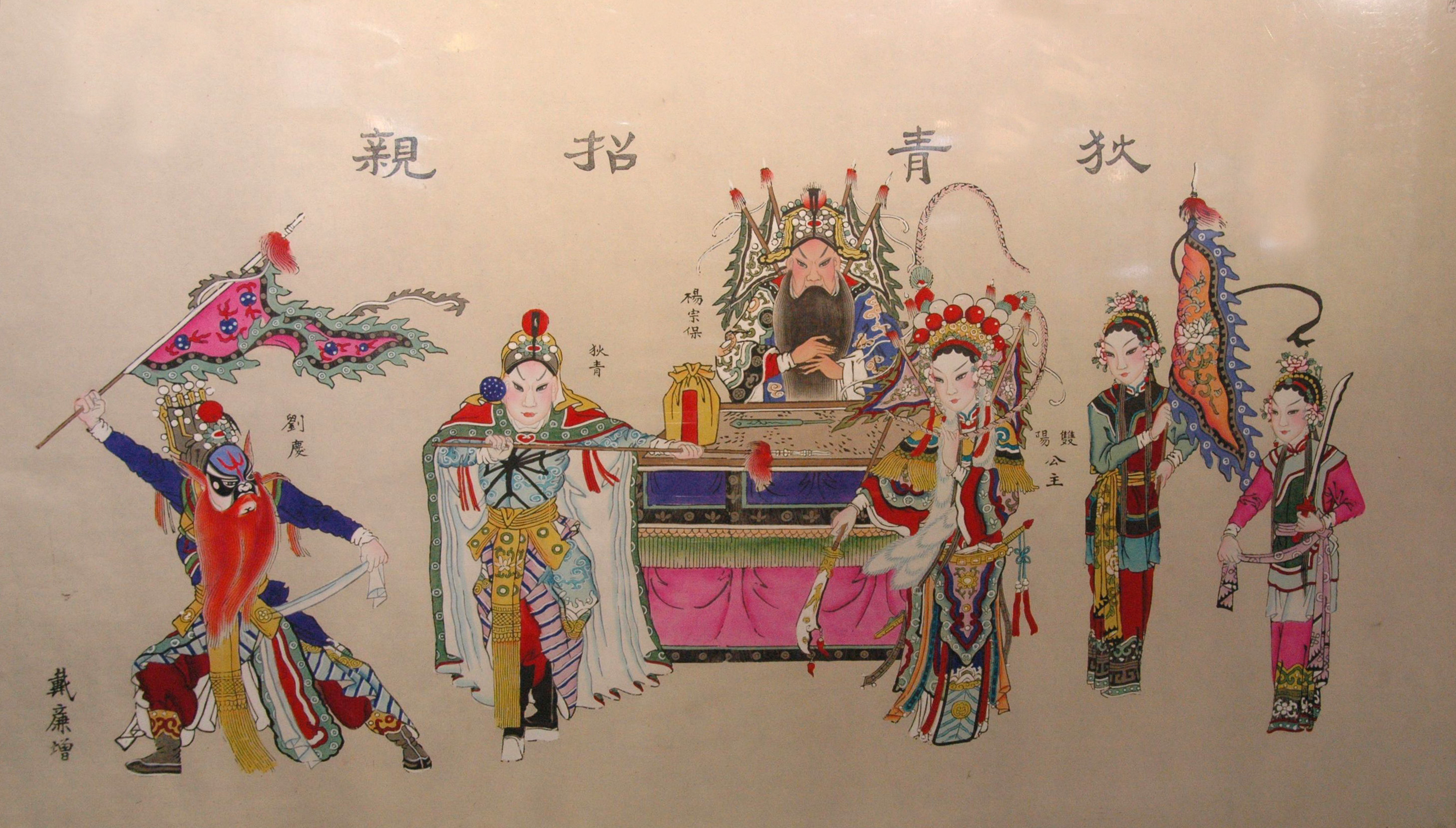
This is a Yang Liu Qing wood block print portraying the story of the fearless Song dynasty warrior Di Qing (2nd left). The story has it that Di Qing and Liu Qing (1st left) of North Song was send by the Emperor to pacify the uprising to the west of the country. Unfortunately the army got lost and ended up in a wrong country, Dan Dan. There, Di Qing met the Dan Dan princess (3rd right) who fell in love with his looks. She lured him into the palace and asked for him to surrender and to marry her. Unwillingly, Di Qing wedded the princess but only thinking about escaping to defend his home land. The princess was upset that her newly wedded husband has departed without a word and set off after him, Di Qing explained about his duty and promised to return after his task. Like most plots, the hero forgot about the princess when he returned home with victory and never returned to Dan Dan. This time the princess was furious and led an army to attack Song, general Yang Zong Bao (center character) was no match with the princess and instructed Di Qing to deal with the princess. When the couple met, of course they forgot all about fighting and lived happily ever after …
Today, lunar 24th December, is the day for thanking the Kitchen God.
On this day, the Kitchen God is about to depart to do his yearly report to the Jade Emperor; a summary of the good and bad deeds of the family his has been with. This is the day the family should thank him for his presence and to sweeten him up a bit so he will speak well of them.
The offering should include:
A Bowl of Rice + A Bowl of Water
– to show the relationship between the Kitchen God and the family is clean and innocent, if the Kitchen God is lenient, the 2 items would turn black when he return to heaven.
Sugar Canes with Nodes and End Leaves
– with the nodes the Kitchen God can use it as a ladder to climb up to heaven, the end leaves symbolizes a beginning and an ending.
Fried Rice Biscuits, Satsumas, Tangerines, Red Sugar and A Red Packet
– food to sweeten his mouth so good words would be used for his report.
A Paper Horse, Black Robe, Boots
– provision of transport and costume for his meeting with the Jade Emperor.
A Kitchen God Cheat Sheet
– a yellow piece of paper with words chosen by the family.
These offerings should be place in the rice storage container.
With so much bribe, I wonder if the rice and water should be there at all …
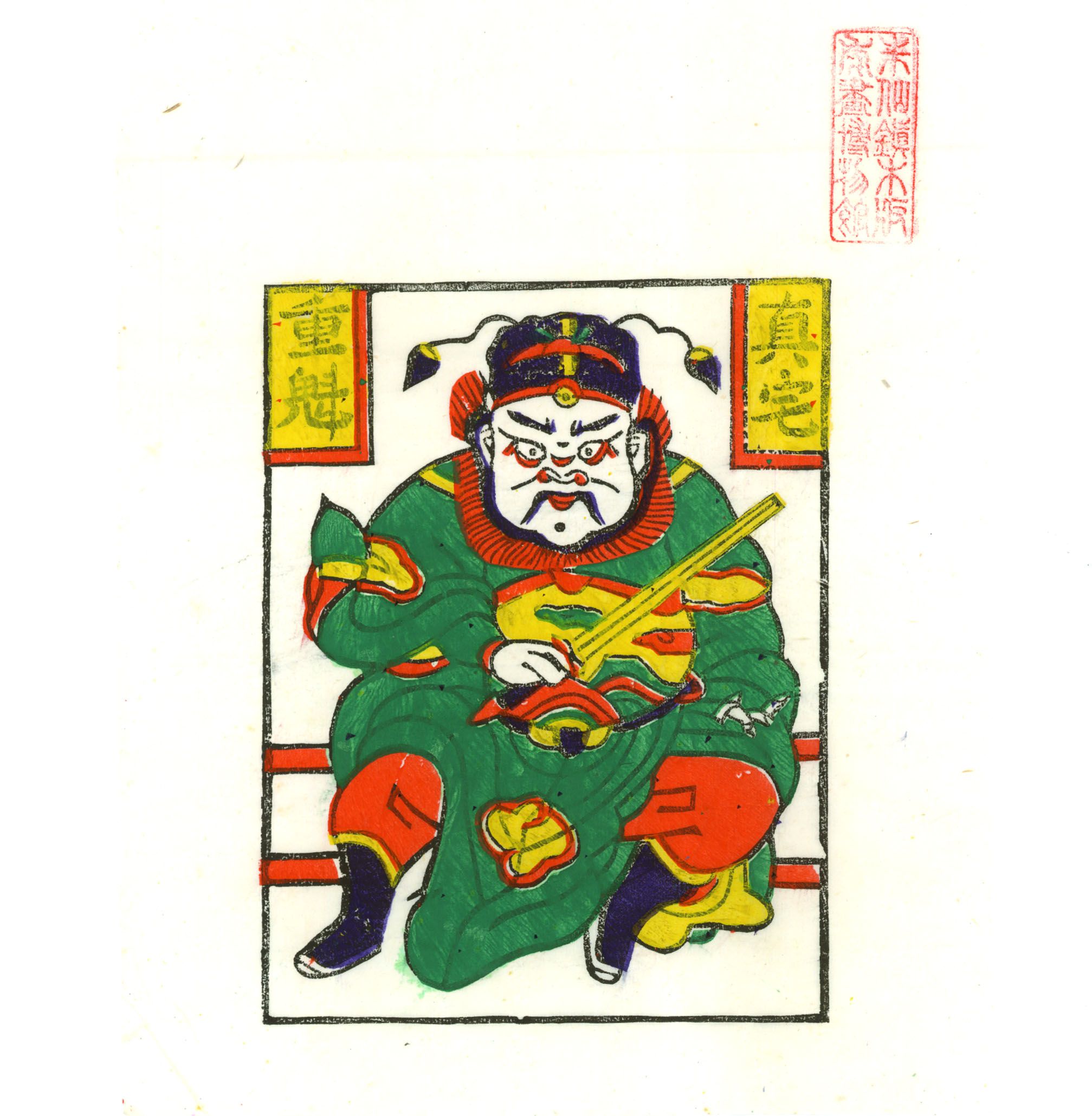
This is a new year print of Zhong Kui, the saint who can defeat all ghosts and evils, keeping the household safe. Zhong Kui has a fierceful stern face covered with a thick beard, despite having such a strange appearance he was a bold character who is a well learnt scholar. Legend has it that in Tang dynasty 730AD, the emperor was gravely ill, one night he dreamt that a ghost came to steal his jade pipe and his favorite concubine’s fragrance sachet. The emperor was upset and was about to send in his warriors to chase off the ghost and saw a larger ghost appear. The larger ghost has messy hair, horns on his head and worn a green robe, he reached out and caught the thief, dug out his eyes and swallowed them. The emperor was horrified by the act and asked who he was, the larger ghost paid his respect and said he is Zhong Kui and that he tried hard in the scholar exam but failed. Ashamed for his failure, he met his death by the steps after reading the results at the courts, feeling sorry for him the earlier Tang emperor award him a green robe for his funeral. Moved by the emperor he oath to remove all the ghost and evils for the Tang dynasty. When the emperor woke up from his dream, his sickness was gone, he ordered the making of Zhong Kui’s print to spread the news. Later on it became a new year tradition for the Tang emperor to award his officials prints of Zhong Kui.
In certain part of China, Zhong Kui is worshiped at every occasion from Chinese new year to opening of a temple to a shop, the start of a work for the year to the start of construction, relocation to birthday and weddings. The ceremony will include the offering to the print of Zhong Kui and for a grander gesture the performance of masked dance or a puppet show of the Zhong Kui theme.
Here is a masked dance performance for a temple ceremony in Taiwan.
Verre eglomise is a technique which dated back to Roman time as early as 400AD and revived in Europe in varies different centuries. The French term was attributed by the french decorator Jean-Baptise Glomy who made it popular again in the 18th Century. Verre eglomise was introduced to China from the west in the Qing dynasty, it quickly took on as a home decorative object for the wealthy and riches. By the end of the Qing dynasty it has been adapted as a popular craft form in China, so much that they were also for exports back to Europe.
 L380xW260mm, China






 Mountain Folkcraft