Archives for category: fabric

This simplest kind of tied dye is by pinching up certain spots of a plain fabric, wrapped with thread or string and then putting the fabric to dye.  The wrapped areas resist the dye from getting in and thus form a white pattern in an indigo background.

Other than the above method, tied dye can achieve different effect by folding, pleating, stitching and twisting.

Tied Dye Fabric are shown at the Mountain Folkcraft shop in the Something New Something Old exhibition with Soil.

The term brocade to the Chinese denotes mostly brocades woven by the minorities in Guang Xi province, the Miao tribe, Dong tribe (Gaeml) and Yao tribe in particular.  The characteristic of these brocades are their vibrant colour combination and interesting geometric designs.  To achieve these means that they have to have several shuttles for different colour yarns and a special designed jacquard hand loom.

During the Ming dynasty, these minority brocades were articles of royal appointment tribute.  In the past, young girls by the age of 10 would have to start weaving a brocade of her own design and this would become her dowry for her wedding later on.  Motifs of brocade mostly are cloud, water, fish, bird and floral.  Brocades are used as quilt cover, wall hanging, cushion, head dress and belt etc.

Brocade Samples are shown at the Mountain Folkcraft shop in the Something New Something Old exhibition with Soil.
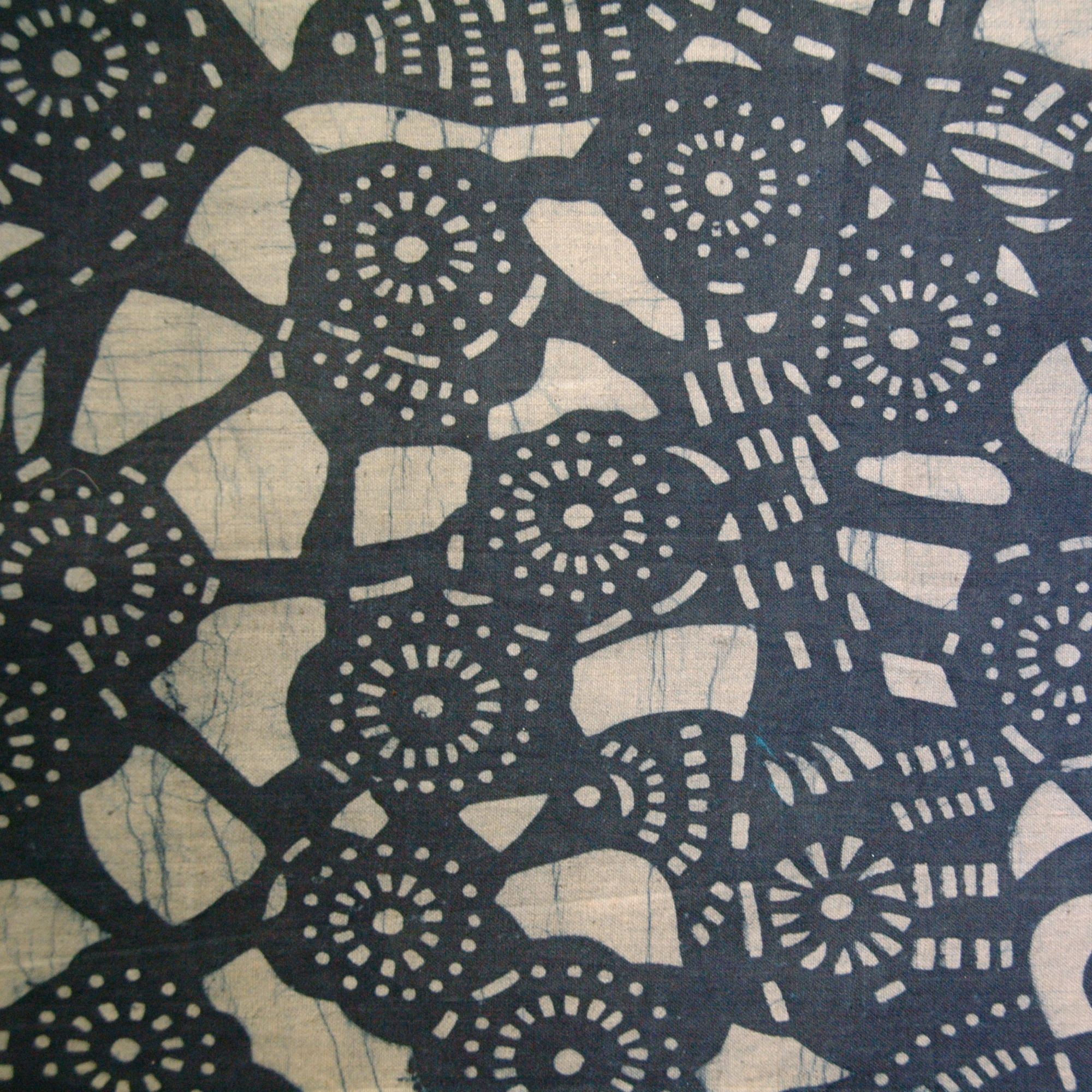
Wax resist is generally known as Batik.  Apart from Indonesia, south west region of China is believed to be one of the early development area of wax resist dye according to recent excavation reports.

Molten wax held in a special wax pen is used to draw design directly on plain fabric as a resist.  After the drawing work, the fabric is then put into a drying vat.  As wax is a brittle substance, dye gets through minor cracks which gives a characteristic batik result.

Si Chuan and Gui Zhou provences in China are well known places for wax resist dye fabric.

Wax Resist Dye Fabric are shown at the Mountain Folkcraft shop in the Something New Something Old exhibition with Soil.

In China, the technique of lime / bean paste resist dye has a long history of 1300 years.  It is commonly known as “indigo print” all over the country.

The basic technique involved the application of lime and bean paste as a resist material.  A paper stencil, permeated with “tung oil” for the purpose of water proofing, is placed over the plain fabric where the lime / bean paste is applied.  The fabric is then dripped into an indigo vat.  The paste resist is scraped off to reveal the white design pattern.

Also see step by step guide from Hulu10.

Lime/Bean Paste Dye Fabric are shown at the Mountain Folkcraft shop in the Something New Something Old exhibition with Soil.
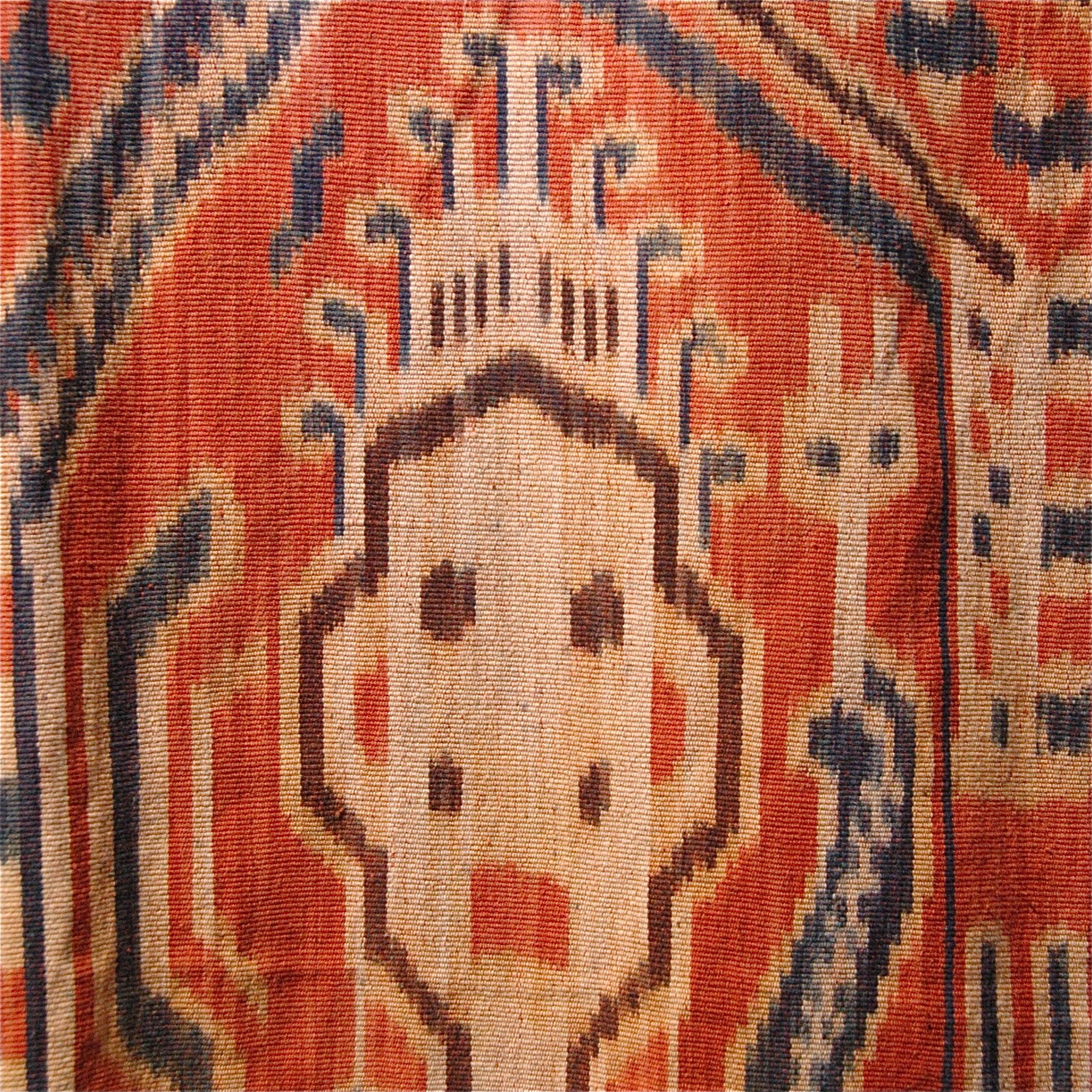
The technique of ikat dyeing starts before the actual weaving begins.  Certain yarn on the warp is wrapped up with thread or string.  When the dye applied to the warp, the wrapped up part form a resist to the dye.  Threads are then removed, leaving an area of undyed yarn.  It is then ready to be woven into cloth.  Because of the unevenness of the warp wrapping, the woven result has a characteristic ikat effect.

Ikat weaving is particularly laborious as the pattern is often pictorial, the warp has to be loaded on the weaving loom before carefully tying up the pattern.  After dying the warp has to be loaded but on the loom at the same location before weaving.

Indonesia ikat are a precious and sacred fabric use in ceremony.

Samples of ikats are shown at the Mountain Folkcraft shop in our Something New Something Old exhibition with Soil.

We are having a joint venture with Soil which will start tomorrow.
Mountain Folkcraft will be focusing on fabric items while Soil will be on other craft objects.
Do come visit both shops!

MOUNTAIN FOLKCRAFT. 12 WO ON LANE . CENTRAL . HONG KONG
SOIL . 43-45 SQUARE STREET . SHEUNG WAN . HONG KONG

DIA130xH70mm, China

Like the tiger shoes, this is a tiger headband for the baby’s hundred day celebration.  They normally comes as a form of a hat, this headband is a relatively rare item.

In the old days when natural disaster and disease cannot be explained, they are often taken as an evil spell.  Helplessly people projected their hope onto a powerful animal and the tiger being the king of all animals (as there are not native lion in China) it has been an object of worship.

W900xH1040mm, Hong Kong

This is a modern door god design by my father, this is a silk screen print on a cloth, the traditional door gods are wood block print to be posted on the doors to offer blessing and protection to the household.

One of the legend for the origin of the door god goes like this; according to the Qin geographical documentation “Shan Hai Jing”, in midst of the ocean there is a mountain, there stood a giant peach tree which spread over 3000 miles.  At the north east is the door to the dark world where the ghosts go in and out. Over this door stood 2 gods – Shen Shu and Yu Lv, their duty is to censor the good and the bad ghosts, the evil ghosts will be thrown down the mountain to feed tiger.  The character here is Yu Lv,  brother of the Shen Shu, the pair are the legendary ghost busters.

W65xL3200mm, China

Like the colourful band in the previous post, this black and white woven band is also a band of blessing.  The Miao tribe reside on the hillside where they are constantly harassed by the snakes; once upon a time, a snake attacked a girl by wrapping its body on her, a young lad came to her rescue.  The two soon fell in love, the girl woven a band for the young man as a sign of their love.  One day as they were travelling together they came across another snake who was ready to attack, the lad used the band, wiggle it to imitate the snake and led the snake back into the woods.  Since then, it was believed that the band would protect them from snake and all evils and the woven band became popular for the Miao.

W900xH2200mm, China

This silk embroidery painting is a traditional gift for birthday of a lady of high social status.  In figure in the embroidery is the saint Ma Gu and the phoenix (queen of all birds) going to give her best wishes the Queen Mother of the West (the supreme head of all female saints) for her birthday.  On the tray that she is going to present to the Queen Mother has a few of the magic peaches which are believed to take 3000 years to flower, 3000 to bare fruits and another 3000 years to ripe, a bite of it will make one immortal.  The peach is a symbol of longevity, it was also featured in God of Longevity.

Unfortunately the closest we can get to the magic peach is through pottery, carving and paintings, but if you would like to try the worldly version, it is known as the Saturn Peach (Prunus persica f. compressa), they will not make you immortal but they are super delicious.