Archives for category: embroidery

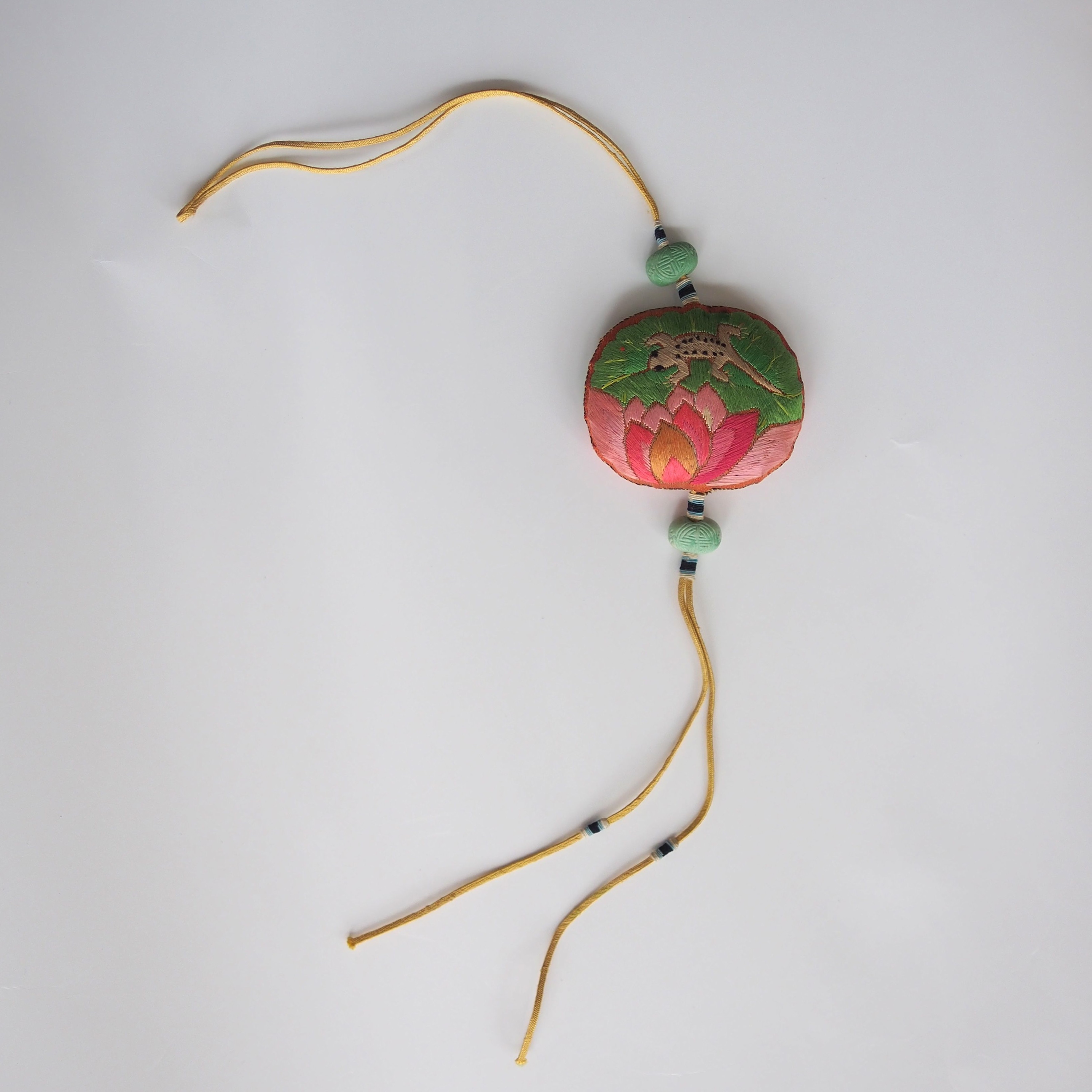
fragrant sachet

W60xL370mm, China

Tomorrow is the Duan Wu festival, the 5th day of lunar May, before Qu Yuan and the dragon boats came along it was a day for casting away the deadly famine.  In ancient times when science and hygiene was poor, it is believed that lunar May is the month of toxin and the 5th is the day of  evil and on this combination the day of death.  To avoid ailment one is to be purified by bathing and resisted on meat, alcohol and sexual activities.  A fragrant sachet would be worn by people all ages, the contents of the bag changes through time as hygiene improves and the taboo of the day of death becomes more remote, from the evil busting copper coins to the pesticide realgar powder, to the antiperspirant clam  powder to medicinal fragrant herbs.  From patchwork, the sachet was later decorated with embroidery; this particular on has on it a lotus and a lizard, lotus symbolizes togetherness with the lizard (one of the 5 poisonous creatures) offering it protection.
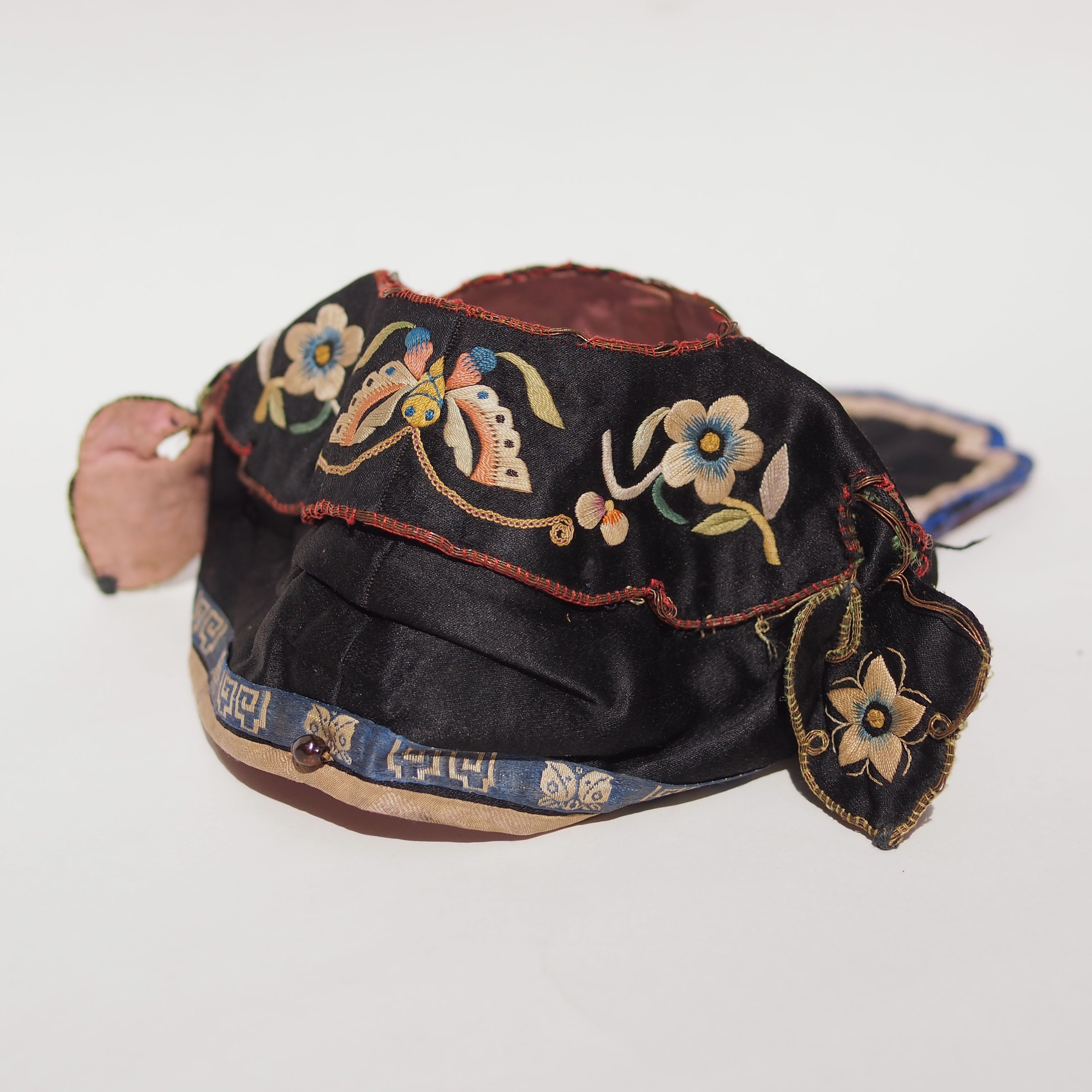
Baby HatDIA170xH100mm, China

This is a butterfly embroidery hat for a new born baby, before a child is born the grannies will prepare a hat for the new comer.  A tiger hat for the boy and a butterfly hat for the girl (there was no ultrasound then, so I suppose they will have to make one of each, just in case).  Butterfly symbolizes beauty, a wish for the family for the young baby girl.

W90xL120mm, China

In the old days,  needles are precious items that a girl would keep as part of  her possession. In the days before the $10 budget store when one will just get a new set instead of looking for the one you already have.  As needlework is part of any girls’ qualification, they would make their own pin holder, decorated with embroidery, patchwork, etc.

This is a pin holder in the shape of a dog.  

maio bag

W300xL250mm, China

When I saw this bag,  I felt the tribal craft has really adapted to the new material and function.  Carrying on the bold embroidery tradition, it  has also made use of fluorescent beads and pom-poms, compartments for wallets and travelling pass.

L250xW70mm, China

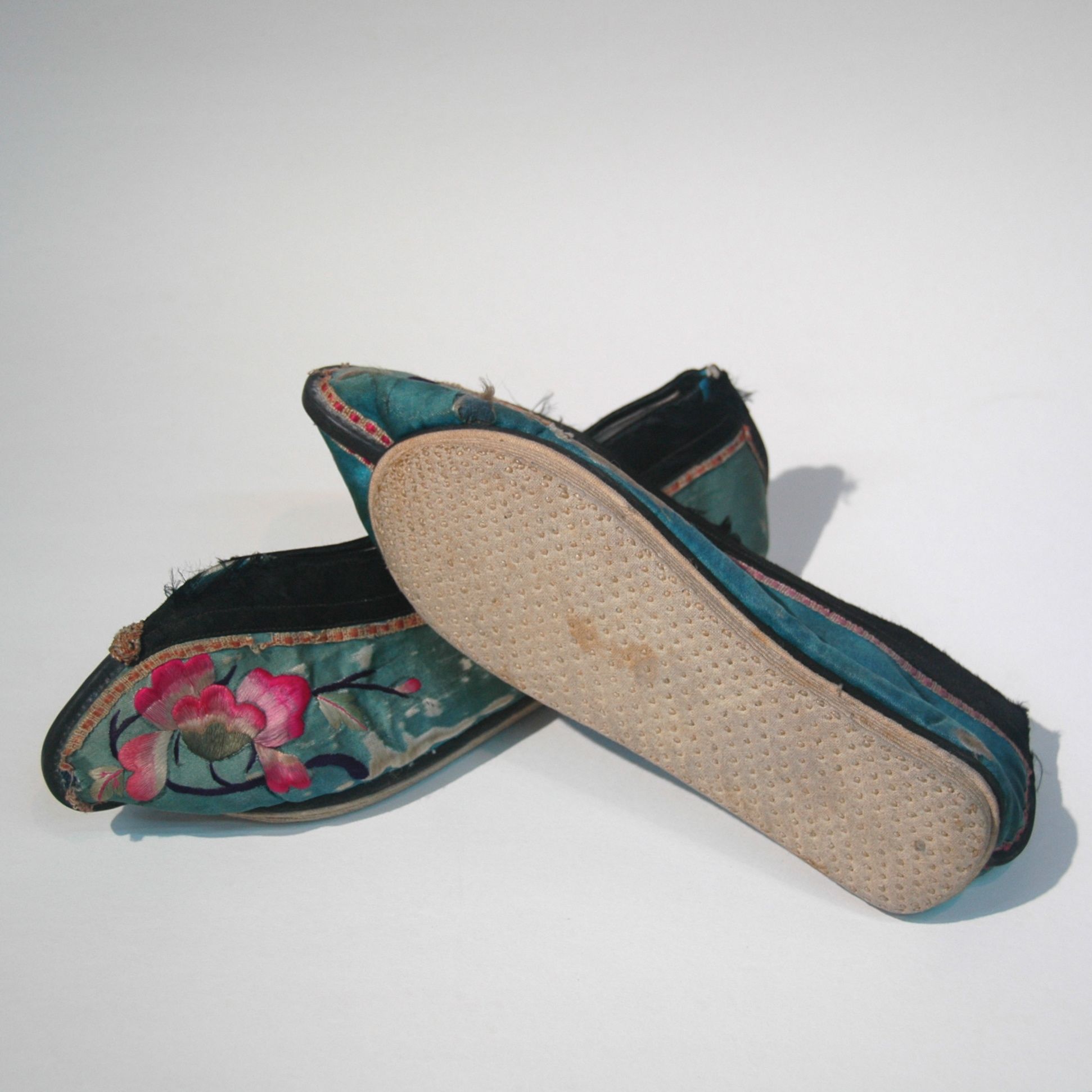
This is a pair of embroidery shoes of the Miao tribe (for more about Miao tribe shoes, see our earlier post, Embroidery Shoes).  Today I would like to concentrate on the cloth sole of the shoes which is entirely handmade.  Before rubber and leather sole became popular in China, most of the soles are made with cloth, it is a common household practice, even mother remembers making shoes for herself in her childhood.  Here is mom’s instruction:

  1. Save up old clothes and off cuts for a year, so materials are ready for making new shoes for Chinese new year
  2. Cook up some glue with water and rice flour (the Chinese version of wall paper paste)
  3. On a flat board, applied glue to the edge of the board, then stretch the a large piece of cotton cloth, apply a layer of glue over it.  On the second layer place smaller pieces of cloth, avoid any overlapping or gaps, apply a layer.  On the top place a large piece of cotton, avoid creases, applied glue over it.  Let dry for a night
  4. Use a newspaper to trace out the sole of the old pair of shoe, enlarge to suit.  Prepare an addition one for a size larger.
  5. Cut out from the dried cloth pile 6 pieces from the larger template (large filler – LF), 7 from the smaller (small filler – SF) one and 2 smaller pieces for the heel (H).  Put the pieces of the same size together, clamp them and give it a good trim so that they are the same size and shape.  Reverse the template and cut out the soles for the other shoe.
  6. Take a piece from the large filler and mount a piece of cotton, wrapped the edges over to the top.  This will become the bottom layer of the sole (BS), the piece that touches on the ground.  Take the other 6 larger fillers and stick on a cotton piping around it.
  7. Then places the fillers in the order; BS-LF-SF-LF-H-SF-LF-SF-LF-SF-LF-H-SF-LF-SF-SF-SF.  Stitch temporarily to hold them together, clamp it well and sew the edge with hemp string (you will need an awl for this).  Then make uniform and small stitiches (as seen in the photo) throughout the whole of the sole.
  8. The completed sole is then brushed with warm water and covered with a blanket overnight.
  9. The next morning, the sole is compressed with a mallet and air dried.
  10. Now the sole is complete, all you need to do is the upper shoes and of course the embroidery …

W720xH450mm, China

Something old,
something new,
something borrowed,
something blue,
and a sixpence in her shoe

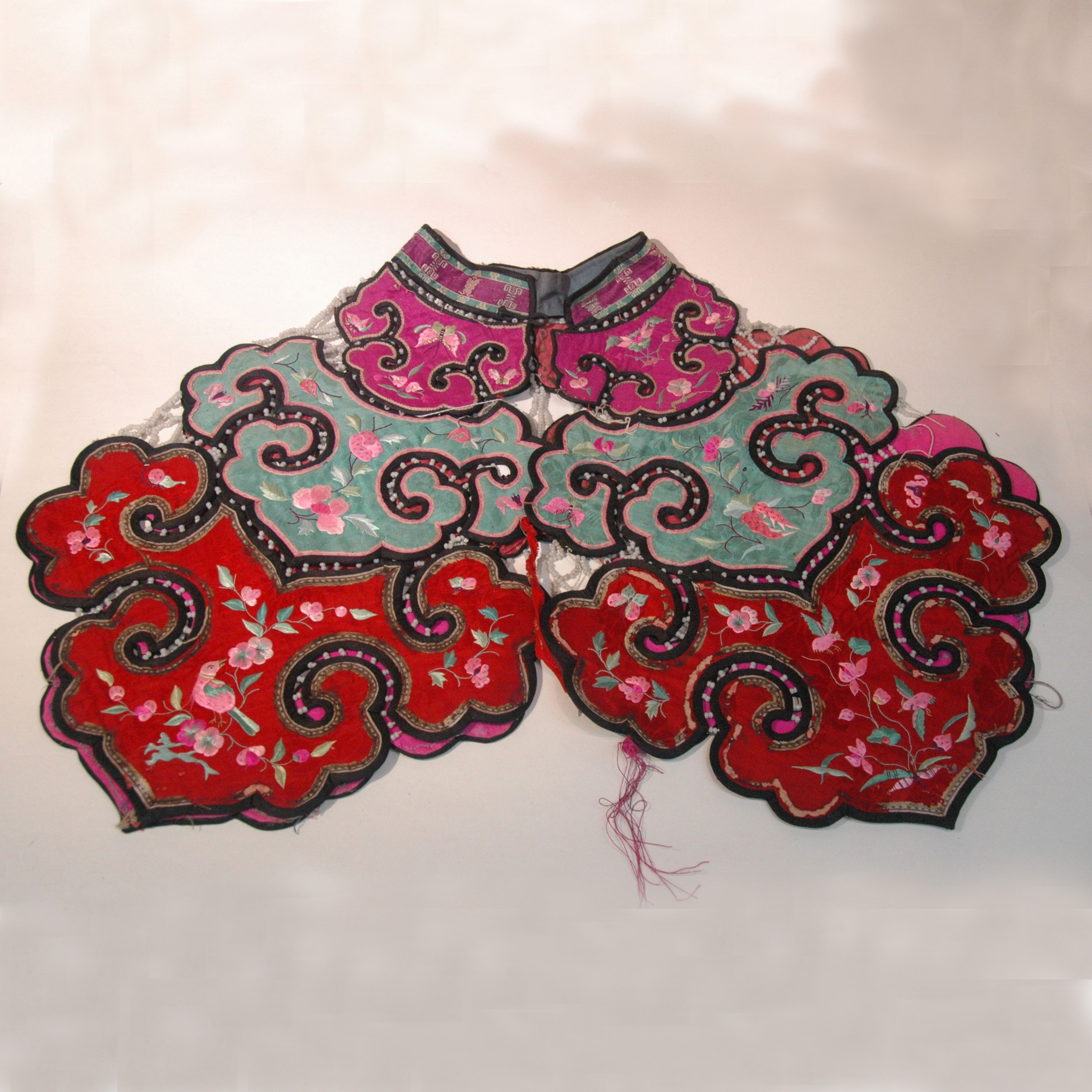
Now how can we have Something Old Something New and not an item about wedding.  This is part of a wedding gown for rural China, this would be the shawl for the bride.  For the common folks, the bride would have wear her hair in a bun and covered with a red cloth, the clothing would be in red with similar pattern as the shawl, on the bottom she would wear a pair of simple red pants.  The shawl is embroidered with patterns of blessing, quite different from the blessing of the west but a blessing nonetheless.

Patch work is a piece of fabric formed by little pieces of fabric.  The idea of patchwork started early in ancient Egypt and northern China, possibly because of the shortage of material and the cold climate.  It was later developed as an art in Renaissance Europe and then became a popular during the period of new settlement in America.  The patchwork quilt at one time was the symbol of reminiscence of their mother countries.

In China, patchwork is called the “hundred swatch quilt”.  Upon a child first birthday, village friends and neighbors would each contribute a swatch of fabric, old or new, to the child as a present.  The mother would then patch these pieces of fabric to make a vest or a small quilt for her child, depending on the quantity she acquired.  The vest or quilt is supposed to embrace hundred of blessins and render the child a happy and healthy life.

Step by step guide for making a patchwork quilt from the International Quilt Study Center and Museum.

DIA130xH70mm, China

Like the tiger shoes, this is a tiger headband for the baby’s hundred day celebration.  They normally comes as a form of a hat, this headband is a relatively rare item.

In the old days when natural disaster and disease cannot be explained, they are often taken as an evil spell.  Helplessly people projected their hope onto a powerful animal and the tiger being the king of all animals (as there are not native lion in China) it has been an object of worship.

W900xH2200mm, China

This silk embroidery painting is a traditional gift for birthday of a lady of high social status.  In figure in the embroidery is the saint Ma Gu and the phoenix (queen of all birds) going to give her best wishes the Queen Mother of the West (the supreme head of all female saints) for her birthday.  On the tray that she is going to present to the Queen Mother has a few of the magic peaches which are believed to take 3000 years to flower, 3000 to bare fruits and another 3000 years to ripe, a bite of it will make one immortal.  The peach is a symbol of longevity, it was also featured in God of Longevity.

Unfortunately the closest we can get to the magic peach is through pottery, carving and paintings, but if you would like to try the worldly version, it is known as the Saturn Peach (Prunus persica f. compressa), they will not make you immortal but they are super delicious.

W970xL970mm, China

This is one of our baby carrier turn cushion cover series
(x-stitch, patchwork, x-stitch).

Many years ago on one of the shopping trips to Gui Zhou, mother was on a bus when she saw this baby carrier.  The baby carrier was not in a shop but carry a baby on the back of a woman.  Falling in love with the unusual design mother jumped out of the bus and ran to find the woman with the baby.  On closer look, the pattern looked even better, the colour are bright and the design abstract and modern.  Mother begged the lady to sell the carrier to her so she can use it as a sample.  The lady was very reluctant, as the baby carrier is believed to be an amulet for the child, protecting him throughout his life.  After much persuasion here we are – a pattern of birds with flower!