Archives for posts with tag: wood block print

H230xW200mm, China

To start the black friday weekend here is a wood block print of the wine god.  Du Kang is believed to be the person who have discovered brewing wine in China and is known as the wine god.  Another person Liu Ling is said to be the wine saint, he is one of the 7 bamboo forest intellectuals who is so obsessed with drinking that he will always has a wine cup with him.  There is story of the wine god and the wine saint, it goes something like this … Once upon a time, Du Kang has opened a wine bar in the small town of Bai Shiu Kang Jia,  one day Liu Ling happened to walk pass, outside of the bar was the words “one cup will make a fierce tiger drunk for a year in the mountain, two jars will make a dragon sleep in the deep sea, if you are not drunk you can drink for three years for free”.  The mighty drinker Liu Ling laughed at the sign and decided to give it a try, what kind of wine has he not tasted before he thought.  Du Kang served the wine and drank with Liu Ling, after 3 cups Liu Ling could only felt the world spin around him.  He stumbled back home and stayed drunk for 3 years.  After 3 years, Du Kang went to collect the money for the wine and was told that Liu Ling has passed away 3 years ago!  The wife of Liu Ling was upset with Du Kang and wanted to take him to court, Du Kang explained that her husband is only drunk and the wine did not kill him.  They open up his grave to find him sobering up, the first thing he said was “what good wine it was!”.  The story is beautiful but in fact made up, as Du Kang was from the Shan dynasty (1000 BC) and Liu Ling was from Jin dynasty (300AD) … probably a story formulated after a glass or two …

W250xH250mm, China

It is believed that when the god Nu Wa created the world, it was the chicken he made on the first day (of Chinese New Year), dog on the second, pig on the third, goat on the fourth, buffalo on the fifth and horse on the sixth.  On the seventh day, human was created (hence it is the birthday for all man on the 7th day of Chinese New Year).  These 6 livestock were very important for the Chinese who are agriculture based for a long time, they are seen as a symbol of blessing (they made up half the 12 zodiac animals).

Legend has it that a long time ago on a mount in Chong Shan lived a golden rooster who like a alarm would crow at the same time every morning.  Hearing the crowing, people who lived a the mount opposite would ring the bell to wake all the villages around.  The golden rooster has a habit of snacking off the vegetable field, one day a farmer was angry at the rooster for damaging his crops and curse on it.  With the curse, the golden rooster fell from the mount and landed on by the river and turned into a large piece of rock, since then no crowing can be heard again.

This is a wood block print of the golden rooster crowing, a blessing.

L240xW150mm, Japan

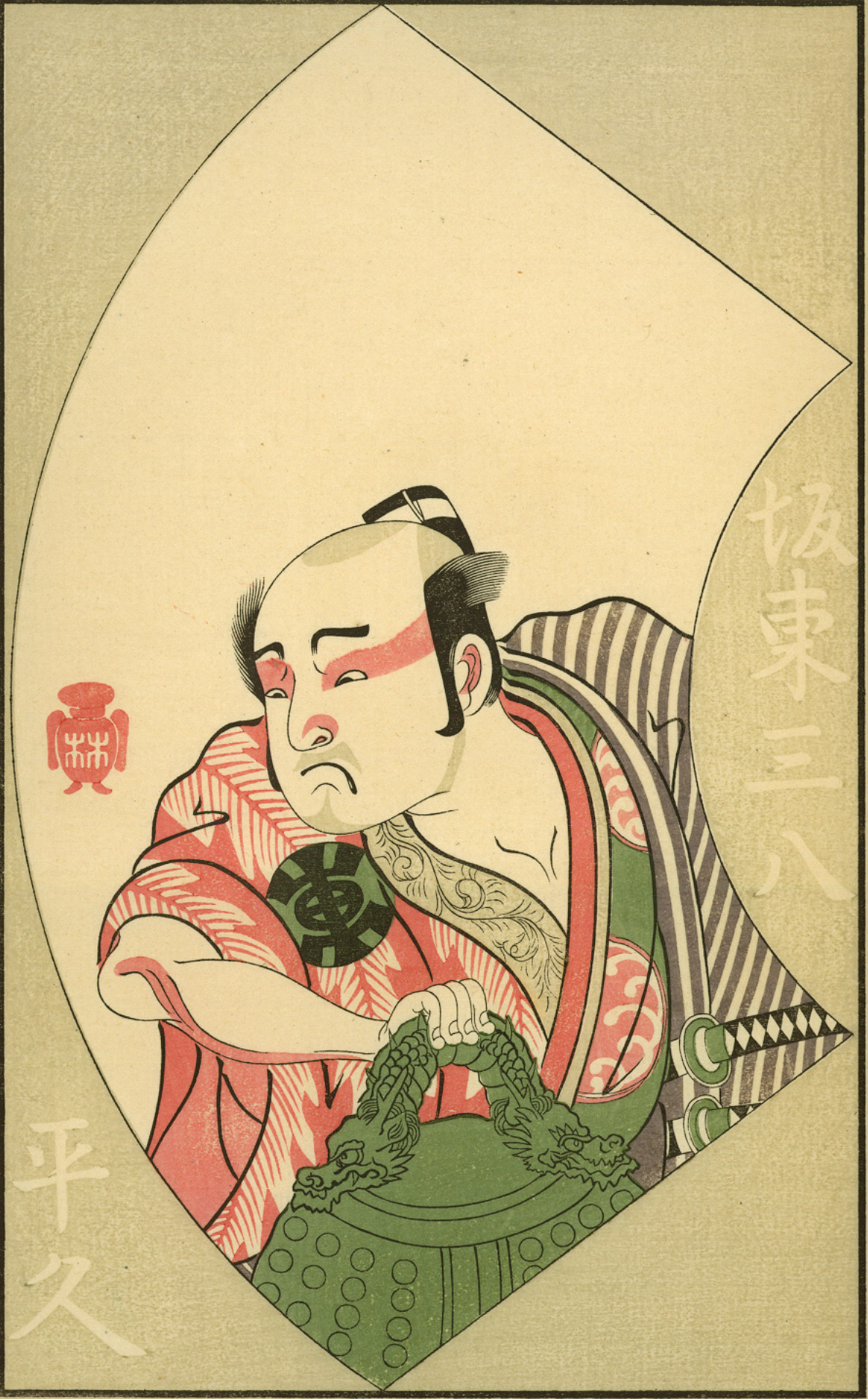
This is an ukiyo-e print of the actor Bando Sampachi I (Heikyu) as Yawata no Saburo published in 1770.  The print beared the tsubo seal of the artist Katsukawa Shunsho.  Katsukawa Shunsho is the leading artist of the Katsukawa school which specializes in prints of the kabuki actors, sumo wrestlers and bijinga (beautiful women).  Shunsho pioneered in realistic portrait of the kabuki actors which contrast with the stylized prints of the Torii school with the individuality of the actor himself identified.

DIA230xH30mm, China

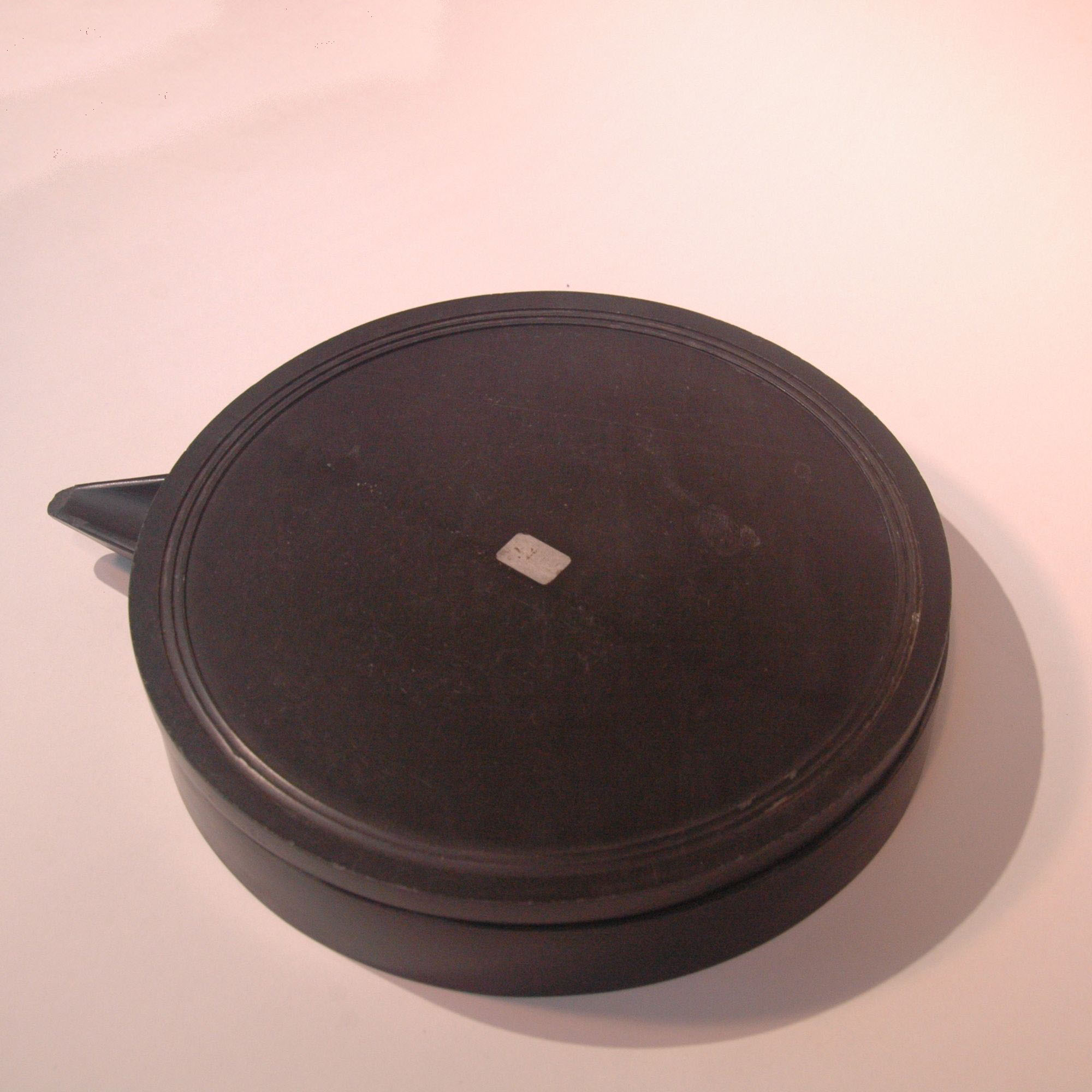
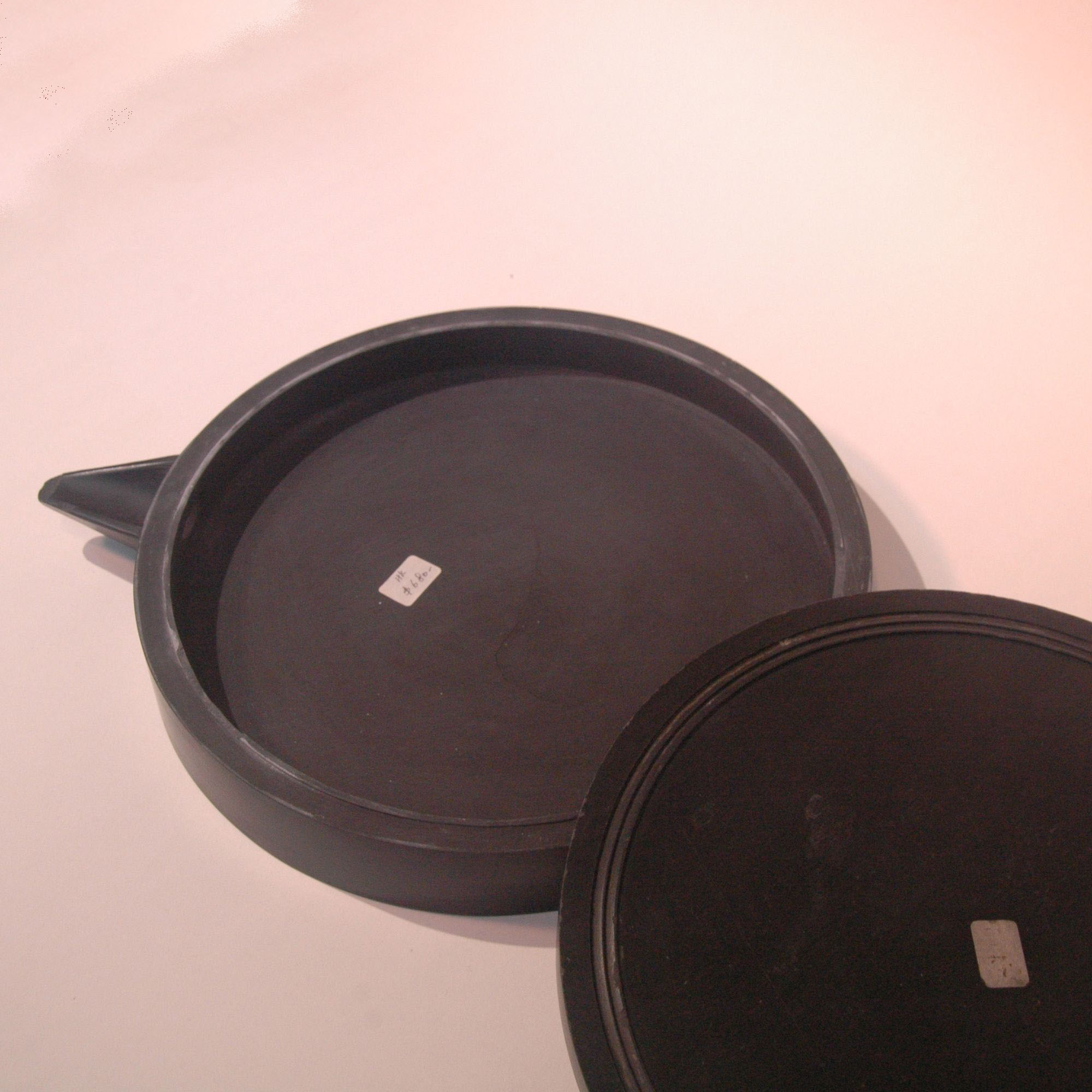
Yan, inkstone is one of the 4 stationary treasures of China, i.e., brush, ink, inkstone, paper.  The main function of the inkstone is for grinding the ink stick in preparation for the ink.  Before the inventory of inkstone, people would getting the pigment directly from the ink stick, this however is very restrictive in the size of the calligraphy word or painting, the brush would have ran out of ink when writing bigger size word.  To over come this problem, in Shang dynasty (17th century BC), flat and hard object (stone, bronze, jade, iron, brick) would be used for ink grinding.  Stone is the far most popular and liked material for inkstone, the stone type are also very selective.  This inkstone is a more utilitarian type, having no carving and the addition of a spout, its is most probably used to make a large quantity of ink for task like wood block printing.

W220xL300mm, China

A wood block print of the lord of medicine Sun Si Miao, he was a doctor and Taoist priest of the Tang Dynasty.  He is said to live to 140 years old.  However, when he was sickly child, the family used up all their saving to treat his sickness.  Being a very gifted child, he studied all forms of medicine, he dedicated his life to save as many people as he can and refused to become a doctor for the court.  He has made a huge contribution to the Chinese medicine; not only did he wrote the “Thousand Golden Prescriptions”, a complete medical ethics, started gynaecology and pediatrics in Chinese medicine and more.  This is a new year print that would be seen in Chinese medicine clinic.

W280xL360mm, Japan

This is an Ukiyo-e Print published in 1862 of the topic of the Kanda Festival.  Kanda Festival is one of the 3 Shinto Festivals in Japan; it is a festival to celebrate the victory of the battle of  Sekigahara.  The festival is biennial, in years of odd number in the western calendar.  Originally the festival is held on 15th Lunar September, nowadays is held on the closest weekend to 15th May.  On Saturday, there are a parade of floats with 300 people, on Sunday, provinces will bring over 100 small and large portable shrines to the Kanda Myojin.  The Kanda area where the festival takes place is at the heart of tokyo, the uptown area.

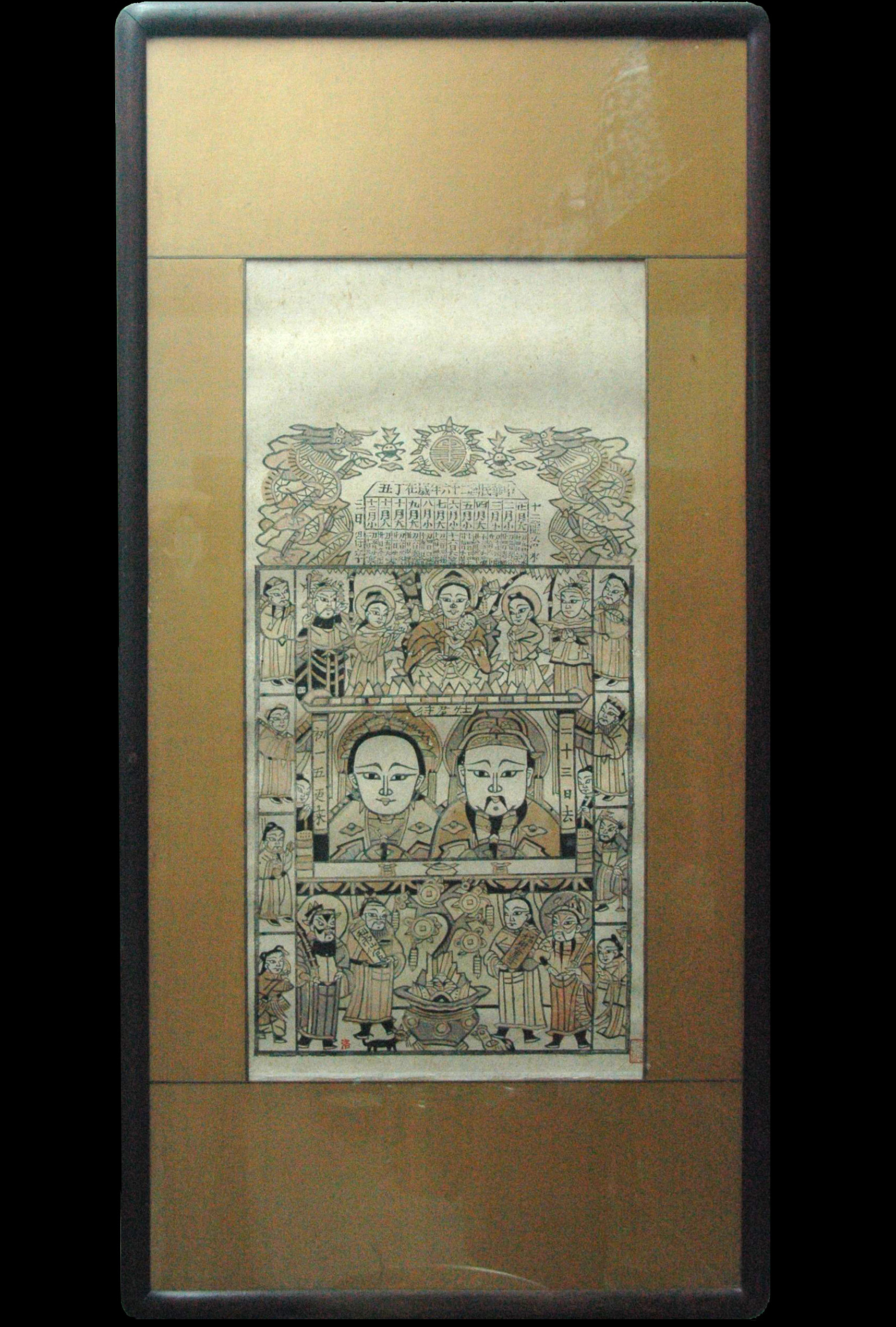
W500xH900mm, China

Previously we talked about preparing the Kitchen God for his report to the Jade Emperor, traditionally today (4th day of Chinese New Year) is the day to welcome him back to the household.  (see Kitchen God Wood Block Print-12/04/2011)  The feast would be the same as that is served for welcoming a guest that has travelled from afar.  Everyone in the household has to be present so he can keep his censors for the new year correctly.

This wood block print was from the 26th year of the Republic of China, i.e. 1938.  Every year a there will be a new calendar for the Kitchen God.  The two gods in the middle are the  Kitchen God and his wife, on the upper row is the god of fertility, the 4 gods on either sides are 3 categories of saints (upper, middle and ground), the lower 4 are the junior money gods and the money bringing kid and the pair of door gods.  For this particular kitchen god, his schedule is tighter then the one traditionally practice, he departs for the Jade Emperor on the 23rd eve and returns on the 5th hour of the New Years day.

W150xH200mm, China

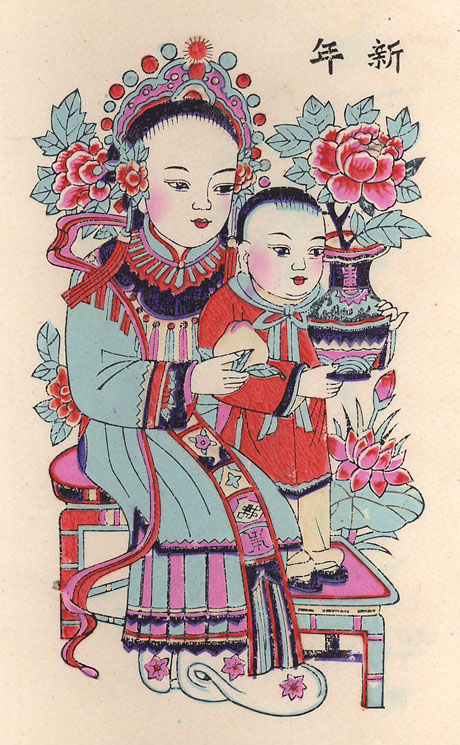
Mountain Folkcraft wishes you at happy, prosperous, healthy year of the Dragon!

W240xL360mm, Japan

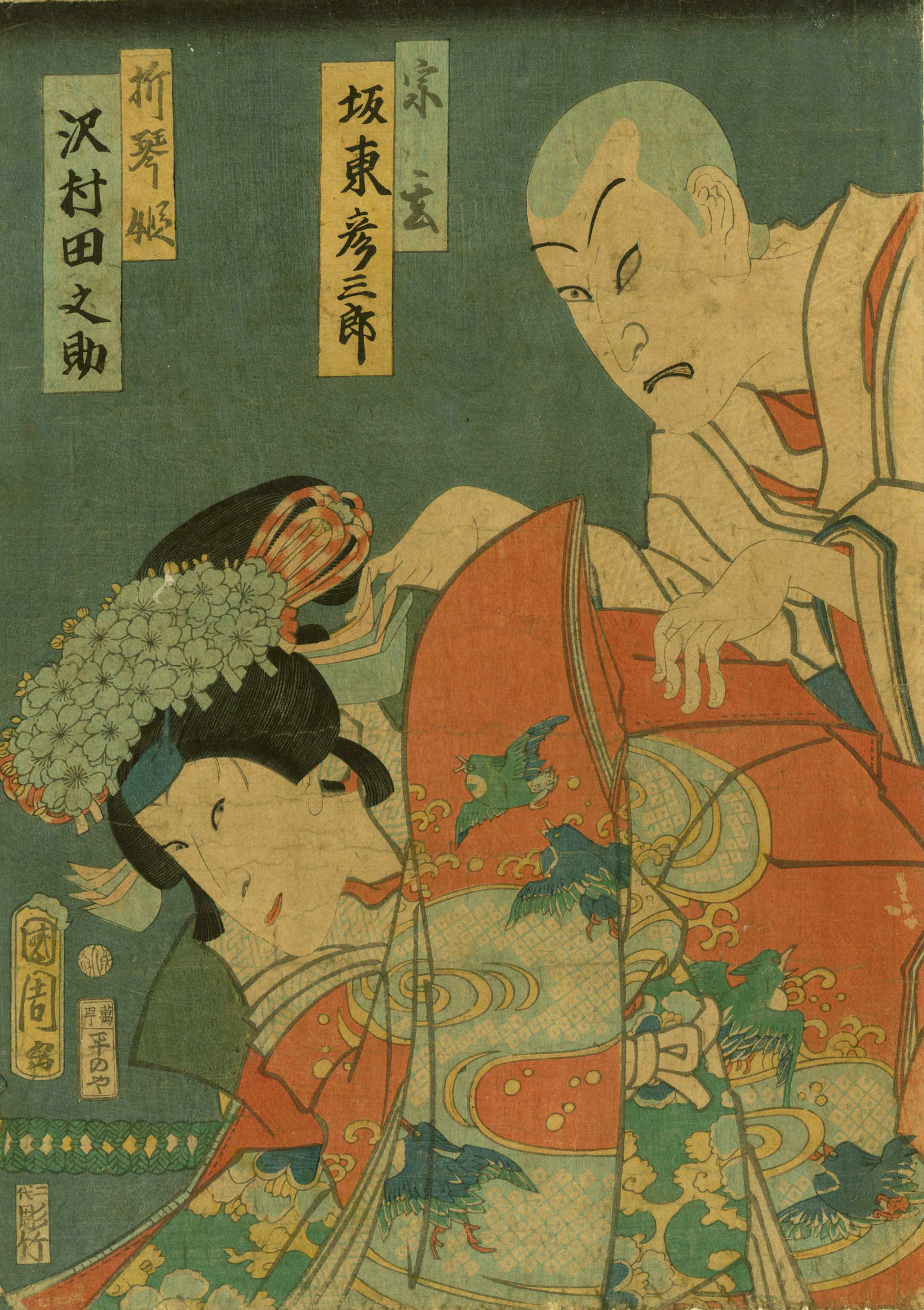
This is a Japanese wood block print by the artist Kunichita, published in 1862 by Hiranoya.  Kunichita was the founder of the Toyohara School and was one of the most famous ukiyo-e artist of his time.  His love with the Kabuki theater led him to work on ukiyo-e actor prints (prints of the kabuki actors and scenes from the popular plays).  In 1867, he was commissioned by the Japanese government to produce 10 pictures for the World Exhibition in Paris.  This exhibition strengthen the Japonism influence in the European art world.

This print is about the Kabuki play where monk Sogen (played by Bando Hikosaburo) became infaturated with the beautiful courtesan Orikotohime (played by Sawamura Tanosuke).  For this Sogen was expelled from the temple, tragically  Orikotohime died and he was left alone.

L150xW120mm, China

Wood block print presented on greeting card.