Archives for posts with tag: wood block print

Yang Liu Qing

W1150xH670mm, China

This old Yang Liu Qing print, depicted a scene from a Tang dynasty poem, 商山早行 Morning Journey At Shang Shan.

晨起动征铎,客行悲故乡。
鸡声茅店月,人迹板桥霜。
槲叶落山路,枳花明驿墙。
因思杜陵梦,凫雁满回塘。

After a restless night thinking of my home town, I woke up with the hurrying bells of the inn.
The rooster crow at the frailing moon, on the frost cover bridge left the footprints of the travelers.
The down hill road is covered by wilting plants, orange flower shines out on the inn wall.
Seeing the sunrise, I thought of my dreams of ansers returning to the pond, maybe too I can see my family soon.

The people on the print, however, described another story;

人家骑马我骑驴,回头再看推车汉,比上不足 比下有余!

I ride a donkey and look up to those who ride a horse, but looking at the cart pusher I feel content.

wood block printW600xL1750mm, China

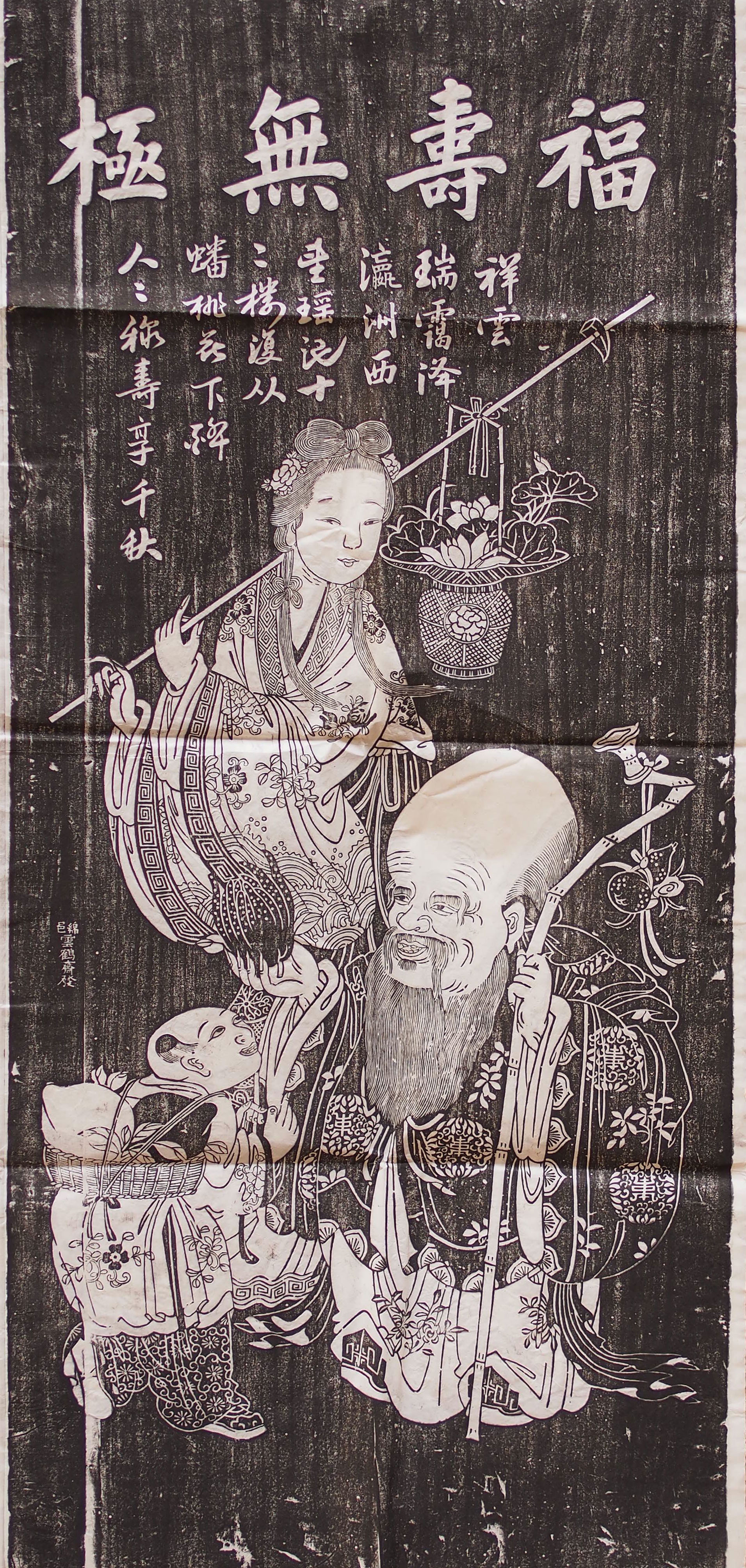
This birthday print is filled with blessing symbols –

God of Longevity who is holding a cane on one hand and the Buddha’s hand fruit on the other hand.
The lady of behind is Ma Gu, the female God of Longevity with a basket full of magical plants.  Unlike the God of Longevity who has an appearance of an old man with a protruding forehead, Ma Gu is portrayed as a beautiful girl in her late teens.  In the legend, every year on the 3rd of lunar March, on the birthday of the Queen Mother of the West, Ma Gu will give her best wishes.
Lastly, the child saint carrying a basket full of longevity peaches, also a well known theme for birthday blessings.

Unlike the birthday scroll being a respectable birthday present for the elderly lady that would be held around birthday time, this is a Mian Zhu new year print that is pasted on the wall on Chinese New Year and to be replaced yearly.

paper mache tigerW60xL140xH90mm, Japan

ASIAN FOLKCRAFT COLLECTION

Though tiger is not native to Japan, its worship has started before the first tiger was imported from Korea some 400 years ago.  The figure was generated from painting, tales and imagination, it is believe that the tiger is a symbol of strength and health.  This is a paper mache tiger with a noddy head.

Here is a collection of the paper mache tiger wood block print by Shirayanagi Eiichi (http://www7b.biglobe.ne.jp/~kokakuro/essay/110619shiroyanagi/toratoratora.htm to see the complete description)


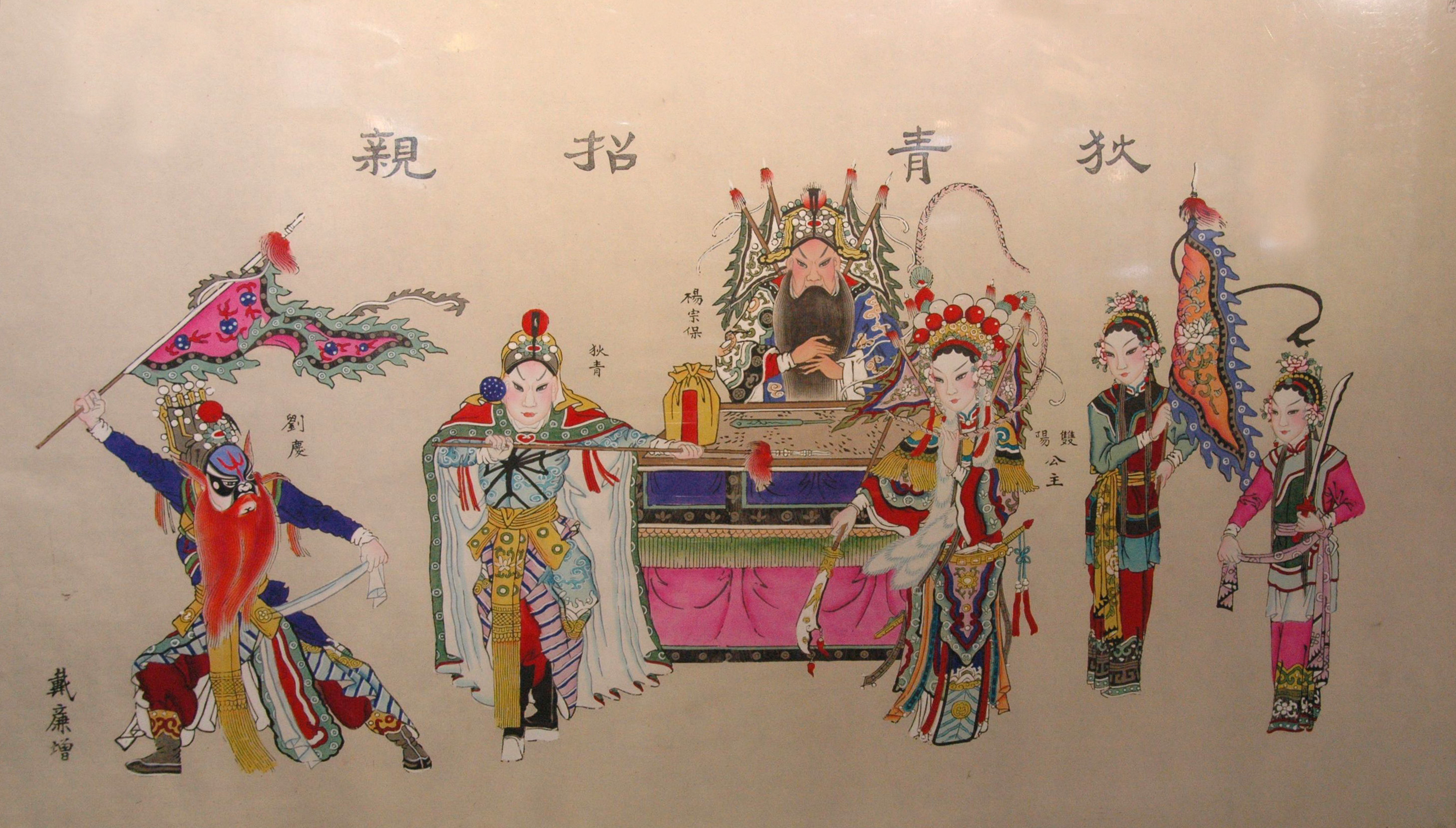
L1200xH700mm, China

This is a Yang Liu Qing wood block print portraying the story of the fearless Song dynasty warrior Di Qing (2nd left).  The story has it that Di Qing and Liu Qing (1st left) of North Song was send by the Emperor to pacify the uprising to the west of the country.  Unfortunately the army got lost and ended up in a wrong country, Dan Dan.  There, Di Qing met the Dan Dan princess (3rd right) who fell in love with his looks.  She lured him into the palace and asked for him to surrender and to marry her.  Unwillingly, Di Qing wedded the princess but only thinking about escaping to defend his home land.  The princess was upset that her newly wedded husband has departed without a word and set off after him, Di Qing explained about his duty and promised to return after his task.  Like most plots, the hero forgot about the princess when he returned home with victory and never returned to Dan Dan.  This time the princess was furious and led an army to attack Song, general Yang Zong Bao (center character) was no match with the princess and instructed Di Qing to deal with the princess.  When the couple met, of course they forgot all about fighting and lived happily ever after …

Here is the opera version of the same story

kitchen god

W280xH400mm, China

Today, lunar 24th December, is the day for thanking the Kitchen God.

On this day, the Kitchen God is about to depart to do his yearly report to the Jade Emperor; a summary of the good and bad deeds of the family his has been with.  This is the day the family should thank him for his presence and to sweeten him up a bit so he will speak well of them.

The offering should include:
A Bowl of Rice + A Bowl of Water
– to show the relationship between the Kitchen God and the family is clean and innocent, if the Kitchen God is lenient, the 2 items would turn black when he return to heaven.
Sugar Canes with Nodes and End Leaves
– with the nodes the Kitchen God can use it as a ladder to climb up to heaven, the end leaves symbolizes a beginning and an ending.
Fried Rice Biscuits, Satsumas, Tangerines, Red Sugar and A Red Packet
– food to sweeten his mouth so good words would be used for his report.
A Paper Horse, Black Robe, Boots
– provision of transport and costume for his meeting with the Jade Emperor.
A Kitchen God Cheat Sheet
– a yellow piece of paper with words chosen by the family.

These offerings should be place in the rice storage container.
With so much bribe, I wonder if the rice and water should be there at all …

W280xL320mm, China

To celebrate Halloween we have a new year print of the god of Feng Du, Feng Du is a physical province in China where it is believed to be occupied by ghosts and spirits, a city where the dead goes to live.  (unfortunately since the Three Gorges Dam project, the ghost town is now submerged in water with only a small island remaining, so there is little chance of visiting it before death.  well, it will be rather cramp as well … o dear)  For Taoist, the god of Feng Du is the controller of all spirits and is in charge of the Hell god, Yan Luo Wanɡ (Yamaraja), he also has 72 helpers who monitor on people during their life time.  At death everyone would be led by officials with the head of a cow and a horse to Diyu where one’s deed will be judged, life long sins will be punished.  At the end of the punishment (the length of time will depend on the sins) one’s spirit will be renewed and reincarnated into the next life.

Diyu is divided into 10 courts each headed by a Yama king (their portraits are shown on the 2 sides of the print) who reports back to Yan Luo Wang.

Court 1: Jiang, King Qinguang – in charge of life and death
Court 2: Li, King Chujiang – in charge of the Frozen Hell
Court 3: Yu, King Songdi – in charge of Black Rope Hell under the sea
Court 4: Lü, King Wuguan – in charge of the Blood Pond Hell
Court 5: Bao, King Yanluo – in charge of the Screaming Hell under the sea
Court 6: Bi, King Biancheng – in charge of those who died before their time
Court 7: Dong, King Taishan – in charge of the Minced Meat Hell
Court 8: Huang, King Dushi – in charge of the Stewing Hell
Court 9: Lu, King Pingdeng – in charge of Avici, the darkest hell of all
Court 10: Xue, King Zhuanlun – in charge of reincarnation

W220xL300mm, China

The character on this wood block print is not a Chinese version of Avatar but the hero Guang Hui Wang who was attributed the title of the country’s protector.  The name Guang Hui Wai is itself a title given to him by general Chen when his effigy was worshiped during Chen’s battle to pacified Ziang Ziu some 300 odd years later.  Guang Hui Wang became an idol god in Ziang Ziu and the legacy spread to Taiwan and South East Asia through the immigration of the Ziang Ziu people.  Now back to Guang Hui Wang, his real name is Xie An, he lived in East Jin dynasty (320-385 AD).  Xie An was a great scholar as well as a politician and a military leader.  Apart from winning numerous battles, reclaiming lost territories and resolving disputes between nobles within his country; he is much admired for speaking and acting with morality and justices, not taking sides in the court and lastly being able to step away from power after battles were won.  Xie An was borned  in a established family, he was well known for his intellect, charm and good looks (this being reconfirmed by his poem with the famous Wang Xi Zhi and his portraits) … who someone please explain why he has turned into Avatar in all the new year prints?

Here is a clip from the procession in Southern Taiwan for Guang Hui Wang and the Xie family.

W700xH1100mm, China

This is a Chinese new year print of the famous yang liu qing school, different from the new year print from other areas / schools, the yang liu qing prints combined the art of printing and painting in one.  Lines for the painting are first carved out from a piece of wood, black water base ink is then applied on the wood block and printed onto the paper by rubbing.  Once there is a sharp outline of the image, water base colour is then applied, giving varies tones of colour to the print.  Then a thick powder colour is used to give all the details to the painting.  The yang liu qing school began at the end of the Ming dynasty; it brought on the tradition of detail painting of the Sung dynasty and combined it with the printing technique popular in the Ming dynasty giving it an unique appearance.

This print is one print of a pair of door gods (traditional doors in China always comes in pairs), Qin Qiong, the other door will be of  Wei Chi Gong.  The legend of the 2 door gods goes like this; during the Tang dynasty an old dragon made a bet with a fortune teller and violated the law of the heaven.  As a punishment the supreme god Jade Emperor ordered Wei Zheng to have it killed at noon the next day.   Hearing the news, the old dragon went to see the Tang Emperor and begged him to help him, the Tang Emperor agreed.  The next day the Tang Emperor summon Wei Zheng to court and asked him to play a game of Chinese chess with him, hoping that if the game is long enough he will miss the noon execution.  During the long game Wei Zheng dosed off and in his dream he went to kill the dragon.  Not knowing the whole story,  the ghost of the dragon felt bitter that the Tang Emperor did not keep his words and came to haunt the court everyday.  Wei Zheng found out and send 2 generals, Qin Qiong and Wei Chi Gong, to guard the gate of the palace and this scared off the dragon.  The Tang Emperor felt bad that the 2 generals do not get a break and asked artists to make a painting of them to be put on the doors, and this seems to have the same effects, the rumor spread and now the door gods are all over China.

W110xH170mm, Japanese

The print belongs to the Tale of Genji, a classic Japanese literature which many consider to be the first and finest pose work novel.  The author Murasaki Shikibu (11th century) was a noblewoman and lady-in-waiting, offer a glimpse into the live of the high courtiers of the Heian period.  There are 54 chapters in the Tale of Genji, each represented by a individual crest (genji-mon/genji-ko).  In this ukiyo-e print, the crest is the repetitive background symbols in dark and light blue, it is the 12th chapter (Suma).  The print depicted Genji exiled in Suma for the scandal of his love affair with Oborozukiyo.

This is an ukiyo-e print of the Utgawa school.  The Utgawa school was founded by Toyoharu and expanded by his student Toyokuni I who made it the most famous and powerful woodblock print school of the late 19th century.

W220xL300mm, China

This is a wood block print of the Skanda, Wei Tuo, a guardian of Buddhism (leader of the 32 celestial guardians).  He has been worshiped in Chinese temples since the Sung dynasty, his statue is often placed behind the Maitreya statue.  It is believed that when the Buddha passed away and cremated, the demons came and robbed away his relics.  Wei Tuo chased and caught up with them and got back the relics, he was honored to be the guardian.  Though Indian in origin, Skanda was adapted into the Chinese culture as a courageous warrior and guardian and even has a Chinese name as Wei Tuo, but his task has never altered.