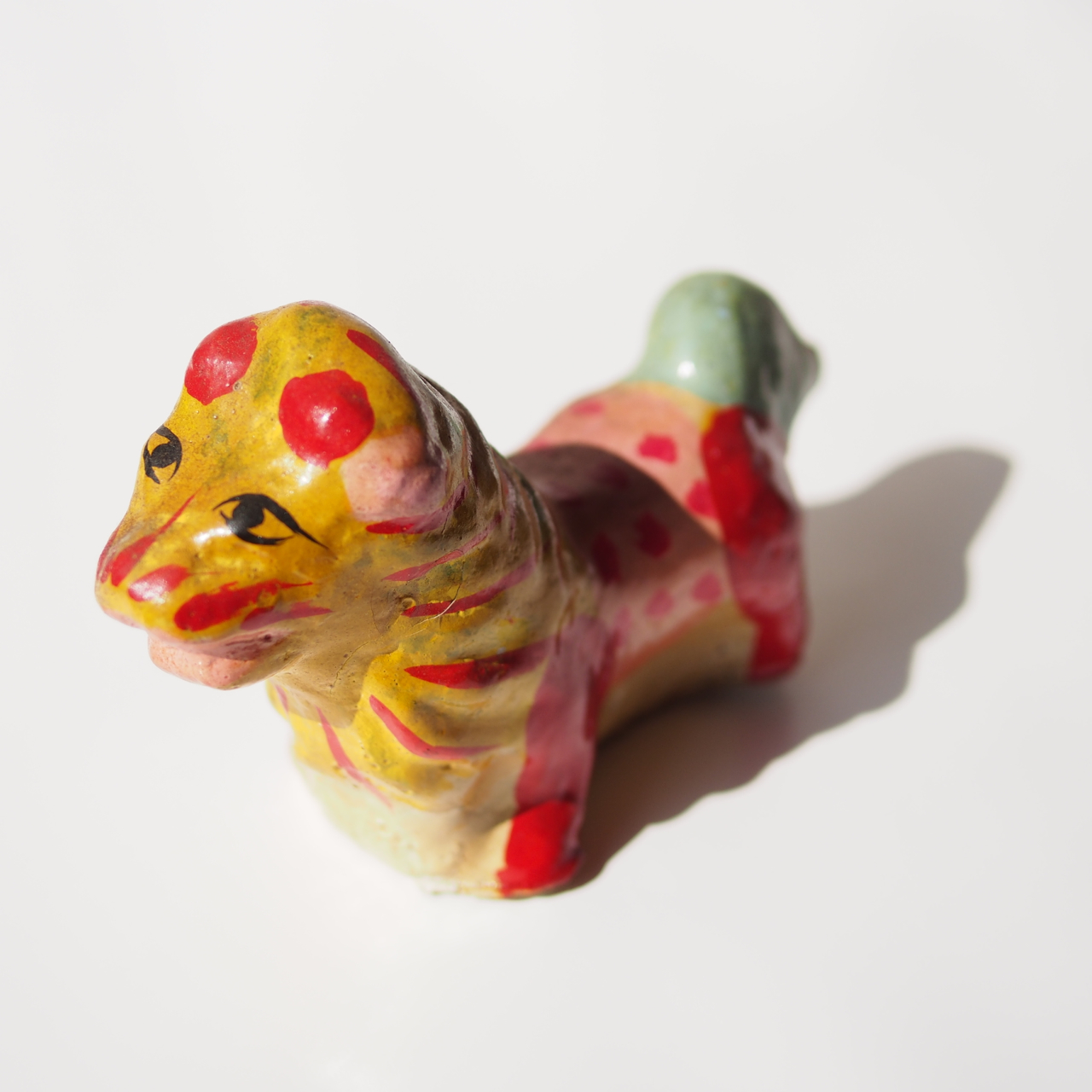
 L190xW70xH120mm, China
May we wish you a joyful X’mas!
Click here to see our other toys.
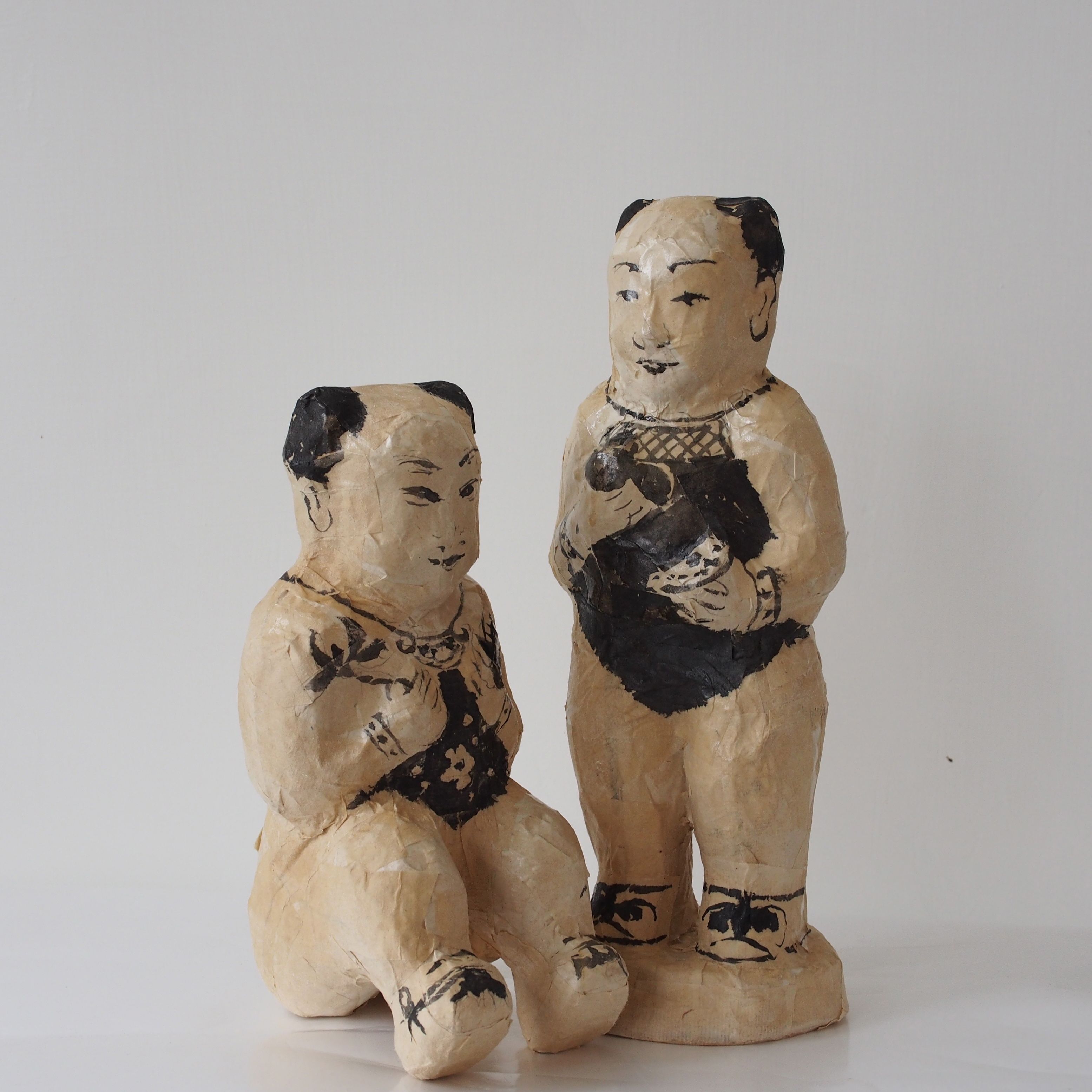
sitting W110xD140xH220mm, Hong Kong
Cute pairs of paper mache dolls inspired by the Ci Zhou kiln dolls.
They are the first in the series, stay tune for their transformation!
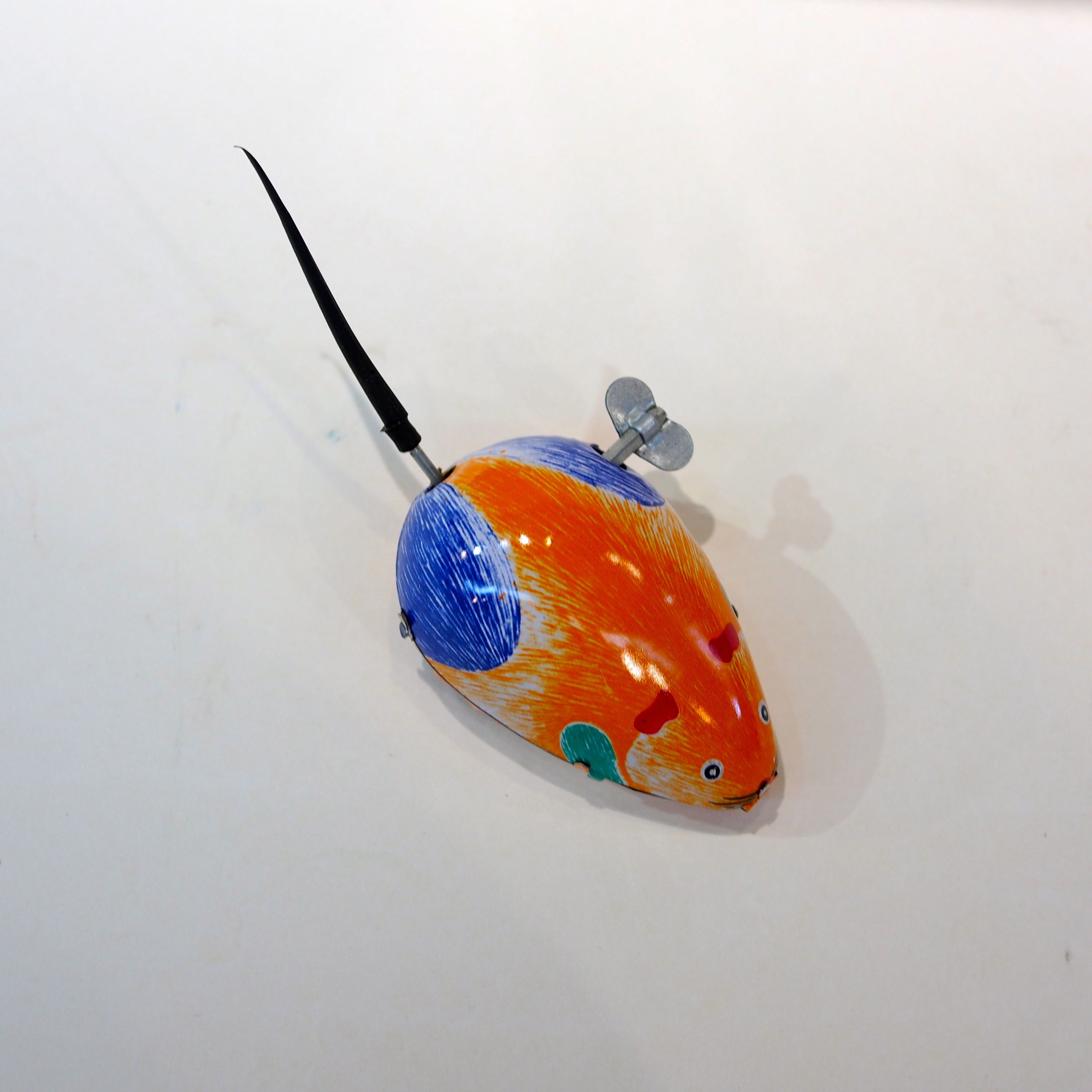
W50xL130xH40mm, China
An orange mouse that has probably had a feast of carrots.
To see our other tin toys, click here.

W150xD50xH110, China
A roly-poly monkey toy.
The story goes like this; in the Sung dyansty, there was an additional of a baby boy to a wealthy household. Precious and spoiled, he cried every night till dawn. Worried that something was wrong, the family consulted all the well known doctors in town but cries continued. One day, the father came home with a clay toy shaped with a rounded bottom and a small top. The child pushes, it wobbles and bounces back, it amuses the child and the crying stopped. The father believed that it was a blessing from god and had the figure of Guan Yin painted onto it, hoping it will protect his family from toppling. Unfortunately, one day the child broke the clay toy in half, a bad omen the father thought but the clay cannot be put together again. Cleverly, he used the broken toy as a mold and created a paper mache version and it became a popular folk toy in China.

W 130D50xH130mm, China
Clay figurines are a popular toy for adults and childern allover China and could be dated back to over 5000 years. In the area of Xu Zhou, clay figurines of dogs, pigs, rooster, duck and even houses were found in Neolithic sites. The tradition continues and was the most established in the Ming and Qing dynasty more subject matter were covered. The more natural non coloured version were favored by intellectuals while the mono white and black version are amulet figures. This figurine being decorated with colour is toy tiger.
Click here to see our other tiger clay toy.
 W100xL120xH140mm, China
As the clay toys of Nie Jia Zhuang was selected as the Chinese Intangible Cultural Heritage, it also signified that it is a dyeing art which is in need of protection. The making of clay toys in the area dated back to the Ming dynasty, folk song was sung about these colour clay toys. Up to the 80s, they were ever so popular, every kid would own one.
This roaring tiger, has a leather waist which forms as a bellow to the squeak inside the front half of the body.
 W60xL140xH90mm, Japan
Though tiger is not native to Japan, its worship has started before the first tiger was imported from Korea some 400 years ago. The figure was generated from painting, tales and imagination, it is believe that the tiger is a symbol of strength and health. This is a paper mache tiger with a noddy head.
Here is a collection of the paper mache tiger wood block print by Shirayanagi Eiichi (http://www7b.biglobe.ne.jp/~kokakuro/essay/110619shiroyanagi/toratoratora.htm to see the complete description)


 W110xL100xH60mm, China
The WWII Avenger Airplane? What do you think?

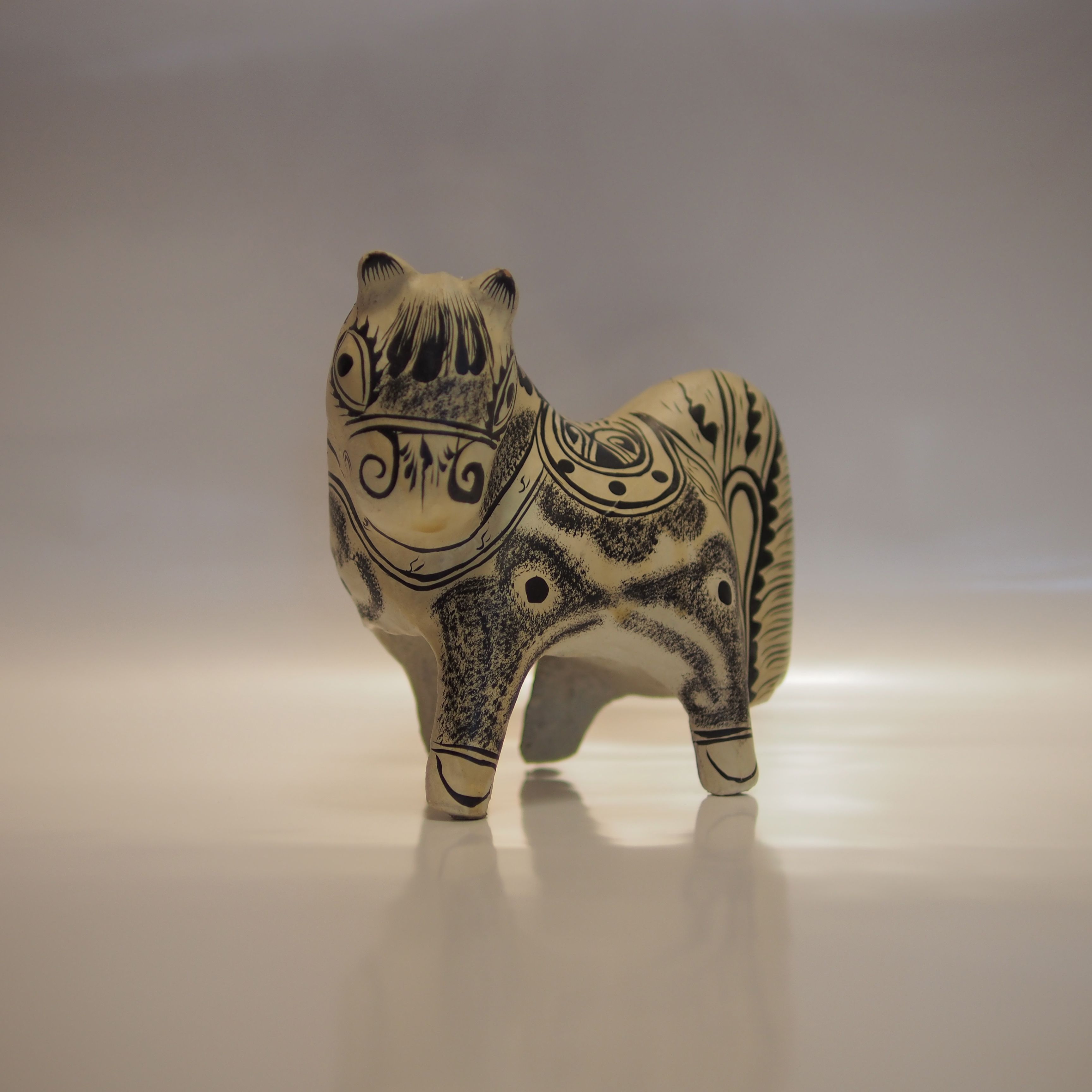
H150xL150xW100, China
This sweet little clay horse is by the Hu Xin Min, an artisan who successfully injected new spirits into the traditional craft.
The Feng Xiang province has a long and famous for making clay figurines, they are dramatic and bold in patterns, a blessing present for the Chinese New Year, festivals. The history of Feng Xiang goes back to the Tang dynasty, the first emperor Zhu Yuan Zhang had the 6th division of his army based in the area. During peaceful time, these soldiers from the south made clay figurines as a pass time. Later on, the soldiers settled in the village and named it the 6th division village and the tradition of craft of clay toys started.
 W70xH200xD120mm, China
Today, for Something New Something Old pottery, we have something old. A figurine of a boy holding a lotus made in the Ci Zhou kiln. On further research, the boy’s name is Mo He Yue, the Chinese folk portrayal of the Buddha Siddhattha Gotama’s son – Rahula. Rahula was born before Prince Siddhartha was enlightened to become the buddha, being raised by the his mother and grandfather King Suddhodana. When Rahula was 7 year old, the Buddha returned to the palace, on the 7th day his mother Princess Yasodhara told Rahula to ask his father for the inheritance of the crown since the Buddha has already renounced his duty as the prince. The Buddha knowing the crown goes with the worldly life is full of trouble, so instead gave his son spiritual enlightenment. The Buddha asked his disciple Sariputta to ordain Rahula who later became one of the arhants.
Since the Tang dynasty, figurines of Mo He Yue have been used for the worship for the Qi Xi festival (7th of lunar July). However, the Qi Xi festival has nothing to do with Buddhism but a celebration of love between a cowboy (Nin Lang) and a weaver girl (Zhi Nu).
The love story goes something like this; a poor boy called Nin Lang who live with lived with his brother and the wife. The sister in law was not keen on having a boy hanging around and had a cunning plan. She asked Nin Lang to herd 9 of her cows but on his returned claimed that there were 10, if Nin Lang didnt manage to find the 10th cow he will not be allowed home again. Nin Lang found a sick yellow cow on the hill, he nursed him carefully until the cow regained its health. The cow was very grateful and revealed that he was actually a saint who has been strike down to earth. The cow became a buddy of Nin Lang and told him a place on earth where the female saints would hang out and there Ning Lang met Zhi Nu. The 2 soon fell in love with each other and had a twin. The Queen Mother of the West (the supreme head of all female saints) found out this forbidden sin, a earthy being having children with the saint, and escorted Zhi Nu back to heaven. Seeing that Nin Lang became very sad at the departure of his wife, the cow told Nin Lang that after his death, his skin could be used to make a pair of shoes that could bring Nin Lang to heaven so he could find Zhi Nu again. Years later, the shoes were made, Nin Lang flew to the sky and saw Zhi Nu at a distance. The Queen Mother of West throw a hair ornament which became the milky way separating the two again. Moved by their love, the pica pica birds formed a bridge to help them cross the milky way. The Queen Mother of West touched, made an exception for them, once a year on the 7th of lunar July, the 2 are allow to meet on the pica pica bridge. This story is of course a conception of the early Chinese astronomy; Nin Lang being Altair, Zhi Nu being Alpha Lyrae, the yellow cow – the Aldebaran and of course the Milky Way.
Since the Tang dynasty there has been the worship of the 2 lovers, in particular Zhi Nu, the weaver of colourful clouds in the sky. It is believed that the girls would pick up her skillful hands. Now what has Rahula, the son of the Buddha got to do with the 2 lovers. It has to do with other custom of Qi Xi, as it is a night of the union of the lovers, baby figurines were made as a symbol of conception of the much desired baby boy. By Tang dynasty, with the arrival of Buddhism from India, these baby figurines were made into Rahula who is gifted and grown to be an arhant, an image of a son everyone wished for. Rahula, being left behind by the Buddha at birth but eventually enlightened and preached by the Buddha. This reunion fulfilled the void left behind the by separation of Nin Lang and Zhi Nu.
Slowly, the figurine changed from their role of being worship to being admired and by Sung dynasty when technique of molding was made popular, the Rahula (Mo He Yue) figurine became a toy.
 Mountain Folkcraft