Archives for posts with tag: pottery

DIA75 x H50mm, China

This item selected by Furze for the Something Old Something New exhibition and is available at both Mountain Folkcraft and Soil.

These pair of cups has a brown glazing (known as the soy sauce glaze) and internally a hand painted blue and white porcelain goldfish pattern.  The goldfish pattern is a traditional Chinese pottery decoration; the word goldfish (金魚) and the word gold & jade (金玉) are heterographs (same pronunciation, but different meaning and spelling), a bowl full of golden fish is hence a house of wealth.

And here is the ultimate goldfish in a bowl by Riusuke Fukahori

DIA50xH70mm, China

This is small vase is a stationary, a water drip for diluting the ink.  The 2 other water drips featured in our previous posts ,which both has a mouth piece, those are known as “shui zhu”, one like this is known as a “shui cheng”.  Water drip is one of the essential stationary besides the fundamental 4; paper, brush, ink and inkstone.  Its small size and its basic utilitarian function enable the craftsman to be more expressive on the material, form and decorations.   The water drip is an articulated item for the scholar, an item kept at the desk which would reflect the owner’s passion.  I tried hard to think of an equivalent object for today’s scholar and failed, at best an old fountain pen and at worst a desktop pattern.  Is it because nowadays we owned too many objects?  Or has the digital life leave us little individuality?

This item selected by Furze for the Something Old Something New exhibition and is available at both Mountain Folkcraft and Soil.

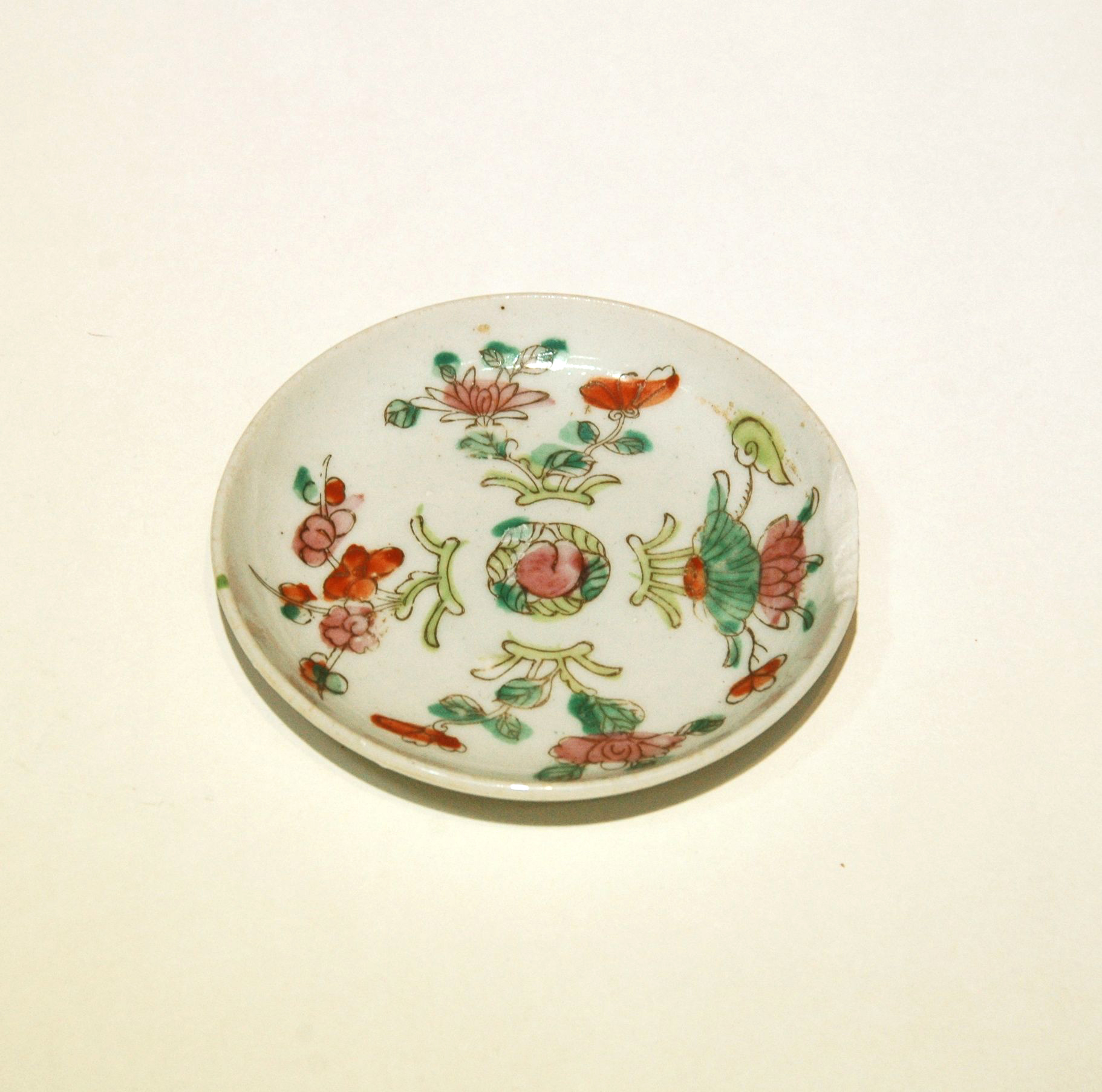
DIA100mm, China

This is four seasons floral plate is a folk’s version of the famille rose decoration.  The normal examples of famille rose you see in museum and exhibitions are very delicate and refine works of art, they can be seen as an extension of Chinese painting, the decoration of this plate uses the same technique of glazing but with a bolder pattern, it is an everyday plate for the commoners.  Famille rose was invented and became popular in the Qing dynasty, basing on the technique acquired from famille verte and the colour material of the color enamel from the West, a decoration of a softer and different shades is achieved.  The work is made from white clay, on the biscuit a colour outline is painted, then glass whiteness (a white colour use for enamel work) is applied within the outline.  Colours are then painted over the glass whiteness glazing, giving a softer colour than the famille verte decoration.

This item selected by Furze for the Something Old Something New exhibition and is available at both Mountain Folkcraft and Soil.

DIA75xH165mm, China

This item selected by Furze for the Something Old Something New exhibition and is available at both Mountain Folkcraft and Soil.

This is a traditional Chinese white glaze candle stand, this can be seen by the small hole on center of the top dish.  The traditional candle has a bamboo stick attached to the bottom, the candle would be secured by inserting it into the small hole.  Candle stands have been around since the 3 Kingdoms period (210AD) until the Tang dynasty they have been more descriptive and elaborated capturing the shape an animal or a plant, etc.  From the Sung dynasty, the form became more utilitarian and the 2 level form are the most common.

Talking about candles, I would like to share with you the candles hand made and designed by my friend Maha Alusi in Berlin.  And of course her view on “Passing Moments”.

http://mahaalusi.com/

DIA 140xH65mm, Hong Kong

This bowl is an example of the traditional mass production of craft which is still 100% handmade.  Notice the ring at the bottom of the bowl?  That it is unglazed?  It is not part of the pattern of the bowl but a feature of the production of the bowl itself – stack firing.

If you turn a bowl over, you will notice that the bottom of the plinth is a bit rougher, that it hasn’t got any glazing.  This is because if the glaze is there, under the heat of the kiln it would melt and cause the work to stick to the kiln board, that’s why the potter would carefully clean off any glaze.  Normally when firing each item would be placed on a kiln board and at some distance apart from other works.  In the Qin dynasty (220BC), demand for pottery is high, stack firing becomes popular in the common kiln.  The bowls would be stacked on top of each other (like how the bowls are arranged  in your kitchen cabinets), about 10 pieces tall.  To prevent the glazing on the bowl sticking together the glazing on the inside of the bowl (where the plinth of the upper bowl is touching) is removed,  hence the unglazed ring.  This would yield a lot more work in a single firing – tradition mass production.

This item selected by Furze for the Something Old Something New exhibition and is available at both Mountain Folkcraft and Soil.

DIA130xH30mm, China

This was at the one time the most common bowl in the Guang Dong and Min Nan area, a bowl that is used in homes, street hawkers and local eateries, now a days they have been replaced by the durable plastic ware   Each bowl is hand printed with rooster, plantain and a flower.  There are a reasons of how the rooster made it to be the decoration for this popular bowl.

For the Chinese, the rooster is a protector of evil (see post Clay Rooster Whistle), it has also contained the 5 Chinese virtues (Knowledge = comb, Strength = footing distance, Bravery = fighting its enemy, Benevolence = calling others to feed, Credit = crowing every morning).  And finally, in the old days meat is a scarcity for common people, dishes are often decorated with chicken or fish to spice up the meal.

This item selected by Furze for the Something Old Something New exhibition and is available at both Mountain Folkcraft and Soil.

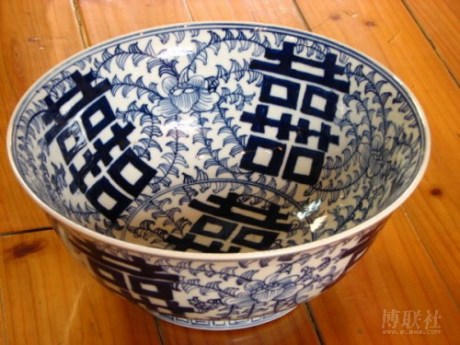
DIA 150xH50mm, China

This item selected by Furze for the Something Old Something New exhibition and is available at both Mountain Folkcraft and Soil.

This is a folk version of the double happiness bowl; on the refined version the bowl is decorated with the word 囍 (double happiness) and a winding stem pattern that is popular in the Qing dynasty.  While the design is passed down from an official kiln to a commoner’s kiln, the design is abstracted over generation of craftsman.  This is likely to be due to that the craftsman are mostly illiterate and the design was taught to the young apprentice almost as a symbol from their master who has learnt it the same way.  Nevertheless, this abstracted bowl is known to them also as the double happiness bowl, equivalent to the original item.  The painter Wu Kuan Chung made this observation about the under glaze decoration of commoner’s kiln; some ideas which was inspired by daily life, they can being transformed into another type of art form by subtraction, multiplication or other means as long as it is still tied to the origin of living.

Can you spot the work 囍 and the scrolling foliage pattern?

Here are some hints;
the first 2 are folk version of a less simplified bowl and the last being a more refined version.  (I somehow preferred the abstracted version)

Answer: the pattern that looks like # is the word 囍 and the three circle is part of the scrolling foliage  pattern.
春 023

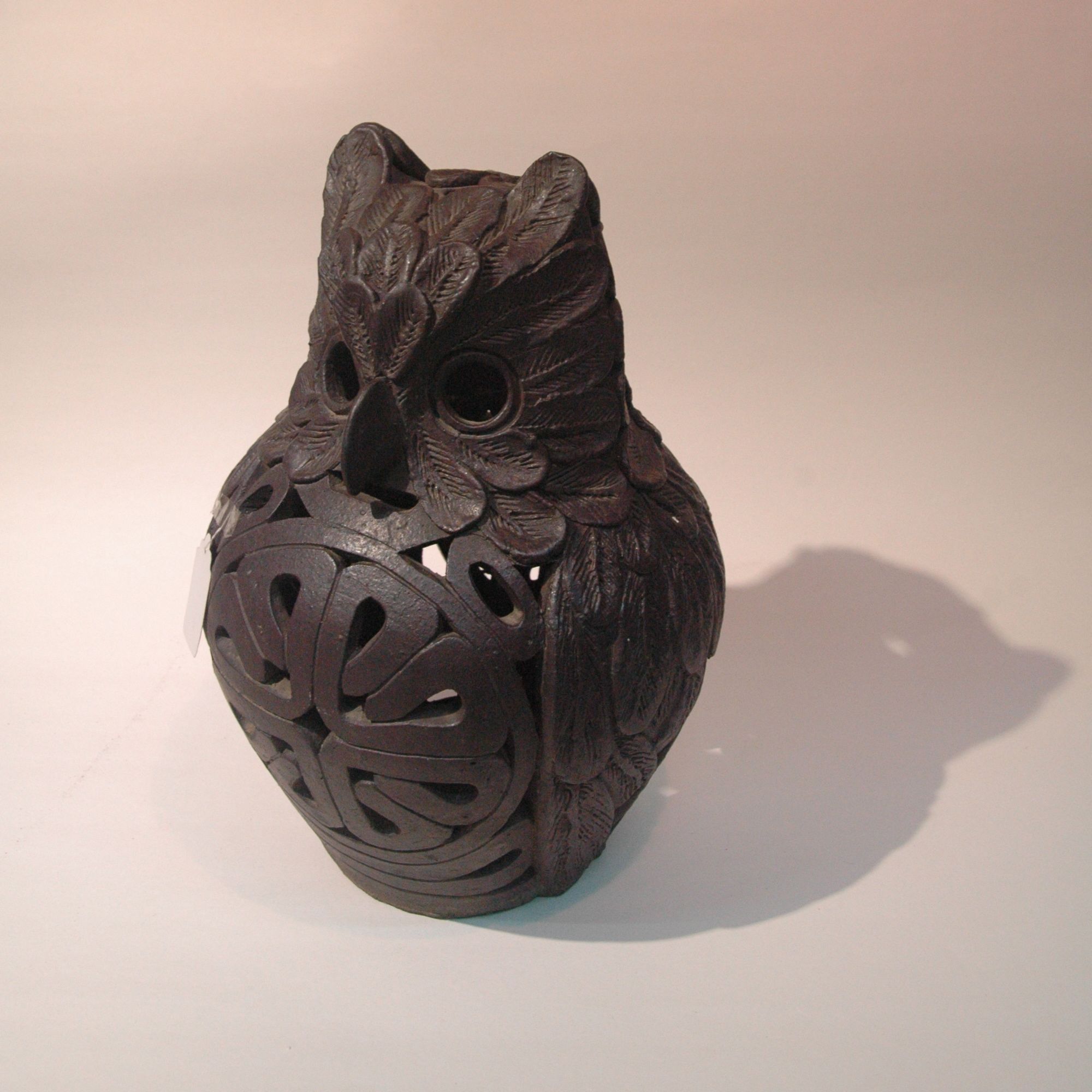
DIA220xH350mm, Thailand

This earthenware is from Dan Kwian, the pottery village in Thailand.  The pottery there is known for its rust like colour which is the result from the high iron oxide content in the clay that were used.  The clay are collected from the nearby Moon River where the Kha tribe used to live, it is believed that they were the original potter of the area.  The style and shape of the pottery has been passed down and even now traditional technique are still used by the potters.

L210xD130xH60mm, China

This is a celadon daffodil bowl, yes celadon is not limited to the pale jade green glaze, it also can be white, grey, blue or yellow.  The cracks on the bowl are only on the glazing itself and has no impact to the bowl, this characteristic is known as crackle glaze.  This effect for the randomness which mimic nature has been appreciated by the Chinese since the Sung dynasty.  However, this texture started off as a defect in the firing process; the clay and the glaze having a different expansion ratio.  This crackle style is known as “a hundred broken pieces”.

For more about daffodil, click on Blue Glazed Narcissus Bowl.

DIA250mm (BOWL DIA220mm), China

This lotus leave was the lid for a container which unfortunately is not with us anymore.  I think it will make a great presentation for lotus leave rice if you have a bowl of similar size or best of all make a  pottery one.  This will be my new pottery project, will keep you updated on this.  Meanwhile, you can start practicing on making my favorite lotus leave rice first.

INGREDIENTS (for 2)

  • 1 lotus leaf (fresh if possible)
  • 300g cooked rice
  • 0.5 tsp salt
  • 40g diced roast duck
  • 40g diced roast pork (Char Shui)
  • 40g diced prawns
  • 40g diced crab meat
  • 40g diced mushroom
  • 1 egg
  • 3 tbs water
  • 2 tsp soy sauce
  • 1 tsp chinese wine
  • 1 tsp sesame oil
  • 0.5 tsp salt
  • 0.5 tsp sugar
  1. wash the lotus leaf thoroughly then put it in boiling water till soft, rinse with cold water and pad dry.
  2. make a thin omelet with the egg, let cool and cut into thin slices.
  3. heat the wok with a little hot till smoke raises, add in and stir fried the diced prawn followed by the diced roast duck, char siu, mushroom and finally the rice and the seasoning.
  4. brush the lotus leave with oil, spoon in the fried rice and fold up the lotus leave like a gift.
  5. put it in a bowl and steam for half and hour.
  6. put the lotus leaf parcel in a nice container and enjoy!