Archives for posts with tag: paper

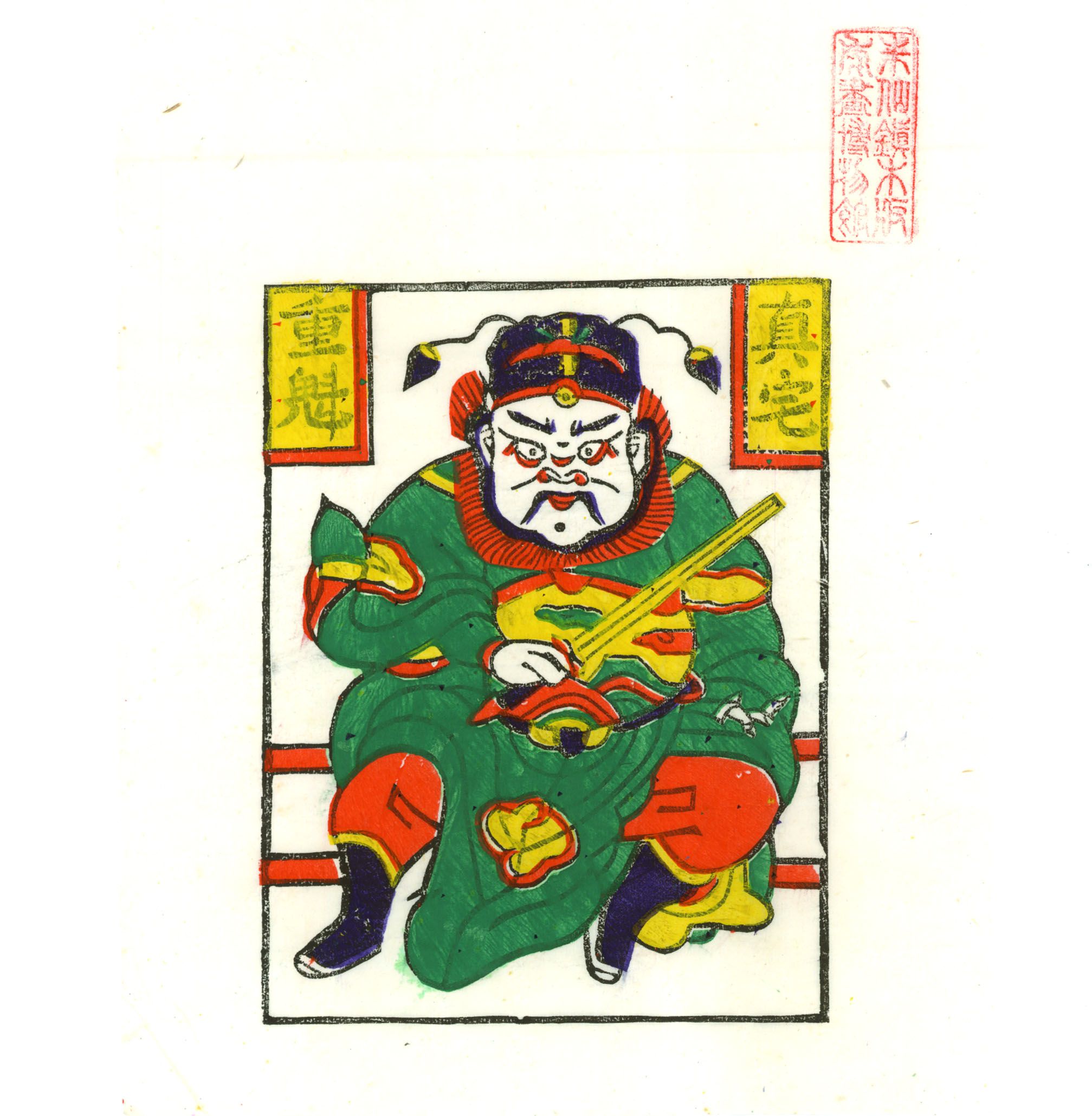
W130xH170mm, China

 This is a new year print of  Zhong Kui, the saint who can defeat all ghosts and evils, keeping the household safe.  Zhong Kui has a fierceful  stern face covered with a thick beard, despite having such a strange appearance he was a bold character who is a well learnt scholar.  Legend has it that in Tang dynasty 730AD, the emperor was gravely ill, one night he dreamt that a ghost came to steal his jade pipe and his favorite concubine’s fragrance sachet.  The emperor was upset and was about to send in his warriors to chase off the ghost and saw a larger ghost appear.  The larger ghost has messy hair, horns on his head and worn a green robe, he reached out and caught the thief, dug out his eyes and swallowed them.  The emperor was horrified by the act and asked who he was, the larger ghost paid his respect and said he is Zhong Kui and that he tried hard in the scholar exam but failed.  Ashamed for his failure, he met his death by the steps after reading the results at the courts, feeling sorry for him the earlier Tang emperor award him a green robe for his funeral.  Moved by the emperor he oath to remove all the ghost and evils for the Tang dynasty.  When the emperor woke up from his dream, his sickness was gone, he ordered the making of Zhong Kui’s print to spread the news.  Later on it became a new year tradition for the Tang emperor to award his officials prints of Zhong Kui.

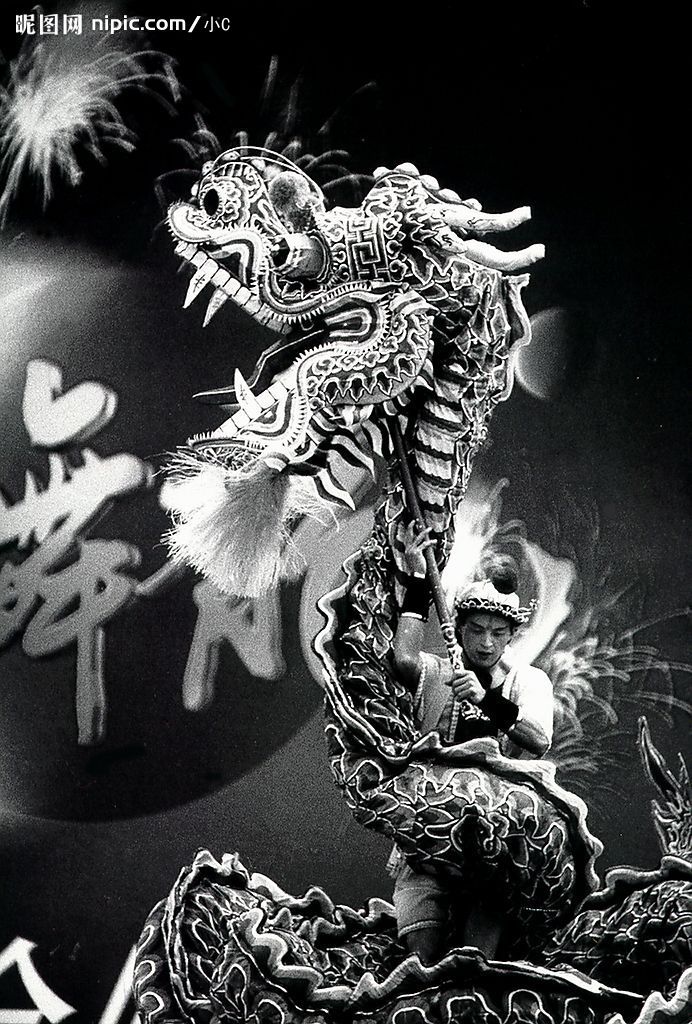
In certain part of China, Zhong Kui is worshiped at every occasion from Chinese new year to opening of  a temple to a shop, the start of a work for the year to the start of construction, relocation to birthday and weddings.  The ceremony will include the offering to the print of Zhong Kui and for a grander gesture the performance of masked dance or a puppet show of the Zhong Kui theme.

Here is a masked dance performance for a temple ceremony in Taiwan.

W280xL320mm, China

To celebrate Halloween we have a new year print of the god of Feng Du, Feng Du is a physical province in China where it is believed to be occupied by ghosts and spirits, a city where the dead goes to live.  (unfortunately since the Three Gorges Dam project, the ghost town is now submerged in water with only a small island remaining, so there is little chance of visiting it before death.  well, it will be rather cramp as well … o dear)  For Taoist, the god of Feng Du is the controller of all spirits and is in charge of the Hell god, Yan Luo Wanɡ (Yamaraja), he also has 72 helpers who monitor on people during their life time.  At death everyone would be led by officials with the head of a cow and a horse to Diyu where one’s deed will be judged, life long sins will be punished.  At the end of the punishment (the length of time will depend on the sins) one’s spirit will be renewed and reincarnated into the next life.

Diyu is divided into 10 courts each headed by a Yama king (their portraits are shown on the 2 sides of the print) who reports back to Yan Luo Wang.

Court 1: Jiang, King Qinguang – in charge of life and death
Court 2: Li, King Chujiang – in charge of the Frozen Hell
Court 3: Yu, King Songdi – in charge of Black Rope Hell under the sea
Court 4: Lü, King Wuguan – in charge of the Blood Pond Hell
Court 5: Bao, King Yanluo – in charge of the Screaming Hell under the sea
Court 6: Bi, King Biancheng – in charge of those who died before their time
Court 7: Dong, King Taishan – in charge of the Minced Meat Hell
Court 8: Huang, King Dushi – in charge of the Stewing Hell
Court 9: Lu, King Pingdeng – in charge of Avici, the darkest hell of all
Court 10: Xue, King Zhuanlun – in charge of reincarnation

W240xH260mm, Japan

This is a Ukiyo-e print of the Nihonbashi, likely to be of late Edo period or early Meiji Period.  The print depicted a scene of the busy junction of the Nihobashi with Nakasendo and the Tokaido which connect Edo with Kyoto.  There is much action going on in the scene.  Since the Edo period, the Nihobashi area has been the commercial center and developed into the financial district of today’s Tokyo.  The bridge in the print is the first bridge, a wooden bridge – Edobashi, it was replaced by a stone bridge, in 1964 an expressway was built over the bridge for the Olympic games.  The  print does not bear the name of the artist, it seems to have a similar style and theme of Utagawa Hiroshige III (perhaps someone more knowledgeable can let me know if my rough guess is correct).

W700xH1100mm, China

This is a Chinese new year print of the famous yang liu qing school, different from the new year print from other areas / schools, the yang liu qing prints combined the art of printing and painting in one.  Lines for the painting are first carved out from a piece of wood, black water base ink is then applied on the wood block and printed onto the paper by rubbing.  Once there is a sharp outline of the image, water base colour is then applied, giving varies tones of colour to the print.  Then a thick powder colour is used to give all the details to the painting.  The yang liu qing school began at the end of the Ming dynasty; it brought on the tradition of detail painting of the Sung dynasty and combined it with the printing technique popular in the Ming dynasty giving it an unique appearance.

This print is one print of a pair of door gods (traditional doors in China always comes in pairs), Qin Qiong, the other door will be of  Wei Chi Gong.  The legend of the 2 door gods goes like this; during the Tang dynasty an old dragon made a bet with a fortune teller and violated the law of the heaven.  As a punishment the supreme god Jade Emperor ordered Wei Zheng to have it killed at noon the next day.   Hearing the news, the old dragon went to see the Tang Emperor and begged him to help him, the Tang Emperor agreed.  The next day the Tang Emperor summon Wei Zheng to court and asked him to play a game of Chinese chess with him, hoping that if the game is long enough he will miss the noon execution.  During the long game Wei Zheng dosed off and in his dream he went to kill the dragon.  Not knowing the whole story,  the ghost of the dragon felt bitter that the Tang Emperor did not keep his words and came to haunt the court everyday.  Wei Zheng found out and send 2 generals, Qin Qiong and Wei Chi Gong, to guard the gate of the palace and this scared off the dragon.  The Tang Emperor felt bad that the 2 generals do not get a break and asked artists to make a painting of them to be put on the doors, and this seems to have the same effects, the rumor spread and now the door gods are all over China.

H300x W190mm, China

To continue with our series of bird entries, here is a paper cutout of a phoenix (the mystified peacock).  For the Chinese, the phoenix is believed to be  the symbol of beauty and talent, an icon of blessing.  Its often paired together with the dragon, the dragon representing the male and phoenix the female (funny enough the more glamorous looking peacock is in fact a male).

DIA60xH80mm, China

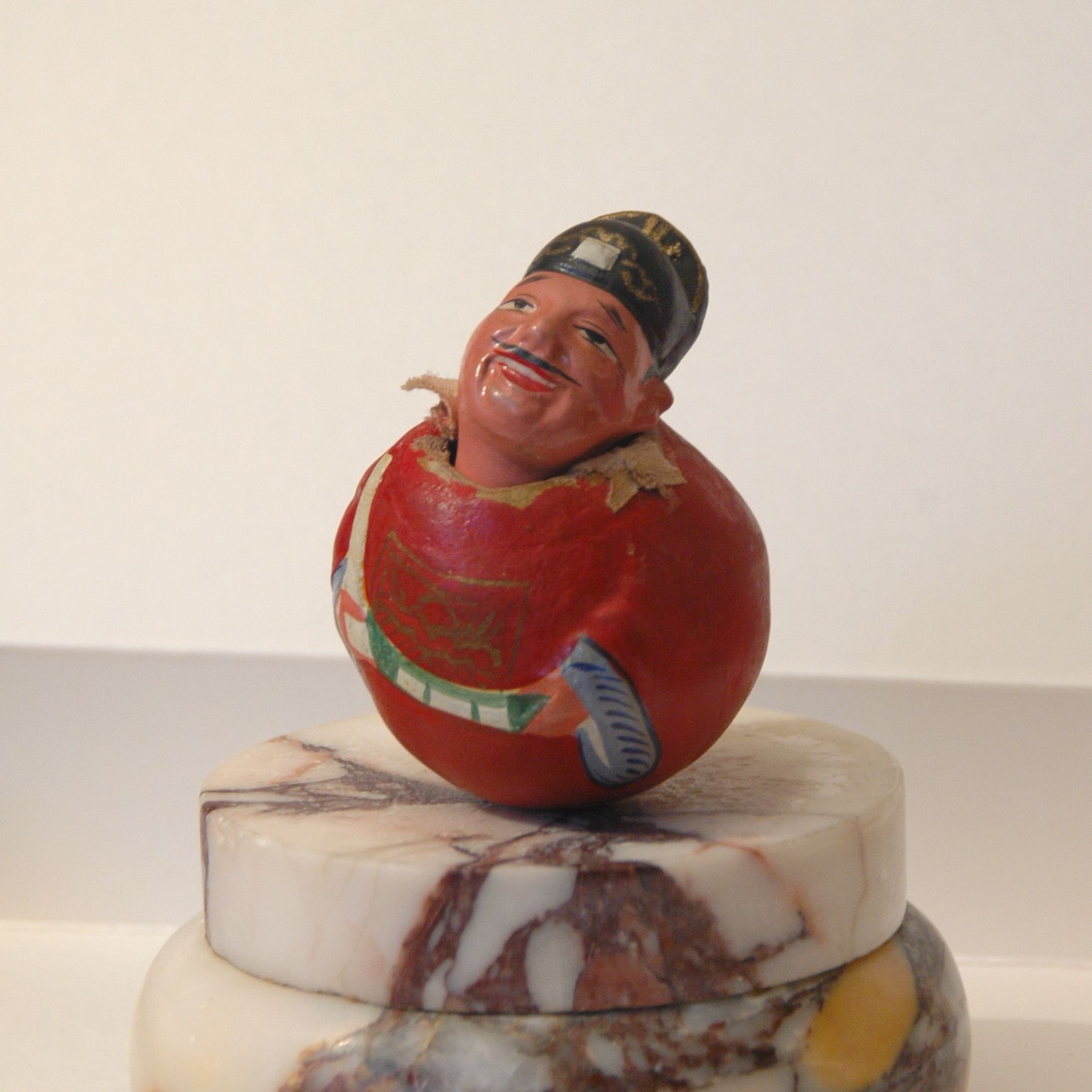
Today is the 5th day of the Chinese New Year and the day for welcoming the Money God, the Money God has his four assistants will visit and bless randomly a handful of people.  On the day of the 5th, you might notice that shops and households trying to draw their attention with fire crackers or food in front of their statue (or nowadays the free posters that come with the weekly magazine).

It is a toy for the drinking game since the Tang dynasty, after wobbling, the person he is looking at will have to drink up!  This money god roly poly toy is made of paper with clay as a weight.

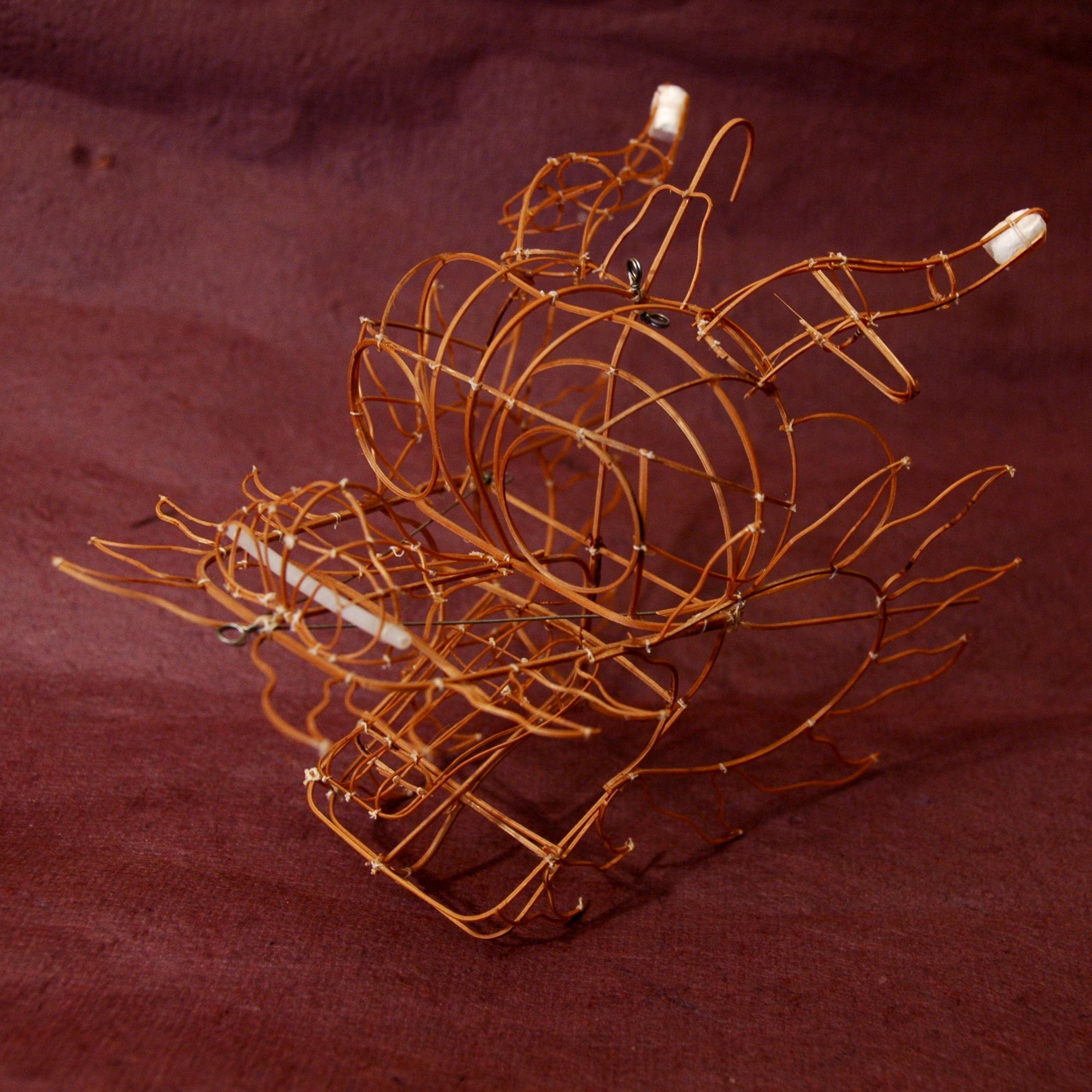
W140xL180xH160mm, China

Everyone must have seen the dragon dance during Chinese New Year, ever wonder how the dragon head is constructed? Here is a miniature version of the bamboo structure that goes under the paper or cloth constructed skin (which belongs to a dragon kite). Bamboo stripes are bend and tied together at junction points with a paper knot. For the actual performance piece the structure will be will be stronger and bolder. The body is made with piece of red cloth with resembled the scale of the dragon, with rods every 1.8m apart for the dancers to control the body. The length between the head and the tail can go up to 4m. Another dancer will raise a sphere for the dragon to chase.

In a traditional dragon dance, in a ceremony the body of the dragon will be invited out from the Dragon King Temple, the head and the tail will be attached and only then will the eyes be drawn on the dragon. Dragon is a creature both respected and feared by the Chinese, being the leader of the 4 spiritual creatures, it is believed to be able to control the sea and the weather, make it calm and peaceful or cause the wave to become furious. After the performances of the dragon dance, the head and the tail will be dismantled and burnt, only the body will returned to the temple to be kept for next year’s dragon dance.

W500xL600mm, China

Though paper is one of the 4 great invention of China, handmade paper is a dying art.  To earn a living from making paper is hard work; there are all together 72 steps!  This is only a rough idea what is has been done to make the paper.

First, in late spring young bamboo are collected from the forest, these 2 m long bamboo are then cut into 2 cm wide stripes.  These stripes are soaked in lime water for 2 to 3 months.  At the point, the bamboo would have turned yellowish, they are then rinsed and cleaned with water and the knots and the outer skin will be removed.  These stripes are then put in a 5 m long x 1 m wide wooden trough for stomping (just as grape stomping for wine).  Now we finally have the paste for paper making; the paste is put into a 2 m long by 1 m tall wooden trough and mixed with a glue solution.  A deckle with fine silk sieve mounted on a wooden frame is lowered into the paste and then taken out, after the water is drained away a thin layer of paste is left.  The paste sheet is flipped out on wooden board, silk sieve removed and we have a wet piece of paper.  These wet paper is piled up and water squeeze out under the wooden press.  Lastly, the paper are separated and posted on the drying room one by one.  These workshops are usually run by 10 people;  2 for the stripping of bamboo, 2 for stomping, 3 for sieving, 2 for drying and one for all the other bits and pieces.

(L)L700xW550mm (S)L370xW260mm, Japan

This is a Japanese fan, uchiwa, it is constructed from a single piece of bamboo.  The bottom part of the bamboo forms the handle while the top part is split into many equal splinters which are splayed out radially to create the frame of the fan, paper is then pasted on top and varnished for water protection.  For the large uchiwa, thick cotton string is used to tie together the bamboo stems to reinforce the fan structure.  The uchiwa are believed to be originated from China, during the Tong dynasty they were introduced to Japan and also became a popular accessories for the aristocracy and ladies.  The pattern on the paper are refined and elaborated.  Apart from daily use for cooling, the uchiwa is also used in ceremonies, dances and gifts.