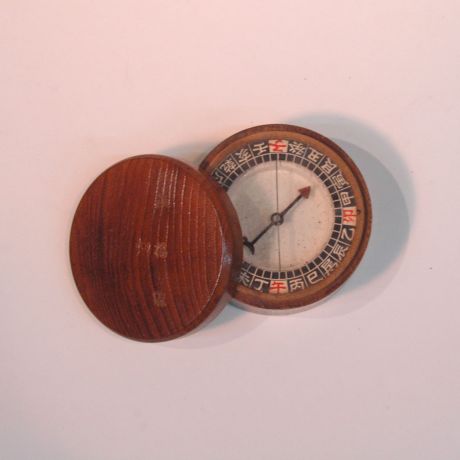
DIA100xH60mm, Hong Kong
This is a compass used by Tanka clan, a clan who lived on junk boats along the coast of Southern China and worked as fisherman. As it is a day to day object, their compass is more simple then the traditional geomancers’ compass. The compass for the Chinese is not only for telling the direction but related to space (direction extending to the universe) and time (past and future) as a whole
The Chinese Compass Points
Chinese navigators reduced the compass they inherited from the geomancers to its simplest form, using only 24 points, or even reducing them to 12 or 8. The dial itself is divided into segments of 15 degrees each, represented by 24 Chinese characters. These are the compass points, which scholars say were the basis for calculations by diviners and geomancers in ancient times. These compass points were stabilized in their present system by at least the early 8th century. These characters used on the compass dial are not the characters commonly used in China to represent directions. Their origin or etymology is, for the most part, lost in the mists of antiquity. But scholars have traced many of them back to over 4000 years ago when they appeared on “oracle bones” used to look into the future. 12 of the characters ; 子 zi, 丑 chou, 寅 yin, 卯 mou, 辰 chen, 巳 si, 午 wu, 未 wei, 申 shen, 酉 you, 戌 xu, 亥 hai, have been traditionally grouped together and referred to as the 12 branches. 8 of these character 甲 jia, 乙 yi, 丙 bing, 丁 ding, 庚 geng, 辛 xin, 壬 ren, 癸 gui, are part of the traditional grouping knon as the 10 stems. The remaining 4 乾 qian, 坤 kun , 艮 gen, 巽 xun derive from one of the earliest Chinese works on divination, the I Ching. In very ancient times, the 12 branches were applied to the months of the tropical year and the 10 stems were used to name the ten day week. Diviners used the stem/ branch combinations of the day, month and year of birth as basis for their calculations and conclusions. The 12 brances are also associated with the Chinese zodiac; the rat, ox, tiger, hares, dragon, serpent, horse, gost, monkey, cock, dog and bear. Each of htese creatures is supposed to exercise an astrological influence over a particular 2 hour period of the day, and one year out of every 12.
子 zi – North, rat, 23:00-01:00
癸 gui – N15°E
丑 chou – N15°E , ox, 01:00-03:00
艮 gen – NE
寅 yin – N60°E, tiger, 03:00-05:00
甲 jia – N75°E
卯 mou – East, hare, 05:00-07:00
乙 yi – S75°E
辰 chen – S60°E, dragon, 07:00-09:00
巽 xun – SE
巳 si – S30°E, snake, 09:00-11:00
丙 bing – S15°E
午 wu – South, horse, 11:00-13:00
丁 ding – S15°W
未 wei – S30°W, sheep, 13:00-15:00
坤 kun – SW
申 shen – S60°W, monkey, 15:00-17:00
庚 geng – S75°W
酉 you – West, cock, 17:00-19:00
辛 xin – N75°W
戌 xu – N60°W, dog, 19:00-21:00
乾 qian – NW
亥 hai – N30°W, pig, 21:00-23:00


 Mountain Folkcraft